Category Archives: Photographers

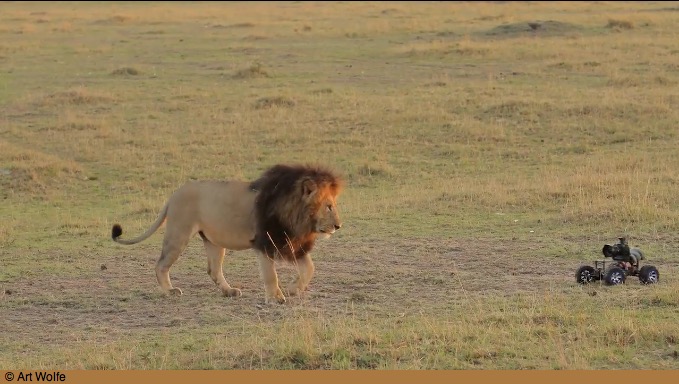
Art Wolfe

No competition.

Your chances of taking wild animal pictures as good as those made by Art Wolfe are precisely zero.


Using the latest technologies. Click the image for the video.

Whether it’s remote dollies, drones, aircraft, you name it, Wolfe has been at it 40 years and no piker on ‘safari’ has a remote chance of equalling his 40 years of applied skill in the business.

In the brief video – click the image – he asks whether it has all been done before? From the amateur, weekend snapper’s perspective the answer to that question is the same as it was 50 years ago. A resounding ‘Yes’. A few specialists like Wolfe change the landscape and the amateur is far better off buying their images and videos than wasting money on a trip to some godforsaken hole without antibiotics or clean drinking water. Best enjoyed from your sofa at home.

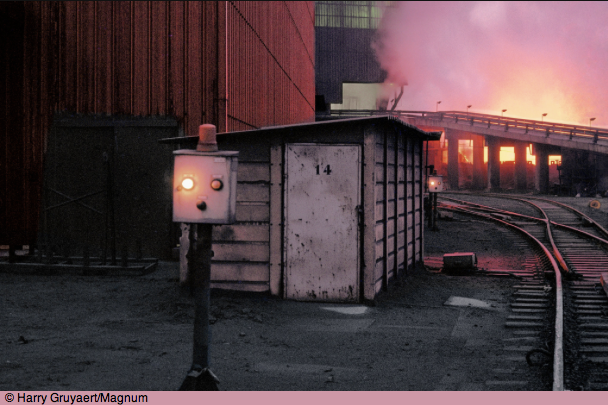
Harry Gruyaert

Surreal master.

Belgian photographer Harry Gruyaert has been with Magnum forever and worked there during HC-B’s time. I rather fancy that had HC-B ever understood color, this is the sort of work the French master would have been producing during his greatest period, the surreal one pre WWII.


Click the image for the New York Times article.

Blow Up

Polish poster genius.

Other than a history of dying heroically on horseback in the face of better equipped enemies, there really is not much to be said about Polish culture. Neither the greatness of Russia or the brute efficiency of Germany, which Poland has the misfortune to call its neighbors, distinguishes the nation’s meagre accomplishments. OK, Chopin excepted, but you might argue he really was French.

Indeed it is with some gratitude that I look at my parents’ history, first with their Polish lands occupied by the brute Germans whose first act was to shoot our two Great Danes. That was probably logical given that the Danes have as much love for the Hun as do the Poles. The dachshunds survived, needless to add. The Wehrmacht was replaced in 1945 by Ivan, and these serial invaders saw to it that commonsense finally prevailed as my folks hightailed it in 1947 via Sweden and Ireland to London, where I grew up. Sadly they did not think of crossing the Atlantic which would have given me the opportunity of graduating at the top of my Harvard class rather than from University College, London, which is OK I suppose, but my son will make up for that.

However, now and then something special comes from the land of potato vodka and herrings in cream and in this case it is an absolutely stunningly original poster for Michelangelo Antonioni’s mythical movie Blow Up. That’s PowiÄ™kszenie to you. Blow Up is a good test of any photographers level of interest in his craft. The next time you encounter a snapper ask what he thinks of the movie. If met with a blank stare walk away for you are speaking to yet another mindless equipment fetishist, from whom you will learn nothing.

In this poster, Waldemar Åšwierzy (OK, so his mother slept around a bit cross-culturally speaking; I mean, the Germans always had schnapps and chocolate, no?) has avoided the common western depiction of the priapic David Hemmings straddling a supplicant and writhing Veruschka, going instead for a neo-Seurat pointillism which at first glance is meaningless. Leave it on your computer screen and step back a dozen feet …. stunning. It captures the very mystery which the movie is all about. Did you see the body or did you not?

For the finest writing on this greatest of movies, click here.

Bel Air – 2015

The best of the best.

These pieces generally run annually in time for Hanukkah and Christmas.

The only way to live and work in Los Angeles is to avoid the freeways, for they are a living hell. No matter the time of day or night, you can be sure of wasting horrible amounts of your dwindling life span in your car, parked on a way that is anything but free.

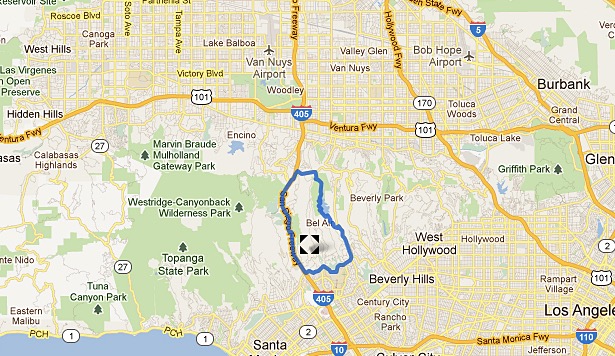
When I lived in Los Angeles (1987-93) I was lucky to have a home high in the hills of the San Fernando Valley in Encino and a job in Century City, the other side of the transverse spine that is Mulholland Drive. Mulholland, named after the DWP engineer who literally made Los Angeles possible (it’s called water) just happens to be one of the most dramatic of roads in that thrilling city. The beauty of this location was that I could zip up to Mulholland from home, turn down Roscomare into Bel Air then wind my way though the labyrinthine paths of this haven which is a very small part of Los Angeles, exiting at Sunset Boulevard with but one city block to my office on Century Park East. Traffic? Nowhere in sight.

The small firm I called home made for great friendships and as often as not we would gather monthly after work for camaraderie at the haven which is the Hotel Bel Air. I had stayed there on business from New York back in 1985 in one of the bungalows in the lush grounds and it was a memorable experience.

When a resident of LA, on one occasion while conducting arcane tests on my Mercedes diesel to determine the exact fuel consumption (don’t ask – it’s the Engineer’s Curse) I crossed Sunset into Bel Air on the way home only to feel that superb five cylinder turbodiesel motor stumble. Barely making it across I stopped on Carcassonne in Bel Air, out of fuel. I had miscomputed the size of the tank, smaller in the diesels than in the gas models …. bloody Germans. No sense of humor.

Flashers lit and making my way on Shanks’s Pony to the Bel Air I headed for the tea room whence I called AAA, alerting the valet that he was to direct my driver there upon arrival. Sure enough, the mechanic was unquestioningly ushered into the rarefied confines of the watering hole a while later and we exited magnificently – I in suit, he in overalls – to get the beast fueled and started. (Diesels need bleeding. Pumping is involved. Again, don’t ask). My love affair with the Hotel Bel Air and with Bel Air itself has proceeded apace since.

You see, unlike most places which boast wealth, the Hotel Bel Air specializes in those costliest attributes – discretion and silence. Not only is it hellishly hard to find, it’s buried deep within Bel Air on 12 acres of heaven remote from busy streets, and if there is a more perfect place on earth to relax I do not know of it. Thus on this, my son’s first visit to Los Angeles at age 13, I determined only the best would do and one night last week found us at the Bel Air in – yes, you guessed it – one of the bungalows in the grounds.


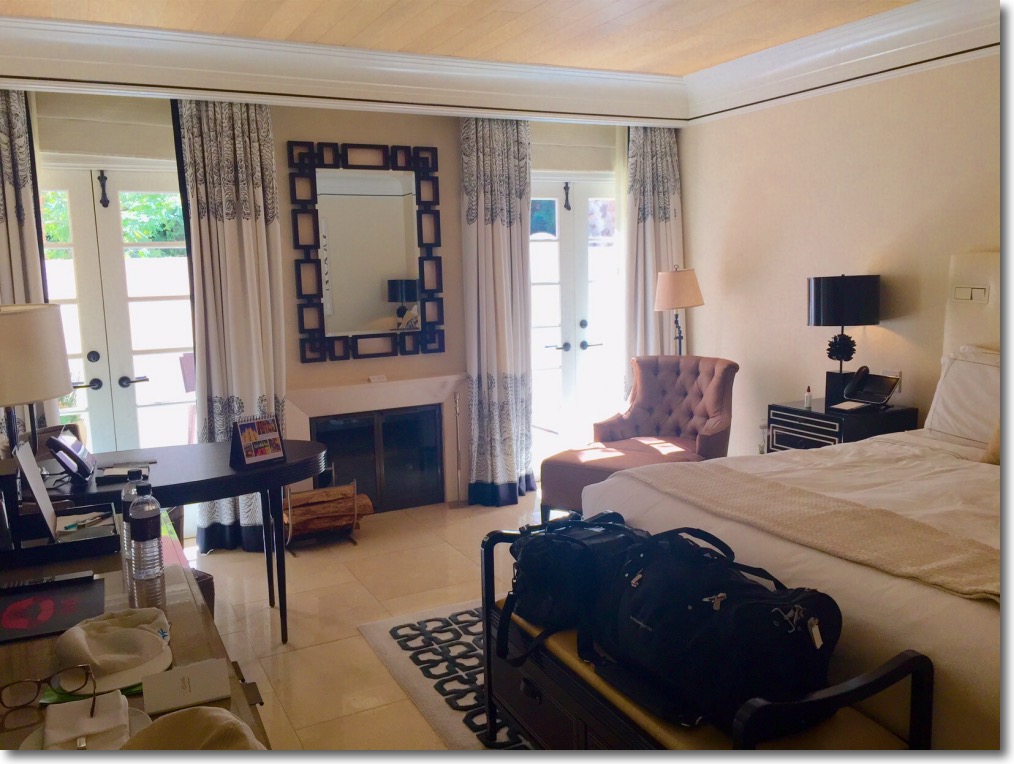
Our room. The bed was magically split into two as we dined.


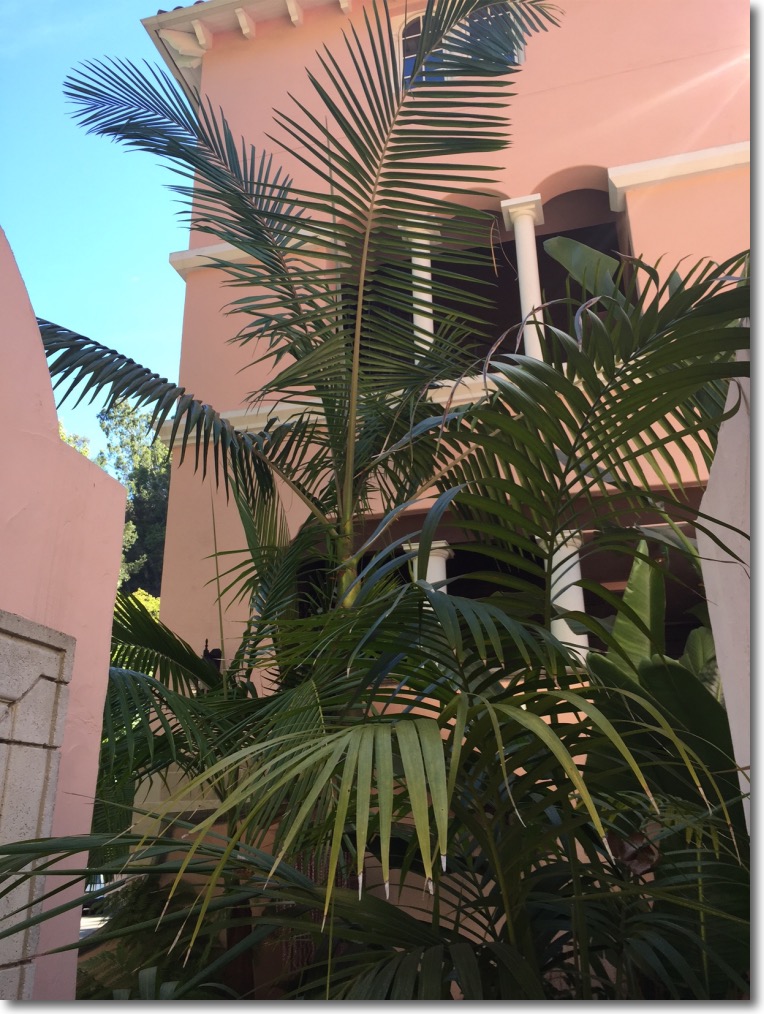
Exquisite landscaping against Southern California pink.


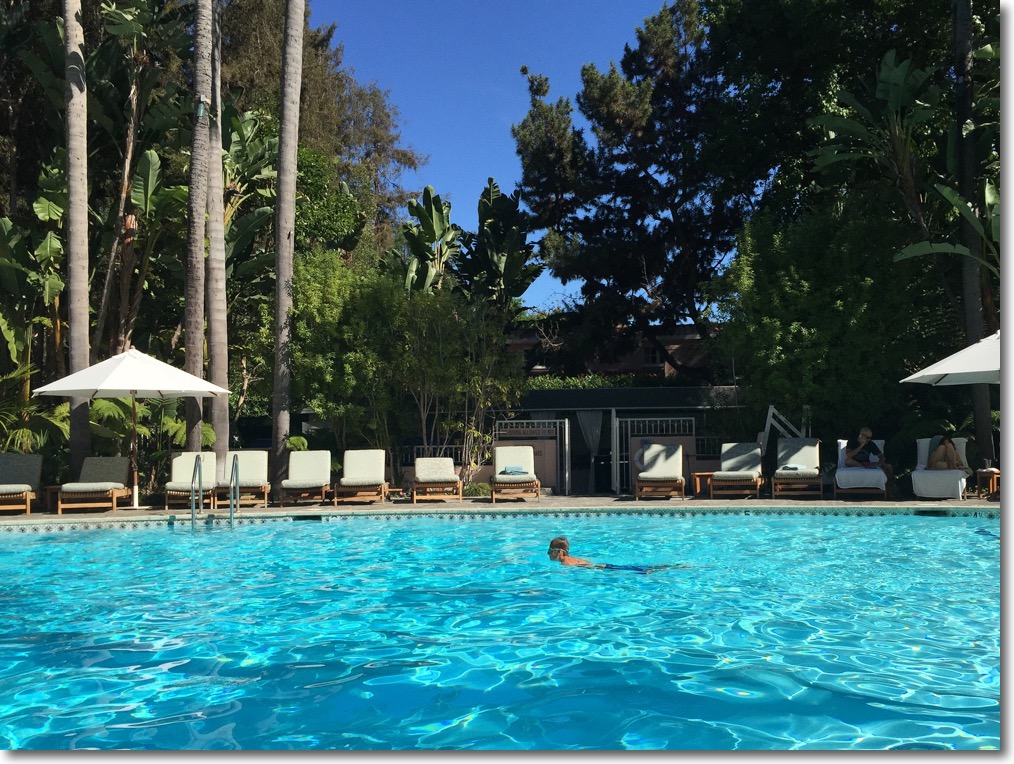
Winnie checks out the pool. Notice the large crowds in attendance.

While my obligatory tea arrived poolside (you can take the boy out of England, but you cannot take England out of the boy) I obeyed Winston’s dictate to think not about work but to merely gaze into the distance and think peaceful thoughts. Much harder than it sounds for one who considers vacations a leading cause of stress, but the boy was clearly onto something. He is wise beyond his years.

These thoughts were interrupted by two young girls to my left discussing education, the one a UCLA junior trying to convince the other, a USC sophomore, to transfer, the better to enjoy their friendship. Half way though this dissertation the one decided they needed a late lunch served to them on the chaise longues surrounding the pool, but things proceeded to get sticky when it came to payment. The young woman dashed back to her room in search of a credit card, returning breathlessly to admit to the pool waiter that she could find neither hide nor hair of it. After some embarrassing back and forth she called her mum only to be reminded that she has an account at the place – this at the age of 17 – and a quick “Charge it!” resolved the issue. High class problems.

I contented myself with mindless thoughts (sort of like ‘military intelligence’ or ‘stock market predictions’ when it comes to grammatical logic, I suppose) and gazing at Winnie doing his thing was a subtle and sublime joy. My boy’s first visit to the City of Angels really had started at the top, and my joy was but sublimation of my hopes for him. He rejoiced in the heated pool and I rejoiced that he was there.


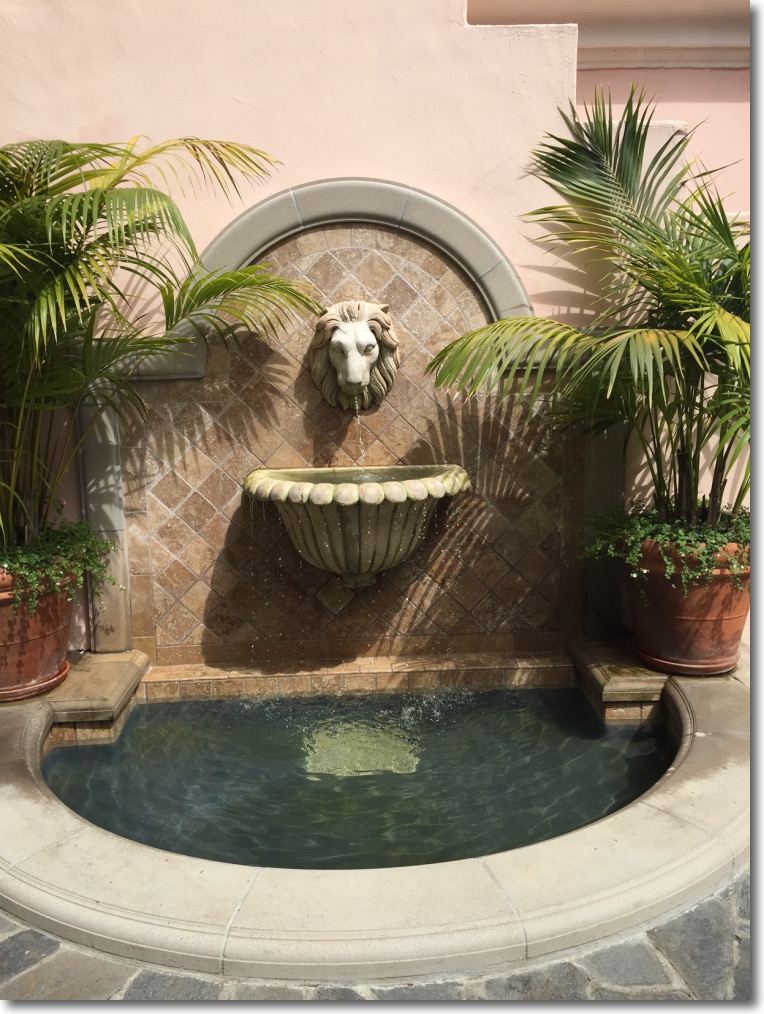
A lovely fountain in the large yet discreet grounds.


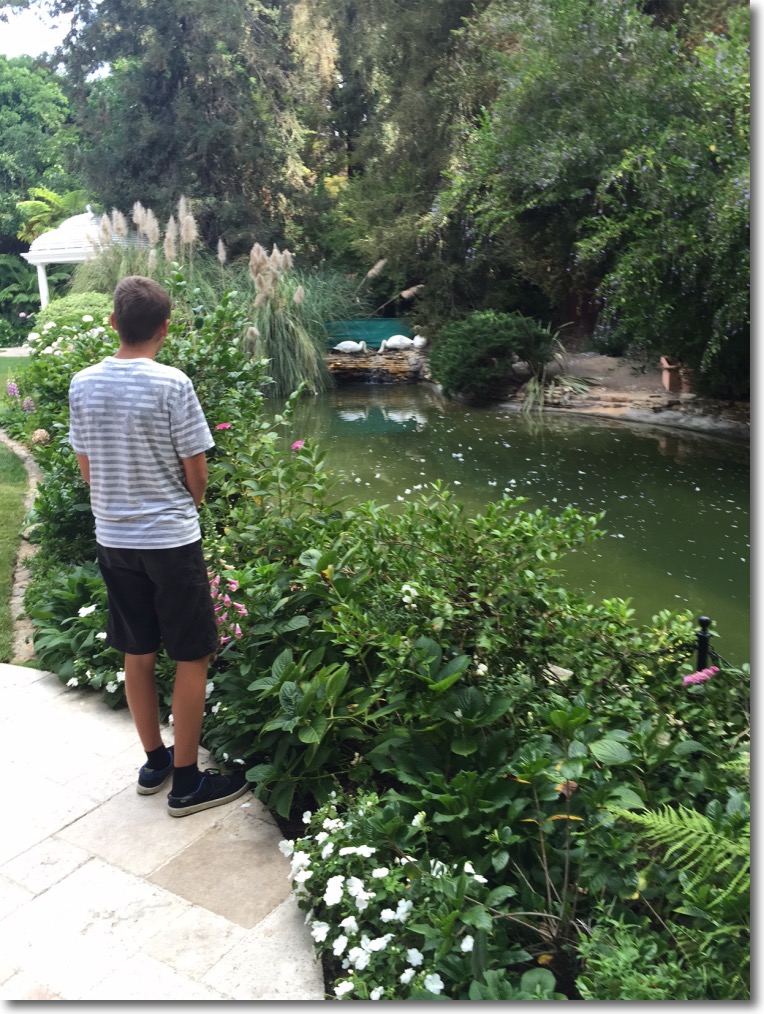
Winston at Swan Lake in the grounds. Back in the 1990 the swans used to be black.
Maybe this is more PC at work?

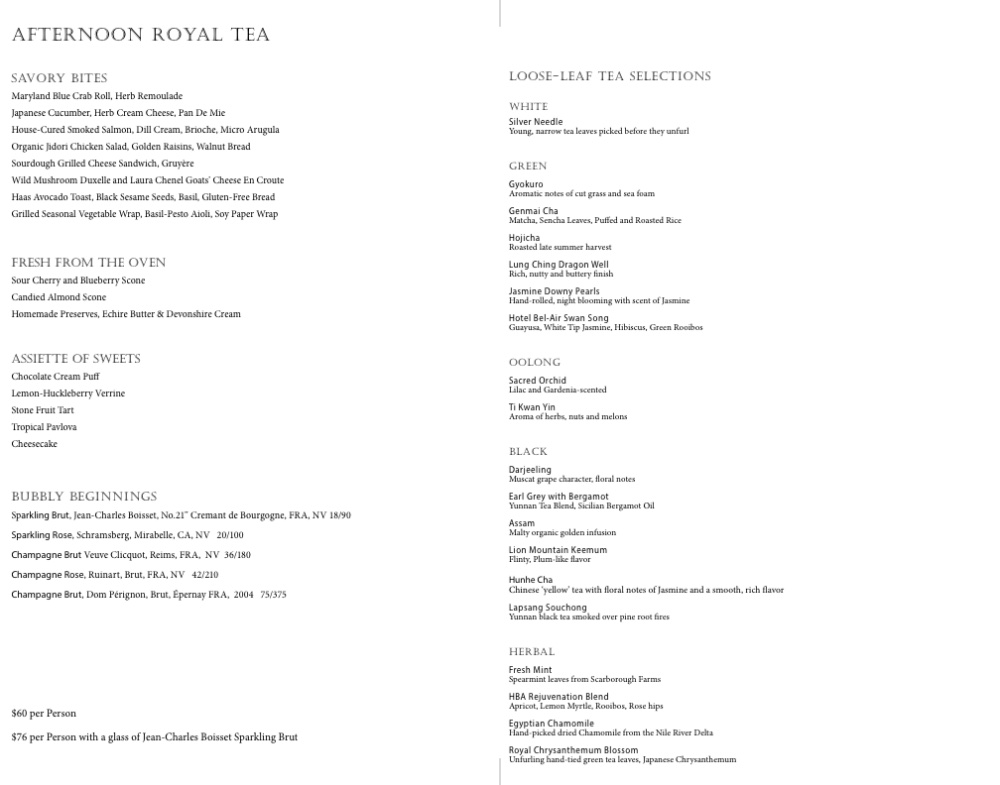
The Hotel Bel Air takes its tea very seriously.


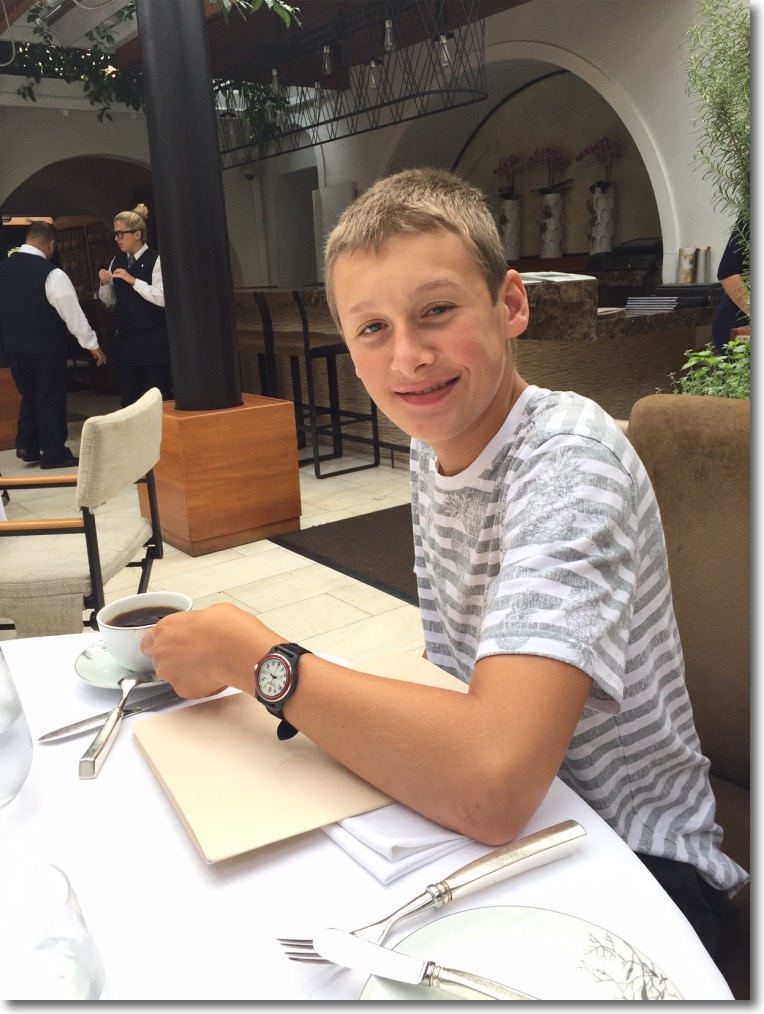
Winston’s first ever cup of coffee at the Wolfgang Puck over breakfast.
You can read all about his Unfair Advantage here in a piece that remains 100% correct.

There’s no need to drive anywhere for dinner for the Wolfgang Puck Restaurant in the hotel would be hard to improve on. Dress code dictates a jacket and long trousers for dinner and tattoos are nowhere to be seen. White trash need not apply and the prices see to it that they do not – this is a feature, not an issue. The women’s dresses over dinner have to be seen be believed. And they are wonderful to behold – the women and the frocks. Breakfast dress code is relaxed as the above shows, and the staff is so professional you leave regarding them as friends. Jeans are notable by their absence and let’s all be grateful for that.

Money is quiet here and waistlines are slim. The bungalows are the preferred places to stay and many have been the location of choice for discreet assignations among the Hollywood set, from Frank Sinatra to Elizabeth Taylor who enjoyed most of her numerous honeymoons in one. Or was that in seven? They came here to not be seen. Ask nicely and the hostess who walks you to your room will point out the bungalow in which Howard Hughes lived, right around the time he crashed his experimental single wing plane at the LA Country Club next door, barely surviving. It’s an episode which is perfectly recreated in Martin Scorsese’s The Aviator, a favorite with both Winnie and I. Hughes was an American with a capital ‘A’, and Hollywood history is writ large at the Bel Air.

This is a haven for the visitor. If you crave isolation, hate crowds and desire peace and quiet with the most charming friends to look after you, a stay here is de riguer.

All snaps on the iPhone 6.

* * * * *

Click here for an index of all the Biographical pieces.

At the Movies – 10 years

Nothing new here.

As with books, the movies which most inspire the visual senses were all made a long time ago. The modern obsession with the action/adventure genre, along with attention spans shortened by video games and the like, largely preclude the making of beautiful movies. There’s no money in them and the Hollywood system no longer has time for art house movies.

But go back a few years and choosing just five of the most beautiful movies is not at all easy, for there is so much great work out there especially from the 1960s and 1970s.

In no particular order, then, these are the five which have most stimulated my visual cortex this past decade.

1 – Death in Venice, starring Dirk Bogarde, directed by Luchino Visconti. 1971
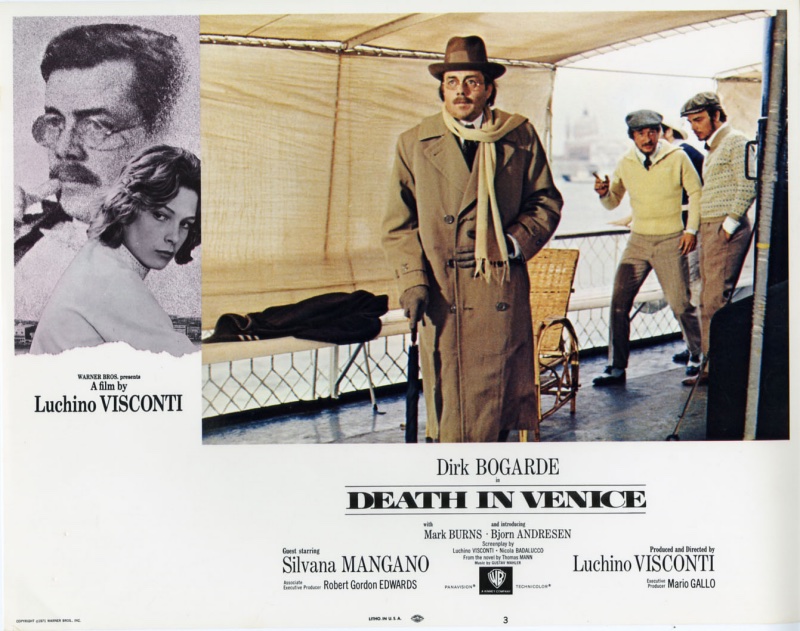
Based on Thomas Mann’s novel of the same name, Death in Venice chronicles the last vacation and death of one Gustav von Aschenbach in fin de siècle Venice. Visconti’s work was always rich and lush with Italianate color and from Bogarde, a lightly regarded British comedic heart throb, he coaxed one of the very greatest performance on film. Never less than lovely to look at the movie is a treat for the ear, too, much of it set to the Adagietto from Mahler’s Fifth Symphony. The movie demands attention and patience, both amply rewarded. I originally saw it on its first run in Mayfair as a young man of 18 and recall well stumbling out into the Belgravia streets simply dazed and overcome with emotion.

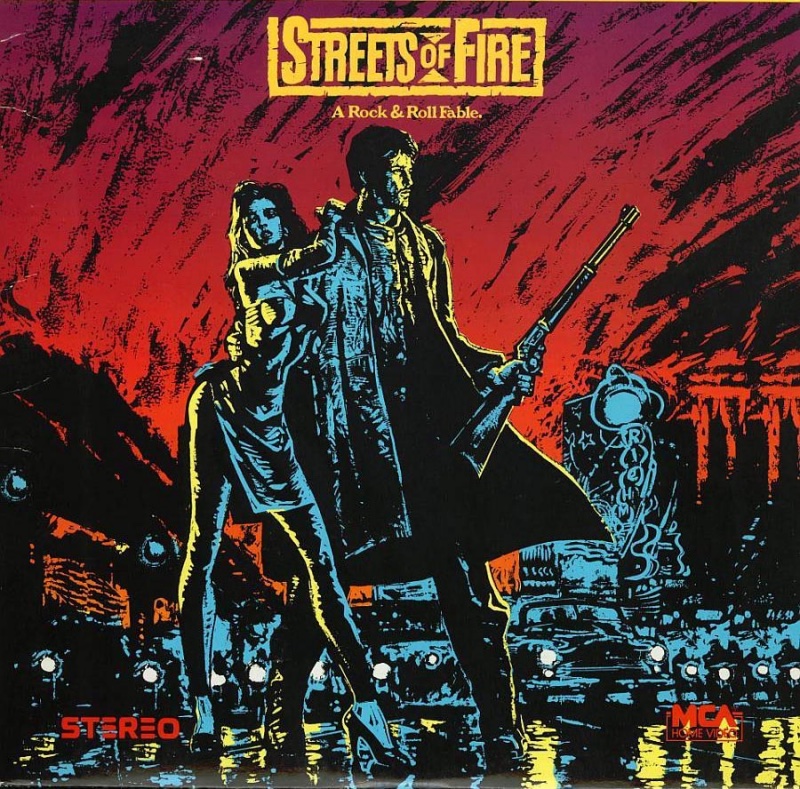
2 – Streets of Fire, starring Michael Paré, directed by Walter Hill. 1984.

You could not find a visual masterpiece as culturally removed from Death in Venice as this rollicking good time. Set seemingly in 1950’s Chicago and filmed almost exclusively at night, the imagery – set to a raucous Ry Cooder rock track – is startling and attention getting. Even the video game generation will get this one. The youngest movie here.

3 – Barry Lyndon, starring Ryan O’Neal, directed by Stanley Kubrick. 1975
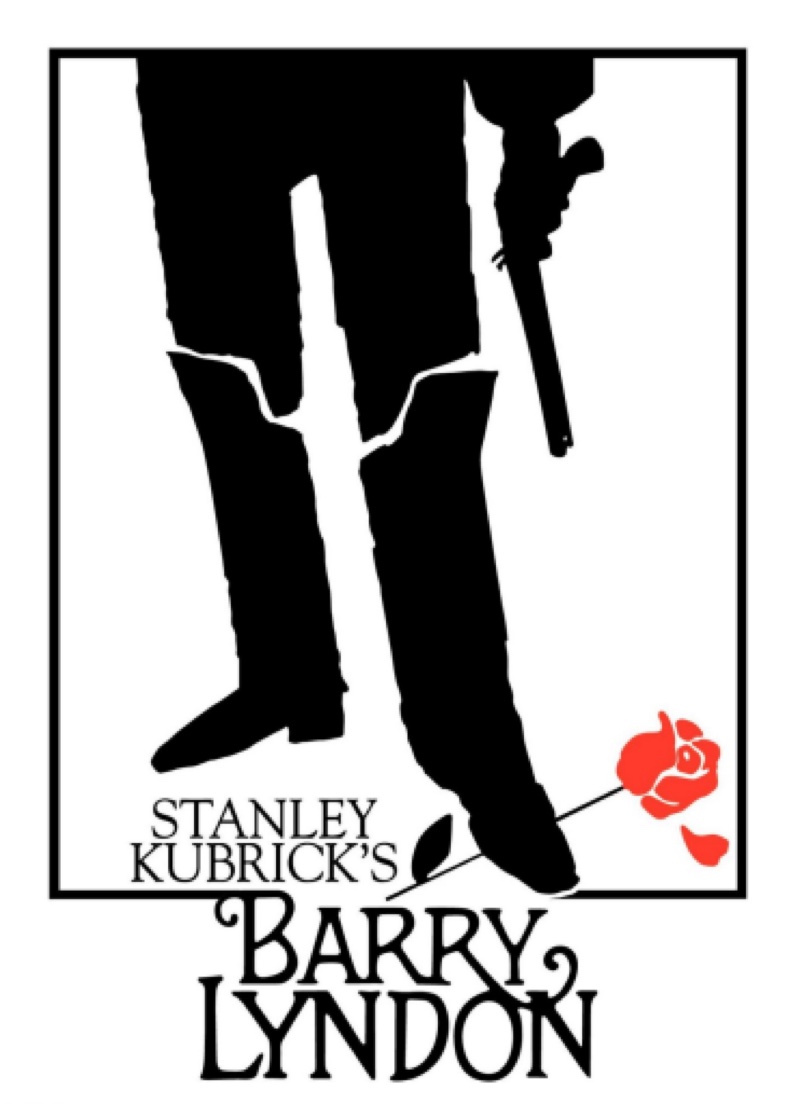
This three hour long movie is not for those in a hurry, and visually it remains unsurpassed. Rather forgotten in a Kubrick oeuvre whose admirers prefer ‘2001: A Space Odyssey’ and ‘The Shining’, this lushly filmed and costumed period piece is balm for the eyes. If your visual senses matter to you, this is probably the movie to see above all others. If nothing else, Marisa Berenson (the niece of that great Renaissance art expert and charlatan, Bernard Berenson) has never looked lovelier. Handel’s Sarabande dominates the sound track and could not be bettered.

My son, aged 13, had already watched it – all rapt attention – thrice, which tells you something about how you should bring up a kid in today’s world. He will be successful as a result of his attention span, not despite it.

4 – 2001: A Space Odyssey. The star is the English cinematographer Geoffrey Unsworth, directed by Stanley Kubrick. 1968
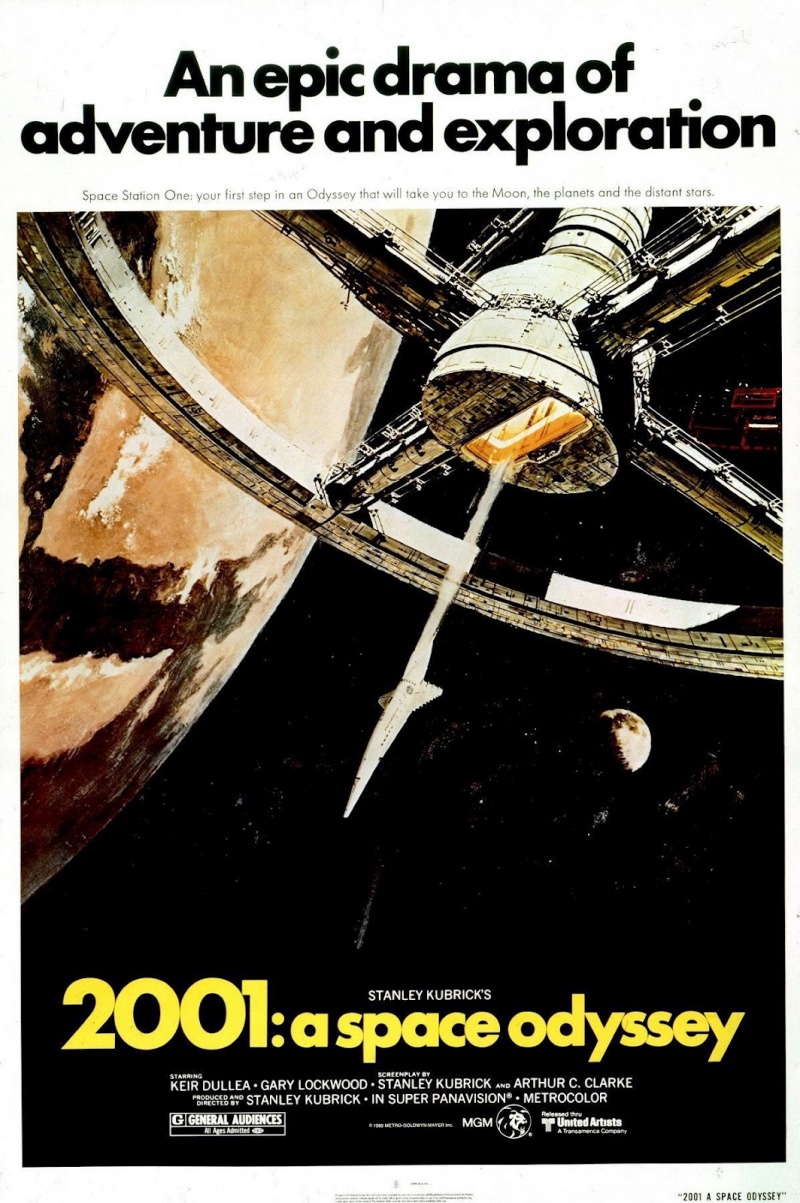
In the previous column, one on photography books, I made mention of the adjective ‘breathtaking’ as one which is abused yet remains useful for lovers of good English. And ‘2001: A Space Odyssey’ is nothing if not breathtaking. It does not hurt that the movie includes simply the most stunning cut in world cinema, the moment when the monkey hurls the bone/weapon victoriously in the air and Kubrick and Unsworth cut to a space station set to Strauss’s Blue Danube Waltz. Breathtaking. And if you have never quite understood Varese’s music, this is a good place to start.

5 – Lawrence of Arabia, starring Peter O’Toole, directed by David Lean. 1962.
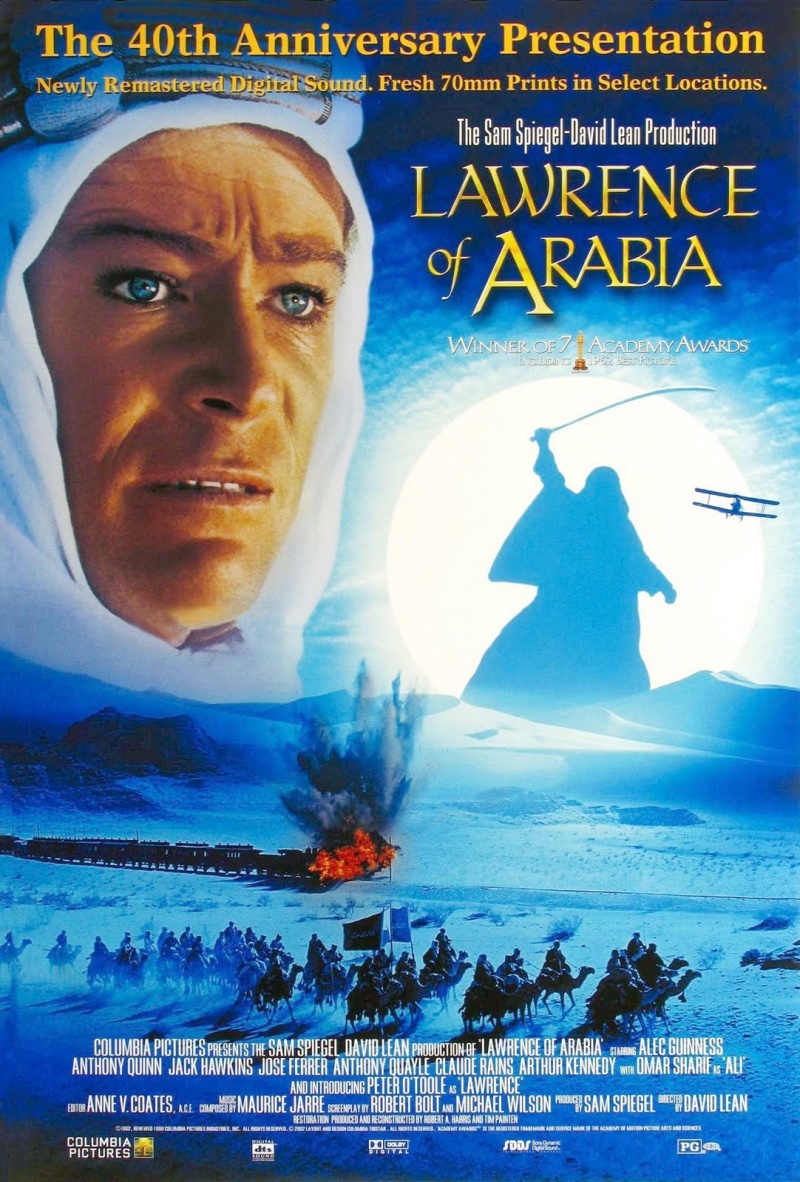
Jackson Bentley: What is it, Major Lawrence, that attracts you personally to the desert?
T.E. Lawrence: It’s clean.

A rare moment of humor in a film which you should see, if at all possible, in a revival movie theater on a huge Cinemascope screen. I saw it thus twice when it played in the Carnegie Theater in Manhattan, close to my home on 8th Avenue and 56th Street in the mid-1980s and it really is the only way to do it justice. And speaking of great cuts, the one here is in the same class as Kubrick’s money with the femur. Lawrence, showing off his disdain for pain, snuffs out a match with his bare fingers and Lean cuts to the infinite vistas of the desert. That is special and Maurice Jarre’s music is the icing on the cake. One of O’Toole’s earliest movies and one for which he was cruelly denied the Oscar.

If there was ever a more physically perfect leading man than O’Toole, I cannot think of one and it’s lovely to hear him speak in the proper English of my youth, not the grammar school garbage emerging from the mouth of the average English speaker today.

* * * * *

With the exception of Barry Lyndon, made on Kodak film (Kubrick opting for the pastel rendering), all were made in Technicolor. No surprise there. ‘Death in Venice’ comes on an SD DVD only (a so-so print) as does ‘Streets of Fire’ (an excellent print). The others all come in Blu-Ray options and there really is no alternative but to get these.

You can see all my movie reviews here.