Very promising.
You can read my review of the Panasonic GX7 here.
Part I of this lens review is here.
Chrome and small:
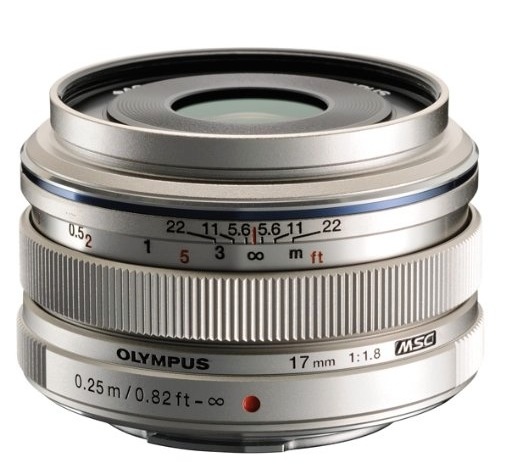
A chrome body deserves a chrome lens, so that’s the version I chose of the Olympus 17mm f/1.8 for my GX7.
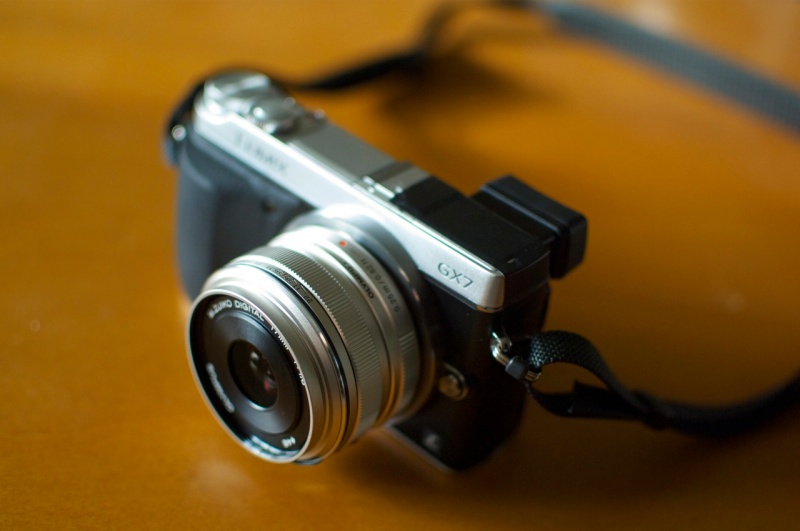
On the GX7.
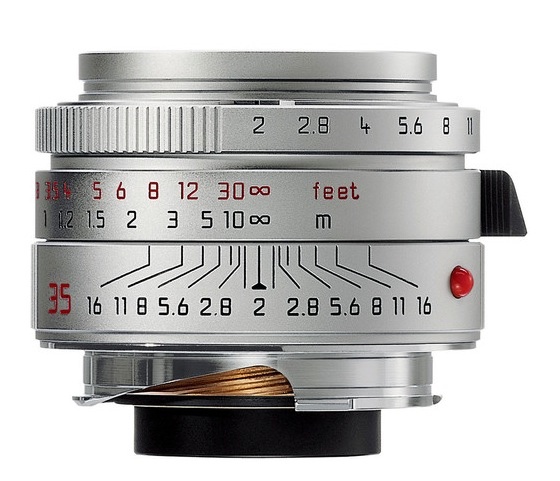
Compared with the (really excellent, though constrained by its slower apertures) 14-45mm Panasonic MFT kit zoom, the 17mm Olympus is noticeably more compact. Weight is about the same, the metal exteriors of the Olympus seeing to that. Is it meaningful that the finish is metal rather than resin? No. As long as the result is small, sharp, fast and cheap, who cares? And, as I will illustrate, the Oly is all of those things. Say what you may about the construction quality of Leica’s 35mm f/2 Aspherical Summicron, throw-away cheap it most certainly is not. You can buy eight of the Olys for one Summicron and still have dinner money left over, not to mention AF into the bargain.
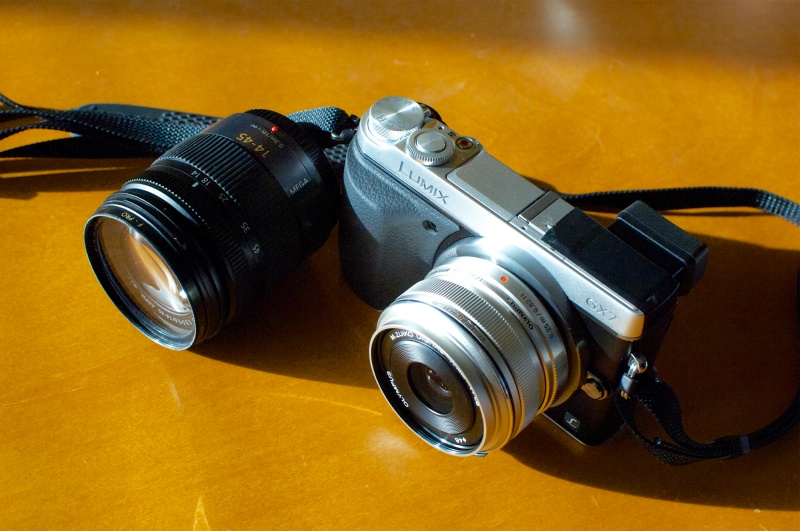
Compared with the Panny kit zoom lens.
Now anything is smaller than a Nikon D2/3/4 body, short of a Mack truck, but you can get a sense of the diminutive size of the lens on the GX7 here:
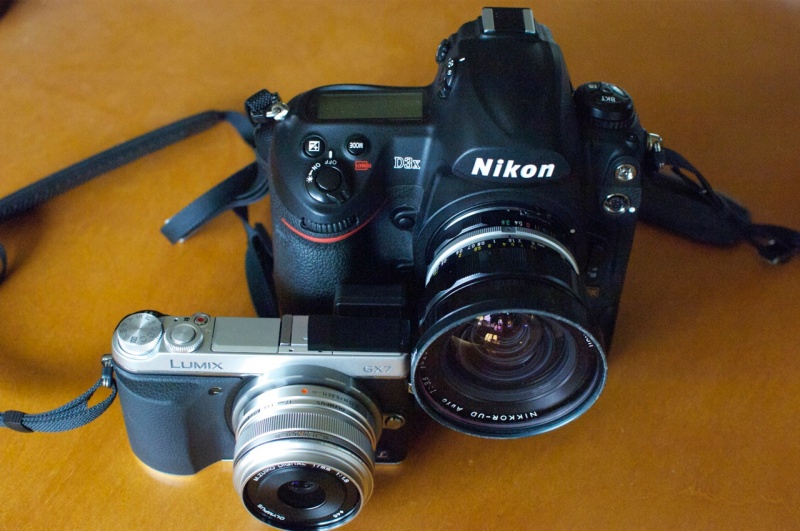
The warbler and the cuckoo. The awful looking black electrician’s
tape was replaced with chrome duct tape, below.
Ergonomic fixes:
First, a couple of fixes with silver duct tape are called for to enhance the functionality of the GX7.
Because Olympus uses a snap-back focus collar allowing engagement of MF, a piece of tape is stuck to the underside of the lens to prevent accidental engagement of MF mode. The spring detent is relatively weak and MF makes absolutely no sense with this lens, though I can testify to the smoothness of the MF action, with proper infinity and closest focus stops and no feel of grinding gears:
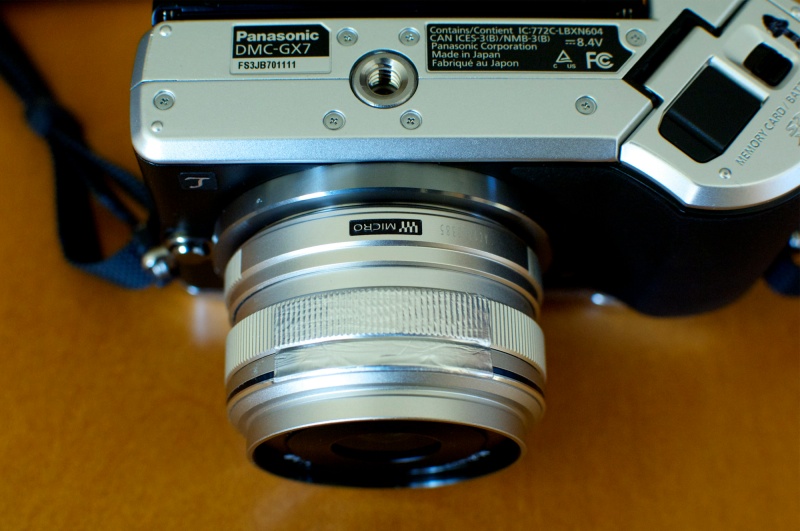
Tape prevents engagement of MF mode. The big arrow upper
right makes it easier to open the battery/SD card cover.
Then the hard-to-see-who-would-ever-use-this pivoting EVF eyepiece is taped well and truly in the normal position as it has shown a frustrating preference for getting dislodged with the GX7 slung over the shoulder. I admit that the superglue option is tempting here. You snap the camera to the eye and the bloody eyepiece is pointing heavenwards, accomplishing the twin results of ensuring you miss the snap and making sure you look like a dork.
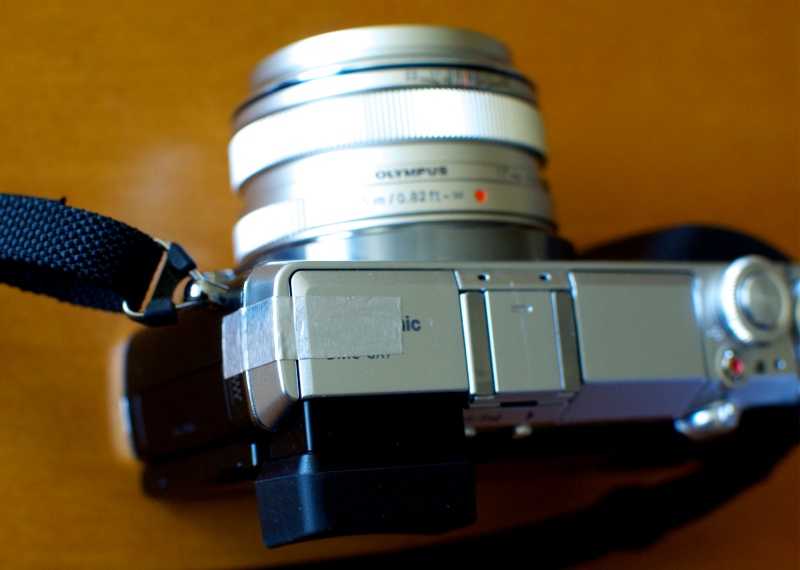
Tape keeps the eyepiece where it belongs.
This is tough silver duct tape.
Lens correction profile:
Next, I created a lens correction profile as none seems available from Adobe – probably because on Olympus bodies vignetting and distortion are automatically corrected, not something available to Panasonic body users.
You can find the profile here (scroll to near the end, past all the yummy MF Nikkor profiles), download it and install it where indicated. Thereafter, if your camera’s import profile is set to automatically apply the lens correction profile, you will see this once your images are imported to Lightroom (or Photoshop):
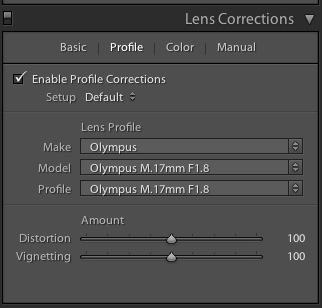
EXIF data in Lightroom,
using my profile.
Why create a lens correction profile? Because, through f/5.6, the 17mm Olympus shows noticeable vignetting on Panasonic bodies, especially from f/1.8 through f/2.8, together with very minor barrel distortion at all apertures.
Camera orientation sensor:
Yippee! One of my (minor) grumbles about the outstanding Olympus 9-18mm zoom lens was that the orientation sensor was missing. Import of images to Lightroom, where the camera was held in portrait mode, would import in landscape orientation, necessitating these all be highlighted in Grid view and turned through 90 degrees. Not a big deal, but an irritant. Well, when I imported my first images from the Oly 17mm on the GX7, portrait snaps came in correctly oriented. So I went back and checked the GX7 with the Oly 9-18mm and, blow me down, those came in correctly too. So the fault appears to lie in earlier Panasonic MFT bodies which did not play well with Oly optics in this regard, and it’s nice to see this has been fixed.
Manual vs. autofocus:
MF is there if you must, but quite why you would want to use it beats me. It’s rather like a stick shift in a modern car where automatic gearboxes are far faster than any manual shift possible. The focus speed with AF is instantaneous to all intents and purposes. Need to focus off center? Pre-focus on the area of interest then take a first pressure on the button to lock focus, recompose and click. What could be simpler, faster or more accurate?
The provision of near-instant AF with the GX7/17mm Oly combination does more to obsolete any thoughts of a digital Leica M/35mm Summicron than any consideration of price, sensor size, quality of manufacture, bragging rights, you name it. I’ll have taken five perfectly focused images while the Leica user is still futzing with his focus collar, trying to get those small rangefinder images superimposed. As a street snapper, the Leica is obsolete regardless of affordability. Period.
Comparing the Oly optic with the Panny 20mm is no contest. In addition to awful flare, the Panny adds to its woes by making a noticeable grinding noise while struggling toward the focus point, where the Olympus optic is dead silent, making the Oly especially useful for movie makers. Sure the Panny optic is sharp, once it gets there (just avoid sun anywhere near the optical axis), but it’s probably best destined for architecture and landscape snappers with a tripod where focus speed is irrelevant. Static subjects, in other words. For that matter, an FF DSLR is a far better choice for this sort of work where definition tends to be the be all and end all, and weight is rarely a consideration.
To enter MF mode, the focus collar is pulled back toward the body where it clicks into place, disclosing the useless depth-of-field scale but providing real hard stops at closest focus and infinity. Nicely done. Focus peaking on the GX7 works fine (and especially so in poor light for MF mavens) but, for the life of me, I cannot engage the enlarged center of image focus mode which is so well engineered with Panasonic lenses. Switching the GX7’s body lever to MF makes no difference. If it’s in the extended instruction manual I cannot find it, but even a Talmud scholar would struggle to find anything in that abomination. Panasonic continues to make the worst user manuals in the universe.
Spare battery: Goodness knows who the supply chain genius at Panasonic is – probably Tim Cook moonlighting – but spare batteries for the GX7 remain unavailable, and will run $60 when they finally arrive in the US. I bought a $15 Wasabi spare and it works perfectly, both in the camera and in the charger. A spare or two make sense with the GX7 whose small size dictates an even smaller battery. You will be luck to get 300 snaps on a charge and if you pixel peep or use the camera’s wi-fi 150 is more realistic. Not great.
In Part III I will report on use of this lens on the streets.
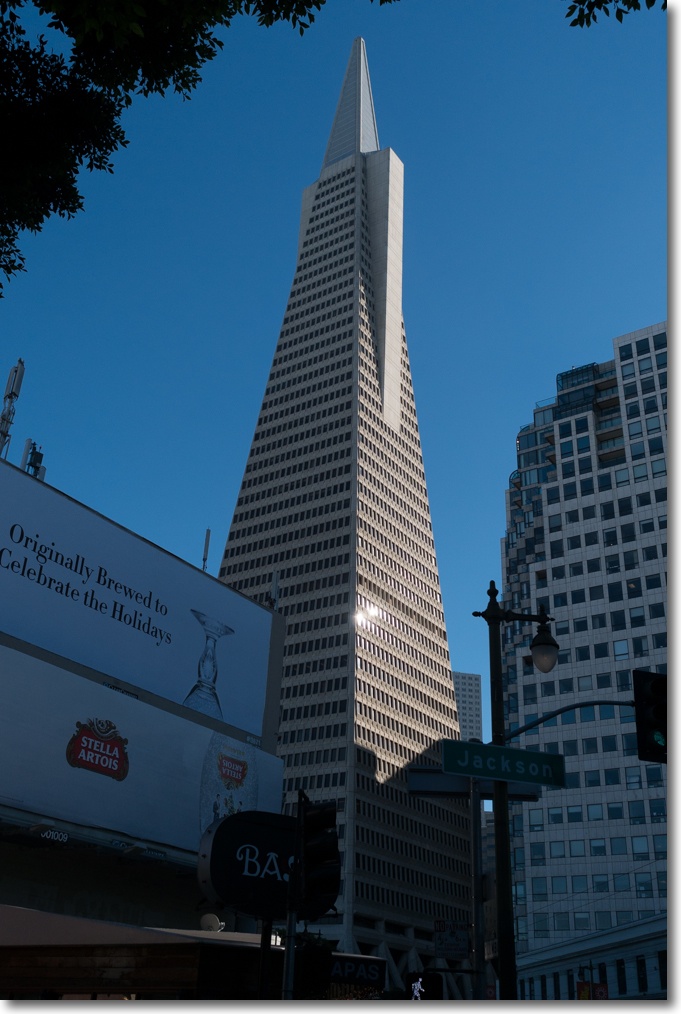
Here’s a first snap at f/2, ISO1250:

Waiting for my French coffee and croissant.
Trust me on this one, you will like what you see.