Fuji FX100

Looks promising.

Fuji expects to release its new FX100 in early 2011 and, on paper, it’s the nearest thing yet to the street snapper’s ideal – a fully automated Leica M2 with a 35mm lens and digital imaging.

The fact that so many are getting over-excited by this announcement is indicative of the pent-up demand for such a camera – it uses a 12.3 megapixel APS-C sensor and a 35mm equivalent focal length high quality f/2 lens. Memories of the 35mm Leica Summicron of yesteryear but with autofocus added.
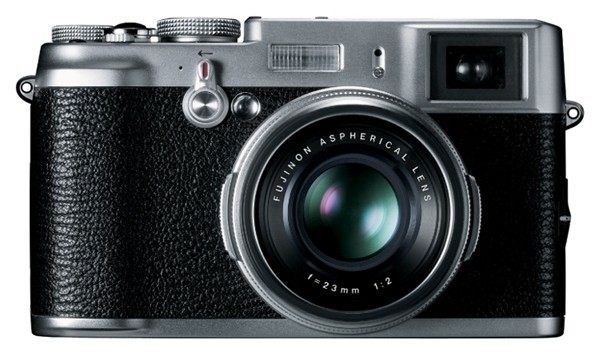
The Fuji FX100 high quality street snapper.

The camera uses traditional analog dials for aperture, shutter speed and exposure compensation, as this discloses:
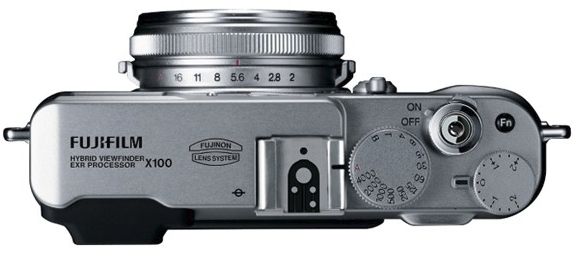
Top view – note the ‘A’ on the shutter speed dial for aperture priority exposure automation.

Exposure automation is either aperture priority (the camera sets the shutter speed) or shutter priority (by setting the Aperture ring to ‘A’). The texture of the body covering looks similar to that of the rubberized version so well used on the Leica M through the M4 after which it went downhill.
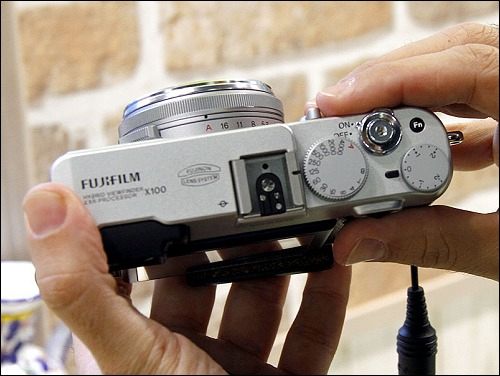
Shutter priority automation is available by setting the aperture ring to ‘A’

Most importantly, the camera just looks right and what causes the pulse to quicken is the inclusion of a proper eye level viewfinder. Not only does this promise a high quality EVF 1.44 megapixel image with data display (same definition as in the Panasonic G1 and GH1) it can also be switched from EVF to traditional optical viewfinder mode. Now the magnification is only 0.5x full size (the G1/GH1 are 0.7x life size), a tad on the small side (the Leica M2 is 0.72x by comparison) but anything, just anything, beats the awful LCD display used by everyone else as the sole viewfinding device in 100% of competing cameras – OK, absent the ridiculously priced and antiquated Leica M9. Let’s hope the optical finder is not a dog – here the Leica sets the standard though the clutter of finder frames in the M9 is awful compared to the one-frame-at-a-time of the M2.

The Leica X1 is an also-ran here. No viewfinder, slow to start retracting lens and silly-priced at $2,000. Strictly for the Rolex set – people who need to show everyone they are checking the time …. or taking a picture.

Three big questions need to be answered:

  • How responsive is the shutter release?
  • How fast is the autofocus?
  • How quiet is it?

Oh! yes, and there’s always that small issue of price. Fuji is a low volume manufacturer so it’s unlikely to enjoy the economies of scale of the majors, so this will not be cheap. Rumors have it at $1,400 which seems too much. At $1,000, if it’s responsive, I’m interested. And you should be too if street work is your thing. And you certainly do not need interchangeable lenses for the camera’s design brief – street snaps.

I have no qualms about the optical quality of the lens. Fuji is a long time designer and manufacturer of high quality large format lenses and also makes the optics for the Hasselblad digital range of cameras. These people are skilled optical designers.

Dimensions?

Fuji FX100 – 127 x 75 x 54mm.

Leica M2 – 138 x 77 x 34mm – and that 34mm swells to some 73mm when you attach a 35mm lens.

So the FX100’s size is just right; not so small as to be fiddly, but more compact than a Leica M with like functionality.

Weight?

Fuji FX100 – not yet disclosed, but I would guess 16 ozs. That f/2 8 element aspherical glass element lens will not be light.

Leica M9 + 35mm Summicron – 32 ozs – no lightweight as Leica refuses to use modern composite materials in its obsolete design.

Now what is needed is something at the $700 price point from Panny, Canon and Nikon with like features,
Frustration

More of the same, masquerading as new.

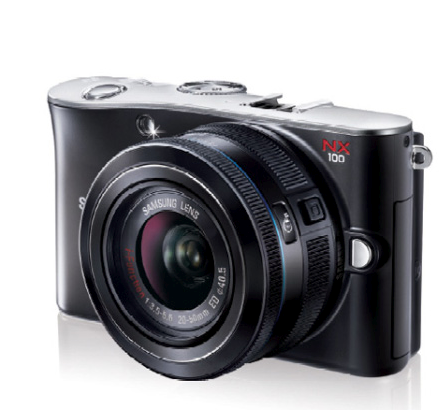
It’s frustrating to see the lack of innovation from Samsung in it’s new ‘small body’ mirrorless camera, the NX100.

The NX100 underwhelms.

The only substantive change the NX100 makes compared to the aging Panasonic GF1 is that a slightly larger APS-C sensor is used. Otherwise it’s the same as the GF1, missing the one feature street snappers are screaming for: a proper viewfinder. Add a ridiculously bulky lens on what is purportedly a compact snapper and you have the worst example of ‘me too’ thinking to come out of the far east in quite a while.

Panasonic can redefine this category in a trice and make a lot of money doing it. Reengineer the excellent EVF from the G1 into a GF2-sized body, delete the silly pop-up flash and movie modes and sell it with that sweet little 20mm compact standard lens and you have a recipe for success.

The new Kindle

A mixed bag and mostly disappointing.

When Amazon announced the latest version of their Kindle monochrome book reader I took the bait. At $139 ($189 with 3G) the cost is low enough to make acquisition an impulse purchase and, indeed, I expect the device to be free in a couple of years with your first purchase of x books from Amazon.

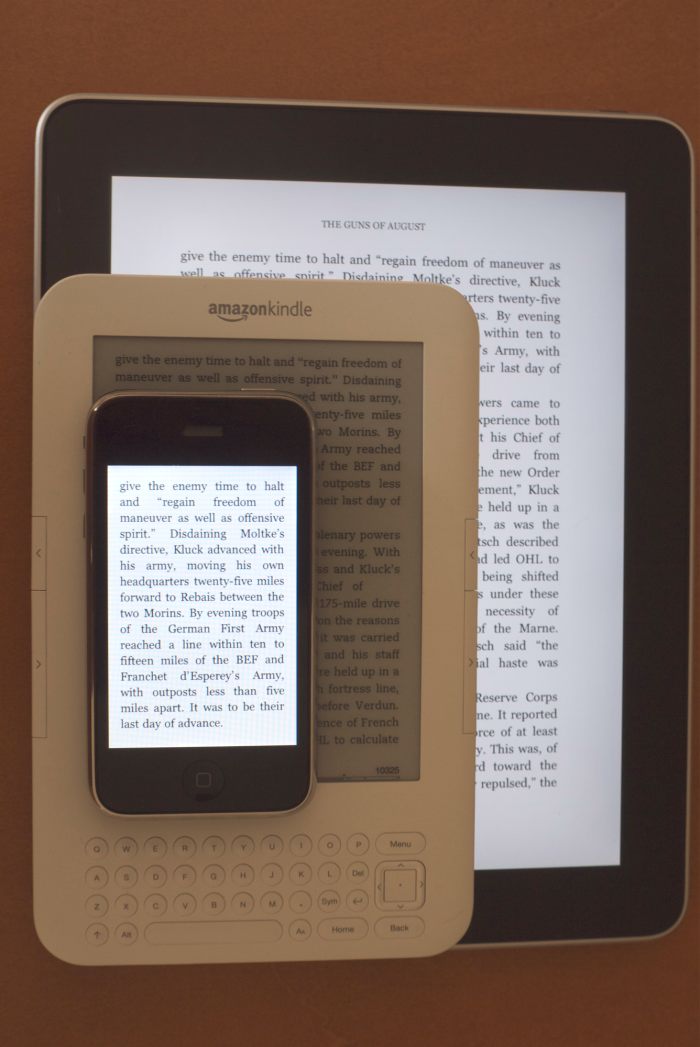
iPhone 3G, Kindle, iPad indoors in indirect natural light.

First, let’s be clear. The Kindle competes with the iPad in only one regard and that is as a single purpose book and periodical/newspaper reader. Its use to photographers is extremely limited as it cannot display color, has a small screen and is mostly useful if you upload your PDF instruction books to it. The bulk of the device is so low and the weight even lower, that it makes sense to take the Kindle with you in preference to the various instruction books for your picture computer, aka the modern digital camera.

Amazon ships the Kindle pre-registered in your name, a nice touch, and adding your wifi network at home is a matter of moments. There’s a nice pre-loaded instruction book (why does Apple make you download that for the iPad?), the recharger is minuscule and a nice long USB/recharger cord is provided to charge the device. Mine came 50% charged and power consumption is so low (the Kindle’s display is always ‘on’ – switching it off merely switches off wifi and the related power drain) – that you can expect days of continuous use on one charge. When ‘off’ the screen displays a portrait of one of any number of famous authors. A nice touch.

So while the Kindle does not compete with the iPad, there’s no denying that it’s hard not to make comparisons and, in a word, the Kindle is plain awful when thus judged.

The feel is ‘throw-away-plastic’ rather than ‘Leica-fixit-when-it-breaks’. The ergonomics are simply foul. Lots of tiny buttons, awful placement of the ‘back’ button right below the five way controller, no touch screen (I kept touching mine, after so many happy hours with the iPad) and, worst of all, the page forward and back buttons – which are duplicated along the long sides – could not be placed worse. Every time I pick the Kindle up I do so by spanning it with my hand to grasp the long sides, thus avoiding actuating any of the keyboard buttons. This immediately causes pages to flip and I lose my place. Horrible – did anyone actually try using this ergonomic horror? Further, every time you change pages you get a disconcerting ‘flash to black’ like with an old fashioned mirrored SLR or DSLR.

The Kindle’s screen technology when used indoors is equally poor. The background is a light gray, the contrast is accordingly low, the screen is small and unless you have direct light shining on the screen it’s an eyestrain to read. Look at the picture above. Awful.

Many make much of the Kindle’s low 8 ounce weight compared to the iPad’s 24 ounces and, frankly, that’s nonsense. The iPad weighs no more than the average book, you do not hold it elevated but rather supported on a lap or in bed (just as you do with a book) and holding the Kindle aloft is simply a pain in the you-know-what, but you find you have to do that to get close enough to the small screen. The iPad’s weight is not an issue. Don’t be told otherwise. Or, if you prefer, return to your 48 oz. netbook or 80 oz. MacBook. That’s weight.

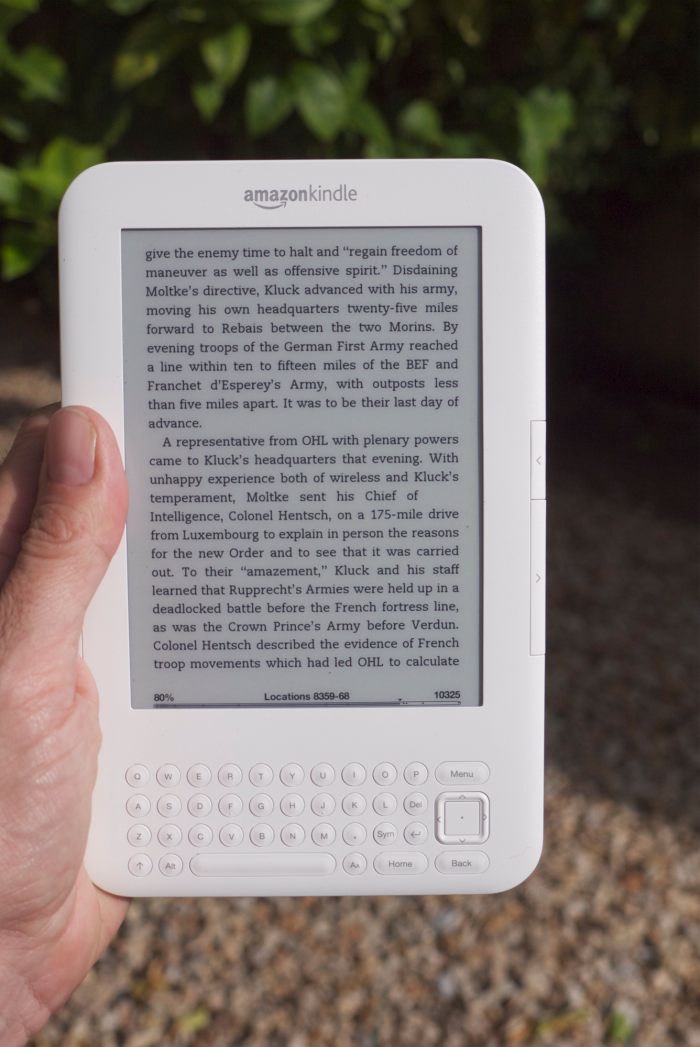
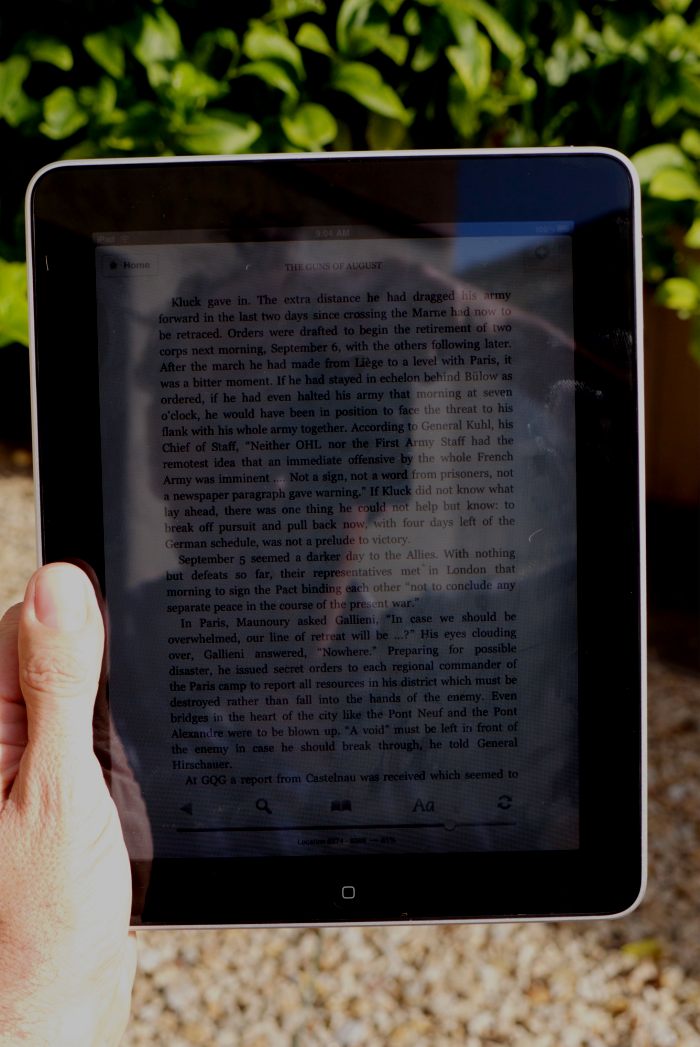
So why would anyone buy a Kindle? You only need look at the next two snaps and you will likely buy one. These show the iPad and Kindle in direct sun.

Kindle in direct sun. The grey background does a lot to reduce eye strain in bright light.

iPad in direct sun. Useless.

Here you can see the two best and worst features of the devices – the Kindle screen just gets better as the light intensity rises and the iPad not only sucks in the sun, it’s made impossible to use by the Chief Fetishist’s insistence on glossy screens only for all Apple’s devices. So at $139 if you live in a place with sun and like reading outside (meaning CA, Florida, southern Spain, France or Italy, I suppose) buy one. The $189 version is a waste of money, though that’s what I got. You simply load up your books at home using wifi. 3G, I thought, would be nice for on the road download of newspapers, but as Amazon and the publishers idiotically insist on charging you yet again even if you already have an iPad or desktop subscription, and because the Kindle version of the WSJ or NYT is severely edited, 3G makes no sense unless you get an urge to buy books from the Kindle Store when in an area without wifi. Worse, while you can access a mere couple of dozen famous blogs, Amazon wants to charge you for that too! Why on earth would I pay for something I can get free on multiple other devices? Mr. Bezos, what have you been smoking?

There is one reason, however, to get the 3G model. For the occasional beach or outdoor reader, 3G allows you to use Whispersync to pick up a book where you left off on your iPad or iPhone or other Kindle device. And as the 3G service has no recurring monthly cost (unlike with the iPad) you can just about convince yourself that it makes sense, if you try hard. Of course, the 3G service is from AT&T so better first decide if your place of contemplated use can get AT&T reception. If not, the Kindle falls back on the even slower EDGE system, which is better than nothing and has good US coverage.

The book shown on the screen, by the way, is Barbara Tuchman’s splendid ‘The Guns of August’ detailing the ‘outbreak’ (meaning unilateral unprovoked German aggression and the usual German atrocities) of WW1, each device at the same page owing to Amazon’s excellent ‘Whispersync’ technology which keeps all books you are reading using the Kindle or a Kindle app in sync. That’s the only other feature to like about the Kindle.

Bottom line? It’s no bargain. $139 if you like to read in the garden on sunny days or at the beach.

Update September 27, 2010:

Thank goodness for Amazon’s 30-day money refund policy. Today is my thirtieth day with the Kindle and after daily use throughout that period I am returning it. It simply got more and more frustrating to use, especially in its inability to allow the user to reset the last page read when trying to reread a book, rendering synchronization between devices inoperable.

You can see my review at Amazon by clicking here. The many ill informed comments – which I refute strongly – show confirmation bias at work. You bought it so you have to like it ….

Riding

You either get it or you do not.

My right wrist is shot.

My gluteus maximus* (aka my left bottom muscle) is stressed to an extent that makes me walk with a limp.

And my neck is so far gone that a look over my shoulder makes paying taxes seem like fun.

In other words, I have been riding an old motorbike in the twisties and couldn’t be happier. What’s wrong with a couple of aspirin and some internal bleeding, after all?

And when I say ‘old motorbike’ I suppose I really should write ‘old BMW motorcycle’ because that’s the only brand that speaks to me. And when I say ‘BMW motorcycle’ I really should write ‘BMW motorcycle with an air cooled, twin cylinder motor’ because like the Leica M2 and M3, they simply do not make them like that any more. A minimum of what you need, promising a maximum of its potential if you rise to the occasion.

So if you don’t ride, get with the action, take some lessons, learn what your sense of smell is really about (bikes have no air conditioning or air filters so you smell where you are, if you get my drift) and stop reading this. But be sure to take a camera.

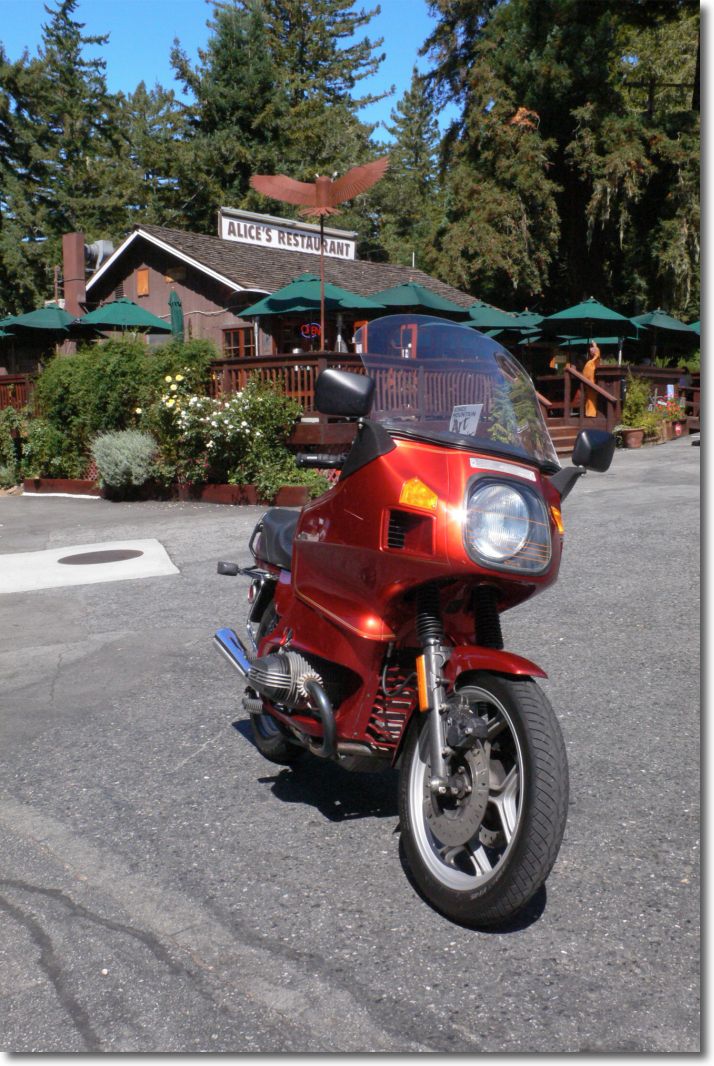
Here’s where my bike took me for breakfast today.

1989 BMW R100RT at Alice’s Restaurant this morning.
Panasonic LX1.

* Two of the words in the Latin vernacular known to any schoolboy repeatedly caned for misbehavior in the English public school system.

Point Sur lightstation

On Highway One.

Go a few miles south of Carmel on California’s Highway One and you will reach a desolate windy stretch of the world’s most beautiful road to which abuts a rock which is home to the Point Sur lightstation.

It’s no exaggeration to say that I have been trying to take a half decent snap of this majestically situated relic for some two decades now. First, I can never resist the call of One and while I much prefer to take in that magical highway on a motorcycle, that form of conveyance is ill suited to carrying the sort of gear needed to do Point Sur justice.

On my most recent attempt I was actually visiting One to take some virtual reality panoramas at Point Lobos, just outside Carmel, but could not resist the short drive down to Big Sur, passing Point Sur en route.

The problem with photographing Point Sur is that it’s far away, the gates are always locked, you can’t get a good view of it from close-up, it’s windy as all get up and the place, when not shrouded in mist, is enveloped in sea haze. But this time I came prepared. With monopod and tripod and with that killer duo, the Canon 5D and the Canon 400mm f/5.6 L telephoto. The latter, while huge and unwieldy, is by a considerable margin the best 400mm lens I have used and will likely remain so because the next step up is Canon’s f/4 and f/2.8 variants and I have more sense than the money demanded for these.

To cut a long story short, I banged away from the roadside, over the fence, with the hardware neatly supported on a monopod, trying not to sway in the heavy wind. The long Canon lens does not make matters easier by offering a lot of barrel for the wind to push on. I left the lens fully open as it gets no sharper stopped down and because I wanted the shortest possible shutter speed at the optimal ISO 400 setting on the 5D’s grainless sensor. The image was made in RAW format, of course, as I knew a lot of post processing would be needed to bring up the tones and contrast, experience having taught me it is very hard to destroy the quality of a 5D RAW image no matter how much you tweak things.

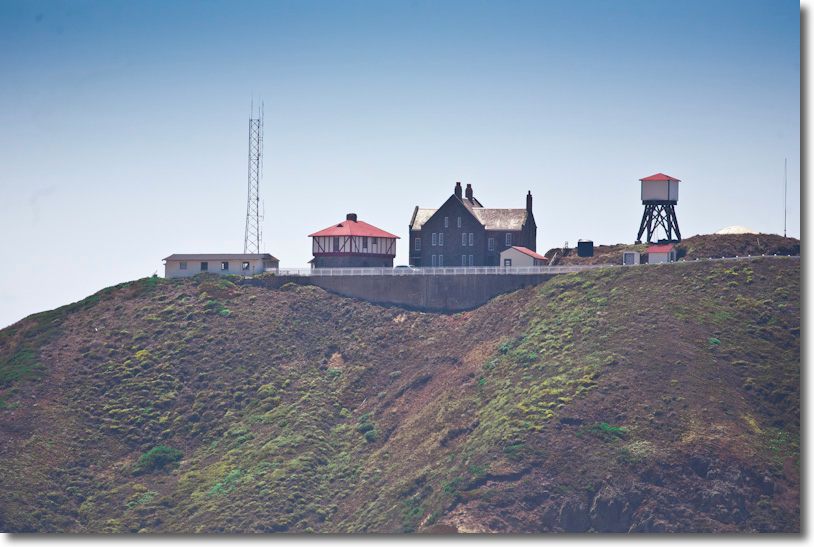
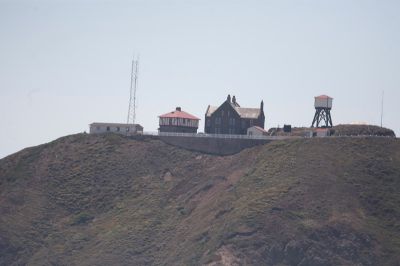
Well, here she is. I can still do better and propose to spend another 20 years trying, but this will have to do for now. The camera was maybe a mile from the buildings.

Point Sur lighstation. Canon 5D, 400mm, 1/3000, f/5.6, ISO400, processed heavily in Lightroom 3.

Here’s the original – let me tell you that even with a monopod it’s a challenge holding this rig level in heavy wind.

Original.

To read more about Point Sur click here, bought to you by us California taxpayers who are largely refused entry to this special place.