A simple workaround for the clumsy flash socket cover on the EOS 5D
When using non-hot shoe flash, like my studio Novatron flash kit, this is how the flash cord is attached to the Canon EOS 5D body:
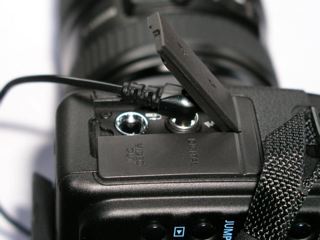
Can you believe this design?
However, for less than $20, Nikon still makes a hot shoe flash adapter, the AS-15, which can be locked in the hot shoe on the camera and the flash cord is then attached to the front:
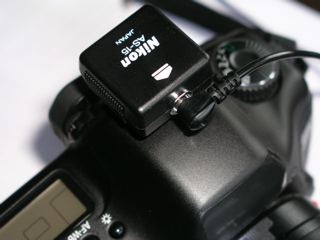
It makes hand holding a lot easier and you prolong the life of that very fragile flash socket cover. What were they thinking of?
I am by no means an expert, but I seem to recall that some non-dedicated flash units apply a very high trigger voltage between the hot shoe base and the central contact. These voltages may damage the sensitive electronics in modern electronic cameras. The flash connector at the side of the 5D body is made to withstand considerably higher voltages. Robin, The Netherlands
That’s a valid point. I use a later model Vivitar 283 with low triggering voltage (earlier ones were higher) and for my Novatron studio flash I add a small adapter between the power pack and the camera which reduces the triggering voltage ‘seen’ by the camera. I would, however, be interested in a definitive source for your statement that the two flash sockets on the camera differ in regard to voltage sensitivity.