Category Archives: Photographers

60 years

A sad demise.

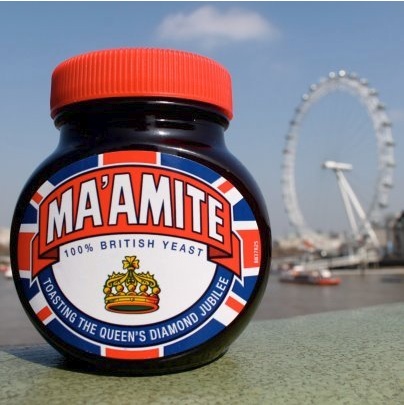
The only thing I have in common with the Queen is that my time on this earth closely coincides with hers on the throne. Britain celebrates its Queen today, with displays of bunting and small craft on the Thames as have not been seen since the US won the last world war.

During that time Britain has destroyed what was left of her magnificent industrial heritage, forgotten what Englishness is all about by virtue of a seemingly non-existent immigration policy, and sold whatever was left to foreigners. Thus, somewhat comically, what lucre is to be made from the upcoming London Olympics will largely end up in the Swiss coffers of tax avoiding American global enterprises. You know, people like Kraft and its newly American Cadbury’s, whose unspoken goal is to kill as many of its consumers with its junk food products as nature allows. Think of it as the Tobacco Lobby business model.

What prompts these thoughts was a question from a very English friend asking whether I was watching the Jubilee celebrations on TV. “Well, not exactly, dear” I responded, “you see, America is a republic”.

After a carefully crafted British education, complete with public schooling by pederast Catholic monks and a proper degree from a proper university, I was all set to join Rolls Royce aircraft to help make better engines when RR went bust, taking Lockheed with it. Bother. Scouting around I found a job with a multinational in finance (where the numbers bit was child’s play compared to fluid dynamics) and, inevitably, started working with and for Americans. Now this was a greatly distasteful experience. That same schooling on which I prided myself had carefully inculcated a deep xenophobia directed at all things American. Yanks, you understand, were still regarded as “Over loud, over sexed and over here” as the pointed epithet aimed at Britain’s savior Eisenhower had it a few years earlier. But as one trained in analytical ways I stood back, observed and shortly thereafter …. emigrated. Rarely has a decision been so easy to make on grounds of sheer obviousness.

Meanwhile, since that November day in 1977 which saw me leave, Britain has continued to sink. Its serial theft of centuries past, known euphemistically as ‘The Colonies’, came to a rapid end, though the English always had a reason until then to pillage, plunder, rape and steal, for as the toast in the Officers’ Mess had it: “Gentlemen, the Queen!”. Now they still have the Queen but little to toast.

Still, it doesn’t take a computer to figure out that Mrs. Windsor is one heck of a good deal for a nation that has little left to sell. Sure, she’s a poorly educated philistine with awful taste in dogs. However, receiving a modest stipend from the taxpayer and paying substantial taxes on her investment income, she costs little or nothing in upkeep. As for all the tales of her wealth, they are meaningless. She can no more sell Buckingham Palace and its stolen Leonardos than the US taxpayer can sell the White House. It has zero value, as do her other residences as they cannot be transacted. In exchange, she fills the Treasury’s coffers mightily with tourist dollars, at least those dollars as are left after Kraft et al have kept theirs.

So happy Jubilee Your Majesty.

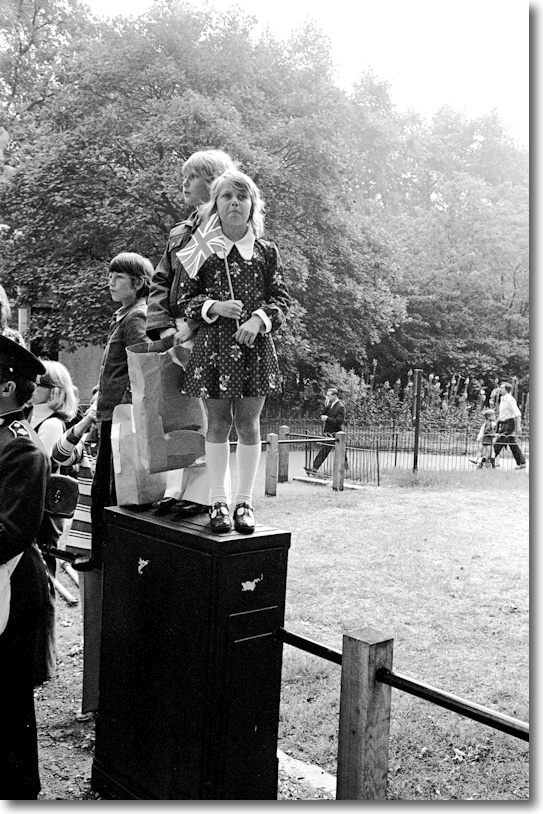
Nothing to wave the flag for. Hyde Park, 1977, right before I left.
Leica M3, 35mm Summaron, TriX.

Madame Yevonde

A famous British photographer.

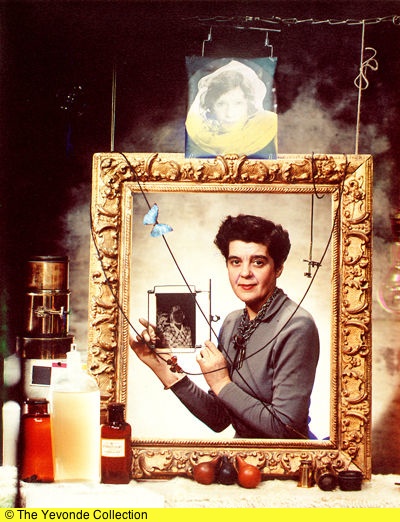
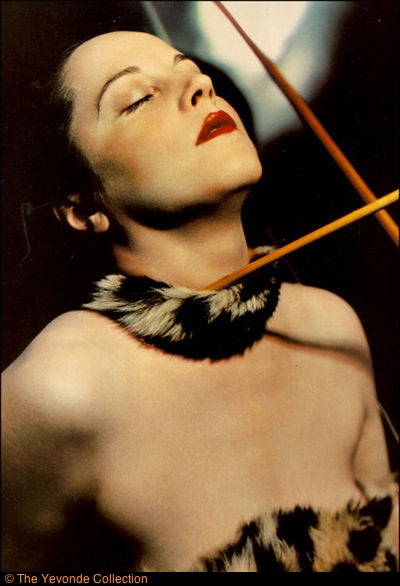
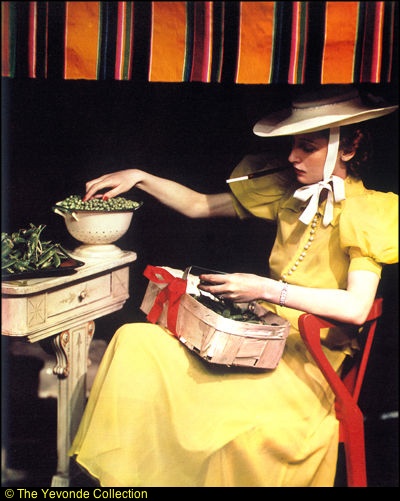
Somewhat forgotten today, whereas the light of her peers from Beaton to Penn continues to shine brightly, Madame Yevonde (Yevonde Middleton) was the ‘go to’ society and advertising photographer for the best part of half of the previous century, starting in 1920. She pioneered the use of the three plate Vivex color process in the early thirties, where three primary color images were successively exposed, then merged at the printing stage. Conceptually similar to Technicolor used in the movies, this process resulted in highly saturated colors in a world used to black and white.

If you were a society woman in 1930s London, then Yevonde was your photographer of choice, as you sought to memorialize your flouncing about in flimsy fabric dressed as a Greek goddess. The pictures verge on kitsch, but it is high quality kitsch.

Madame Yevonde. Click the picture for the Madame Yevonde web site.

Lady Milbanke as Penthesilea, Queen of the Amazons (!)

1930s advertising shot using the Vivex process.

Click the first picture for the web site, which is a lot of fun.

Rules of Civility

A fascinating novel.

Click the image for the book on Amazon US. I get no click-through dollars.

Amor Towles’s novel, set in late-Depression era New York is fascinating. It starts with a flash forward to the sixties where the narrator is attending a Walker Evans New York show of the latter’s great subway pictures, and recognizes a friend in one. Not once, but twice. The first image is of the man destitute, the second, a few years earlier, at the height of his wealth in the Roaring Twenties before the Depression.

Major sections of the book are illustrated with Evans’s subway portraits, clandestinely taken and some of the best work he did.

The novel tells the story of the wealthy and their lifestyle, seemingly unaffected by the Depression, insured by inherited wealth. But things can, and do, go wrong. It’s illustrated with the same Walker Evans’s images and strongly recommended.

Celebrity

Book review.

Click to see on Amazon – I get no click-through payment.

This came along as a welcome gift to my photography book library. When it comes to the bad boy British photographers of the Swinging Sixties, the names you hear most often are Donovan, Duffy and Bailey. But a fourth, with a claim to having been there, is Terry O’Neill, whose pictures of the famous and near-famous are reproduced here.

In a typically well written essay introducing the book, A. A. Gill (who did sterling writing in the Sunday Times before the Dirty Digger came along) summarizes it nicely. Fame, he writes, is haute couture whereas Celebrity is ready to wear.

Some of these pictures leave me cold because given the natural beauty of their subjects it’s quite literally true to say that anyone could do it. I mean, can you imagine taking an ugly picture of Catherine Zeta-Jones, for example? Heck, even if you were a complete klutz, she wouldn’t let you.

But there are others which get through and show insights to the subjects’ characters that are quite fascinating, with perhaps the best being the cover picture, above. There’s a fine one of Roger Daltrey trying to act the land baron and not quite succeeding. It’s tough when, as Pete Townshend once described him, you are just ‘a sheet metal worker from Shepherd’s Bush’. One more poignant is of Tom Jones back in his Welsh coal town, ridiculously overdressed with a huge Rolls Royce. Sad. I wonder if he was in on the cruel joke? One even more moving is of an old Marlene Dietrich (German, yes, but the sheer number of GIs she slept with testifies that she was on our side), emerging from the side curtains onto the stage like a chrysalis becoming a butterfly. A pretty old and past-it butterfly, in her case, but extra points for trying. Another well observed one is of Faye Dunaway, O’Neill’s spouse at the time, on the morning after winning the Oscar, replete with silk gown and Beverly Hills Hotel pool. (Dunaway was a Celebrity; Bailey went one better, marrying Catherine Deneuve who was, and remains, Famous).

It’s a fun book, a confection which occasionally gets you thinking. Was O’Neill a great photographer. No. The fame of his subjects rubs off, but too rarely does his work show the sort of insight common to the terrible trio mentioned above.

There’s a video of O’Neill sounding disillusioned and preaching how digital is not ‘real photography’ which you can see, in lieu of watching the kettle boil, by clicking below. (Refresh your browser window if it’s not visible below):

Paul Bock

An American photographer of Hungarian descent.

Paul Bock makes his home in Los Angeles, one of my favorite American cities. He tells his own story below and it’s one of a dedicated and involved student and practitioner of photography. His work is studied, contemplative and insightful – an oasis of calm in a fevered world. I think you will enjoy his work as much as I do. Click here for Paul’s site.

* * * * *

I was born in Hungary and got my first camera when I was fourteen.

At about that time, I read Perelman’s “Physics of Every Day”, and I was fascinated by this character, who had better eyes then anybody else. Walking in the forest, he could see the birds, the squirrels, the snakes, before they could see him. Thus he lived in a world different than ours: he was closer to the truth. At that time, I wished I had eyes like him, so I could see behind the scene, so I could be part of a world hidden from most.

That childhood fascination is still with me. It is all about discovery, about seeing “the other side”, finding the essence of things, the hidden, the importance, the truth.

At that very special moment when I release the shutter and an emotional rush makes my heart pound and stops my breath, I feel that I am like Perelman’s character: I’ve seen behind the obvious, I’ve gotten a glimpse of that hidden world behind the façade and I captured it in my camera.

My intention is to bring this hidden world, my world, to the viewer though my images, and share the excitement of discovery.

I became a structural engineer, and photography had to stay in the background, but was never forgotten. In 1974 I immigrated to America and have lived in the Los Angeles area since then.

In 1998 I purchased a 4×5 camera, and dedicated increasingly more and more time to photography. I was attracted to the richness of detail and tonality of 4×5 film and to the control provided by the camera’s movements. When digital capture reached a reasonable level of quality, I happily embraced it. I still enjoy the freedom and mobility I gained by shedding the 60 pounds of large format gear and the unlimited control available in post processing.

In 2000 I studied photography with Larry Janss (in his early days Larry Janss was Ansel Adam’s assistant and later became a renowned fine art photographer and educator), and in 2004 I graduated from Tri-Community School of Photography in Los Angeles.

In 2008, in a juried competition, my “Silent Scream” image (Reproduced below – Ed.) created in Antelope Canyon won the prize of the Associated Artists of Inland Empire.

In 2009 I was invited to present a solo exhibit of one hundred of my images at the “Euro Foto Art” Photo Salon in Oradea (Nagyvarad), Romania, and was installed as a creative member of the AAFR (Association of Fine Art Photographers of Romania). Those one hundred photos were later exhibited in Bucharest, Arad and Iasi, and then were donated to the Partium University of Nagyvarad.

I like large prints, and print all my images on an Epson 7800 Stylus Pro printer, using K3 pigment based inks, on Epson Ultra Premium Matte Presentation paper.


Twenty Years Later.


Red.


Woman with Buffalo.


Waiting.


Rapture.


Philosophers.


It’s a Small World.


Silent Scream.


Totem.


Moonstone Bay.


The Angel.


405.