Category Archives: Photographers

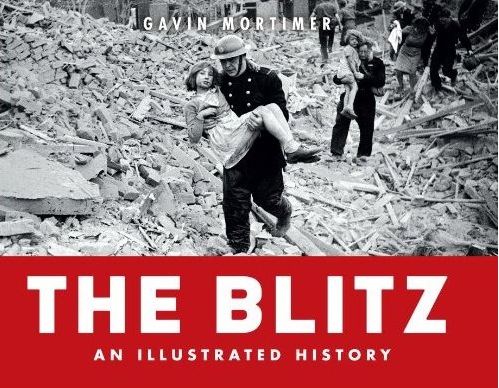
The Blitz

Book review

This collection of photographs from 1939 -1944 London is simply riveting.

If you look at the severity of Germany’s unprovoked aerial bombardment of London in WWII, using deaths as a yardstick, then the worst year was 1940 when the might of the Luftwaffe poured death and destruction from the skies. The combined efforts of I G Farben (now Bayer, BASF and Hoechst) for chemicals, Daimler Benz, BMW, AEG and Siemens for hardware and Deutsche Bank and Commerz Bank for finance, aided in no small part by massive conscription of slave labor, made all that insanity possible. Needless to add, all those firms survive and prosper to this day, along with the vermin offspring of their parents.

So it is impossible to write objectively about what this book of war time photographs from the Daily Mirror’s reporter George Greenwell portrays, other than to wonder at the miracle which gave England the English Channel, the greatest of all defenses, and a half-American named Winston Churchill. Our son Winston – a simple act of gratitude – will never know how close he came to not seeing this world.

While some of the pictures here are undoubtedly propagandistic in nature, the reality is that people did get married in bombed out churches, kids did play in the ruins and life went on as best as it could. ‘Muddling through’ may be a trait ascribed to the English but realistically what else were they going to do? I bow in admiration to their wonderful grace and stoicism in these hardest of times.

What many forget, and this book makes clear, is that death from the skies was not confined to 1940. Almost as many died in London in 1944. This time, with the Luftwaffe finished, it took the form of the V1 pulse jet and V2 rocket flying bombs, the first effective guided, pilotless missiles. The V1 could be put out of action by the faster Spitfires who would daringly tip it over with a delicate nudge from a wing tip and a 100 mph speed advantage. The V2 was altogether a different proposition. At 1,800 mph it flew at more than twice the speed of sound and no 400 mph piston-engined, propeller aircraft was about to catch it. That little number was created by a brilliant rocketeer who became a more than willing member of the SS in 1937 and managed to look resolutely the other way while Jews and Poles died on his production lines creating his evil weapon.

What became of him?

A few short years later he was to be seen in one of the last ticker tape parades down Manhattan’s Broadway, proudly waving a Stars and Stripes, testimony to his new citizenship and to the fact that his Saturn V rocket had just made it possible for Neil Armstrong to make his ‘Giant Leap for Mankind’.

That rocketeer was named Wernher von Braun.

Helen Levitt

A New York street snapper.

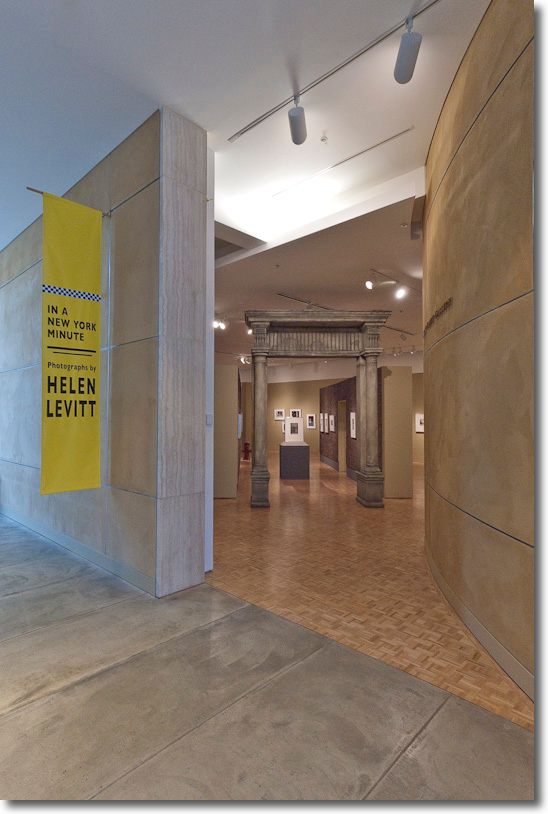
A friend of the blog pointed me to a Helen Levitt show at the Cantor Arts Center at Stanford University in Palo Alto and I finally manage to toddle along. The show, named “In a New York Minute”, is worth attending if you can make it; unlike the overblown Cartier-Bresson one earlier this month at SF MOMA, this one has relatively few pictures on display and leaves you wanting more. That’s how it should be done. Plus you can see a great collection of Rodin sculptures and tour the Stanford campus while you are there.

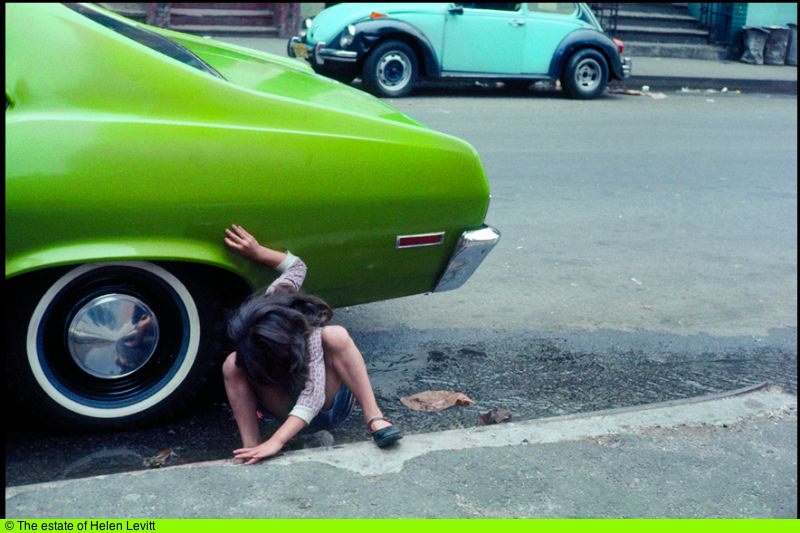
The distinguishing feature of Levitt’s work is that it is never less than witty. Often it’s laugh-out-loud funny. You could never accuse HCB’s output of that.

You can read Levitt’s biography here. The theft of many of her color originals from her home only further emphasizes the need for every photographer to have multiple back-ups – there is no excuse in a digital age not to, using technology not available to Levitt.

Though there’s a paperback of Levitt’s work available for browsing in the gallery, their bookshop only has a very costly $60 hardback of her work. Duh! I asked the salesperson and she didn’t even know there was a paperback ….

No matter. Do the smart thing and order the same hardback from Amazon for much less. It’s beautifully printed and an essential addition to any street photography fan’s book library. I just ordered one of the last ones, so you may have to wait! But a search of remaindered booksellers will get you there for a like price.

Levitt’s work often features children and many of the images in the show are in color, which only adds to their impact. Color is another thing largely missing from HCB’s work which, if you have seen his color snaps, is just as well.

* * * * *

Here’s a typical Levitt photo, full of wit and whimsy:

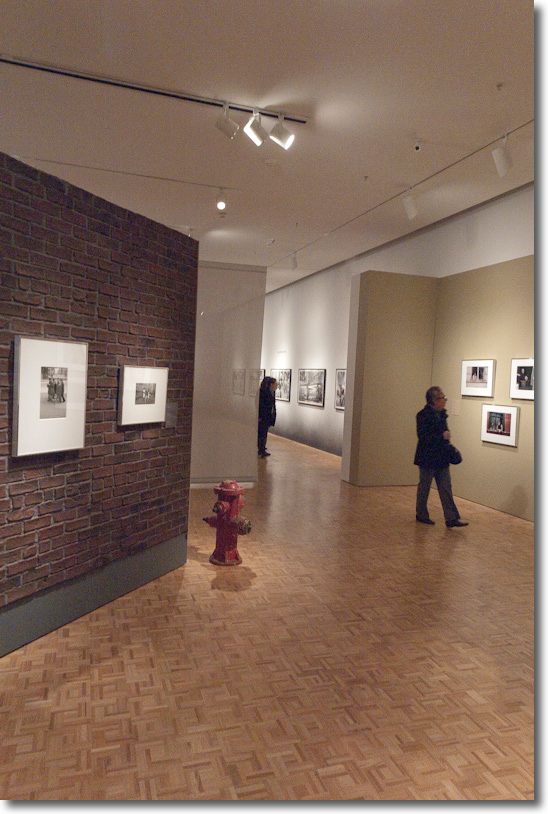
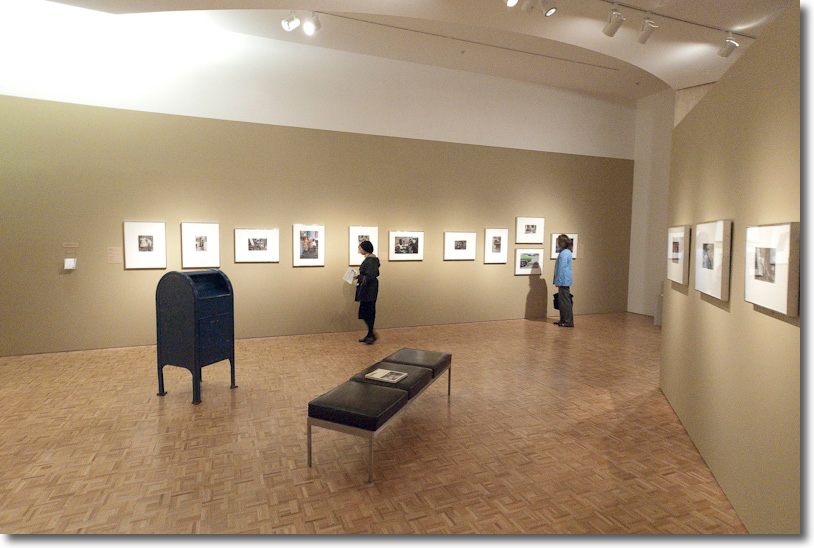
The show is not lacking in humor either. There are but two props, visible in the following snaps, which I took once the ever watchful guard’s back was turned. (Excuse me, but why exactly are they ‘guarding’ machine made prints?) If you want to get a camera in there, don’t take a backpack as they make you check those. My shoulder bag, Panny G1 and all, survived the strip search ….

All snaps on the Panasonic G1 with the Olympus 9-18mm MFT superwide zoom at 9mm and at ISO 1600. In truth, that’s really pushing the poor little sensor in the G1 which starts emitting creaking sounds at anything much over ISO 400, but it works at a pinch when the light is really low. Levitt – and HCB – would have loved it!

HC-B at SF MOMA

Not great.

I finally made it to the Cartier-Bresson show at SF MOMA and have to say it was underwhelming.

There are four ‘periods’ in HC-B’s work:

  • The surrealist masterpieces 1931 -1951
  • The photojournalism – tourist snaps of China and Russia before they opened up
  • The portraits of famous people
  • America

The first is a beacon for modern photographers and was poorly shown, replete with low contrast small prints poorly lit, many yellowed. The curse of the ‘original print’ which I described here. Sure, his technique wasn’t the greatest, his exposure all over the place, but the work is definitive. It needs better display than MOMA managed. It’s this period that haunts, amazes and inspires.

The second is blah. Notable only for the fact that no Westerner had photographed these exotic places before.

The third has generally left me cold but I’m warming to it after this show. Too bad they didn’t include those two great shots of Giacometti crossing the street in the rain and moving one of his sculptures in the studio.

The fourth? Well, he sees only the crassness and vulgarity in America, something the show’s narrative repeats. He just does not ‘get’ America but, then again, he was French – an honorable excuse!

It’s on for another week, then moves to Atlanta. The MOMA show has too many mediocre works and displays over 200 pieces. 80 would have done it.

As you can see it was zooed, making the small prints even harder to enjoy.

Felipe Dana

A Brazilian photojournalist

A friend of the blog sent me this link to the work of Brazilian photojournalist Felipe Dana, documenting last week’s landslides in Brazil. The work does what pictures do best – inform, question, shock – while simultaneously displaying great compassion. Click the picture for more.


Vivian Maier – Part II

It just gets better.

I wrote of John Maloof’s serendipitous discovery of Vivian Maier’s wonderful mid-century Chicago street photography here and eagerly await the DVD of the documentary he is working on about this great photographer’s life and work.

Meanwhile, here’s a brief introduction to her work which, I think you will agree, is as fine as anything in the genre (Note: The code is buggy so refresh the page if it does not display the video. It’s a Flash video, so it will not play on an iPad).

Maier’s world reminds me of Angel Rizzuto’s – the unknown talent with a singular dedication to his or her photography, dying unknown only to be discovered posthumously, each leaving a vast treasure trove for later generations to explore.