A fine German fashion photographer.
The words “wit” and “photography” are rare companions when the photographer in question is German, but Regina Relang is an honorable exception to the rule that has it that humor has yet to be discovered in Germany.
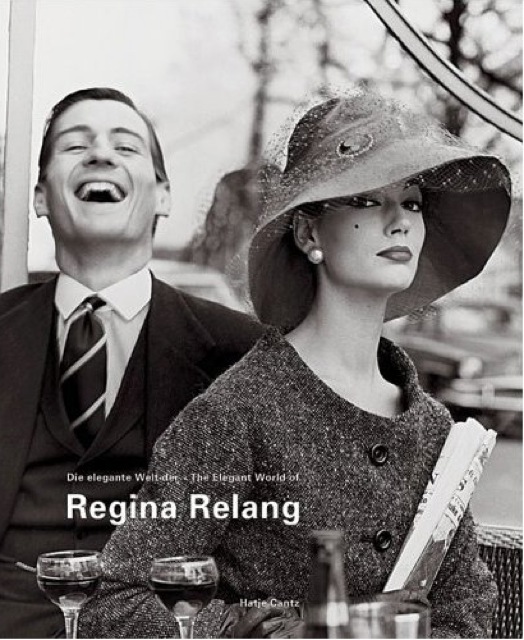
The Elegant World of Regina Relang, by Esther Ruelfs
Relang’s career spans the immediately pre- and post-WW2 periods, the latter perhaps the greatest outpouring of great fashion and photography we have yet seen.
Her oeuvre is both light hearted and witty and never less than totally sophisticated. And while many of her German models look as if someone took a floor brush to them to reveal a new layer of perfect, unblemished epidermis – what else to expect of the Master Race? – that detracts little from the charm and beauty of her photography.
The book is frustratingly written in both German and (stodgy) English, with the English version in very light print on a light background (conspiracy theorists can have at it here) but as it’s the only monograph out there on Relang, I’m going to button my lip. No book on photography should have a ‘must read’ text and this one certainly more than espouses that dictum. The writing, or maybe it’s the translation, is beyond pedantic.
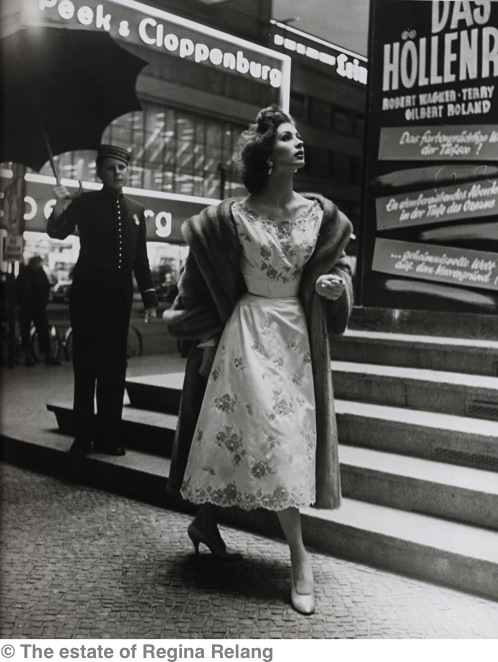
Wit, class and sophistication. Suzy Parker photographed by Regina Relang, Berlin, 1954.
Relang was also a fine photographer in the more general sense and a selection of her non-fashion work is also on display here. Some of her later work is in color and she has as fine a sense for a simple color palette as she does for monochrome.
A few points of technical interest. Reading between the lines I conclude that Relang was mostly a Rollei twin lens reflex user. What makes this remarkable is that while the small size and low weight of the Rollei liberated the camera from the studio, nothing could suit a waist level Rollei less well than Relang’s style. Relang, you see, was all about motion and action, movement blur and so on. If you have ever tried using a TLR Rollei to follow action (in her time the eye level frame finder was not yet available, being introduced on later models) you will know why I say this. It’s near impossible as the image in the viewfinder is reversed.
Unlike her contemporaries Avedon and Penn, who typically adopt an “everything must be sharp” style, it is rare to find a Relang picture which does not use selective focus. The varied use of this technique in the many pictures in this book speaks to a very high level of technical skill on the part of the photographer. With the depth of field equivalent to a 75 or 80mm lens on a 35mm camera, (but with the field of view of a standard lens), selective focus is easily available at larger apertures, of course.
I highly recommend this book for anyone interested in beautiful photography, gorgeous women, haute couture or great technique.
In my case that’s all of the above.
Don’t waste your money at Amazon – get a remaindered copy. Mine ran $20 from Edward G. Hamilton.