Category Archives: Photographers

Bob Carlos Clarke

Never boring

When it comes to photography of exotic women, when America gave us the crass, crude and vulgar German, Helmut Newton, England blessed the photography world with Bob Carlos Clarke, who died by his own hand and was buried a year ago yesterday in one of my favorite haunts, Brompton Cemetery.

Clarke never saw a woman, it seems, he did not like, though towards the end disillusionment with his profession had set in:

After 30 years as a photographer I can say this
business has got harder, more callous, less open and much
more competitive. In the 1960s, photographers ranked just
behind rock stars in terms of image. Now they’re way down
the list, behind brawling footballers and provincial DJs.

As the UK’s Photography magazine printed my snap which went on to become the Photographer of the Year prizewinner in 1974, I always remember that the issue where I was published also had an article on Clarke’s photography, my first intoduction to his work.

Here’s a snap from Brompton Cemetery I took in the early ’70s which, it seems, is appropriately dedicated to his memory.


RIP BCC. Brompton Cemetery. Leica M3, 90mm Elmar, TriX

Beating the system

Here’s someone who got it right

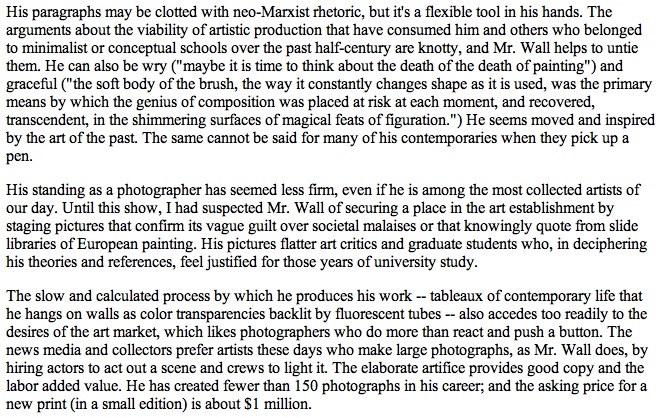
From yesterday’s Wall Street Journal article on photographer Jeff Wall:

Now while I wish Mr. Wall the best of good fortune in selling his snaps for $1mm a pop, maybe you should read this for a reality check while you’re at it.

And while I remember, you can get my framed 22″ x 28″ prints for quite a bit less. Though I do like his fluorescent tube touch, I must say. If you really want those, let’s talk. Limited edition? No problem.

Annie Leibovitz

Finally, she does it right.

I have avoided reference to Annie Leibovitz’s photography in this journal, finding her work so over the top and in such poor taste that the less said the better. She is very much of the “put a famous face in a ridiculous situation and fame and fortune follows” school. That doesn’t make her work good photography.

So it give me considerable pleasure to relate that the annual VF Hollywood Issue (March) has a 33 page film noir portfolio of her latest work which is an absolute cracker.

As I mentioned before do not buy this magazine for its editorial views unless you are one of those poor, foolish conspiracy theorists who believes the administration is responsible for all the ills of the world while solely interested in enriching itself. No, you are not going to find rational, objective political analysis anywhere near the pages of Vanity Fair – the content is by loonies for losers.

But you will find cutting edge photography which inspires and teaches – not a bad reason to subscribe.

Rush out and get the March issue and you will see some great photography by Leibovitz, meticulously directed and with lots and lots of top notch actors posing in the pictures – the likes of Amy Adams, Ben Affleck, Jessica Alba, Pedro Almodóvar, Alec Baldwin, Adam Beach, Jessica Biel, Abigail Breslin, Jennifer Connelly, Penélope Cruz, Judi Dench, Robert De Niro, Robert Downey Jr., Kirsten Dunst, Aaron Eckhart, James Franco, Djimon Hounsou, Jennifer Hudson, Anjelica Huston, Rinko Kikuchi, Diane Lane, Derek Luke, Tobey Maguire, James McAvoy, Helen Mirren, Julianne Moore, Jack Nicholson, Bill Nighy, Ed Norton, Peter O’Toole, Sylvester Stallone, Sharon Stone, Kerry Washington, Naomi Watts, Forest Whitaker, Bruce Willis, Patrick Wilson, Kate Winslet and Evan Rachel Wood.

Quite a list, huh?

The Gutenberg effect

It makes for a lot of photographs.

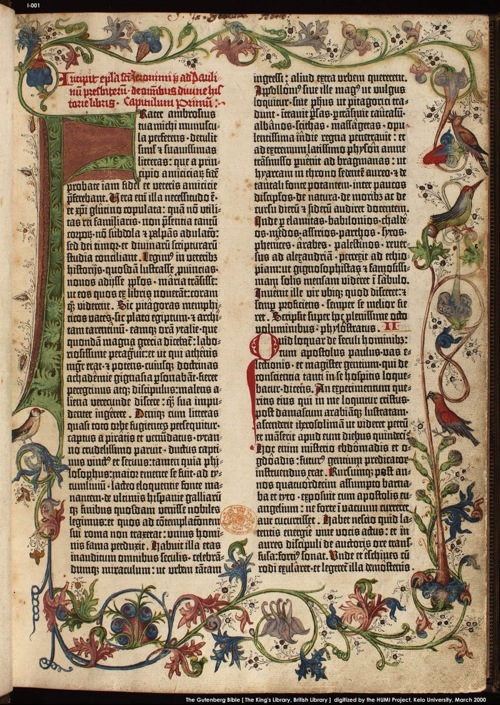
When the Gutenberg Bible was printed in 1455, it was the first book printed on cheap paper using moveable type. At the time there were maybe a hundred thousand books in print in Europe. Fifty years later there were twenty million. A similar tidal wave is sweeping over photography through the proliferation of web sites.

A couple of weeks ago the U.S. Census Bureau reported that America’s population had crossed 300 million. Even given Government magnitudes of error, meaning the number is 300 million +/- 100 million, that’s a big number.

A few days ago, the Wall Street Journal published a piece on how sales of digital SLRs were booming as photographers wanted something perceived to be better, or at least something without picture destroying shutter lag or camera shake. They mentioned that the percentage of ‘serious’ photographers in the US was 2%. While I have no idea where that number came from, let’s assume a 200mm population of age capable snappers. At 2% that makes for 4 million serious photographers.

Of those four million, lets dismiss 75% as equipment fans who couldn’t take a good picture if it hit them. Down to 1 million.

Of that million, let’s be charitable and say 10% can see rather than just look. 100,000.

Half of these will be mired in old ways, denigrate modern technology and think a web site is a place where ducks with big feet gather. 50,000.

Of those, 50% are passionate enough to show their work. 25,000 real photographers. Why ‘real’? Because if you do not show your work you are not a photographer. No artist can claim the title if no one sees his work as, by definition, photography/art must be seen to be appreciated. By others, that is.

So 25,000 web sites. Now add 25,000 for Europe and 25,000 for the rest of the world and you have 75,000 web sites of good photography, each containing some really good work.

Now add the Gutenberg effect as the populations of China and India and Africa get digital cameras and you have a quarter of a million photography web sites in twenty years.

Which brings me back to the theme of my entry the other day, No more Great Photographers? The individual has been buried by the very technology that makes his work accessible in the first place and the chance that you or I come across one another’s work in a lifetime are very remote indeed.

Technology as enabler has destroyed the significance of the individual.

So while I love how easy it is to make a picture today, I also rue the lack of fame, or even the prospect of fame, that dooms my work.

And yours.

No more Great Photographers?

Falling attention spans and video are the cause.

When I was a teenager gazing at photographs some forty years ago, the ‘Great Photographers’ I knew then pretty much remain the ‘Great Photographers’ I know today.

If you want to know their names, just click on Book Reviews and many of those profiled fall in the list. Cartier-Bressson, Sudek, Callahan, Evans, Capa, Ray Jones, Frank, Snowdon, Erwitt, Brandt, Brassai, Kertesz, Penn, Avedon, Porter, Beaton, Blumenfeld. The list is not long. You could add maybe another dozen names and the whole collection would represent 90% of content in photography shows in art galleries and museums.

Journalists do not feature in this list. They never will. Capa comes closest to that description but his pictures transcend journalism and become works of great humanism. Of the other well known photojournalists they are, for the most part, One Shot Wonders. Most remember the picture of the Viet Cong being shot in the head by the Vietnamese, one or two know it was Eddie Adams who took the picture. That’s it for Adams. The American Flag raising on Mount Suribachi during the Battle of Iwo Jima? Why Joe Rosenthal took that one – something most learned when his obituary was published the other day. Matthew Brady and all those dead soldiers in the Civil War? Who has any interest in these drab works today?

No, I’m afraid photojournalism is about as much respected as an art as its twin, journalism. Journalists award one another the Pulitzer Prize as no one else will reward them, for theirs is a transient art, good for the moment, forgotten tomorrow.

The list above include five photographers who made their living in the world of fashion (Penn, Avedon, Snowdon, Beaton, Blumenfeld) yet each reached to greater heights with their art and reportage work. Beaton’s searing pictures of London in the Blitz are more than mere photojournalism and his work in the Far East approaches Cartier-Bresson’s best. Penn’s fertile mind rendered art of everything about him. Snowdon’s work, the touchstone of sensitivity, ranks as one of the greatest photo-portraitists. Avedon was incapable of being ordinary in any work he did, be it fashion or social commentary. Blumenfeld simply changed the way we see.

And what of the others? To a man they were great photographers of man and his environment. From the cubism of Cartier-Bresson to the expressionism of Walker Evans, the beauty of Kertesz or the sublime passion of Sudek, they simply saw more clearly, in a fresher vein, than anyone before.

But how about since? Why is it that most of these ‘Greats’ are long gone? Has the world stopped making great photographers?

No, not a bit of it. Surf photographs on the Internet and you will see photography every bit as good as that of these masters. But the problem is, we no longer care. The age of the still photograph as a Great Photograph is over. On the one hand, still photography has never been so ubiquitous, or so easy to do well, if only from a technical perspective. Focus, exposure, sharpness – they are all pretty much guaranteed today. Results? Instant, obviously. So while it is finally true that Anyone Can Take a Photograph, and certainly many good photographers can take a great one, the audience is, in large part, gone.

And while I, for one, find that sad, I know better than to deny history.

Today’s attention spans, in Western civilization at least, are simply too short for the still picture to make sense. Who is going to stop and gaze and think and wonder just what was going on when Cartier-Bresson pushed the button and why he chose that moment to push it? You and I, maybe, as I doubt you would be visiting here otherwise. But the consuming public needs 24 images a second to hold its attention, even if the visual content is execrable, the message beyond banal. Maybe our brains have become so attuned to, nay, drugged by the need for constant change, that we prefer moving pap to still literature?

And that is why, except for a few devotees of the art, there are no new Great Photographers any more in the world of still photography.