Category Archives: Photographers

Vision

Hoppé got it right


Carmel, CA. M2, 35mm Asph, Gold 100, processed in Aperture

“The task of the artist is to develop his powers of perfection and sympathy, to bring a new vision of beauty and spiritual strength to a mechanistic age. This cannot be done in a darkroom or laboratory.”

E. O Hoppé, A Hundred Thousand Exposures. Focal Press, 1945.

Jacques-Henri Lartigue

Book review

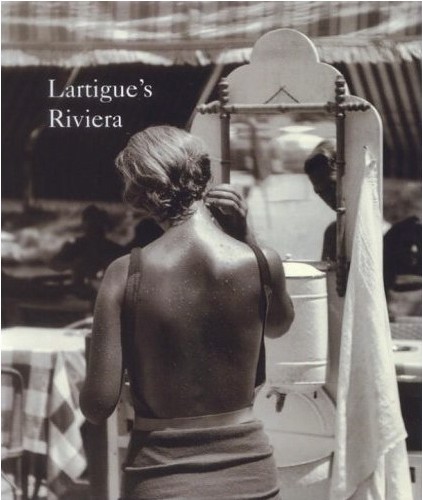
This slim volume has been on my bookshelf for some ten years now, a gift when it was first published. Amazingly, it remains in print, which says something for the appeal of these light-as-air sunny snaps from a great French amateur photographer who did his best work in the 1930s.

This collection makes for a pleasant way to spend an hour or so on a sun filled Sunday afternoon. Nothing deep here, just pure confection, and worth it for that fact alone.

André Kertesz

Book Review

For an index of all my book reviews click here.


Click the image to go to Amazon.

With a Hungarian expatriate about to win the French elections – not hard when you are running against an idiot who never read Economics 101, meaning an opponent whose cure for unemployment is to create half a million new government jobs – it seems appropriate to focus today’s journal entry on a Parisian expatriate photographer who also happened to be Hungarian, none other than the great André Kertesz. Kertesz at least had the good sense to leave Paris before the forces of evil took over, a similar sitiuation to that prevailing today in the world’s most gorgeous city. The difference this time is that a more insular America is not about to bail out a country cursed with the muddle headed socialism of fifty years of the Fifth Republic. Like the worthless doorman in my New York apartment of days yore, the only thing most French workers seem good at is walking around, hand outstretched, palm upwards.

The Paris of Kertész’s day was a better place.

This large format 302 page book, available from Amazon, is not cheap but as, to my amazement, I had no definitive Kertesz monograph in my library, I paid up the not inconsiderable price of entry and have to say it was worth every penny.

The book has its frustrations – the difficulty of finding the right illustrations to match the text, the sheer pig headed idiocy of reproducing miniscule prints of his early work sorrounded by acres of white – are the two worst. However, the narrative, broken into the three main periods of Kertesz’s life, is priceless, something you will rarely encounter in any art book. Special note has to be made of Sarah Greenough’s writing in her two essays which address his formative years in Hungary (1894-1925), and the key years in Paris (1925-1936). Erudite, deeply researched and incredibly informative yet never condescending, it’s art writing at its very best.

Anyone growing up with black and white photography – which means largely people my age and older – cannot have but been affected by Kertesz’s work. His unusual compositions, original points of view and tightness of framing all make for compelling imagery.

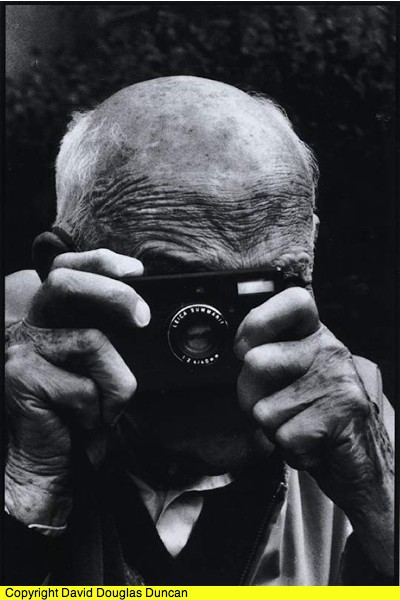
Kertész by Pindelski, South Bank, London, 1973. Leica M3, 50mm Elmar, TriX

I cannot count the number of my early images I made by looking up or down at severe angles – Kertész’s influence at work.

A key book for any photographer’s collection.

Winston Hofler: Photographer

Starting them young

I unleashed our son Winston with his new camera on an unsuspecting world. Not before Winston had tested the shockproof design by dropping his new toy on the floor. It survived. Bravo Olympus! A few moments after arriving home the snaps were processed in Apple’s estimable iPhoto and the best is below.


Photograph by Winston Hofler. Olympus 770SW, ISO 80, 1/320, f/3.5

Well, let’s face it, the boy has what it takes. The modernist composition, the action aspect, the sparse use of color …. it’s all there.

Winnie had banged off no fewer than 270 exposures! Whoa! Winston is five and has already taken more pictures than I did in my first ten years with a camera. I started late – at 7 years of age.

It was intriguing to see how he instantly took to the LCD screen for composition – something I find pretty much unusable. There’s the video generation for you.

Anyway, our boy will be spared the insane tedium of film/processing/scratches and has gone ‘straight to digital’. Lucky man. I can’t think his first book is too far off.