Category Archives: Photographs

Pachino

A reminiscence.

He remembered those lazy Saturday afternoons when granddad would ask all the family round to his restaurant. There were no tall buildings back then, the area full of Italian immigrants and artisans. Stonemasons, painters, bricklayers, plasterers, plumbers, cooks. Most, if they spoke English, did so with difficulty and Italian was preferred at work or play.

It was the smells he remembered best.

He remembered how Grandpa would have an immense pot on the stove to which the whole family had to add tomatoes, spices, pepper and salt and the obligatory bottle of chianti. As he sat on his knee, Grandpa would recount stories of the Old Country, and the magnificence of the opera house in Palermo. “My boy, if you ever want to say you have arrived in the world of opera, there are but four venues which testify to talent. Palermo, La Scala, Covent Garden, The Met.” And it was invariably Tosca or La Traviata or La Bohème or (Mario’s favorite) Rigoletto which would be playing in the background on the old Victrola. “Lad” Grandpa would say, “Verdi and Puccini. That’s all you need to know about music.”

He remembered how his job was to change the discs, a task he adored. You would have to flip the huge 15″ acetates every five minutes or so, but it was his job and he was immensely proud of it. He never broke one, fragile as they were.

He remembered how his father had once told him that granddad was known to one and all as ‘The Don’, but to young Mario he would only ever be Grandpa. He never quite knew what Grandpa did for a living but the family never lacked for anything. Tables bursting with all manner of meats, condiments, breads, cheeses, cakes, bottles of wine, as often as not dropped off by grateful friends.

He remembered how obsequious these donors always were, how cowed, always behaving with exaggerated politeness to the young boy. “What a beautiful boy” they would say, as cheeks were kissed, hair tousled.

He remembered when Grandpa had passed away – it must be twenty years now – young Mario leading the procession of mourners, his three brothers and four sisters in lock step behind. Now, he was a man.

He remembered the long black limousines, the unending garlands and bouquets, his father and his father’s friends all dressed in black suits and white shirts, the priests, the ceremony. Hair slicked back, a touch of pomade, scent, heavy gold watches. His mother with all the other veiled women, solemn in their grief for The Don, upright yet broken.

He remembered how on those afternoons, all those years ago, the old man had always told Mario how one day the restaurant would be his. It would pass to his father on The Don’s death and his father in turn would leave it to young Mario. And so it had been. And while Mario, now a successful businessman, had no interest in running the humble eatery, he had kept it out of sentiment for Grandpa and, every now and then, would take the wife and kids there of a Saturday afternoon to hang out with the cook in the kitchen and reminisce about those lovely warm times from far away.

To remember.

Now the place seemed a lone survivor in a sea of mindless high rises, but the neon sign still proudly proclaimed the family name. And when he went there it was as if time stood still and nothing had changed. He was still that little boy who sat proudly on Grandpa’s knee, watching the pot bubble and the pasta cook. He was home.

Pachino, Kearny Street, San Francisco. March 3, 2012.

Nikkor-H Auto 50mm f/2 lens

Move over, Mr. Hemmings.

When I wrote recently about early manual focus Nikon lenses, I suggested that the 50mm f/2 Nikkor standard lens was a competitor for Leica’s vaunted Summicron. That opinion was not exactly guesswork. I had used the Nikkor extensively as a kid and a succession of Summicrons over 35 years with Leica M bodies. Both optics were beautifully engineered in metal with performance to match. Plastic was not a concept. Nor was multi-coating, AF or VR/IS. That does not take away from the performance of either. My favorite 50mm Summicron was the first black version, and the last with the removable head, made by Leitz Canada. It took on more of the gutsy rendering offered by Nikon and Pentax at the time and deleted one element from the earlier design, making do with just six glasses, not coincidentally the same as the Nikkor addressed here.

With the intention of testing my ‘new’ 50mm MF 1971 vintage Nikkor, I took to the streets of San Francisco the other day with the D700, and had at it. I used the classic metal hood of the period, given to me for no charge by a nice person at Kaufmann’s Cameras in San Mateo, the same location where I had bought the 75-150mm Series E lens for a song. No filter was used. This 50mm lens is not the later “HC” version which was multicoated, and distinguished by a black front ring. This is the earlier single coated version, a classic symmetrical six element Gauss design. Apertures used in the snaps below were f/2 through f/5.6, and f/4 looks like the sweet spot, just like with those Summicrons of yore. Post processing in LR3 was minimal, and my standard Sharpness setting on import of 86 seems just right. Even at f/2 definition is more than adequate to permit large prints to be made, though micro contrast improves a couple of stops down.

Manual focusing proved easy, with the D700’s screen more than up to the task. While there’s always the focus confirmation light as an option, I found I rarely needed to use it, except in very poor light.

Here are some results:


Umbria


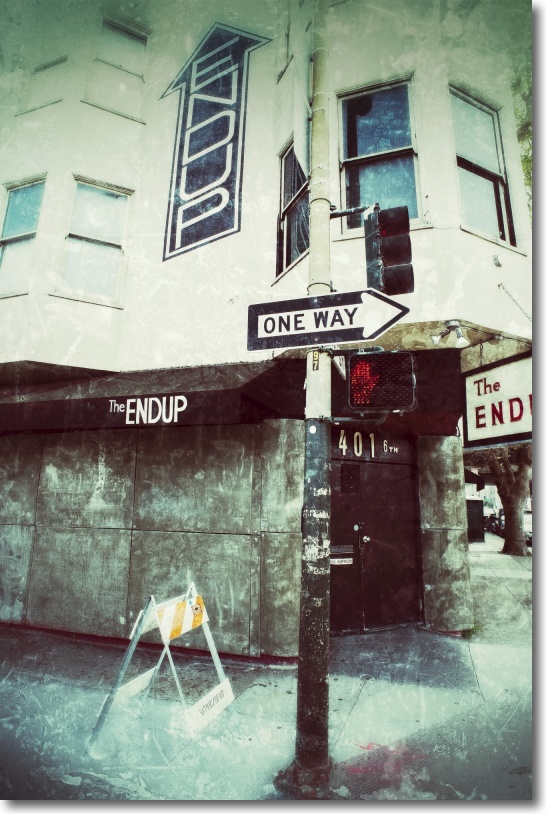
Speakeasy.


Biker bar. I had to beat this guy up for a better view of the bike.


Self portrait. Unlike Mr. Hemmings, below, I’m holding the camera right!


Things go worse with Coke.


San Franciscan.


101.


Spotted!


Bubble Lounge.


Blue. At f/2 – definition is even across the frame.

Looks like a keeper to me. All in cost with AI conversion by John White for my mint specimen was $75. Conversion is required for ‘pre-AI’ lenses to permit mounting and metering on modern bodies. Thank you, John, for a job well done!

And if you absolutely must make out like David Hemmings, this lens may even get you a hot date – I suspect he is using the f/1.4 variant:


Click here to read A Fantasy.

Cheap, not nasty

A few from the 75-150mm Series E lens.

The trade offs with these older, inexpensive Nikon lenses are simple. You give up AF and VR and save on cost, weight and bulk. It means that everything is slower in practice and only the user can decide if that matters.

But the one thing you most certainly do not sacrifice, based on my early experience with the budget 75-150mm Series E Nikon zoom, is definition. It’s superb.

Statuesque. D700, ISO 800.

Nap. Same data.

Cell call. Same data.

Window detail – 1895. Same data.

Burlingame station – 1895. At 150mm. Same data.

Station detail – in heavy shadow. At 100mm. Same data.

Enlarged section of the above. Taken at f/5.6. Definition
is the same across the frame. Flare is handled well.

Late shift

Hype dispelled.

What with everyone going on about the spectacular low light performance of the Sony sensor in the Nikon D700, I thought I would find out for myself, rather than read test charts. With the idea of using higher ISOs I set out on San Francisco’s streets an hour before sunset and messed with ISO 1600 and up a bit. While I had a lot of fun taking snaps I can happily dispel all the hype about the awesome noiselessness of the D700’s sensor. Yes, it’s fine at 1600 and no, it’s not as good as at 800. You can even tell the difference in an 18″ x 24″ print. Anything higher and luminance noise skyrockets. You can tweak it out in LR3 but at the expense of definition.

Comparing the results to those from my old Canon 5D, there’s little in it, quite frankly. Both have very large sensors and you would expect good noise performance from such relatively low pixel densities. But it’s not night and day compared with the excellent 16mp Panny sensor in the G3, as an example. Sure, it’s better, but not ‘blow you away’ better. The D700 had better be superior – it costs five times as much and has four times the sensor area.

If you must have full frame and are on a budget, a good used 5D body goes for $800. A D700 for $2,000. Unless you are heavily invested in Nikon lenses, the Canon would be the best price-performance choice by a country mile for all but those suffering from brand loyalty or some other strange hang-ups.

Enough noise about …. noise. Here are some snaps.

Because 3200 is too grainy to retain micro-detail, the ones below are all at 1250-1600 ISO, taken with the 16-35 lens at f/4. Yes you can get decent snaps at 3200, 6400 or even higher, but they sure will not look too pretty when printed large. Let’s be real here.


Outing with dad. ISO 1250.


Going home. On Sansome Street. Lots of noise in the shadows, underexposure
required to preserve detail in the Transamerica building. ISO 1600


Valentine store, Maiden Lane. ISO 1600.


Dumpster Diva. ISO 1600.


Muni bus. ISO 1600.


Kryptonite. ISO 1600.

Still, 1600 ISO is pretty decent and not a lot to complain about, except that it does not come cheap. While hosing a big DSLR around on the street tends to invite attention, San Francisco’s famously liberal culture makes that a low risk matter. Come to think of it, a couple of whacks around the head and ears with a D700 would likely do the recipient more damage than it would the camera.