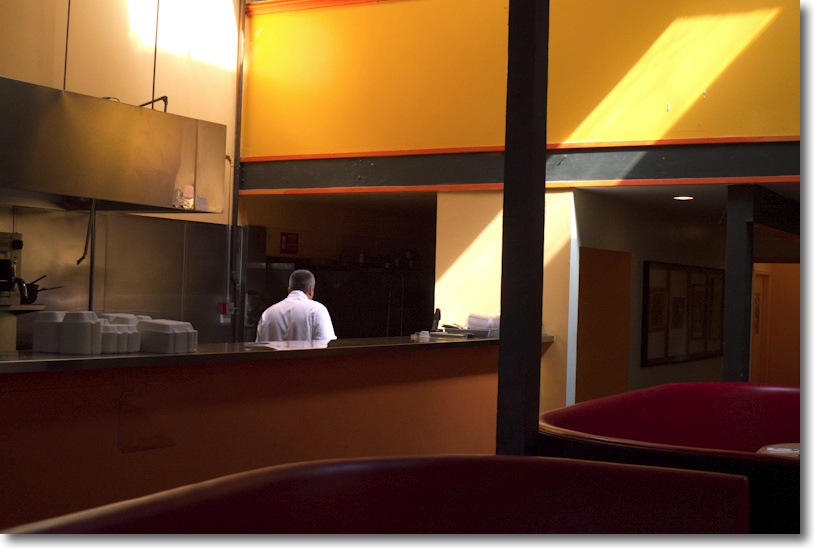
A shaft of sunlight.
At Third and Brannan Streets, San Francisco. G3, 1/400, f/4.9, ISO 1600.
In a large print the G3’s sensor confirms that it’s as good at ISO 1600 as the G1’s is at ISO 400, when it comes to a lack of noise.
A shaft of sunlight.
At Third and Brannan Streets, San Francisco. G3, 1/400, f/4.9, ISO 1600.
In a large print the G3’s sensor confirms that it’s as good at ISO 1600 as the G1’s is at ISO 400, when it comes to a lack of noise.
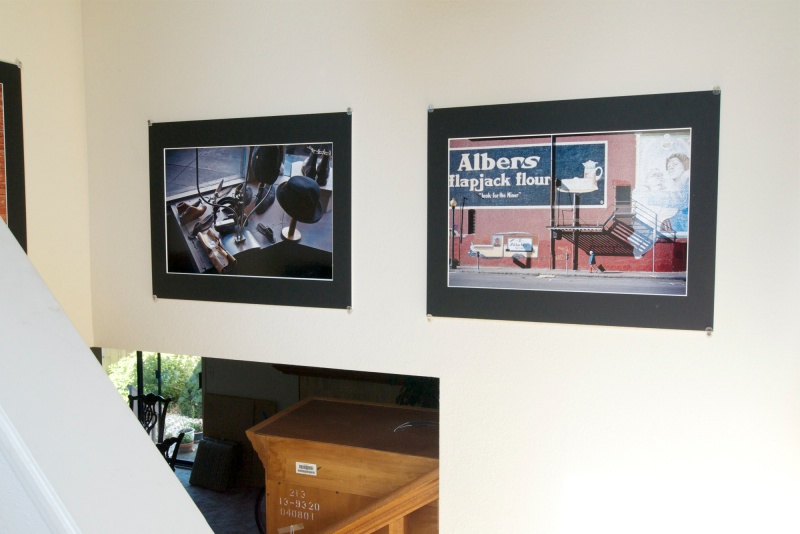
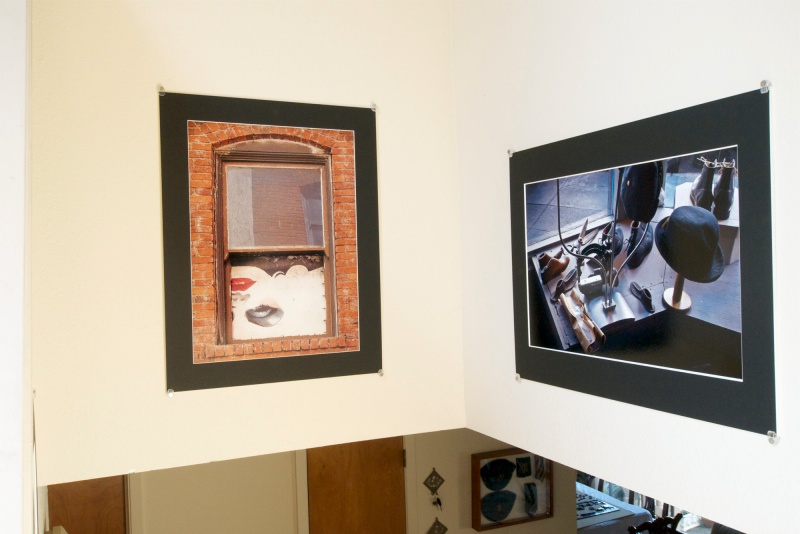
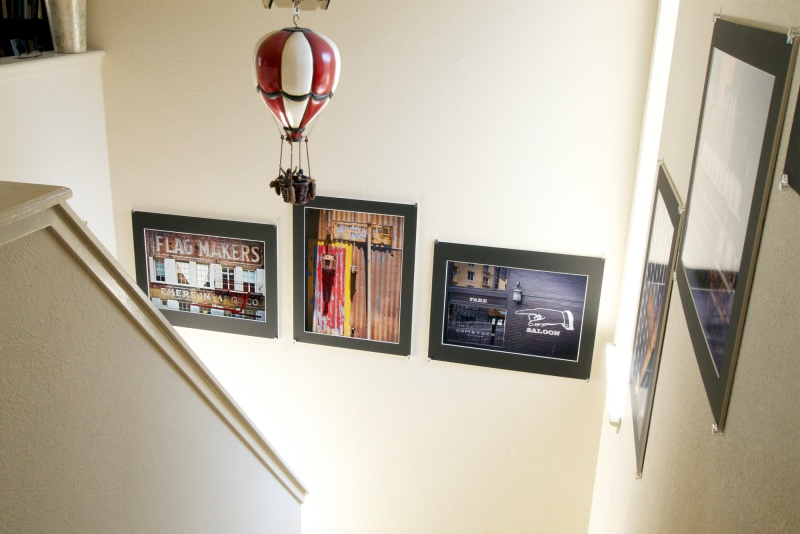
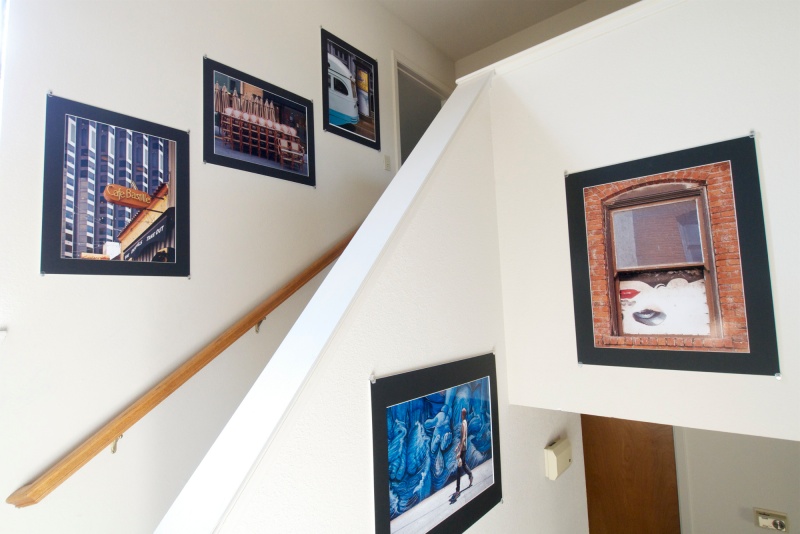
A few prints later, and the gallery is done.
I wrote about an inexpensive way of displaying large prints in a professional manner here. After satisfying myself that this worked well and did not fall apart after a few sun cycles (a daily occurrence here in California, not known to residents of England and northern Europe ….), I got at it and ran off another nine 16/18″ x 24″ prints on the HP DesignJet (a company now permanently stuck on stupid). After mounting them all that was left to do was to wait on Documounts to deliver the required mats. Paper used is HP Premium Plus Glossy. Some speedy work with 3M Double Sided tape to fix the mats in place, a spirit level, measure and hammer, and 90 minutes and 36 mirror retainers later all was done.
All of these were taken in the last year in San Francisco, their recency based in the simple philosophy that if your latest pictures are not your best you should quit the hobby.

Cobbler’s display in North Beach. Mural at Capp and 16th Street.

Woman in the window in an alleyway in the Business District.

Mural behind the W hotel at 3rd and Howard. Rusted wall at Dogpatch. Comstock Saloon on Columbus Avenue in Little Italy.

Mural (lower) off 24th Street. Café Bastille on Belden Place in the Business District. Chairs on Maiden Lane and tram at the Ferry Building.
Hopefully all of these will have changed a year hence, or I’ll be doing needlework in my spare time and you can buy my photo gear. All snapped on the Panasonic G1 using the kit lens or the Olympus 9-18mm wide angle zoom.
Meanwhile, the thrill from walking up the stairs and recalling the exact circumstance of each picture is really quite something. Even in our modern LCD digital world, there’s nothing quite like a nicely displayed wall print.
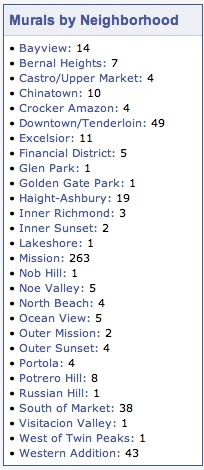
Several of these snaps involve murals or wall art. If you are in San Francisco and want a good guide to the city’s many murals, click the picture below:
Click for the SF mural guide.
A worthy iPad photo magazine.
The cover of the inaugural issue. Click the picture,
The first issue of ‘Once’ for the iPad is available as a free download from the AppStore and it’s something I suggest you get. The magazine does everything right in contrast to the BJP which does just about everything wrong.
First, it downloads fast and loads quickly.
Second, content is limited to three photo essays, some with nicely integrated sound clips.
Third, navigation is excellent – intuitive, direct and simple. Everything about this says “Designed for a touch tablet”.
Display quality on the iPad is as good as it gets – just like looking at Kodachrome slides on a light box.
The magazine is a sort of modern LIFE, with traditional high quality photography accompanied by excellent writing. True photojournalism. There are no advertisements and no equipment reviews. The focus is on the pictures and the story.
The first issue has articles on the dispossesed people living in the no man’s land between Russia and Georgia in the aftermath of the hostilities there; on the last suvivors of an ancient lifestyle in Greenland – this piece is quite special; and on a retirement community in Arizona. Typically these include a 5 page essay and 20 photographs. Unlike with the BJP, there is no bloat so there are no attention span issues, nor is there any frustration in finding things.
Recommended. Let’s hope it’s published more than its title suggests.
Update August 24, 2012:
Sadly, as the following email indicates, Once has folded after just 11 months:

Seems it’s pretty much impossible to make money at these things.
Amid the bustle.
While my snaps of cities are invariably taken during the hustle and bustle of a busy day, I tend to seek out silence and maybe a lone figure, to better show the beauty of a scene. Here are two examples. The first is near Mission Street:
In the spirit of Ambrose Bierce a friend writes:
“I can almost smell that big city, late afternoon, breezy smell, with that old immense highrise feel shrinking you down to size. Shadows and dazzling edifices reaching for the sky…..and, at the bottom, a boutique dress shop and the Wing Yap Noodle Factory.”
Ambrose Bierce Street, SF, named after the American satirist. Also known as Aldrich Street.
Looking south toward Annie Street. G3, kit lens @17mm, 1/250, f/5.6, ISO 320.
The second is on lovely Leidesdorff Street in the Business District:
G3, kit lens @ 42mm, 1/400, f/5.6, ISO 320.
The G3’s sensor does a lovely job here, rendering an especially full, creamy tonal range.
Beyond impressive.
I finally corrected a major omission in my visual history of San Francisco. At last I went inside City Hall and I must say the experience was simply overwhelming. While the present 1915 structure is smaller than the original which was destroyed in the 1906 earthquake and fire, its proportions are far more pleasing. The dome is one of the largest in the world and, as befits America’s most productive state, the building is taller than the Capitol in Washington DC. The floor space is some 500,000 square feet; Buckingham Palace, by comparison, is over 800,000 square feet. It looks like several marble quarries were called into service in its construction and the quality and condition of the building are breathtaking.
As befits a great democracy, access is amazingly easy. You have your bag checked and pass through an airport-style scanner and that’s it. You are free to wander wherever you want and no one hassles you if you take pictures. As luck would have it someone was having a marriage celebration during my visit, and the sound of Vivaldi lofting into the great cupola while I gazed on in awe made for a wonderful visit. I made my way up many back staircases and engaged several City employees in discussion, finding them to be invariably helpful and as thrilled to be there as was I.
All the interior snaps were made on the Panny G3 at ISO 1600 in RAW format. The G3 has two incredibly useful click-stop settings on its mode dial – C1 and C2. I have both set for aperture priority with C1 at ISO320 and C2 at 1600, making switching simplicity itself. No need to dive into fiddly LCD menus. Compared with the G1’s sensor I estimate the G3 is not one but two stops finer grained – ISO 1600 is close, as regards noise, to ISO 400 on the G1, which is pretty amazing. I switched on that auto dynamic range control in the G3’s menu (a feature not available in the G1) and it did a fine job of taming some of the extreme contrasts on what was a very sunny day, with sunlight pouring through the windows. No need to mess with multiple exposures and HDR techniques. The following snaps are mostly straight from the camera, converted from RAW to JPG in Lightroom 3.5 RC.

Beaux Arts magnificence.

Looking down into the main hall.

Gorgeous light on one of the second floor landings.

A third floor corridor. Acres of marble.

Looking down on the grand staircase from the first floor landing.

A view across the main hall.

All ages come to visit.

Lovely architectural details which even Piranesi would admire.

Rear of a second floor landing, light streaming in.

Marriage ceremony on the second floor balcony, opposite the main staircase.

Memorializing the visit.

One of the staircases.
All snapped on the G3 with the 14-45mm kit lens at ISO 1600 (except for the exterior which was at ISO 320), all interiors at full aperture and handheld.
If you find yourself in San Francisco, take some time to visit this special building.
Other domes of western civilization worth a visit? Start at the top – Michelangelo’s St. Peter’s Basilica in Vatican City – Bernini’s spherical original stretched just so by a wizard, transmuting the ordinary into the magical. Brunelleschi’s Cathedral in Florence – was anything more perfect ever built? One of the great meldings of art and engineering. Then the Pantheon, I suppose, if bigness is your thing. And St. Paul’s in London, remarkable for its light airiness from a nation more given to the lugubrious in its architecture. And, frankly, it would be unfair to exclude City Hall from that short list.
Original City Hall destroyed in 1906. Note the ungainly proportions.