Finally a solid field test.
Flowers? Fughedaboutit! I don’t do flowers. Millions do, all better than me, so why bother?
Give me a choice between Yosemite and the local workshop (mine!) and the latter wins every time. Used motor oil smells far nicer than all that foul fresh air. And flowers.
So when it came to find a serious subject for my macro rig, I would have to suggest that that posits the issue backwards. I bought the rig because of my intended subject, rather than having to go in search of something to macrosnap (my word!). And given that I’m an engineer by graduation and a mechanic when time permits, it can hardly come as a surprise that my object of choice was the machine. Or machines, to get it right.
Those poor deprived masses who have never attended a motor race are missing three things, only two of which can be recreated in the home theater. Sight and sound. But unless Nintendo is about to perfect it – quite possible given the genius of the Wii – you cannot get the third, the missing ingredient. The smell. You have to go to the races to enjoy that. Same with horses I suppose, though I never trust anything which eats while you sleep and lacks a gearbox. And let’s face it, horses stink.
Thus Tuesday found me at Laguna Seca, not 2 hours north of the old estate which I call home, in the paddock, surrounded by some one hundred vintage race cars, from million dollar Ferraris to plain vanilla Austin Healeys. As a design maven I’m generally more fixated on the unity of form and function than I am with speed on the track, so my happiest times are spent in the paddock. As this is an amateur event, the teams are very friendly, and only too willing to show off their machines. You can get close to anything with no questions asked.
While the hand-held combination of Canon 5D/100mm Canon Macro lens/Ring Flash looks cumbersome, it is, in practice, very easy to handle and with the 5D’s magnificent autofocus most of your attention can be devoted to the subject rather than the technology. In bright sunlight, which was the case at this event, the ring flash – inherently shadowless lighting – acts as a dynamic range enhancer by filling in the shadows. The circuitry in the 5D balances the natural and artificial light sources, so original shadows are preserved and not unnaturally duplicated (as would be the case with off-axis flash) and the whole thing becomes a printer’s dream rather than a nightmare. Just check the natural shadows in the snaps below.
It was simply striking in the extreme how all this automation frees the photographer to focus on the subject. After several dry runs at home, my confidence level was such that I never once felt the need to consult the LCD screen on the 5D after the first snap. Unlike Apple hardware, It Just Works. Thank you Canon and thank you El Cheapo Chinese aftermarket manufacturer of the ring flash.
After some two years I have got sick and tired of all those landscape prints decorating the garage, so I reeled off a dozen of these on the HP DesignJet 90 and will have them mounted and framed by the weekend. As I write this the last few are rolling out to the accompaniment of the merry clack-clack of that wonderful printer and the foul smell with which HP sees fit to invest its printing inks.
Technically there are actually quite a few limitations. First, your shutter speed has to be 1/200th or slower to accommodate the 5D’s needs. Second, if there’s any depth in your subject you really need to stop down if you want things sharp all over. Third, because you have to use slower shutter speeds, in bright sunlight that means cranking down the ISO to 50 or 100. I found myself wishing more than once that the 5D had what I call a Kodachrome 25 speed. You know, ISO 25. Really slow. Finally, while the 100mm macro gives you nice lens-to-subject distance, you will struggle getting a parallel plane relative to high horizontal subjects. (Reread and work it out! It means standing on tiptoe ….)
Here are a few of the snaps whose primary goal was to focus on the abstract beauty of man-made machines.
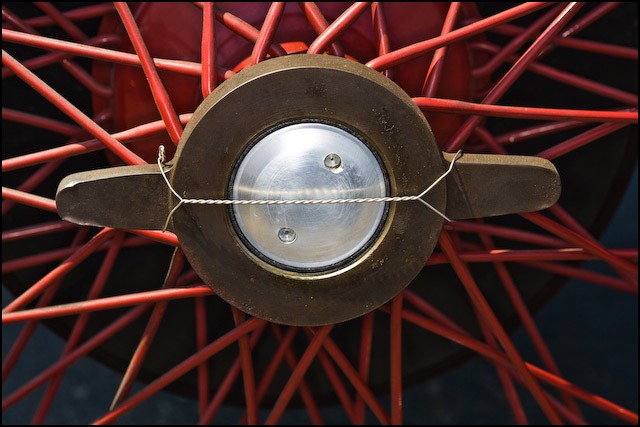
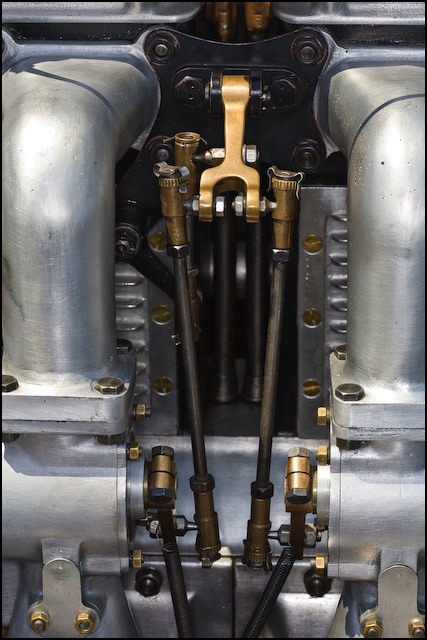
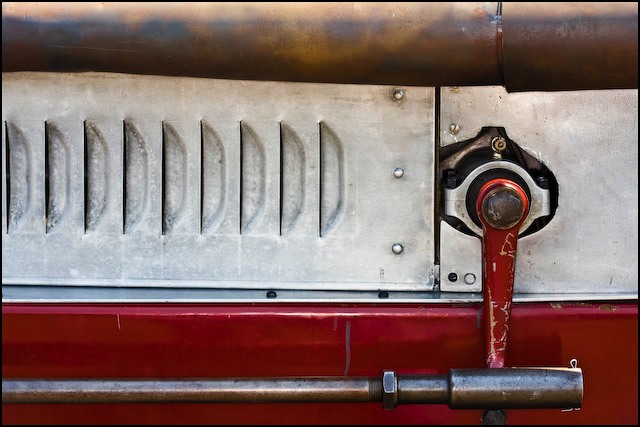
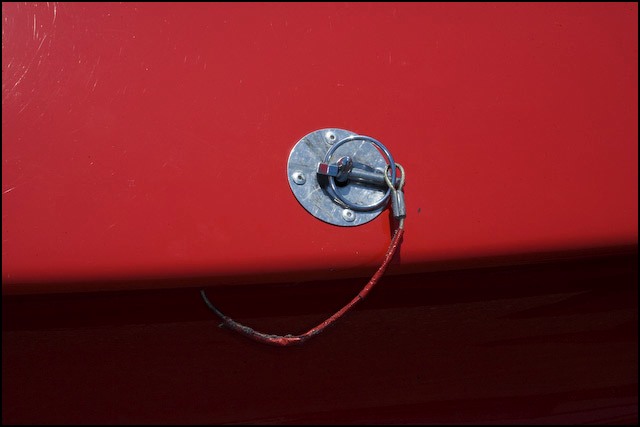
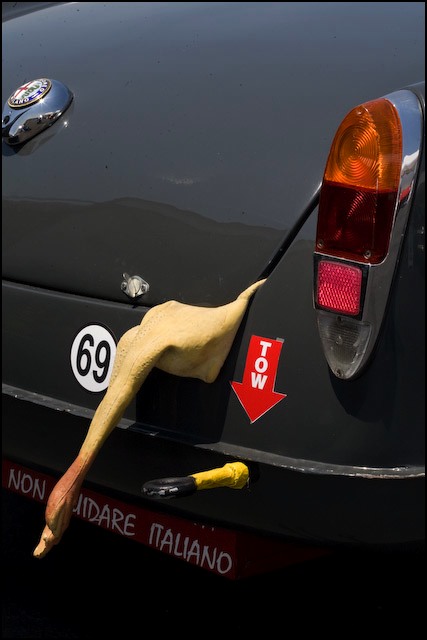
What of the quality of the originals? My rejects were deleted owing solely to composition issues, never because of a lack of sharpness. As I use shutter priority (to avoid going faster than the maximum sync speed of 1/200th) the 5D selects the aperture and this seems to have varied from f/4 to f/22, with ISO anywhere from 100 to 320. Regardless of the aperture used, the originals are critically sharp (after the usual sharpening of the RAW originals in Lightroom) and easily scale to 30″ x 45″ on the screen. And not a burned-out highlight to be found. Stick your nose in the dozen 18″ x 24″ prints I just made and your biggest risk is personal injury – your schnozzer is likely to sustain cuts from the incredible sharpness and resolution in the print. You could probably improve on this with a large format camera – 4″ x 5″ say – but the ergonomics and miniscule depth of field that gear suggests would simply make the rig unworkable.
On a closing note, I am constantly reminded of Charles Coburn’s line in Monkey Business when a very curvaceous Marilyn Monroe, as his secretary, exits the room to the adoring glances of Coburn and Cary Grant. Grant looks quizzically at Coburn who shrugs and replies “Anyone can type”. With this rig, “Anyone can do macro”.