Category Archives: Paintings

Without paintings we are nothing

No more cover-ups

Too funny.

This has to be one of the funnier examples of the overreach of regulations.

Could it really be true that cosmetics makers use the one ten thousandth of one percent of the world’s most stunning women, heavily made up, superbly coiffed, expertly lit, photographed by top dolllar image makers, to sell their make-up to the rest who are really largely beyond help?

Surely not?

What is even funnier is that the companies making these products feel they have to further enhance the results in post processing. Photoshop may be a no-no when it comes to news reporting, but in anything else I say “Have at it”. If the result sells more product or makes for a more striking picture, why not? What happened to caveat emptor? Every painter in the history of art has been a putative Photoshop user by editing at the creative stage. These modern digital artists simply do it in post production, just like Ansel Adams did it in the darkroom. (“Dodging and burning are steps to take care of mistakes God made in establishing tonal relationships”, though what God had to do with it beats me).

You really think that Raphael was telling it like it was to Julius III?
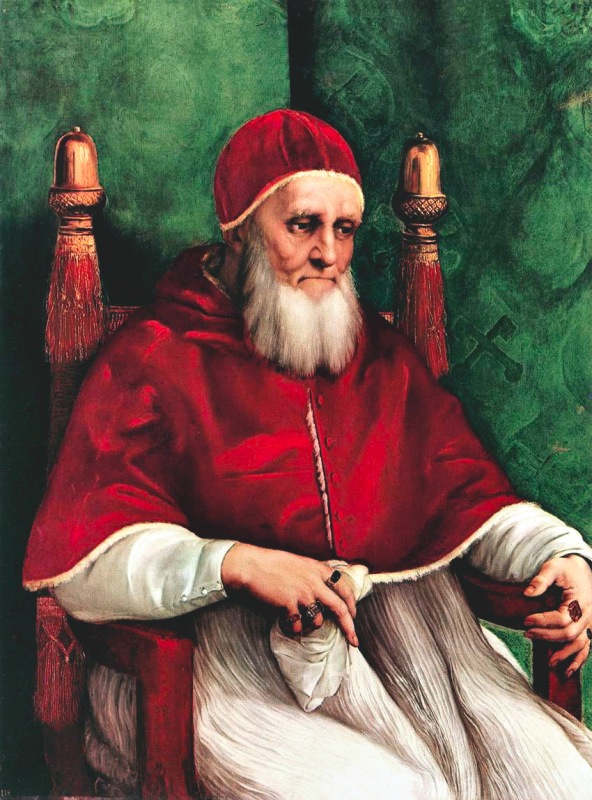
Raphael. Julius III, 1512.

My, but the old boy aged well. No liver spots on his pristine white hands, no syphilis sores.

Raphael wanted to get paid just as much as the photographer, art director and Photoshop maven responsible for the Cover Girl number.

Google Art Project

Exceptional.

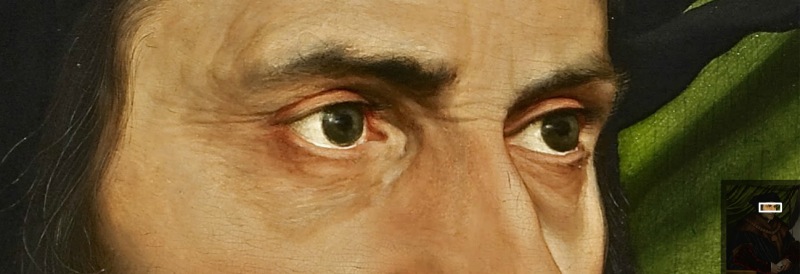
I make no bones about my dislike for Google’s ‘anything for a buck’ raison d’être but its Google Art Project, which has been around a couple of years now, is really special. You can wander through the halls of many of the world’s great art collections, manna for photographers and the visully inclined everywhere, and examine these at a level of detail and in simply stunning definition that no docent would ever permit, lest your nose make contact with the hallowed canvas in question.

Here’s a perfect example, Holbein’s extraordinary portrait of Thomas More in the Frick Collection in Manhattan:

Click the picture for the interactive site.

The extent to which you can zoom in, with the image refreshing for ever greater detail, is breathtaking.

MOMA NYC, The Met, The Uffizzi, The Frick, Versailles, The Hermitage – they are all there. Sadly, the Louvre is not.

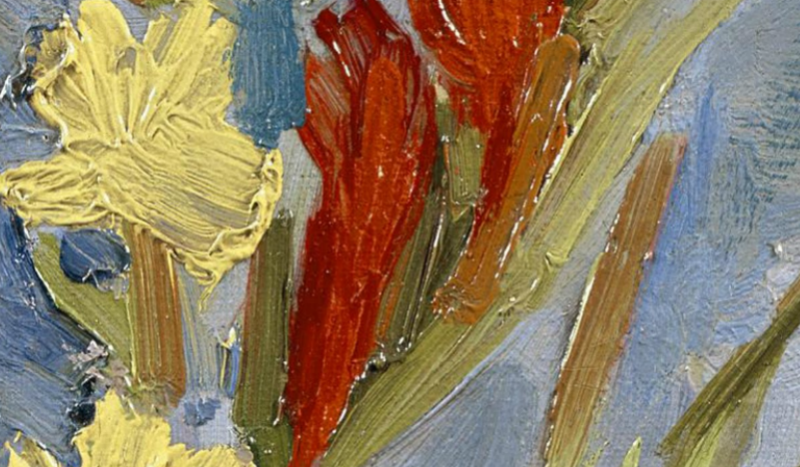
And you want to feel Van Gogh’s passion in his vase of gladioli? Look no further than his eponymous museum in lovely Amsterdam.

For many viewers these picture are simply too remote to be seen in person. You might argue that the Google Art Project experience is superior. You need Flash to view, so iDevices will not work.

Diptychs and Triptychs

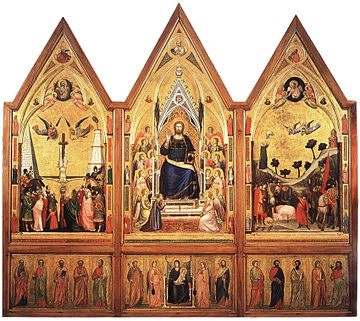
Giotto did these a while back, too.

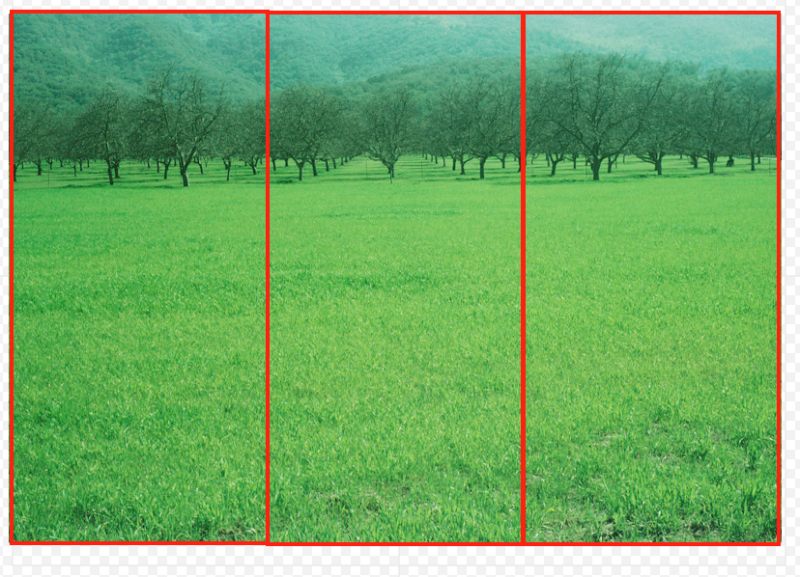
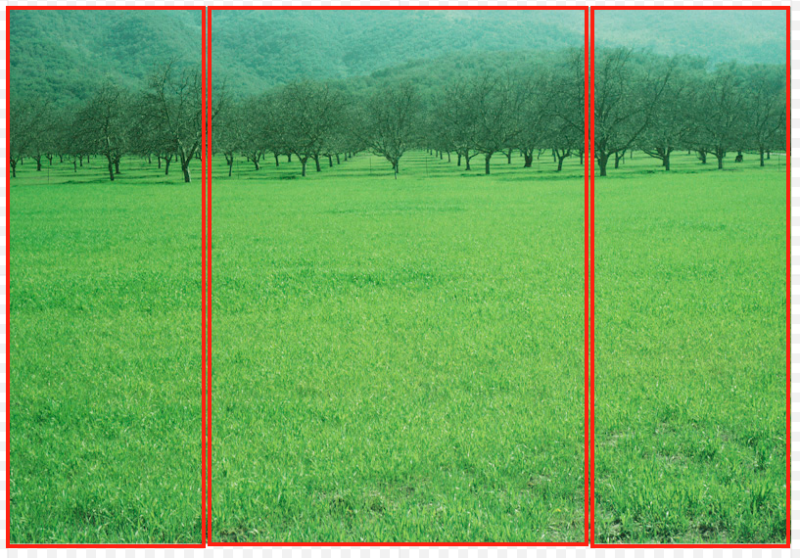
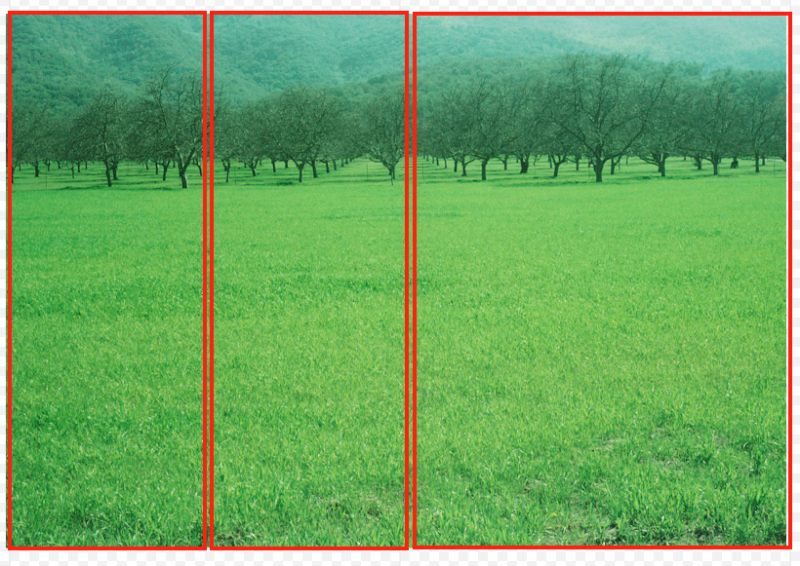
A friend having recently decorated a room, asked for something Big, Wide and Green for the wall, so I suggested the idea of a triptych.

Once we agreed on the snap I suggested some variations. The tool used to make the red outlines is Xtralean’s ImageWell.

In case you think this is original, that old dauber Giotto was doing this sort of thing some 700 years ago:

Giotto c. 1320.

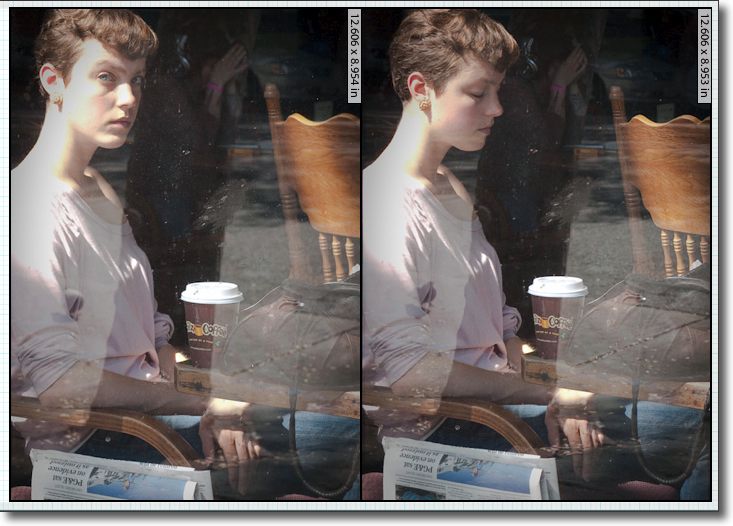
A related use of multiple images is to show two or more taken a brief moment apart. In this diptych I have used the Print->Custom Package function in Lightroom 3 to place two similar images next to one another, ready for printing on 13″ x 19″ paper. This is the serenely beautiful young woman I snapped the other day and wrote about here:

Diptych ready for printing in Lightroom 3.

Lightroom 2 could not place different images on one sheet, but if that is what you use search the web and there are simple code changes to the print template which will permit this, easily conferred with any text editor like TextEdit, which comes with every Mac.

Devorah Sperber

An unusual digital artist.

Mention of the Stein show at SF’s MOMA prompts me to add that a far more interesting show, with insights into Stein’s collecting, writing, sponsorship of artists and friendships with photographer, is to be seen at SF’s Contemporary Jewish Museum.

The size of the show is far more manageable than the overblown offering at MOMA and you come away with a better understanding of the woman and her work. While her writing is pure, undiluted crap, we owe her a debt of thanks for sponsoring so many struggling artists and photographers.

The fact that Stein continues to inspire contemporary artists is seen in the last of the five rooms of the CJM show and one of the pieces on display there is quite startling.

Detail View: “After Picasso,” 2006, by Devorah Sperber, 5,024 spools of thread, stainless steel ball chain
and hanging apparatus, clear acrylic viewing sphere, metal stand (104″-122″ h x 100” w x 60”- 72″d)

Sperver has done nothing less than recreate, on a large scale, Picasso’s famous 1906 portrait of Gertrude Stein. Her choice of pixels is ….5,024 spools of thread! Viewed though the small magnifying glass some feet in front of the spools, the compressed and right-way-round image of Stein is a perfect reproduction of Picasso’s masterpiece.

It’s easy for me to say that anyone could do this. Simply create a look-up table for the colors of each pixel on your computer then order $30,000 worth of spools of thread. Tell your nine year old to assemble it according to your table and there you have it. All you need add is a $5 magnifying lens. And just imagine the image taking to life as your child gradually assembles it!

Simple to say because I didn’t think of it and neither did you. This is a different kind of digital imaging.

You can visit Devorah Sperber’s web site here.

One Magic Second

Just divine.

One Magic Second.

Date: July 2, 2011
Place: 24th and Folsom Streets, San Francisco
Modus operandi: Loitering about.
Weather: Fabulous morning light.
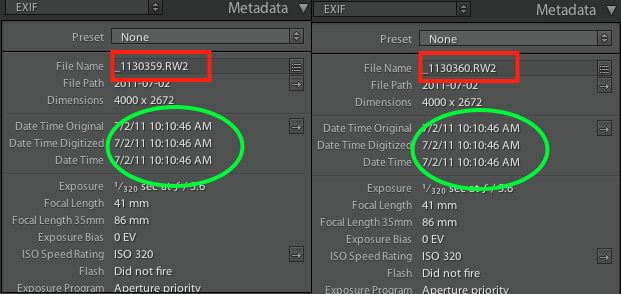
Time: 10:10:46 and 10:10:46
Gear: Panasonic G1, kit lens at 86mm FFE
Medium: Digital
Me: Creating an indelible memory
My age: 59

Our boy has been taking cartooning lessons at the Sirron Norris studio on Valencia in the Mission District. Sirron is a marvelously talented cartoonist and his work is to be found on murals all over the Mission District. As he relates it, the only thing he recalls wanting to do as a child was to draw, and his vocation has become his profession. While Winston labors away under Sirron’s watchful eye, I traipse around the area hoping to catch a snap or two of the vibrant street life that is everywhere. Truly, few square blocks of San Francisco so abound with possibilities as do these.

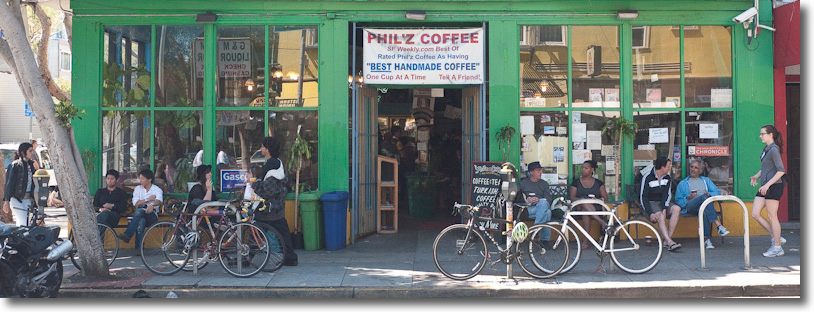
Phil’z Coffee at 24th and Folsom is very much at the center of Mission District culture. On any morning you will find the locals gathered for a cup of joe and some gossip. And, if you get lucky, you will see some beautiful people there.

Phil’z Coffee at 24th and Folsom Streets. G1, kit lens @ 23mm, 1/500, f/4.7, ISO 320.

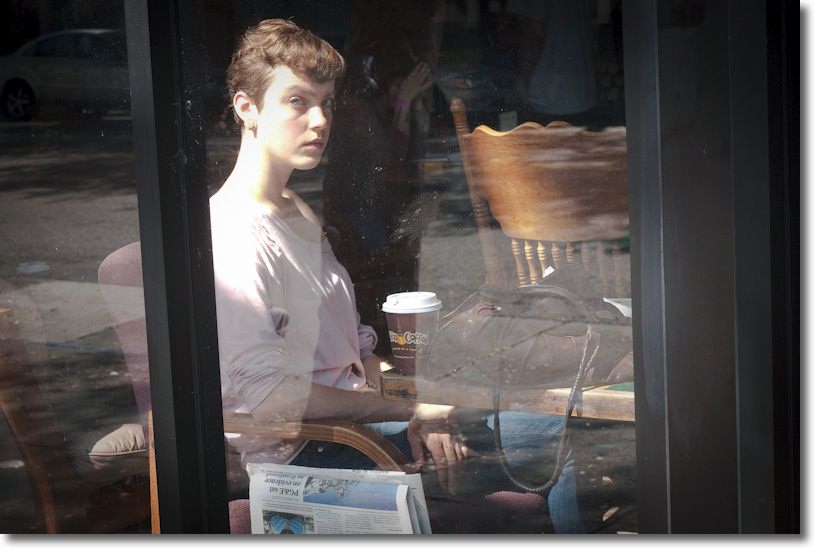
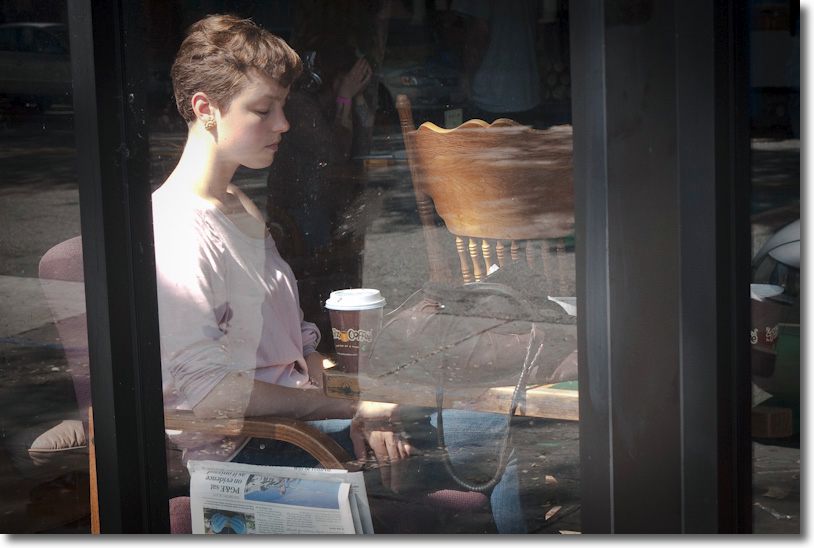
I was meandering along 24th Street yesterday morning and idly turned the corner onto Folsom where my eye was instantly drawn to this serenly beautiful young woman, posed as if for Titian and his oils. She saw me raise the camera deliberately to my face, gazed back at me untroubled and unthreatened, then looked down, lost in thought, the morning sun outlining her swan-like neck. The magic moment was over so quickly I found myself wondering if it had really happened, yet the processed film suggests it did. This is the sort of thing any street snapper absolutely lives for. Literally, One Magic Second.

Swan Neck. G1, kit lens @ 41mm, 1/320, f/5.6, ISO 320.

So fleeting was this moment that a check of the EXIF data for the two snaps shows both were taken within the same magical second of time – 10:10:46 am, July 2, 2011.

This sort of thing used to be the province of the rangefinder Leica but, frankly, that camera’s antiquated, slow manual focusing could scarcely be a worse choice for the modern street snap genre. Quite why anyone buys these anymore leaves me mystified – too slow for street snaps, no zoom lenses, too limited for anything else and silly-priced. Doctors and dentists, I suppose. Or should that be hedge fund managers?

Update: I shared these snaps with a friend who writes eloquently:

“That look…… the right half shows the shyly flattered contentment …(wild inward pleasure)….at being considered actionably photogenic.”