Feature enhancement.
Background:
Manual Nikkor lenses lack a CPU, distinguished by 5 (AF D lenses with aperture ring) or 8 (AF-S G lenses with no aperture ring) electrical contacts on the back of later lenses. The CPU (really just a simple EPROM, hardly a CPU) confers a lot of modern functionality on the hardware when the CPU’s contacts meet like connectors in the body of the camera.
Advantages of a CPU:
- Correct automatic recording of lens focal length in EXIF file data, except for zoom lenses.
- EXIF data for focal length is posted in a searchable field in Lightroom, unlike the case where a non-CPU lens is keyed in manually.
- The limitation on nine non-CPU lenses keyed manually into the camera’s body disappears.
- The user cannot forget to dial in the right lens, as is the case when using non-CPU lenses. Correct EXIF data are assured.
- Lenses which focus incorrectly, as indicated by the focus confirmation light in the viewfinder, can be fine tuned for optimal focus.
- Ai and Ai’d lenses can be set so that aperture control reverts to the aperture ring on the lens, not the control dial on the camera, permitting correct exposure in ‘A’ and ‘M’ modes. ‘P’ and ‘S’ modes require the lens be set to its minimum aperture and control reverts to the body, but correct exposure in these modes is not guaranteed, owing to the non-linear design of the aperture cam.
- Ai-S lenses can be set so that aperture control is either with the aperture ring on the lens or the control dial on the camera, permitting correct exposure in ‘A’, ‘P’, ‘S’ and ‘M’ modes. ‘P’ and ‘S’ modes require the lens be set to its minimum aperture and control reverts to the body; correct exposure in these modes is retained, owing to the linear design of the aperture cam.
- Exposure automation is no longer limited to Aperture priority.
- Full matrix metering becomes available and I confess I am becoming a devotee given how good it is. Non-CPU lenses use matrix metering only if the ‘non-CPU’ lens data is entered using the LCD on the rear of the camera.
- Program and Shutter Priority exposure automation are added; non-CPU lenses support Manual and Aperture Priority only. Shutter Priority would seem especially useful for sports photographers.
- Focus lock is an option – the picture cannot be taken unless the lens is correctly focused when focus lock is programmed ‘On’.
- Enhanced fill-in flash capabilities are added.
- On ‘pro’ bodies like the D700 the Command Dial wheels can be used to set aperture (in aperture priority mode) in preference to the aperture ring on the lens, the latter being left at minimum aperture at all times, like with an AF D lens. I confess I prefer to use the aperture ring as I support the lens with my left hand from below, but it’s an option.
- A lens with CPU fitted permits the appropriate lens profile to be automatically applied on import in Lightroom 3/4/5 when using custom lens profiles.
- Certain earlier Nikon DSLRs, which do not provide auto exposure when no CPU is fitted, will now do so, allowing the use of MF lenses on these bodies with full exposure automation.
- One reader has reported that chipped lenses (programmed on a D700, for example) can be used with bodies – such as the D40 – that don’t allow input of non-CPU lens data.
- Bodies with electronic aperture readouts in the viewfinder which do not otherwise report the aperture to which the lens is set will now report it if aperture control is passed from the body to the aperture ring on the lens.
I am a huge fan of early Nikkors – Ai and pre-Ai with Ai conversion as, in my opinion, the construction and operating ‘feel’ of these lenses have never been surpassed, and the optics are outstanding on my D700. They are generally incredibly inexpensive, too, with near-mint copies easily found. As I never use ‘S’ or ‘P’ exposure modes, the limitations on auto exposure for these pre-Ai-S lenses, above, do not trouble me.
What I am aiming to accomplish with these articles:
Having had a couple of really old Nikkors converted for AI operation on my D700, I began to realize some of the shortcomings of not having a CPU in those lenses, so I did some investigating. My due diligence disclosed that there is a substantial body of knowledge relating to updating old manual focus Nikkor lenses by adding a CPU, that this knowledge is not to be found in one place, and that a programmable CPU could be purchased for $30 from a Singapore eBay vendor. What I have done in this piece, and in the article which follows, is put simple instructions in one easily accessible place and added a substantial amount of detail based on my practical experience of installing CPUs in both Ai, Ai’d and Ai-S manual focus Nikkor lenses. I address aperture non-linearity issues in Ai and Ai’d lenses and how to avoid these. I illustrate the differences between aperture control approaches. All of this was done using my D700, but much of it likely applies to other Nikon DSLR bodies.
Finally, I integrate the CPU installation and programming process with the use of custom tailored lens correction profiles for use in Lightroom and Photoshop, as the icing on the cake when a lens with a CPU installed is used.
Who can do this?
Anyone with two hands, one eye, an MF Nikkor, $30, maybe a screwdriver and jeweler’s file/Dremel/milling machine, some patience and some glue can install a CPU in most MF Nikkors. An engineering degree is not required. Some exotic lenses like the 55mm/1.2 and Noct cannot be easily adapted as there is simply insufficient room to install the CPU. But most Nikkors can be easily converted.
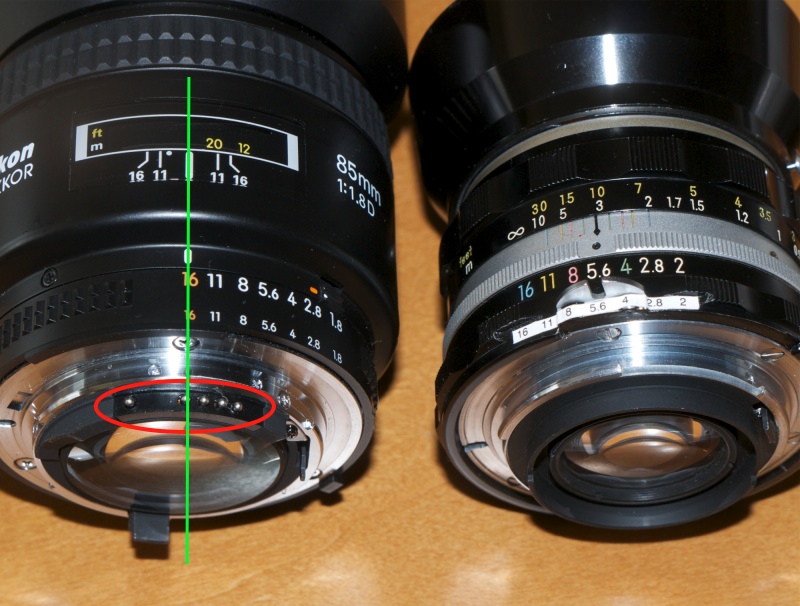
Red oval denotes the 5 CPU contacts on this AF D Nikkor.
Green line denotes alignment of the fourth contact on the CPU with the focus mark.
Non CPU Nikkor on the right; this is my 50/2 converted to AI operation.
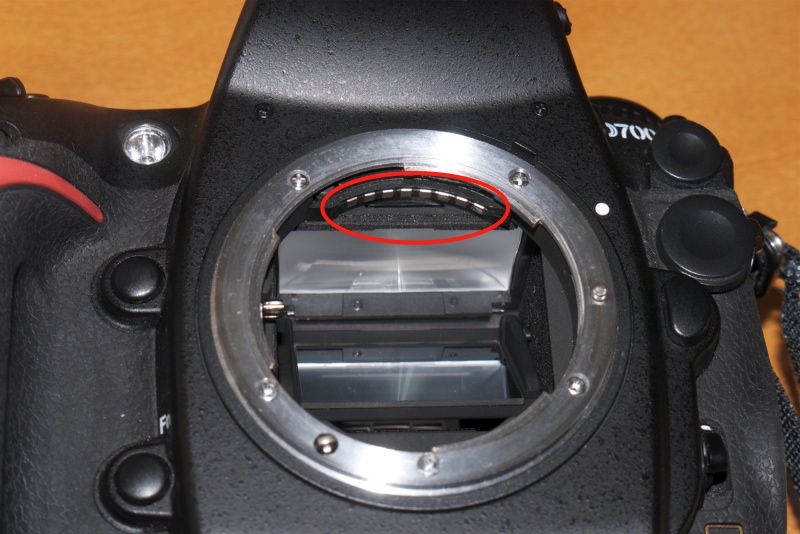
Corresponding contacts in the camera body. AF-S lenses use all eight; AF D use only five.
Source for the CPU:
Here is the information on the eBay seller – the price includes shipping. The reference to Leica in the listing is irrelevant:
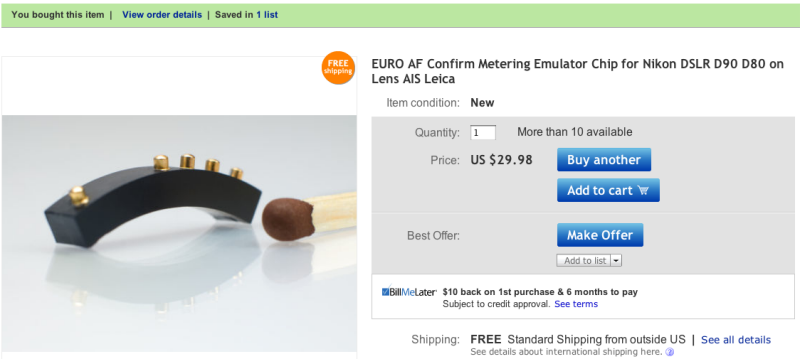

The vendor says that the CPU comes with an alignment template but if you follow this article all should be well even if you do not use it.
One reader advised this vendor is out of stock so try this one – look for ‘Dandelion Chip’. I do not know whether this Leitax CPU includes the ’60’ option to switch aperture control to the lens. If that’s important to you – meaning you are using pre-Ai-S lenses or prefer to use the aperture ring on the lens to the control dial on the camera – you should check before spending your money. See Part II of this article to understand what the ’60’ option does.
CPU alignment:
This CPU is simply glued into place on the rear of the lens’s internal barrel with the fourth pin aligned as shown by the green line in the picture above. However, the five contacts must not protrude beyond the periphery of the adjacent chrome bayonet mounting ring if proper fit in the camera’s body is to be assured. Likewise, they must not be too far recessed or no contact will be made.
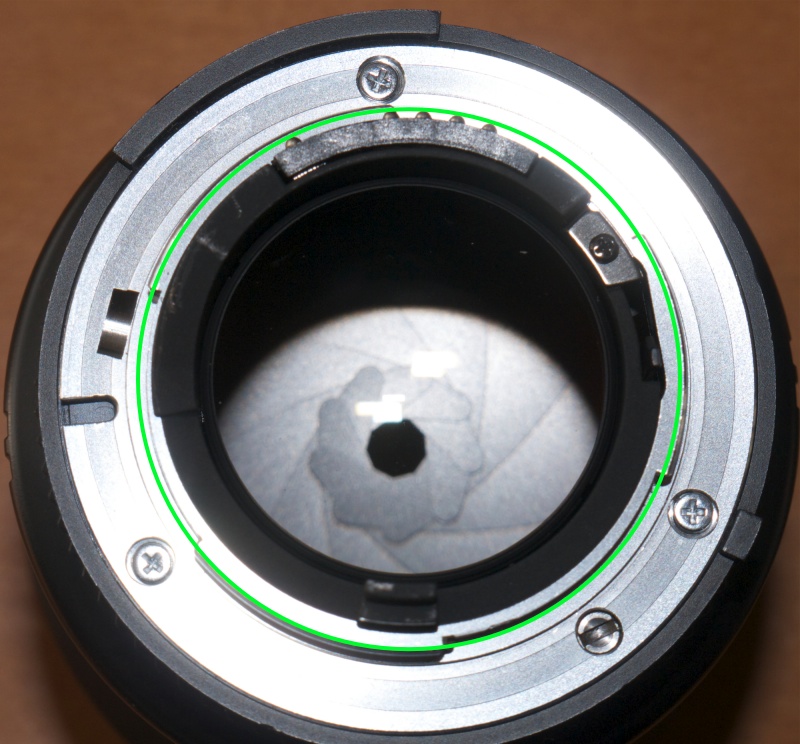
Green circle denotes correct protrusion of the five contacts.
This is on an 85mm f/1.8 AF Nikkor D.
So there are four scenarios:
- The contacts protrude just so when the CPU is positioned on the barrel. Just glue the CPU in place, aligned as shown.
- The contacts do not protrude enough. Glue a shim in place first to confer the appropriate stand-off, then the CPU, thus ensuring electrical contact.
- The contacts protrude too far, risking damage to the camera and/or CPU. Remove metal from the barrel to ‘countersink’ the CPU appropriately.
- There is insufficient room for installation of the CPU. (e.g. 55mm f/1.2, 58mm f/1.2 Noct). Delegate the job to an expert.
In the first two cases, no lens dismantling is needed. Glue only. In the third case, the internal baffle must be removed (generally requiring removal of three radial, countersunk Philips screws in the chromed bayonet flange), removing excess metal from the baffle with a Dremel cut-off tool, until the CPU is sufficiently recessed. It seems a modicum of material can also be removed from the base of the CPU but care is needed not to trash the CPU when doing this, so I do not recommend that approach. In the fourth case DIY is not recommended – seek out an expert. The idea of butchering a $3,000 Noct-Nikkor and getting it wrong is not one I want to contemplate!
Here are the key dimensions – the protrusion of the contacts and their distance from the outside edge of the bayonet flange:
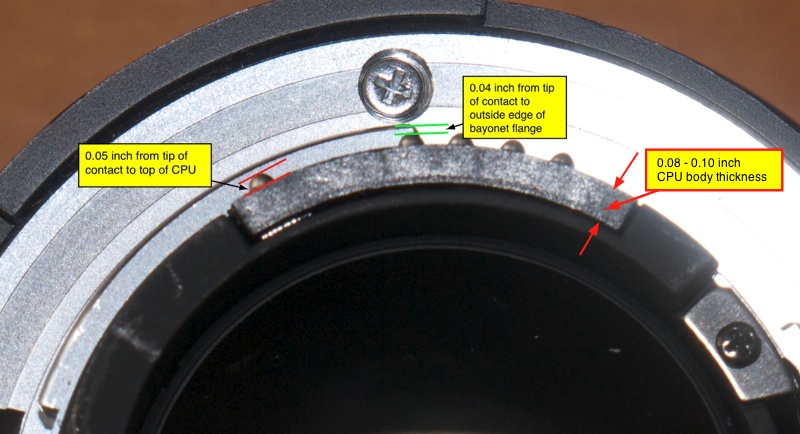
Dimensions, as measured on a factory AF D lens.
Here is the key longitudinal measurement – the contacts are centered between the green lines but, once again, it’s not that critical – look how broad the contacts in the camera body are, above:
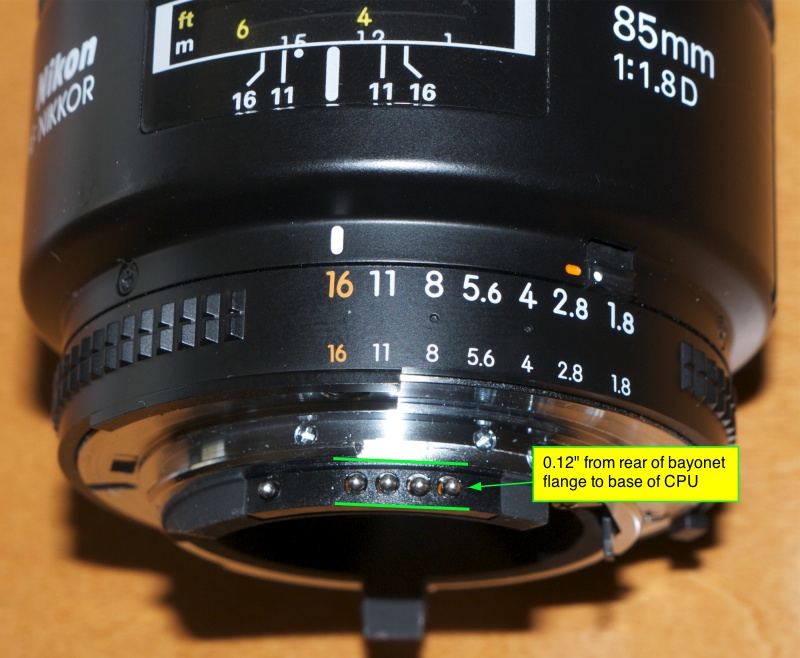
Longitudinal protrusion. Just look how shoddily made the CPU on this 85mm f/1.8D prosumer lens is!
Precision vs. accuracy:
I do not want to overemphasize the need for precision here. Reasonable accuracy is all that is called for. The contacts on the CPU are sprung for 0.05″ of travel, allowing for radial error, and as you can see from the above picture of the mating contacts in the camera body, you would have to be way off on axial placement to get it wrong. Looking at the above, if your Nikkor has 0.18″, give or take 0.01″ say, of clearance between the barrel and the outside edge of the bayonet flange, you should be able to simply glue it in place. Any less and you need a shim; any more and you will have to use a file on the barrel. As an example, my 50mm Nikkor-H of 1971 vintage measures a total of 0.16″, so 0.02″ of barrel would have to be removed before gluing the CPU in place.
General dimensional rule:
Based on my experience in adding CPUs to several lenses, any lens whose rear baffle external diameter is in the range 1.355″ through 1.426″ (34.62mm through 36.22mm) permits a simple glue-on CPU installation, with no need for machining. The ‘rear baffle’ referred to is the black ring protruding from the rear of the lens, inside the chrome bayonet mounting flange. Lenses with baffle diameters larger than this will need metal removed from the baffle to avoid damaging the CPU and/or camera’s contacts. Tow examples in my collection which needed such surgery – a few minutes with a Dremel cut off wheel and a file after removing the baffle – are the 100/4 Micro Nikkor Ai-S (1.621″ diameter – 41.17mm) and the 300/4.5 ED IF Ai-S (1.613″/40.97mm). Two others, the 28mm f/3.5 Ai’d and the 50mm f/1.4 Nikkor-S Ai’d are much trickier.
Choice of adhesive:
Which adhesive? I am no fan of Super Glue (cyanoacrylate). It is extremely dangerous should you get it on your fingers (two fingers become one), runs far too readily (though ‘gel’ consistencies are available) and has far too short an ‘open time’. I propose to use a two-part epoxy which has none of these drawbacks and also is far more reliable than the fussy Super Glue variants, working with a broad range of surfaces. The glue used must work with plastics and metal. The very last thing you want is for the CPU to become detached and get whacked by the camera’s mirror or trapped in the focal plane shutter, either scenario guaranteed to spoil your day. And what with the occasional whack from a rear lens cap when the lens is removed for storage, you really want this to last for the long-term, without having to baby it. Waiting 24 hours for the glue to cure seems like little to ask for peace of mind.
Programming:
The beauty of this CPU is that it is programmable using the camera! Once the CPU is in place, the lens is mounted on the body and the programming instructions are followed. The programming step serves to tell the generic CPU the maximum and minimum apertures of the lens and the focal length. Additionally, you can switch on focus lock (though I don’t see doing this with an MF lens) which will operate in ‘S’ shutter mode only, just as with any modern AF Nikkor. ‘C’ mode disables it.
This ‘CPU’ is a simple EPROM (Erasable, Programmable, Read Only Memory) meaning that if you make a mistake you can simply redo your work and your latest settings will be saved. The CPU has no variable or moving connections to the lens. It simply sits there, like a lump on a log, waiting to tell the camera body which lens it’s attached to, and the camera’s battery provides the power to do this.
Further, if your MF lens front focuses or back focuses (meaning the focus confirmation light does not come on at the optimal focus sharpness), you can correct for this when programming the CPU. For regular AF Nikkors you do this using the LCD panel and the Menu system. For CPU-modified lenses it’s done as part of the CPU programming step.
Non-OEM lenses and zooms:
The programming instructions are relatively well written and easy to follow. However, I hope to improve on them in Part II of this article, based on my practical experience. It is clear that Zeiss (and other non-OEM) lenses in Nikon mounts can be programmed to work correctly so long as there’s room to glue the CPU in place, but it’s unclear how one programs zoom lenses’ focal lengths. As the CPU is a passive device, it cannot report the correct focal length with zoom lenses, and there appears to be no way to state a focal length range in the programming instructions, so I expect I would enter the 75-150mm lens as ’75mm’ for identification purposes in EXIF data. Note also that my zoom is a fixed maximum aperture lens. I would expect that variable maximum aperture zooms would run into exposure problems as the CPU can only program one maximum aperture.
Coming in Part II:
To cut a long story short, I have ordered several of these CPUs and when they arrive I’ll write about my experience in installing and programming. As a first pass I’ll try it on the newly AI-converted 50/2 H, 105/2.5 P and 200mm f/4 Q as the barrels are easily accessible even without removal of the rear chrome ring on the lens, and I should be able to do a dry run to confirm positioning and programmability using just two-sided 3M Scotch adhesive tape (very carefully!) for a temporary fit. If all is well, epoxy will be the next step.
The CPU will not, of course, add AF or VR, but it does add a lot of value to some great classic Nikkors for little time, effort and cost.
More in Part II.