A painting that would not exist without photography.
In 1980 I had just moved to New York. Dead broke. But that didn’t stop me from making my first visit, the first of many, to the Museum of Modern Art on West 53rd Street with but one goal in mind. To see the greatest anti-war painting ever created.
When Franco’s fascists recruited the Nazi war machine for a trial run in killing innocent civilians in 1937, it was a photograph in the Times of London that spurred a famously apolitical painter to action.
Even the isolationist Times, which was the appeasement mouthpiece of British Prime Minister Chamberlain, couldn’t hush the story up, and was forced to run pictures of burning buildings and general mayhem in the paper.
Pablo Picasso saw the pictures and read of how one quarter of the town’s 7,000 inhabitants perished in a couple of hours.
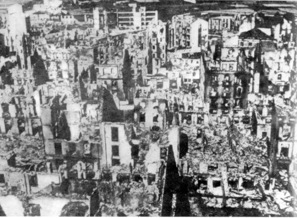
After the bombing, April 26, 1937
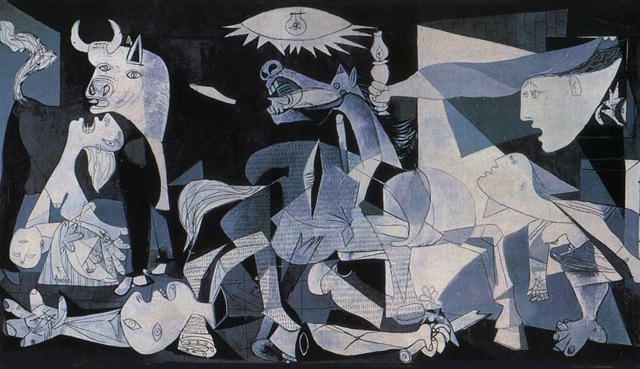
June, 1937. The Picasso.
MoMA did a pretty poor job of displaying the work, given its enormous size – some 23 x 11 feet. Only later did they add space but, by that time, Guernica was gone, back in Spain where it belongs. Picasso had sent the painting to New York for safe keeping until such time as Franco died, a happy event which finally took place in 1975. MoMA tried mightily to hang on to the piece – it was, after all, a huge money maker for them – but lawyers prevailed and it moved back home in 1981. Sadly, Picasso, who died in 1973 saw neither the death of the tyrant or the return of his work.
It remains the single greatest anti-war work ever and, had it not been for those photographs in the Times, may never have been painted.
Picasso, ballsy as ever, spent the war years in occupied Paris, with postcards of his master work in his apartment. When the Nazis harassed him, asking “Did you do this?” he replied “No, you did”.