At Fort Point.

The apertures are for cannon, long removed.
Nikon D3x, 135/3.5 Nikkor-Q MF.
Bigger is better.
When I wrote about installing a 4TB drive in the HackMini the other day, to store large Blu-Ray movie files, I added:
backup.jpg)
Well, it did not take long to admit I was wrong, and I have installed a second 4TB drive in the HackMini and given away all my Blu-Ray DVDs to friends. There’s nothing quite like direct access to a movie which has been stripped off all the junk they typically come with nowadays (sort of like Windows come to think of it, though the preferred path there is to avoid the product all together) and physical media deny ease of cataloging and retrieval, both easily added once the movie resides on a hard drive.
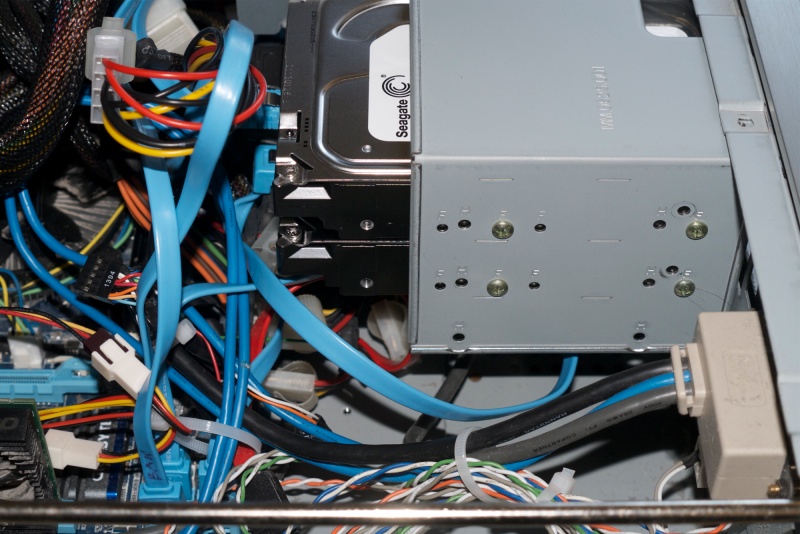
The cheapest 4TB drive currently at Amazon is the Seagate ST4000DM000, retailing at some $175 + tax. In fact you can get it in a USB3 enclosure for even less than that – $165!
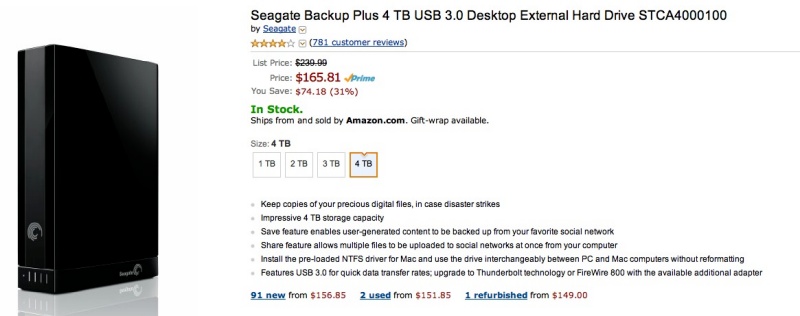
So if you need a 4TB internal drive, buy the boxed one and discard the enclosure. (A similar waste of materials applies to cheap and excellent Brother laser printers. Rather than replace the fuser at the end of its life, it’s cheaper to buy a new printer ….)
The full complement of drives driven by the HackMini:
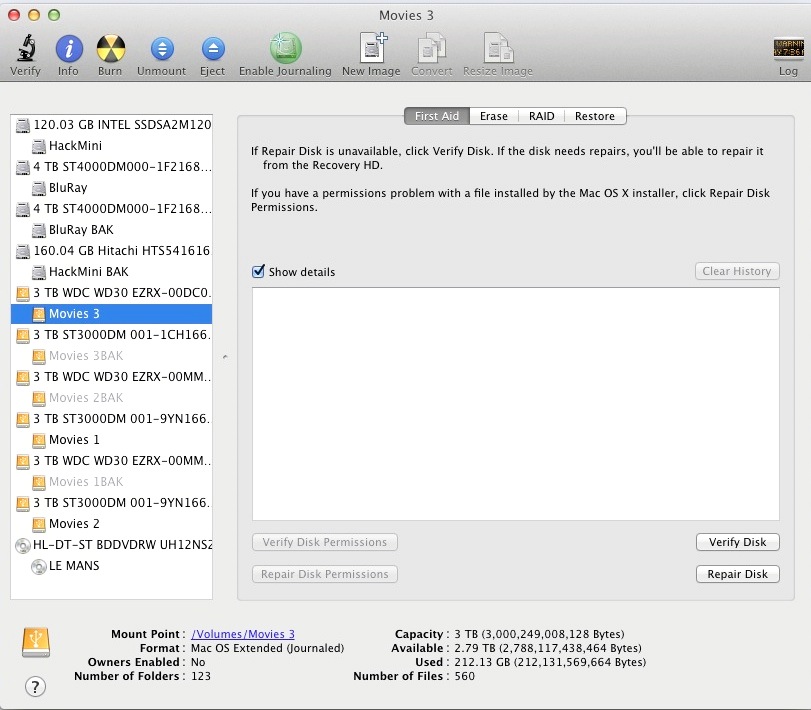
The six 3TB external drives reside in two Mediasonic boxes – with room for two more drives. The SSD contains the OS and Applications, with a small Hitachi notebook drive backing it up. You can see the Blu-Ray player at the bottom of the list.
The pricing per terabyte for 2, 3 and 4TB drives is identical. Reckon on $45 per TB. 1TB drives are no longer economical at $65. A few dollars more gets you double the capacity.
Now storing data on so large a drive makes no sense without an identical backup drive. The thought of losing 4TB is not one calculated to improve your sleep cycle.
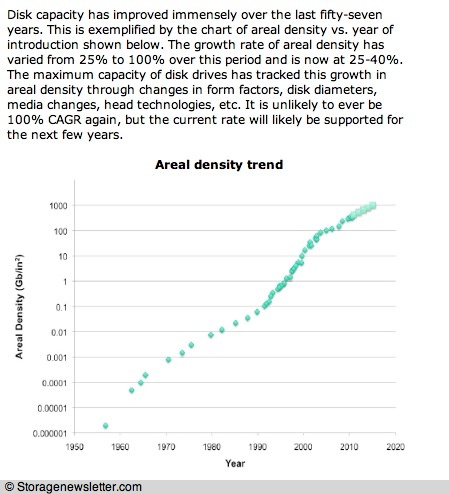
This piece gives a good overview of areal density trends in HDDs, suggesting we will be seeing 10TB HDDs – probably for a lot less than $45/TB – in 2-3 years’ time:
More than enough for all those D800 monster files!
I’ll report back in the event I have any reliability issues, but after one year of running four 3TB drives (2 Seagate, 2 Western Digital) in my Mediasonic box, I have not had one problem, so I’m optimistic all will be well.
Speaking of the excellent Mediasonic box, I can confirm that mine sees and formats the 4TB drives fine. By contrast, my ancient Aluratek drive cradle which holds a 1.5TB Time Machine drive for my main Hackintosh sees 3TB drives as 1TB and 4TB drives as 1.8TB, so it’s useless for these large HDDs. So if you propose using a 3 or 4TB drive in a drive cradle or older HDD enclosure, first check that the enclosure will work properly.
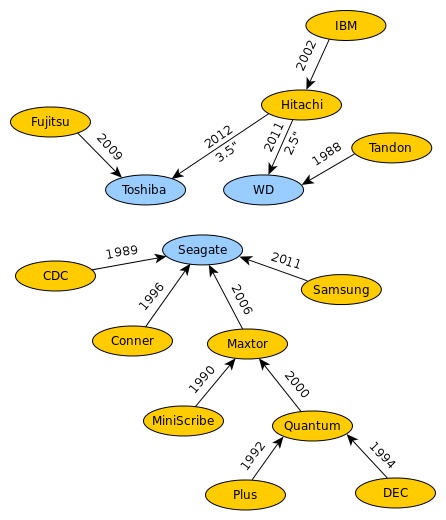
What is most disappointing is how slow Solid State Drives have been to reap economies of scale. These are generally from makers who have no legacy HDD business, so they have every incentive to innovate and improve. Yet at the time of writing, 1TB SSDs cost an arm and a leg – over $2,000 which is plain silly – and 500MB ones run $400-500, or $1,000 per TB. That’s twenty times the cost of HDDs. It seems that every time prices of SSDs drop, HDDs make another storage leap, keeping SSDs uncompetitive.
There are still great advantages to SSDs and all my three Hackintoshes use a small 64 or 128GB SSD ($60-90 today) as the start-up drive, containing OS X and applications. Start-up is so fast that there’s no going back to HDDs for this purpose, and while my Hacks run months on end, powered 7/24, the very fast application launching SSDs add makes them worthwhile. They run much cooler too, of course.
High definition at a bargain price.
These are the most exciting times for photographers, with 4K displays coming to market in the guise of LED TVs.
I wrote the other day of the $220 32″ Seiki TV I bought to replace two 21.5″ displays for my day job. Easily wall mounted it is working splendidly, delivering 1920 x 1080 (1080p) resolution, driven by my back-up economy Hackintosh using an ancient nVidia 9800GTX+ graphics card. The all in cost, with display, is some $1,000 and any failed part is replaceable same day – it’s called a short drive to Fry’s Electronics in Silicon Valley – with the costliest part being the $220 display. Try that with your iMac.
For comparison, the Retina Display in the MacBook Pro is 2560 x 1600. You can expect to see these on most laptops in the new future, as well as on the iPad mini.
Now a new breed of LED display panel is coming to market, generally referred to as ‘4K’, meaning 3840 x 2160 pixels, or four times as many as the current HD TV spec of 1920 x 1080. Sony will sell you 55″/65″ ones for $5-7,000 or an 84″ version for $25,000. But there’s no need to pay those silly prices when you can get the newly released 50″ Seiki – the same as the maker of my modest 32″ 1080P set – for much less:
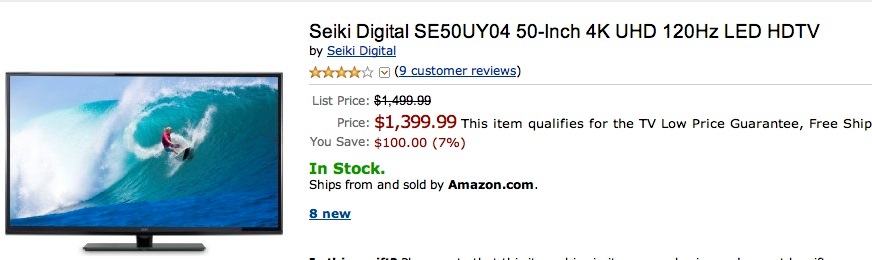
Weighing but 49lbs, it comes with three HDMI inputs and offers far higher resolution than the overpriced displays from the likes of NEC (whose 27″ 2560 x 1440 sells for $930) or the Dell’s like-resolution 30″ U3014 which is $1250. The Seiki offers almost 3 times the display area at 50% higher resolution for $150 more. Optimal photographic use would be to tile the display into two or four tiles to allow, say, Lightroom Loupe/Develop views, as well as Photoshop, all running simultaneously on the one big screen.
Now I very much doubt whether current PC hardware (by which I mean Hackintosh boxes, as Windows is anathema here, though feel free to check back when hell has frozen over) can deliver the 4K resolution of which the Seiki is capable, but there’s good news. Just yesterday, Anandtech ran an article profiling the first Gigabyte motherboards which will run the forthcoming Intel Haswell CPU ($300 for the i7), and we can expect to see these at Amazon within a couple of weeks, probably priced around $100-200, depending on the external connections provided. A related article discusses Haswell and its 4K capabilities, specifically focusing on Home Theater PCs. Their test saw them using the integrated HD4600 GPU which comes with the CPU, but I imagine that an nVidia GTX660 ($200) would provide abundant power to drive the 4K display with no issues. Indeed, they used the same Seiki mentioned above to prove this. Anand specifically state:
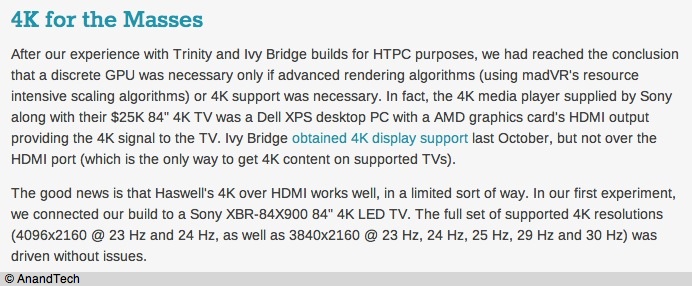
They mention some connectivity issues with the Seiki, but I’m confident it’s not something that will remain unsolved for long. Further, they go on to say:
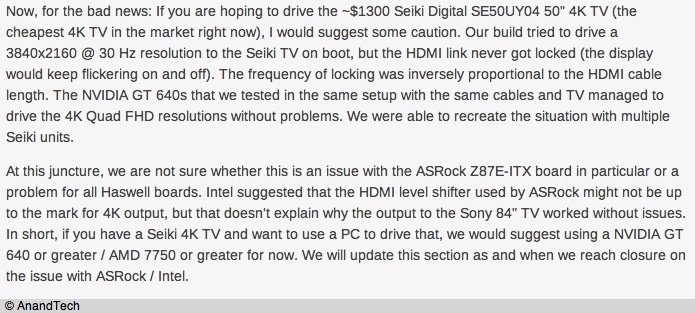
How does all this work for the Mac OS X devotee and Hackintosh builder? I believe we will see a new version of OS X, 10.9, at WWDC in a week’s time or maybe shortly thereafter, which will support Haswell. As for Gigabyte – the preferred motherboard maker for Hackintosh builders, those should be out by the end of this month and you can bet that the excellent software hackers at Tonymacx86.com will be all over the project in no time. These guys live for change! So things look promising, and the appeal of a 4K 50″ display for processing photographs is great indeed. Exciting times.
Will we see a >50″ 4K LED set from Apple in the near future? Who cares? I, for one, do not have the required $7,000 to blow on jewelry, especially when I can build something better for $2,300. Gizmodo has a review of the Seiki, but it’s written by 16 year olds for 14 year olds. You are better off with the comments at Amazon US.
4K on Blu-Ray?
Sure.

No smoking.

Panasonic G3, kit lens.