The world is full of meaningless rules.
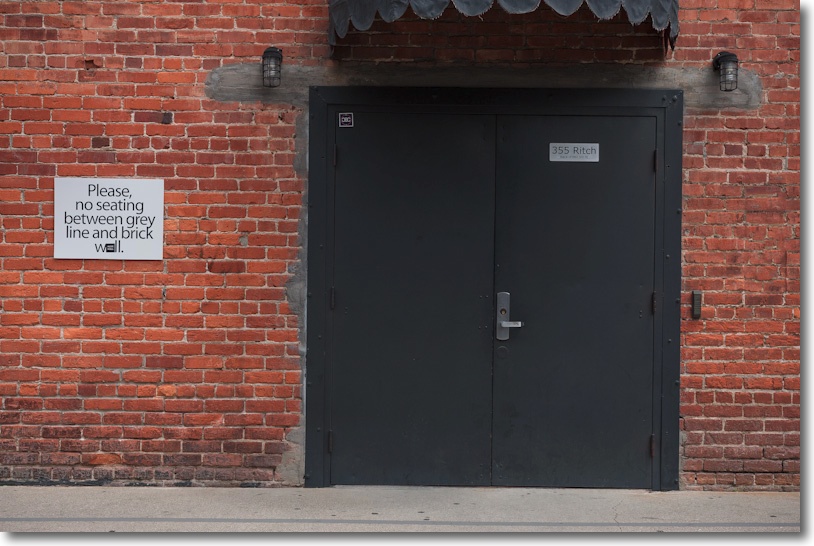
No seating. Click the picture for the map. D700, 50mm f/2 Nikkor at f/8.
I mean, really, who wrote that tripe?
The world is full of meaningless rules.
No seating. Click the picture for the map. D700, 50mm f/2 Nikkor at f/8.
I mean, really, who wrote that tripe?
Click!
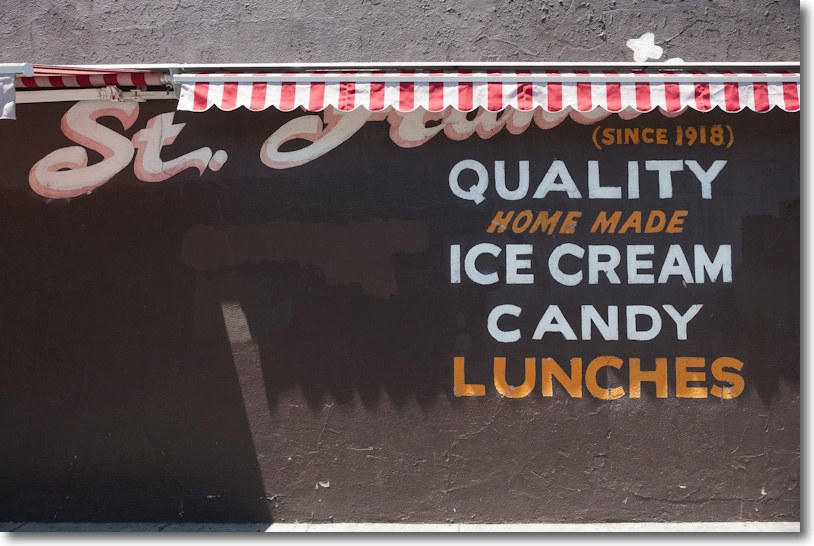
Off 24th Street, SF. 24mm, D700.
More of the same.
Microsoft Surface was a visionary product from Redmond, a decade ago. A huge table-style touch screen allowed icons and elements to be moved around by touch, and the whole thing was just so tomorrow.
Of course it was so good that it had to die; Microsoft has long known how to kill a good thing. Though there are many brilliant, innovative thinkers at Microsoft, neither skill has been in abundant supply in the corner office, occupied by a doofus whose only claim to fame is that not even he has managed to screw up one of the world’s great annuities – Windows + Office. The only other product which has sold in volume in the Ballmer years is the Xbox360/Kinect, emphatically not a Microsoft invention, and one whose profitability is a rounding error, so brutal is price competition in the game console segment.
For a long while I have refrained from knocking Microsoft in this journal as it has just become sort of assumed that anything from Redmond would be a costly time sink, and why mock the afflicted? But Microsoft’s latest just begs for a thorough thrashing, which it is my pleasure to administer.
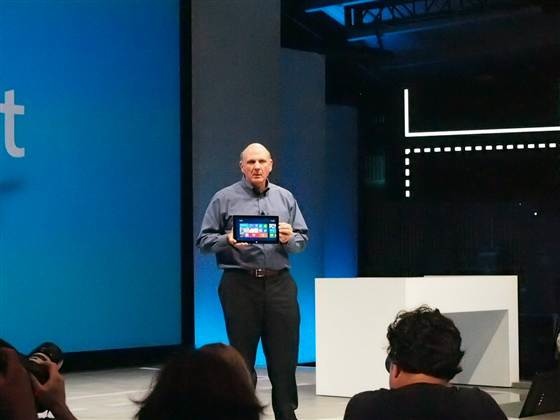
Doofus with his latest disaster.
I mean, goodness, must he really insist on demonstrating something he is clearly clueless about? Has no one at MSFT the courage to tell this emperor that he has no clothes? Imagine the management culture at a company which prohibits criticism.
You see, Surface is the name for MSFT’s new line of tablets. Yes, the same tablet which Doofus was knocking (in this case, knocking on) two years ago. That was just when MSFT’s previous tablet effort was scrapped. And there’s little reason to think that the new one will last any longer. Goodness, they couldn’t even make up a new name for the product.
Each iPad comes with bullet proof software, iOS, robustly interlinked Mail, Scheduling, Address Book, etc. through iCloud, and a vast ecosystem of hundreds of thousands of applications developed over many thousands of man-years.
Now look at MSFT’s offering. First they are offering the tablet with two completely different CPUs – ARM and Intel. Eh what? Lucky developers having to craft apps for that. Then they come with plain, touch or type keyboard covers. There are two sizes – 32 and 64gB. And while they are mum on cellular, you can bet they will have to offer at least two carriers in the US, in addition to wi-fi only. And of course they come with a stylus, presumably because the touch interface is so poor there is no alternative.
And this from a manufacturer whose experience in hardware is largely limited to making mice and has little skill in complex hardware supply chain management.
Oops, did I mention applications? Ummm, no, there are none as of the time of writing.
Worst of all, the Surface Mk.2 runs Windows. Two different versions, no less. That spells DOA to me. And by the time these things hit the stores, if they ever do, iPad4 will have been released, instantly obsoleting whatever claims to currency Surface2 may have made.
So thanks, Microsoft, for reinforcing my disgust in you and confirming my decade old decision never to touch one of your foul products again. Apple may make mediocre, overpriced PC and laptop hardware, but OS X and iOS are robust as they come, the iPad is insanely great, and the whole ecosystem linking the two hardware platforms is not something that the dysfunctional corner suite in Redmond is remotely capable of disciplining into a functional whole.
Kudos to Bill Gates, however. He got out at the top and is doing truly wonderful things with his fortune. I would prefer to see a fool like Ballmer running MSFT into the ground than have Gates return and leave behind his groundbreaking philanthropic work. The only thing which mystifies is that Gates allows this Boob to continue running the business.
A master of the candid photograph.
Before the Leica popularized the candid snap in the hands of the likes of Cartier-Bresson, there was Erich Salomon (1886-1944) and his Ermanox.
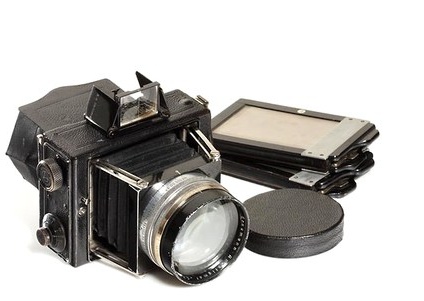
With f/1.8 lens and plates.
The lens was very fast for the time and the body took glass plates 6 x 4.5cm (2.4″ x 1.8″). Leicas came with an f/3.5 Elmar as standard, whereas the faster 50mm Leitz f/2 Summar was not introduced until 1933. By contrast, the Ermanox with its f/1.8 lens was first sold by Ernemann, a German maker, in 1924, so it’s not hard to see why Salomon favored it. 2 stops may not seem that much in the day of 6,400 ISO digital, but film was 5-10 ISO at best back then, a full 10 stops slower! In addition to the faster lens, the negative only needed half as much enlargement for the same size print compared to the Leica, reducing apparent movement blur and grain.
Clunky as the camera may be, with the plates meaning only one snap at a time, this German master made the best of what he had, and pulled off great photojournalistic snaps in the 1920s and 1930s before the Nazi killing machine chewed him up at Auschwitz. Salomon was a German Jew, training in engineering and law before devoting himself to photography, something we can all be grateful for.
I was vividly reminded of his work when contemplating the current spectacle of Europe’s evil, corrupt men (and now women) destroying all around them in the interest of self rather than that of their fellow human beings. They call this a Union?
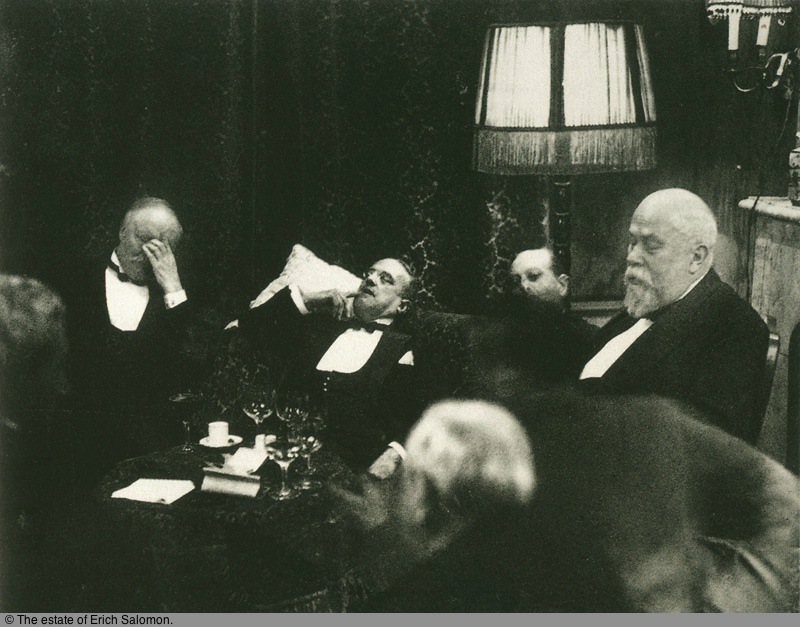
Evil men, wondering how to safeguard their supply of brandy and cigars.
The picture shows various purported diplomats at the 1930 Second Hague Reparation Conference where the assembled victors of 1918 are trying to figure out how to squeeze dry what is left of Germany in the name of war reparations. Brilliant economic concept that – tax the poor into oblivion, drive them to extremism. Among the collected toadies are Louis Loucheur, French Minister of Labor, holding his hands to his eyes, the poor tired dear; French Premier André Tardieu wondering when the cognac would run out. Next is Germany’s Foreign Minister Dr. Julius Curtius, (all Germans are Doctors, it’s a well known fact), yet to realize that he would soon be so much chopped meat. Henri Cheron, French Finance Minister, is on the right, seated in the high-backed chair, hoping his mistress is in town.
What caused this flashback? After all, these were pictures I had first seen when knee high to a grasshopper. Well, just look what is being done to the poor nations of Europe right now by the rich ones. And it’s the same lot, with all their expenses paid by the taxpayer, residing in their fancy palaces, transported in chauffeur driven bulletproof limousines, with legions of servants, wondering how to best screw the taxpayer while preserving their life of comfort and sloth.

Former French Prime Minister Aristide Briand points to
Salomon whom he dubbed ‘The King of Indiscretion”. 1930.
Such a witty, charming rogue, that Aristide.
How sad that Erich Salomon was murdered by the same evil men whom he so ably portrayed. Truly a great photojournalist.
A little tweak ….
The other day the Hackintosh HP100 got a nice performance boost when the boot+applications SSD was upgraded from SATA2 to SATA3. Fast disk I/O is essential for best Lightroom and Photoshop performance. Now it’s the CPU’s turn.
Geekbench is a test of CPU speed. It’s a simple and quick comparator of great use to photographers as apps like Photoshop and Lightroom are far more dependent on CPU speed than on the latest in GPUs. Little is to be gained, data suggest, from using a high-end gaming GPU.
Cinebench framing rates are a measure of GPU speed. My Hackintosh HP100 (Sandy Bridge Core i5, 16gB RAM) uses a three year old, low power draw, Nvidia 9800GTX+ GPU, yet returns a very high Cinebench framing rate.
One of the beauties of the Sandy Bridge and later Ivy Bridge CPUs is that overclocking is trivially simple, unless you go crazy. Clock speed is a near-linear indicator of effective speed for like CPUs. Double the clock speed and you should see an almost identical change in the Geebench score. In summary, the Sandy Bridge i5-2500K overclocks from 3.3gHz stock to 4.4gHz with one key entry in the BIOS. The i7-2600K goes from 3.4gHz to 4.5gHz for the same effort. As long as you dispense with the inept stock Intel fan and fit a Coolermaster 212 ($27) or similar, you will be thermally protected. Further, the BIOS has many failsafes to turn things off if heat rises too much.
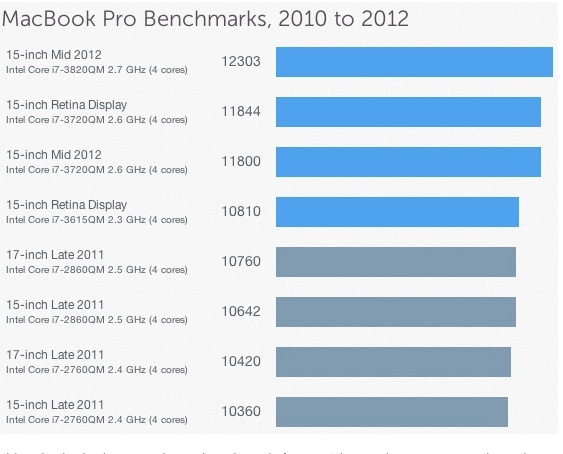
I have been running my Sandy Bridge i5 at 4.0gHz since inception, or 21% over the 3.3gHz stock, but the new Geekbench Ivy Bridge data for the just released MacBook Pros spurred me to action. Here are those data:
Meanwhile, HP100, perking along at 4.0gHz, records the following in Geekbench 64:
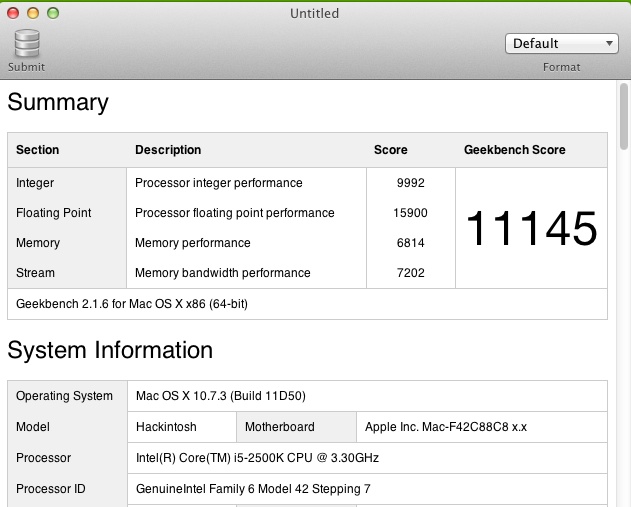
Actual speed with several apps running. 4.0gHz is correct, GB states it incorrectly.
Hmmm. Not good enough, even if my environment measures ‘real world’ results with Mail, Finder, Safari, Firefox, etc. running. You can also bet that the above MacPro data are in an ideal setting with no other apps running. That’s how Apple does data.
So I hopped into the BIOS on the Gigabyte motherboard, changed the ‘Frequency Multiplier’ from 40x to 44x, meaning the clock speed is now 4.4gHz, and restarted. Two minutes later I had the following result:
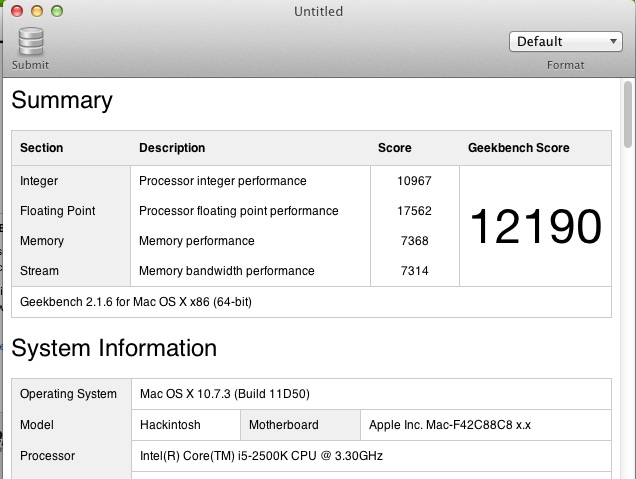
Core i5 Sandy Bridge at 4.4gHz. 42% faster than stock.
That’s more like it. A 10% clock frequency increase realizes a 9.4% CPU speed gain, and equalling the fastest, latest and greatest from Apple, at no incremental cost to me.
Heat, that bugbear of all computers, remains unchanged.
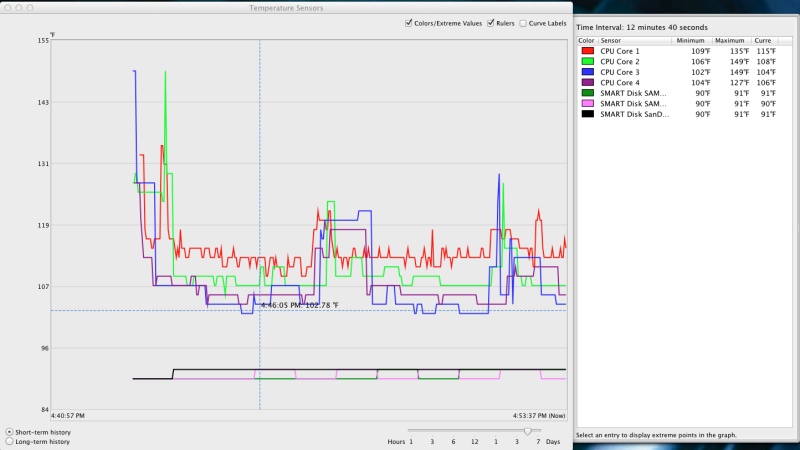
Temperature graph at 4.4gHz.
The above graph reports the temperature of the four CPU cores from restart. The usual start-up spike quickly disappears to settle at 109F, indistinguishable from the reading at 4.0gHz. The CPU cooler is set in BIOS as a variable speed device, meaning it cranks up only when needed. It sounds just a little louder than at 4.0, meaning it’s working harder but just as effectively. On the other hand, when I was running this test, ambient temperature was a high 85F (we have no air conditioning as it rarely gets that warm in the SF Bay Area) so there’s little to worry about. Things can only get cooler on regular days. The spike toward the right results from starting Lightroom 4. Starting Photoshop CS5 does not make any discernible difference. I have had no stability issues so far.
The Cinebench tests for GPU speed are outstanding. Brown (#5) is for HP100 at 4.0gHz, Orange (#4) is at 4.4gHz (not 4.0 as shown) – 13.3% faster. The highest reading here (#1) is for a Xeon equipped machine with a high end gaming GPU – meaning $1,400 more for the CPU and $1,300 more for the GPU – for a 25% speed increase. Goodness, the all in cost of HP100 is less than one of those components! And PS and LR do a very poor job of multi-threading so a 12 thread CPU is money wasted. Those economics do not solve for me nor does any photographer need to spend that sort of money. #3 is for HP100 running at stock GPU speed but with all other apps closed – hardly realistic, but impressive if you are a marketer. Marketing, after all, is lying for a living.
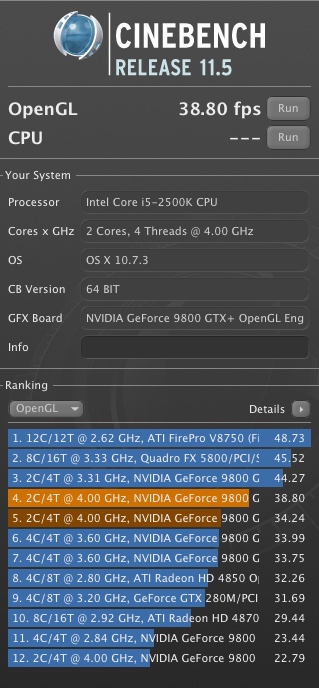
GPU results from Cinebench.
And when Apple gets faster, you can bet on one thing. With a tweak or two, HP100 will be right there at very little or zero cost.
Looking forward:
If you accept that CPU speed increases are leveling off, and that the focus will increasingly be on lowering power consumption, then simply dropping an i7 in place of the i5 will yield a 25-30% speed increase, for a net upgrade cost of maybe $150 after reselling your i5. I doubt Intel will be able to increase its CPUs’ speeds by more than 5% annually henceforth.
GPUs are already so far ahead of anything photographers need that spending lavishly here makes little sense. Any conceivable pixel density is already supported.
In the case of both, Adobe’s software is a long way behind what the hardware can do. Poor use of multi-core, multi-threading technologies means that far greater gains are to be had from software design than from hardware upgrades. Lightroom, in particular, is showing massive code bloat, with no improvement in operating speed. LR4 is some ten times the size of LR3.
The next frontier is peripheral I/O, where Intel’s LightPeak (we keep hearing that Apple’s Thunderbolt is the latest invention from Cupertino, when in reality it is simply LightPeak on which Apple’s 1 year wasted exclusive has now expired). LightPeak promises disk read/writes ten time faster than USB2, maybe three times faster than USB3. Whether it succeeds like USB2 did, or fails like Firewire has, remains to be seen. Very slow adoption is not encouraging, and I suspect it’s simply not a mass-market selling point. External drives are hardly the norm in the average home. If it does succeed, you can bet cheap PCIe cards will become available and that photographers’ Hackintoshes will be adding these for a few dollars.
Update:
As I’m not about to be beaten by Apple’s poor hardware, I set about adding a little more fire to the pot by tweaking the i5’s frequency multiplier from 44x to 45x, for a CPU frequency of 4.5gHz, and increased the VCore voltage to 1.385volts for stability. Nothing else was changed. System ambient temperature remains at 113F (45C) and is stable. At stock VCore it kernel panics. Intel specifies the maximum safe VCore at 1.52 volts so it’s not like I’m really puashing it here. This is the result – faster than the Core i7 in the fastest MacBook Pro:
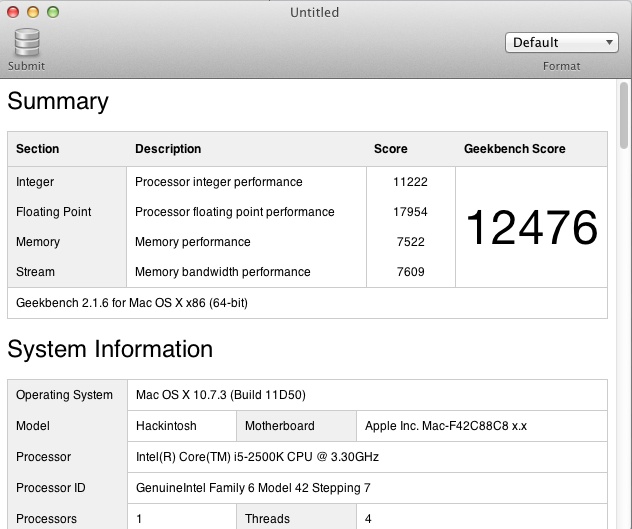
Intel Core i5 – 2500K at 4.5gHz CPU speed.
1.4% faster than the fastest MacBook Pro, with more to come.
Cinebench GPU data remain unchanged.
I have shutdown failsafes in the BIOS set at a CPU temperature of 176F (190F is the danger point for the i5 2500K) so everything remains conservatively specified.
These data suggest that a modestly overclocked i7 – 2600K Sandy Bridge should be good for 16,000 or more. But you do need proper cooling to do this sort of thing, not Intel’s stock cooler.
The Z68 chipset on the motherboard does not work happily with OS 10.7.4, and while there are workarounds, it’s not worth the effort. (It slows to a crawl). H67 and P67 chipsets have no issues with 10.7.4. So on the HP100 I’m sticking with 10.7.3 for now. Only P and Z motherboards support overclocking.
Another 25% in speed?
Sure. Get a Core i7-2600k. Look here.