Why I’m in no hurry to buy iPad2.
Owing to some ego bruising slight, real or imagined, Steve Jobs has refused to let Adobe’s Flash videos and graphics run on the iPad. Putting aside the mindless apologia from Apple’s fan boys, this is in fact a significant limitation for a business user. While I enjoy Netflix and news readers on the iPad as much as the next guy, a lot of business press is coded using Flash, meaning I cannot view it on the device. This is insanely frustrating, as you will be reading a business piece which has an embedded video, the latter key to the piece, and it will not run. Or there’s a stock chart you cannot read. The most used publically available US stock charting service is the free one at Yahoo and if you opt for the interactive version of a chart it cannot be viewed on the iPad, as the system uses Flash to deliver content.
This has translated into my using the MacBook Air (MBA) for most of my business reading when not at my desktop Mac, clunky as a laptop is for this sort of thing. The iPad is used for viewing photographs (at least on Flash-free sites), reading books and watching Netflix. But it means I have two portable devices where one should be sufficient.
The simple answer would be to have Apple include a toggle under ‘Settings’ which allows the user to decide whether to use Flash or not. All that talk of Flash locking up your machine and burning up the battery is so much rot. I have yet to experience any lock-ups on my MBA or HackPro. Further, I use Click to Flash on the MBA so that there is no Flash code constantly running in the background using up battery power. With this great little utility, Flash content is designated as such and a logo superimposed thereon is clicked to allow the content to be viewed.
All of this preamble is to say that I am more than a little interested in an alternative to the iPad which runs Flash, so the one hundred (!) or so tablets being rolled out at the annual CES electronics show this past week in Las Vegas were of more than passing interest to me.
First, I do think Jobs is exactly wrong in stating that the 7″ tablet is ‘DOA’, as he did on Apple’s last earnings conference call. Amazon is rumored to have sold some 8 million of its underwhelming, one-use Kindle book readers in 2010 and believe me, having used one for 30 days before returning it, the 7″ format is just fine for reading. And while at 1.5lbs the iPad is no heavyweight, the 7″ tablet weighs half that. Less weight is always a good thing for portable devices. No, Jobs’s DOA statement is nothing more than lashing out at a missed market opportunity and I wouldn’t be in the least surprised to see a 7″ offering from Apple in 2011, called something dumb like iPodTouch Super to cover for the Great Leader’s error of judgement.
Second, iOS on the iPad may be excellent, but Android is coming along fast and the new Tablet version, named Honeycomb, will likely fix what ails the much adapted cell phone OS, which tablet makers are hacking to provide a half decent user experience on their large screen devices.
Third, I want a built in SDHC or SDXC card reader on my tablet. Telling me about Jobs’s fetishes about smooth surfaces and so on is noise. A small slot for the card is trivial to add.
Fourth, forget about the 250,000 apps available for the iPad. For a serious user maybe a dozen or two of these make any sense. There are two or three RSS feed readers of note (I use Reeder), a couple of dedicated subscription readers (Bloomberg and the Financial Times – excellent, WSJ – weak), Zinio to read magazines until iBooks adds this function, IMDB and Netflix for movies, iBooks and Kindle for book reading, LogMeIn for remote access to your desktop, Tunein Radio for global internet radio, 1Password for all your logins, etc. and ZumoCast to watch movies from the home file server. Those make up 95% of my use and I’ll bet that your experience is similar, a few apps providing most of the functionality needed. So forget about 250,000 apps. 100 or so will satisfy 99% of users.
Fifth, games. Games are for children and those like minded, and are not a decision factor for me when it comes to tablets. I watch our 8 year old son play games on the iPad and I have yet to detect one scintilla of increase in his IQ as a result. Any adult who plays games on a computer likely has little interest in business, so I’m not going to comment further.
So what are the most exciting alternatives about to arrive in the stores? It’s a tough call as the iPad has a huge lead but a couple prospects stick out:
The Xoom from Motorola: MOT, newly reorganized into two companies, one doing cellular technology the other traditional construction site and police radios, has new leadership and an exciting product in the Xoom. Plays Flash, runs Android Honeycomb, has a dual core CPU for speed and multi-tasking, twin cameras for recording and video conferencing. Doesn’t appear to have a card reader. Availability some time in Q1/2, 2011. You think Xoom is a dumb name? How about iPad then?
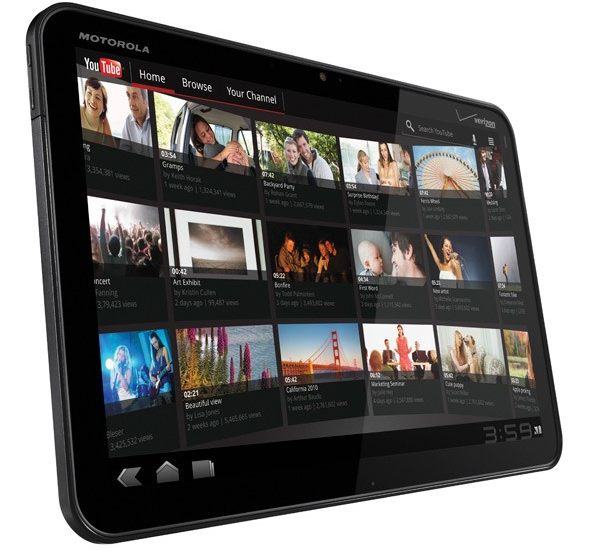
Motorola Xoom.
Blackberry Playbook: RIM may be late to the party with its 7″ Playbook and had to buy yet another OS to run the thing, but their user base in business is large and sticky and they have a lot riding on this one. Every time Wall Street says the game is up for RIMM they come back with stronger earnings, so I dare you to short the stock. Weighs a scant 14 ozs., runs Flash and like the Xoom has 1gB of RAM compared to the 256mB of the iPad. No sign of a GPS model but with an inspired device like the MiFi who cares? Apparently no card slot but will run Flash. RIMM has confirmed an 8 hour battery life, and have stated that the Playbook will provide synchronization with Blackberry contacts, etc. I think this will be a strong entrant despite Jobs’s slagging of the company on the recent AAPL earnings call. This sort of outburst suggests the man has no taste which, amusingly, is a criticism he used to level at MSFT years ago. AAPL, the new MSFT.
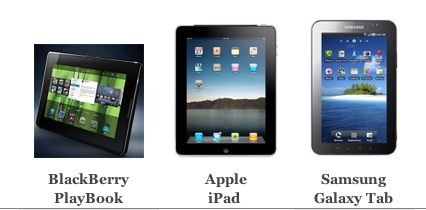
Waiting to eat Jobs’s lunch.
Samsung Galaxy: Only a fool would discount Samsung, the world’s largest makers of displays and supplier to AAPL among others. Their 7″ tablet is selling well and has a microSD card slot for memory expansion, but no SDHC card slot for retrieving data as far as I can see. Pricing is silly with a two year 3G contract required from your local unfriendly cell provider making the two year cost over $2,500, but hopefully they will see the light and make that an option. Runs hacked cell phone Android 2.2 but should be upgraded to Honeycomb soon. They claim to have sold over a million in 2010 (3 months) compared to maybe 12 million for the iPad (9 months) so the low $200 subsidized cost of entry is fooling a lot of consumers.
HP Slate2: Slate1 crashed and burned and there is no specific information from HP as to what v2 will bring. Hardly surprising from America’s most dysfunctional large technology company. But walk into any computer store and you will mostly see HP desktops, laptops and printers. The company has a lock on the Windows/PC world. More significantly, HP paid an arm and several legs for near-bankrupt Palm a year ago and in the process acquired one of the best mobile OSs on the planet, the Palm OS. That move was made by a very capable HP CEO whom, needless to add, HP subsequently fired because he is alleged to have diddled some stripper, or something. Like, what has that to do with creating shareholder value? So HPQ will come out with a tablet, and I am willing to bet it will be a good one, but the timing is unknown, not least to HP’s board of directors. And you can be sure it will run Flash. HP has some of the best tech minds on the planet, despite having done its level best over the past decade to get rid of them by creating an unfriendly workplace.
Notion Ink Adam: This one has been rumored for so long it’s hard to know what to believe, the maker claiming it’s been in development for three years. It’s 10.1″ like the iPad, but unlike the iPad it’s widescreen, has a nice ergonomic design (thicker at one long end than the other) and runs cell phone Android with a custom skin which the maker claims will make upgrades to Honeycomb easy. It’s rumored to be dirt cheap at $375 for the wifi-only regular LCD version or $500 with an enhanced display claimed to have exceptionally low power draw, resulting in a 16 hour battery life, compared with 11 hours for the iPad. It runs the dual core ARM A9 CPU which will likely be found in this spring’s iPad2 also – when Jobs will claim it’s been ‘specially designed by Apple’ – and 1gB of RAM is standard. The camera swivels which is clever. Little is known about the Indian manufacturer and its ability to bring sufficient capital to the game of survival, a question which is a non-issue for the likes of AAPL, HPQ, RIMM and Samsung. The Adam has an SDHC card slot – hooray! – and no fewer than three USB sockets. Someone is thinking here. For hard core Unix types it’s rumored to run the Ubuntu OS as an option, and video output is a full 1080p (iPad – 720p) if that turns your crank. With its speedy Nvidia Tegra graphics processor, enhanced display, competitive price and a raft of ports and slots, this seems to be the most exciting tablet coming to the market in 2011. For those who like to trust their data to a company which specializes in evil, it’s also rumored to run Google’s cloud-based Chrome OS.
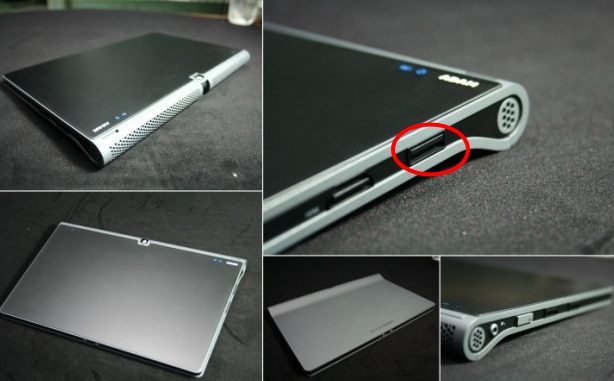
Thinking different. The NotionInk Adam tablet. eInk switch circled.
I think the Adam looks great! The best feature of the Adam? The enhanced display uses a version of the eInk technology in the Kindle meaning that you can switch to outdoors mode for reading in sun – there’s a physical switch to do this on the side not some silly touchscreen button you cannot see outdoors. The brighter the ambient light the better. By contrast, traditional screens, like the one in the iPad, are useless outdoors. Weight is the same as the iPad, but it’s less slim, like I care. An elegant looking design which, of course, runs Flash. The inclusion of a card slot, USB ports, stereo speakers and lots of memory for processing makes this one sound very appealing to photographers and video makers. The asymmetrical thickness is good ergonomic design – in landscape mode the thick part is at the top and in portrait mode the thicker edge affords a better hold. Let’s hope they have the capital to survive, as it’s rumored to be shipping ‘any day now’, a status prevailing for some 7 months at the time of writing.
Microsoft tablets: Last and least, there are sure to be some tablets running Windows in 2011. As long as MSFT has an orangutan in the corner office I propose to waste no time on these.
Apple is on top of the world right now. Great products across the board, no big losers, global distribution, great management. But that strong streak of arrogance in a less than healthy CEO, which has him dictating what the user will be allowed to run, is not promising. The iPad’s sales have shown that consumers prefer simple, limited functionality if the ease of use is there, but denying them Flash is simply an invitation to the competition. Add a Flash toggle on the iPad and all of the above goes away. Fail to do so and I will remain in line for an alternative.
iPad2: I see no way on earth that this spring’s iPad2 with its added cameras, lighter weight, dual core CPU, more RAM and more storage will allow Flash to run, given Jobs’s egotistical stance, so unless a simple iPad hack comes along (and I don’t mean that external browser/conversion thing which is conceptually deeply flawed) you can bet that this time next year will see a couple new tablets in my home and office, and neither will have a fruit logo on it.
Disclosure: Long AAPL call options.