Adding a third monitor

Are you nuts?

It seems like just the other day that I added a Dell 2209WA 21.5″ IPS monitor to what was then my work computer, the 24″ white iMac. That machine overheated and died so I had a HackPro built and added a second Dell. This works beautifully with Lightroom 3 and is also invaluable in my day job where I manage money for a living.

At the time I questioned who needs two displays, yet now I find I cannot live without them!

The Dell is 1680 x 1050 pixels, a pixel size which works nicely with my mediocre eyesight, delivering larger fonts than the default in most 24″ monitors which is 1920 x 1200. Sure, the font size can be increased with the latter in the Mac’s System Preferences->Displays panel but then why pay up for the higher pixel density in the first place? Or so I tell myself.

I thought long and hard about migrating to two 27″ widescreen monitors, similar to those used in the current 27″ iMac (though I would use matte screens in preference to the iMac’s ghastly glossy displays) but after several trips to the Apple Store I concluded that the even smaller font sizes on those 2560 x 1440 pixel displays were not what my eyes needed.

Meanwhile, my growing data hunger meant that I was getting frustrated with too much moving about of windows on the two Dells in my day job, so I resolved to add a third display. Mercifully Dell still sells the 2209WA and it’s still around $300, compared with nearly $1,000 for one 27″ Ultrasharp model, but the question remained how best to drive that third monitor from the HackPro. The Hackster runs a superb EVGA Nvidia 9800GTX+ 512mB display card which has two outlets. If you use a Dual-link DVI cable with these (the cable is a single one despite the name) you can power two 30″ monsters or two 27″ ones, for that matter.

So I asked HackPro’s builder to sniff around the Hackintosh chat boards and found there’s not much out there regarding three or more monitor use. It seems that the HackPro could be hacked (!) to accept a second display card as the hardware slot is there on the motherboard, but while the software part was not impossible, I couldn’t afford to lose the use of the HackPro for an extended period of time. Man’s gotta eat …. When I built the HackPro the 24″ iMac was still struggling along so downtime was not an issue. As that dog iMac is now in silicon heaven I no longer have a full sized desktop backup.

So I put the idea of adding a second video card aside and continued to grumble about my lack of screen space.

Then, out of the blue, I came across the Newer Technology USB to DVI/HDMI/VGA adapter, marketed by MacSales for under $70. Less than the price of another display card, in other words. For that sum I thought there was little to lose and just received mine. I decided to try it with one of the Dells to evaluate whether it made sense to buy a third monitor.
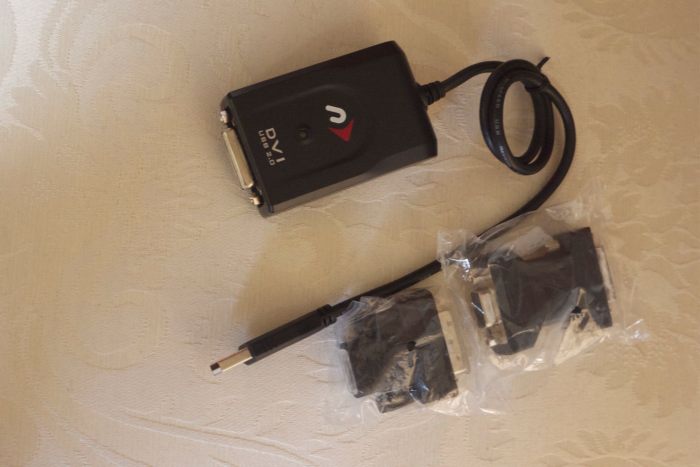
The Newer Technology USB to DVI adapter, with VGA and mini-DVI adapters.

Installation requires download of a driver from the DVD which comes with the gadget and a reboot. Thereafter, I simply unplugged one of the Dells from the HackPro’s video card, plugged it into the adapter and the adapter into one of the many free USB sockets on the computer.

No problemo!

The USB connected monitor came to life immediately and after a few minutes spent profiling the setup (the colors were way bluer than with the monitor driven from the computer’s video card, requiring Blue to be reduced from 97 to 85 for a perfect color match across the two monitors) I was up and running.

The most critical test I could think of was to run a movie DVD in the HackPro’s DVD player, stretch the picture across the two adjacent Dells and observe. The USB connected monitor displays the slightest jerkiness compared to smooth scrolling on the other monitor which is connected to the Nvidia 9800GTX+ card. Would you want to watch movies on it all day? No. Is it adequate for my purposes, mostly the display of streaming stock quotes, occasional moving charts, You Tube videos and the like? Yes, more than adequate.

I noted no untoward changes in the operating temperature of any component, using Temperature Monitor as always; the Newer Technology adapter gets noticeably warm but as it resides outside the HackPro box I am not concerned. It is USB powered and there is no external power supply to worry about. The adapter comes with Mini-DVI and VGA adapters if that’s what you use. I simply used direct DVI. Drivers for Mac OS X Tiger, Leopard and Snow Leopard are included (I use the latter) and the instructions also say that it will work in third world countries where PCs are still in use.

A three screen setup could be of great use to the Lightroom user who frequently finds he has to round trip images through Photoshop, PS being displayed on the third monitor.

Bottom line? I just placed an order for a third Dell 2209WA display and will report back when I have it up and running.
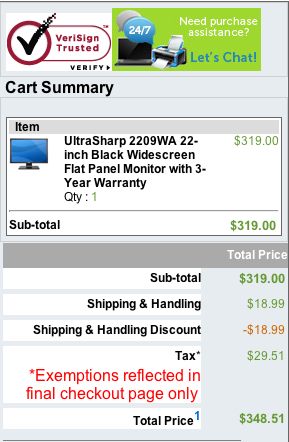
The manufacturers claims that up to four USB powered monitors can be connected to a Mac in this way, one adapter per monitor. Ovbviously, I hope never to have to check this out.

MacSales markets any number of useful Mac add-ons and I have many of their drive enclosures, hard drives, etc. around the home. Check them out – a lot of useful things to be found on their web site.

Anomalies: In addition to the slight jerkiness noted above, I am aware of one other anomaly with regard to the display driven through the USB port using this gadget. Screenshots of that display fail to record, but continue to work fine for the other which is attached to the regular graphics card. So if you take a lot of screen shots, relegate the USB-driven display to more static data where screenshots are not required.

You can read about the final installation here.
Square

A magical payment system.

Remember the old days?

You would be browsing art at a street fair, decide there was something you simply had to have and would then go through agonies while the merchant struggled with one of those massive imprint machines with a slider to record your credit card information. This was not only likely to jam, you were also giving out your credit card number, thus making a massive and unwarranted assumption of trust. Not good.

Well, all of that just changed.

For the photographer setting up at a street fair to sell his prints all that is now needed is one of these and a 3G or later iPhone or a 3G iPad:

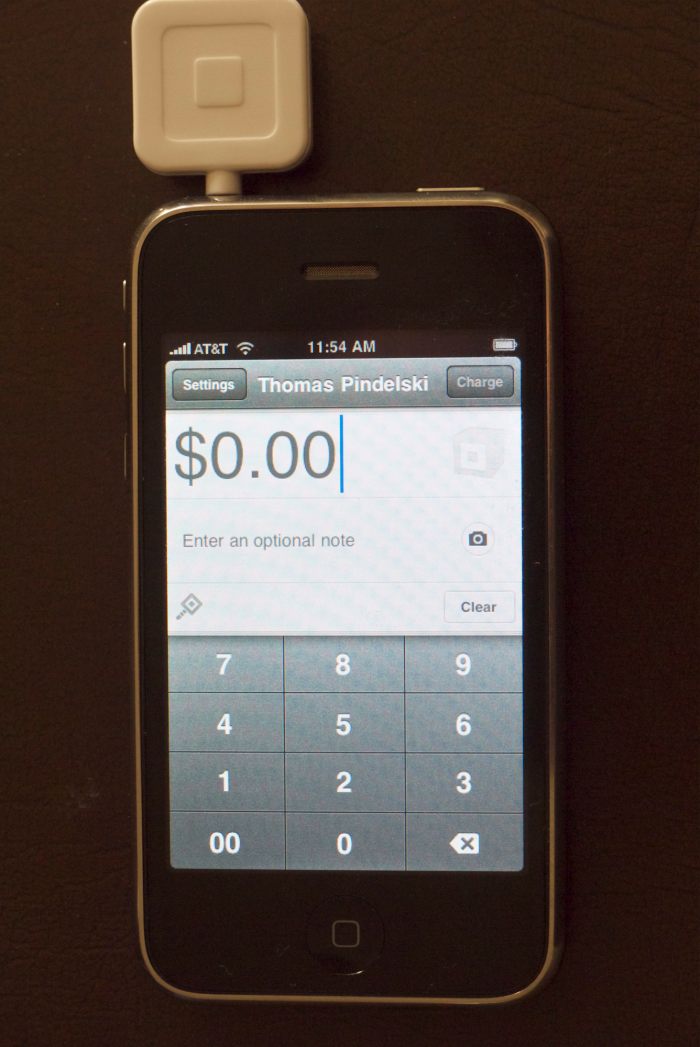
The Square card reader attached to my 3G iPhone.

The card reader is free when you sign up with Square, which I did immediately the service was announced a month ago. They finally shipped the device, which plugs into the headphone socket and has a slot for swiping the credit card.

Now I would love to relate that I had just sold a dozen big prints for thousands of dollars, but until that happy day comes around, I decided to do the manly thing and charge myself $1.00 to see how things worked.

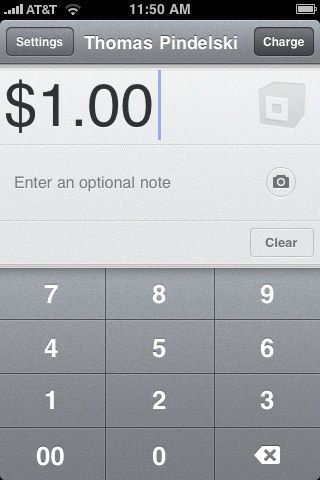
After setting up my Square account and downloading the iPhone app, I keyed in the charge amount thus:

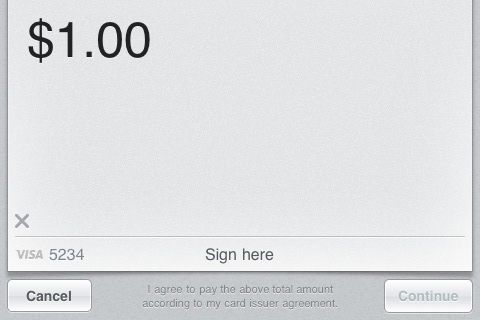
Next, I signed using my finger as a pen:

Hitting ‘Continue’ I saw:

Now my client (me!) wants a receipt:

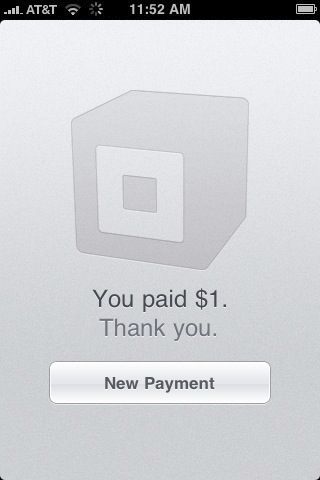
After entering the client’s email (mine!) I saw:

I was done.

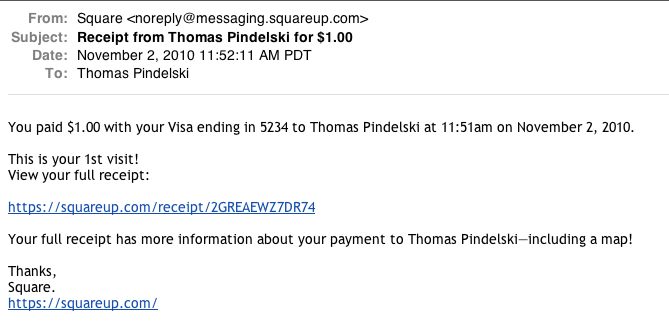
Now going to my desktop HackPro, there were two emails waiting for me.

The first was to me as vendor:

I went to the link and set up my bank account information to receive the payment.

The other was to my buyer:

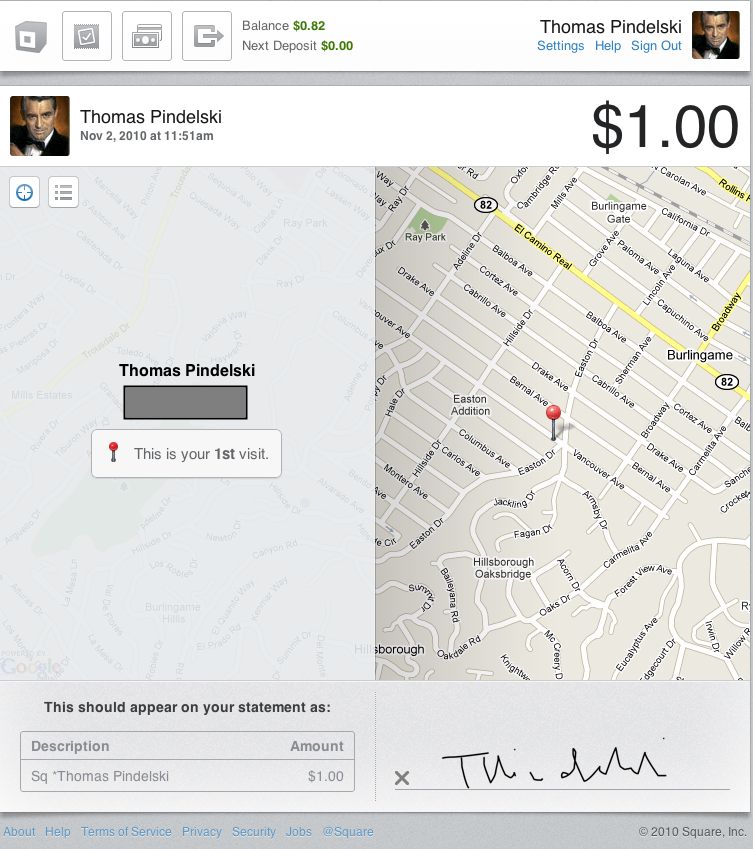
By clicking the link the buyer can see the full receipt – by the way the map location is about a mile out!

Buyer’s receipt.

Many have remarked on the remarkable resemblance I bear to Cary Grant and I confess it’s true. It’s all I can do to keep the women away.

Is that mind blowing or what? You can learn more by clicking here.

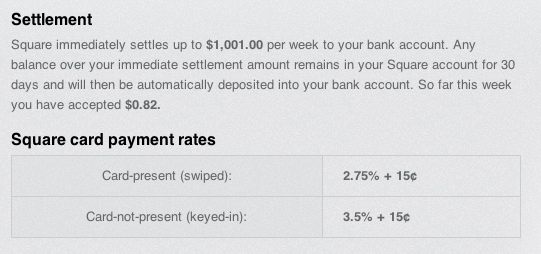
You don’t have to restrict the use of this device to photo sales; any Craigslist sale can now be advertised “Will accept credit cards” and the beauty is that if you swipe the card rather than keying in the number, your buyer has the immense comfort of knowing that the credit card number is never known to you. The fees charged for a swiped card are also lower than for one whose number has been keyed in manually. See below.

Charges?

I have read that the amount limitations will be phased out as your use grows but do not yet have details. This elegant solution mimics the dedicated iPod Touch devices used by sales clerks in the Apple Store. Given that the little attachment can be removed and stashed in a coin pocket it’s a perfect working solution for anyone seeking to accept credit card payments as long as wifi or 3G cell phone service is available at the payment location.

Ansel Adams, photographer?

Please ….

It’s no great secret to long time visitors here that I detest the landscape work of Ansel Adams. His picture postcard subjects, rendered in grossly over processed pretentious monochrome, leave me feeling physically ill. One of his most adulated snaps, ‘Moonrise Hernandez’ is a perfect example. Clearly taken in broad daylight (look at the shadows on the tombstones) it has been grotesquely processed to imitate moonlight. For all I know even the moon was pasted in from another image. As for his image of Half Dome, Yosemite …. well, better not to get me going.

Yet critically deprived Americans – eager for a claim to an ‘artist’ of their own – drool over his pictures and some even cough up serious coin to stick one of his monstrosities on the wall. The older and more yellowed, the more they pay. I know of what I speak, having had a close brush with death viewing the great man’s work myself. Yes, dear reader, I have held an original Adams print in my (cotton gloved) hands, which is more than 99.9% of his uncritical fans can say.

Well, if you thought his landscape work was pure garbage, be assured that his street photography makes it look good by comparison.

NPR has had the courage to reproduce twelve of his street snaps and it’s hard not to laugh once you have supressed the urge to cry at the thought that someone actually paid him for these. Just click the picture below, but maybe first get something cold, liquid and strong. You will need it.

Drink before you click.

The new AppleTV – Part III

Adding a DAC.

Part II appears here.

The new AppleTV lacks traditional coaxial analog connectors for sound output; it comes with an optical Toslink sound output socket only. So if you want to route the AppleTV’s sound output to external speakers via an analog external amplifier/receiver lacking a digital optical sound input, you need a Digital Analog Converter (DAC). Speakers (and amplifiers, for that matter) built into TV sets are generally poor quality so bypassing them and using external loudspeaker boxes connected to a receiver ensures better sound.

There are two versions of the DAC, depending whether your sound system is 2 speakers and an optional subwoofer (2.1) or four corner speakers, a center and a subwoofer (5.1).

My Sony receiver is not that old yet it lacks a Toslink connector for optical digital sound, meaning I had to interpose a DAC between the AppleTV and the Sony. Adding a new digital receiver makes no economic sense, so I bought a Gefen DAC. There are two models.

  • For 2.1 sound – use this one. $58 at the time of writing. This is the one I use.
  • For 5.1 sound – this one. $91.

I went with the Gefen – cheaper units are available – as research disclosed it was known to work with the AppleTV.

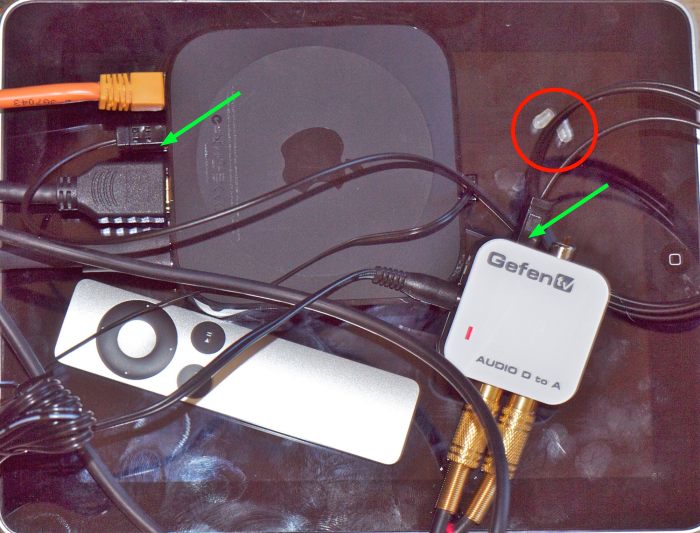
Red circle denotes removed rubber Toslink covers. Green arrows show Toslink cable connections.
Apple Remote included for scale. Gold connectors route two channel analog sound to the receiver. iPad backdrop.

As the specifications are silent I also purchased a short Toslink optical fiber cable only to find that Gefen includes one in the box with the DAC! So save $6 and don’t buy a separate cable. Then I ran into a serious snag. I had never so much as seen a Toslink cable before and, no matter how I tried, I could not get the flimsy connector to stay in either the Gefen or AppleTV sockets. After a spot of head scratching and Googling, it transpired that the optical ends of the connector are covered with translucent rubber caps, circled in the above picture. Removing these allowed the connectors to fit at both ends. Duh! I knew that engineering degree would come in handy one day ….

After that it was plain sailing. I switched off the TV’s speakers, connected the AppleTV to the Gefen and routed my two RCA coaxial cables from the Gefen DAC to the Sony receiver. The DAC comes with a small power supply so you will have to search out yet another adapter to make it fit your already overburdened power strip. The red LED on the DAC confirms it’s getting power but in practice you will hide it out of the way.

The sound is excellent, the Sony receiver’s volume control is set at half way through the scale so clearly the amplifier is being adequately driven by the DAC and, equally importantly, not overdriven. The TV remains connected using an HDMI cable (for video) and the orange cable you can see connected to the AppleTV is for wired internet. I use wired in preference to wireless as the AppleTV sits right next to my broadband modem and I always prefer wired to wireless, having grown up in a world where men were men, cars had carburettors and the word ‘digital’ was not in common use. The small cable routed to the front bezel of the AppleTV is the optical sender from my IR blaster.

Check the Comments to this article to learn how the HDMI and Toslink sound outputs interact.

I have to add that until now I have always thought the USB connector to be one of the worst designed on the planet, and just slightly better than the Firewire800 one. Well, it must now take the runner’s up place to the Toslink one which, though keyed, is so small that you have to look awfully hard for the keyways, for some reason only fits one way (nonsensical for an optical signal) and will leave you scratching your head because of those little rubber covers about which the instructions are silent.

We now enjoy premium quality video and sound from the new AppleTV and greatly enjoy watching our photo slideshows with the help of this handy little device, as well as listening to our music and watching Netflix and iTunes movies.

A bigger hard drive for the MacBook Air

Any day now!

At the conclusion of Part V of my MBA review I wrote:

“The ingenuity of man will ensure that higher capacity flash hard drives become available in no time for far less than Apple will charge you and ifixit already has a supply of five pointed Torx screwdrivers available, for all of $4.95, which will allow you to replace the fan yourself.”

For ‘fan’ you can also read ‘flash drive’, the same tool being required.

Well, that was yesterday. Today a larger, faster flash drive was announced, claimed to be 30% faster and, at 256gB twice as large as the largest base spec sold by Apple. (You can get 256gB but on the 13″ MBA only and that at a $300 premium to the 128gB base spec for the 13″ model; the maximum you can get on the 11.6″ MBA is 128gB, at a $200 premium to the 64gB base spec.)

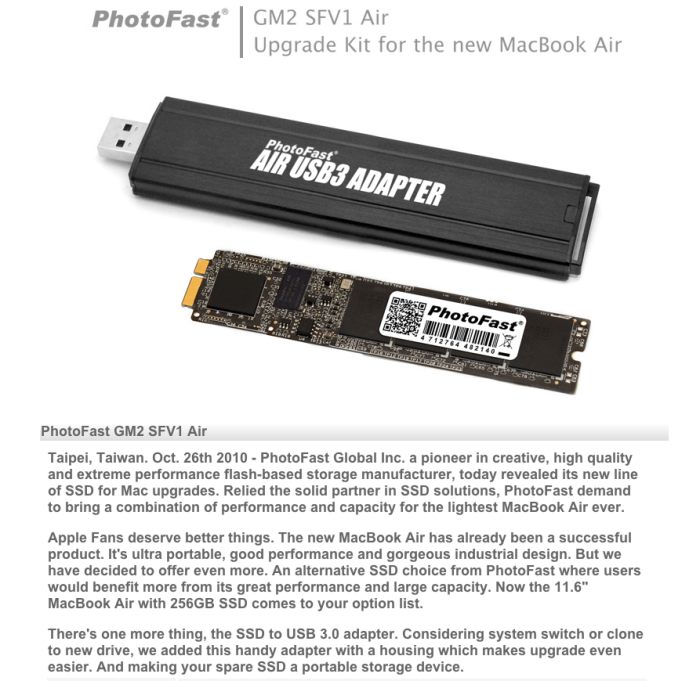
Click the picture for more. The vendor makes the excellent point that the flash drive removed from the MBA can be used as back-up storage using the provided USB casing; the latter is required to plug in the new drive externally to first clone everything to it from the stock MBA drive installed by Apple. The installation, based on the ifixit pictures, should be a piece of cake. 10 Torxscrews using the special screwdriver are removed to free the base and an eleventh like screw, once removed, allows replacement of the plug-and-play flash drive.

While the largest flash drive sold by PhotoFast is currently 256gB, we will be seeing terabyte drives before you can say “Well, Mr. Jobs, that ploy with those silly five headed ‘unique’ screws didn’t last long now, did it?” Duh!

There’s something very appealing about this process. Apple is trying to screw its customers by charging egregious premia for additional flash storage and is, in turn, being screwed by its own suppliers with cheaper and better aftermarket alternatives. US pricing is unknown but I would hazard a guess of $200, which gets you four times the 64gB base spec on the 11.6″ where the maximum of 128gB commands a $200 premium. If I’m right that means twice the maximum Apple offers for the same price. Prices will only fall as solid state storage gradually obsoletes spinning disks.

Update Feb 2011: Apple threatened litigation/contract cancellation of other parts if PhotoFast did not cease and desist from marketing this SSD. Jerks. Anyway, MacSales offers a like upgrade, although without the external enclosure, and you can read about it here.