Alternative keyboards

Hasta la vista Apple.

In my ongoing quest to banish every last piece of Apple’s awful hardware from the home, I have now purchased two non-Apple keyboards in the last six months, both my Apple wireless ones having failed in that period, refusing to pair with their respective computers. One was the white model the other the aluminum slim version. Looks great – but strictly for display only.

One replacement is wired and is the Kensington Slim Type for Mac. It comes with downloadable software for use with Macs and features proper scissor key mechanical switches for that traditional ‘long throw’ feel which those of us over 7 years of age grew up with.
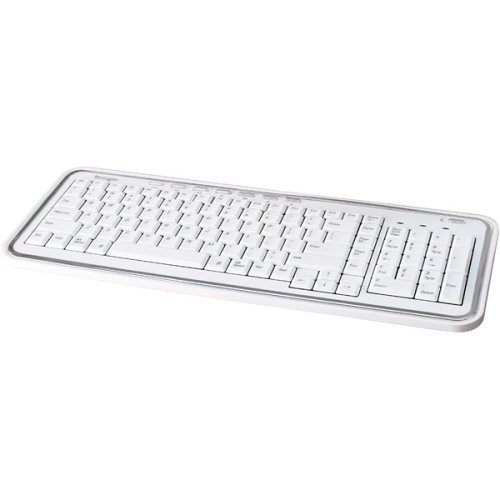
The Kensington Slim Type for Mac keyboard

At $27 it has been working nicely for six months now and I even found a nice keyboard skin to keep it clean for some $10 more.

The other is the HP Wireless Elite. I have lost all trust in Apple’s Bluetooth as a wireless keyboard technology. The aluminum one which just failed was used with my home theater Mac Mini and would constantly lose pairing with the Mini, displaying an obnoxious message in the center of the screen in the middle of watching a movie. When I am luxuriating in the beauty of a Penelope Cruz or Kate Beckinsale on the screen, the last thing I need to be reminded of is Apple’s crappy products.

Having had good experience with the RF wireless technology used in the Microsoft Wireless Mouse I wrote of earlier I decided to stick with that technology and purchased an HP Elite RF Wireless Keyboard, my wild spending ($33) getting me a slim black keyboard with numeric keypad, an RF USB dongle and an ominous looking CD full of software for Windows users. I discarded the latter, plugged in the RF receiver to the back of the Mini, pressed a couple of keys as instructed and, hey presto!, a perfectly working keyboard which pairs instantly and avoids the need for that ridiculous “enter a number” pairing process dictated by Apple for its wireless garbage. The USB receiver is a little larger than the one for the Microsoft mouse and flashes a veritable klieglight blue diode every time a key is depressed, so either install it out of sight or apply a couple of turns of black electrician’s tape. A real genius designed that part. For reference, the keyboard is some 11 feet from the dongle.
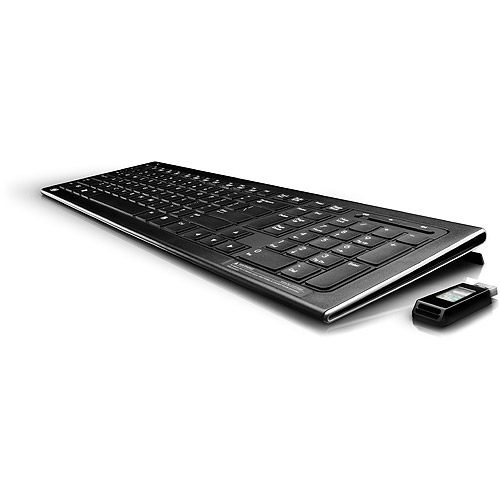
The HP Elite RF Wireless keyboard.

No need to do anything software wise and the OS X System Preferences->Keyboard->Modifier Keys screen even allowed me to disable the Caps Lock button which I like to do as a matter of course. The volume and mute keys work perfectly and are well isolated top right for ease of use in the dark. Interestingly, the elegant gloss chrome side panels match the appearance of the Microsoft RF Wireless Mouse and the whole thing simply works out of the box and has yet to unpair itself. Quality of construction, fit and finish are beyond criticism and the keys adopt that short throw feel used in Apple’s current range. The keyboard comes with two AAA batteries installed and you can blow through two of these before you have equalled the cost of one piece of Apple’s jewelry. Recommended.

The original bad boy

aka Michelangelo Merisi.

No painter has so influenced photography and photographers as has Caravaggio, whom NPR amusingly and accurately refers to as the first of the “Bad Boy artists”. An exhibition in Rome is celebrating the 400th anniversary of his death and you can read more of this master by clicking the picture below.

I prefer the version that has him dying in a sword fight as it seems so in character with the man. Brawler, debauched party goer and totally original genius. His use of light and shade is as fresh today as it was four centuries ago.

On of the best episodes of Simonn Schama’s ‘The Power of Art’ illustrates Caravaggio’s life with some stunning recreations of his signature pieces, not least ‘The Calling of St. Matthew’. You can rent it from Netflix. It’s clear that while his commissions came largely from the Catholic Church (who else had money back then?) his art is about as secular as it gets. Another reason to adore his work.

Any day now ….

…. someone will get it right.

Another interesting product announcement from Samsung, the TL500, following on from their new APS-C DSLR:

The lens is fast at f/1.8, it does RAW and the zoom range is an incredibly useful 24-72mm. Just about perfect for street photography.

But, but, but …. there’s still no eye level viewfinder. I doubt it’s lost on the likes of Samsung and Panasonic, etc. that there’s a profitable and prestigious market segment waiting for a small, fast camera like this with a proper finder, not some dumb ass LCD screen, at $8,000 less than the crazy-priced Leica M9.

I doubt the day when we will see something like this is far away. F/1.8, 24-70mm or so with a manual zoom ring, a bigger sensor than the 0.6″ one in the TL500, low shutter lag and no earthly need for interchangeable lenses. All that’s needed in addition is an eye level EVF. Panny has most of this in the G1/GH1 and just needs to redesign the container, but if someone else beats them to it, so much the better. And forget the poncy built-in flash, for heaven’s sake. The technology is out there, it’s robust and my money is waiting. I would even settle for a smaller sensor than the one in the G1 – who is going to make huge prints from street snaps anyway?

Apple’s awful hardware

To be avoided.

As I value reliability over looks, stability over price, I have been an Apple OS X devotee for a decade now. Windows drove me to OS X. But it would be hard to be unhappier with the reliability record of Apple’s hardware which I have experienced. Here, more or less in chronological order, is the list of that company’s hardware I have used over the past decade and what happened to each.

  • iMac 17″ PPC, 1.25gHz – still working great if a bit slow by modern standards. 10 years old. Good for web surfing.
  • Airport Extreme ‘UFO’ style’ router. Nothing but stability problems. Given to a friend.
  • Airport Express ‘G’ model. Impossible to program and totally unstable. Returned for refund.
  • iBook #1 – DVD drive failed after 30 months. Replaced (awful job) and sold.
  • iBook #2 – DVD drive failed after 27 months. Replaced and given to a friend.
  • iBook #3 – HDD failed. Battery failed after 27 months. In surgery now.
  • iMac G5 20″ PPC, 1.8gHz – started to overheat after 2 years’ use. DVD drive errratic. Sold before it could blow.
  • Airport Express ‘N’ model. Refused to extend network despite much telephone time with Apple. Returned for refund.
  • iMac 20″ Intel C2D, white model. Graphics processor failed after 2 years. Not economical to repair. Recycled.
  • iMac 24″ Intel C2D, white model. DVD drive erratic and failing. Graphics processor started to fail after 2 years. GPU board replaced and additional cooling (fans and holes) added. Failed three months later. Recycled.
  • Airport Extreme router ‘N’ model. Unstable out of the box. Replaced under warranty. Replacement continues to work fine.
  • MacBook #1 12″, Intel C2D. Repaired twice under warranty for a wireless problem – Apple replaced the wifi card twice. No use. Complete computer replaced under warranty after 9 months of use. This one broke me, I confess and started my Hackintosh quest.
  • MacBook #2 12″ Intel C2D. Warranty replacement for the above. Sold as quickly as possible before new problems could arise. Replaced with a $300 hacked netbook which is perfect after 15 months’ heavy use, not to mention that it runs 40F cooler.
  • Mighty Mouse – three models – all died from faulty scroll wheels just outside the warranty period. Replaced with a Microsoft RF wireless mouse.
  • White wireless keyboard. Refuses to pair with the iMac 24″. Recycled.
  • Aluminum wireless keyboard. Has refused to pair with anything over the past week. Must be a solidarity thing with the white variant, above.
  • Mac Mini – too new to fail. May reluctantly buy AppleCare at the two year warranty point to get at least one more year out of it.

My current ‘work’ computer where I do all my Lightroom and Photoshop work is the best of both worlds, based on the above experiences. Assembled from off-the-shelf inexpensive PC parts it has mechanical reliability and low repair costs if anything fails. By far the costliest component, the Intel C2Q CPU, ran $230. The twin 22″ Dell IPS monitors I use have nice matte screens, the pair costing in aggregate about half of the amount Apple is asking for their cheapest external monitor with its awful glossy screen. Everything is easily upgraded if the need arises, right down to the CPU.

As Windows is to operating systems what Apple is to hardware (meaning I refuse to use either) the PC is hacked to run OS Snow Leopard, is equal in performance to Apple’s costliest hardware and has been rock stable in the six months since construction. And it runs 40-50F cooler than any Apple Mac I have used.

Doubtless someone will write pointing out that Apple’s EULA claims to prohibit installation of OS X on non-Apple hardware in the US (it’s not legal in Europe so have at it, those of you across the pond) but frankly, given my experiences with Apple’s hardware, what choice do I have? And I paid for the software. It is the height of arrogance to tell me I cannot use it on a machine of my choice.

So our household is down to an absolute minimum of Apple hardware – one 10 year old iMac, one Mac Mini, no mice, no keyboards, one Apple Airport Extreme router and one iPhone. The latter has been a model of reliability, just like the Hackintosh I assembled in desperation.

Amazing – or admirable, depending on your point of view – how almost all the Apple hardware failures I have experienced have occurred just after expiration of the warranty period.

So if I pause and wait when the iPad debuts, you will understand why. For the most part I propose to avoid Apple’s awful hardware as much as I try to avoid politicians. Both are equally trustworthy.

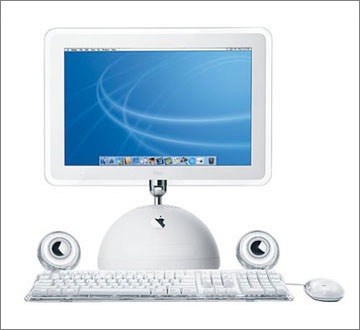
iMac G4. The only reliable Mac I have ever owned.

Ed Hebert

A fine New England photographer.

I first came across Ed Hebert’s work when photoblogging a few years back and suspect that our shared love of both Edward Hopper and Keld Helmer-Petersen was the catalyst for my interest. While Ed frequently does extensive post-processing on his images there’s no issue of striving for effect, for his originals are powerful, sparse, well seen and expertly composed.

Ed makes his home on the Atlantic Ocean in Fairhaven, MA, and you can see his love of the seaside and its landscape from the many examples on his beautifully presented web site. His strong design aesthetic is clearly reflected not just in his work but also in its presentation.

Here are a few of my favorites, reproduced with Ed’s permission – see more by clicking the link above for his web site where you can both view and purchase his work. Ed’s comments, below, are italicized.

* * * * *

Most of my photography is nothing more than a visual representation of the relationship I have with my environment. My photography interacts with the elements of my surroundings in a manner that provides an immediate and palpable sense of place – wherever that place may be. And it’s usually simple, common objects or visual fragments of these elements that hold the strongest allure for me. These fragments are what gets extracted from the whole when we experience our world every day. It’s the stuff that burns into our memories when we think back hoping to remember these places years from now. These fragments of future memories are my subject matter.

I’ll find my subjects in the most common of everyday objects and places – they are mailboxes, doors, benches, signs, paths, structures. These commonly overlooked objects reward me with a defining memory of my experience of the moment, and in return I try to reward them with an uncommon moment in the spotlight of visual recognition.

Since I’ve spent most of my days on the shores of coastal New England, I imagine my style is most heavily defined by this region. But while my subject matter reflects my surroundings, I think my style follows a bit of a more reserved and restrained approach that is commonly associated with New Englanders. If so, guilty as charged.

Since I might be approaching my photography with more restraint, I’m not often interested in capturing objects or landscapes with the same majestic style of those photographers whose images often find their subjects gasping with immediate pleasure, as if watching fireworks explode overhead. Instead, my work is celebrating the quiet beauty of everyday places and objects usually overlooked in favor of a more overtly attractive subject. Further, I typically offer my images with a quiet, sometimes even melancholic presentation. They speak with a much softer voice, and to some the work doesn’t speak at all. But for those who spend time with the photographs, the objects usually keep speaking. Critics of my work have mentioned that it wasn’t until a second or third viewing of an image that they began to understand what was being offered by the photograph. From there, they began to connect with the emotional outpouring offered by the seemingly simple compositions.

These photographs are nothing more than my memories of the world that’s surrounded me. My hope is that by making these photographs, others will appreciate or connect with these memories as well.

* * * * *

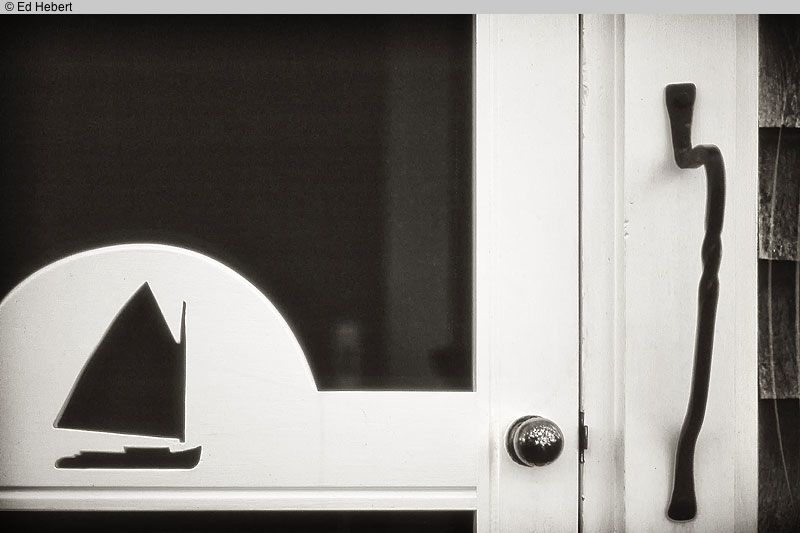
Catboat, Screen Door – This photograph was made on Nantucket, and presents a representative fragment of the local personality. The catboat decorated door rail and weathered bronze handle help define the understated, seafaring architecture of this coastal area.

Green Hull and Bilge – The subject of this photograph is one that most would find of little appeal. It’s the water line of a well-worn commercial fishing boat hull, taken as it pumps its bilge into the water of the working harbor of New Bedford, MA. The play of light on these textured hulls presents some uncommonly beautiful abstract compositions, which I’ve assembled into a series called The Shipyard.

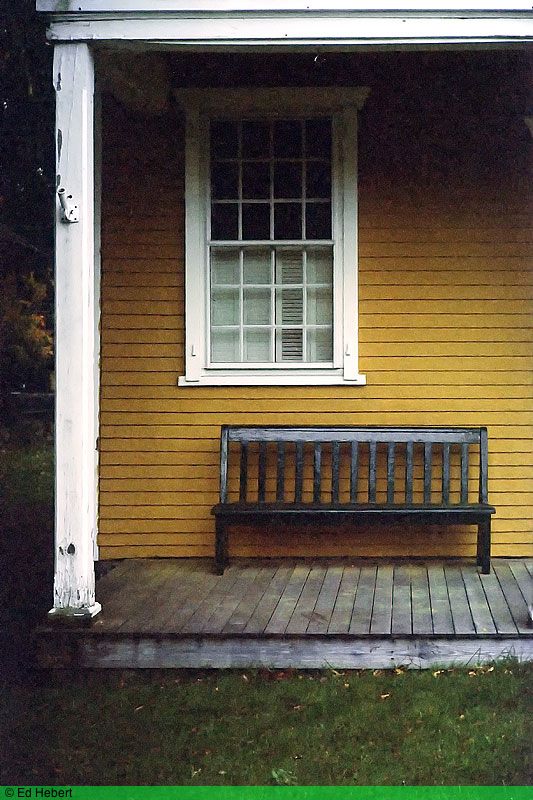
Bench – This is a simple bench that sits on the porch of the building of a cranberry grower in Rochester, MA. One shutter peers open in the window, as if someone recently took a peek outside.

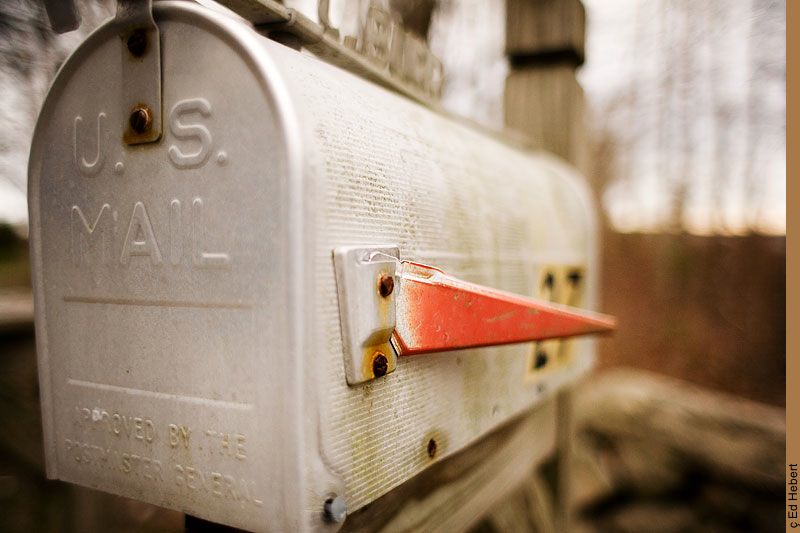
Mailbox – This is the mailbox of a neighbor from down the street. The husband has passed away years ago, but his name still tops her mailbox, its bent flag waving to no one. He is gone now. I think this mailbox is telling us all of this itself.

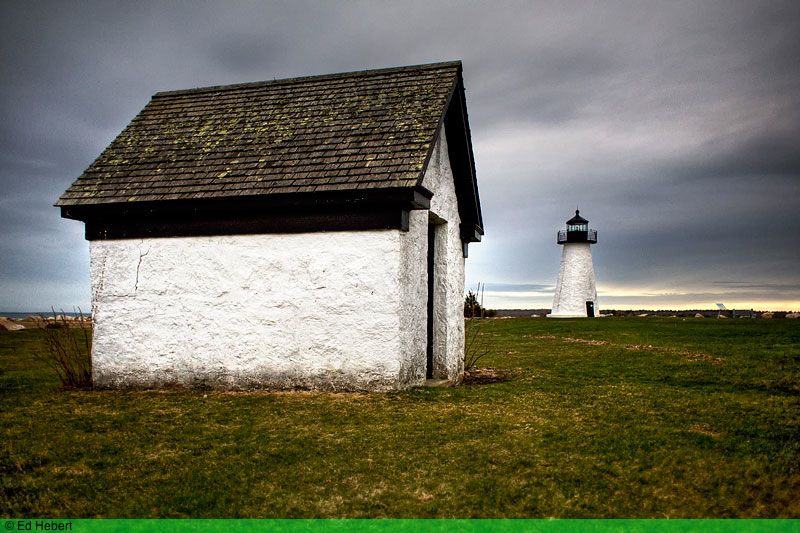
Oil House and Lighthouse – This lighthouse is a local landmark in Mattapoisett, MA. It’s been photographed by thousands over the years. While the Lighthouse enjoys considerable attention, an interesting oil house sits just a few yards away, overlooked by almost everyone who visits the site. Here, I give the oil house the forefront, and relegate the lighthouse to a supporting role.