Category Archives: Hardware

Stuff

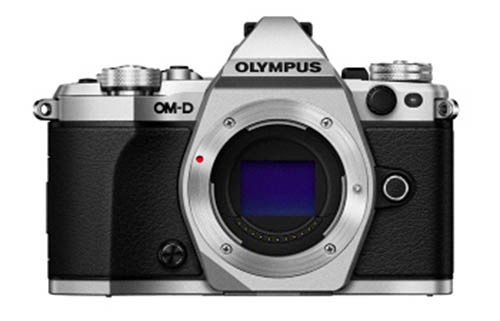
Olympus OM-D E-M5 Mark II – Part I

A quart in a pint pot.
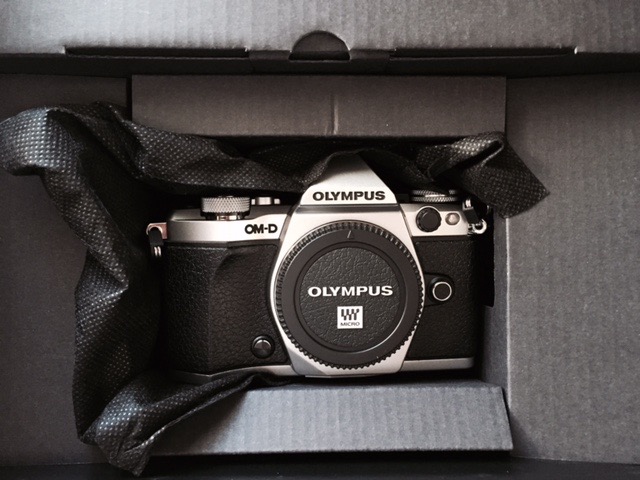
I just took delivery of my Mark II Olympus MFT body, my first non-Panny MFT, having been happy with the Panny G1 (superb and innovative), G3, two GX7s and an LX100 (my son’s, actually). All have been a delight to use and my current modest MFT lens complement includes the Oly 17 and 45mm f/1.8 primes, the original Panny 14-45mm kit zoom (outstanding) and the inexpensive and excellent 45-200 Panny tele zoom. An earlier MFT Olympus 9-18mm wide zoom was sold for lack of use and I have some twenty MF Nikkors, both primes and zooms which fit any of these bodies with an inexpensive adapter. Rarely used owing to the loss of EXIF data, AF and sheer excess bulk, but it will be fun to try some of the longer ones with the allegedly state-of-the-art 5 axis Optical Image Stabilizer in the OM-D body. The Panny favors in lens stabilization and while the GX7 adds In Body Image Stabilization, it is limited to two axes.
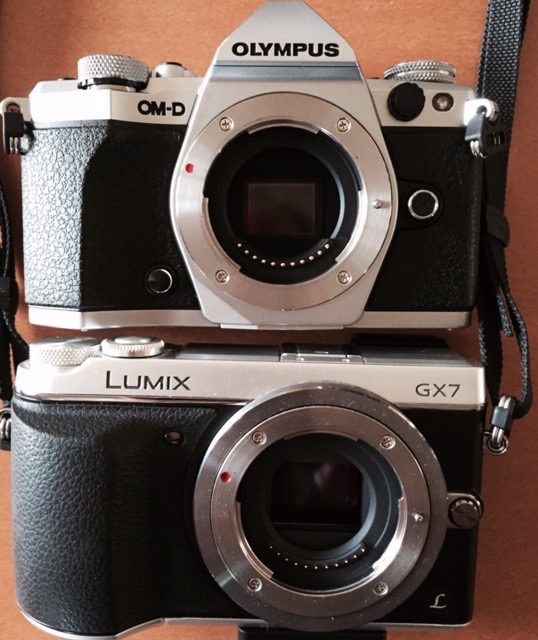

Size and weight are near identical. Compare – shark, top – friend, below.

The main reason for buying the Mark II is that I was intrigued to try a semi-pro Oly body and also to take a look at the innovative pixel shifting technology whereby Oly takes 8 images of a stationary subject in one second and melds them into one 40mp original (JPG in camera) or in a Photoshop plugin (RAW, 64mp). As my earlier piece sets forth, definition from the HD files thus produced rivals that from the current FF DSLR definition king, the Nikon D810 and unlike the Nikon results in no moiré on patterned subjects. These tests were conducted by the excellent Imaging Resource site. Some of their later tests suggest that the files produced rival those from the MF Pentax 645 51mp sensor! More on where Olympus is going with this exciting technology – not new but very much a first for MFT – appears here.

By the way, the 8-shot function even works with studio strobes and Oly has thoughtfully included an adjustable delay setting between shots to give the flash time to recharge. Very smart. I can see a lot of museum curators junking their crazy priced Hasselblad multi image cameras with neanderthal Firewire connectivity and 20 minute processing times with wired connections only. Yes, I do know, as the head of imaging at a leading west coast museum and I have had many discussions on the subject. There is very little right with Hasselblad’s implementation and no USB2 or wi-fi for you, sucker!
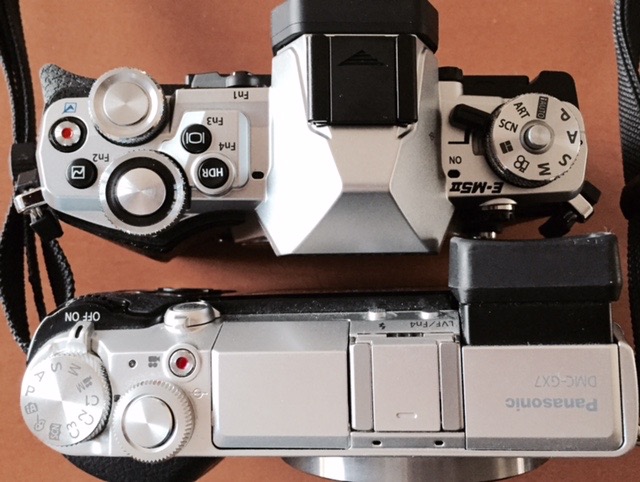

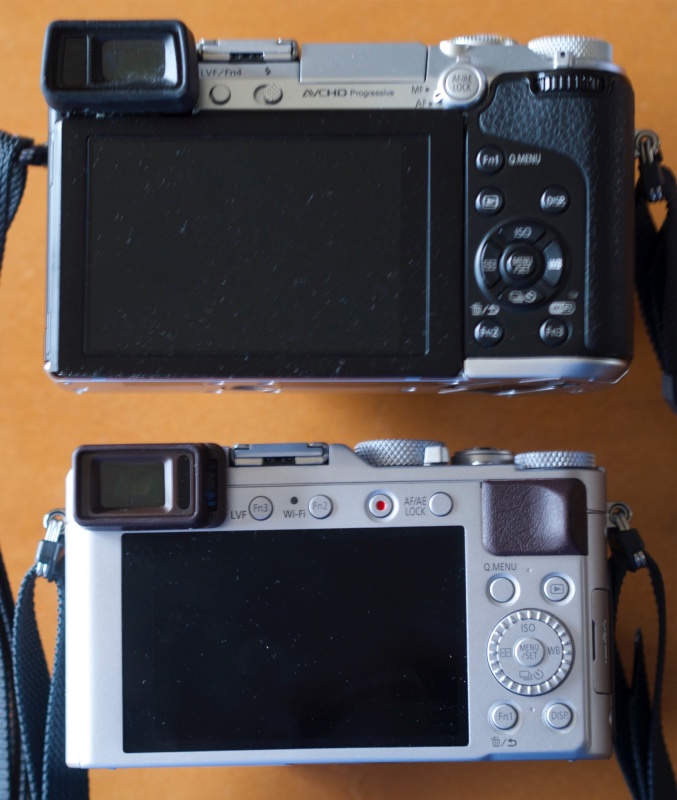
Top panels could not be more different. Oly goes crazy with miniscule buttons (albeit programmable), Panny relegates less used controls to menus.

First impressions are of a tightly packed, dense body but really no better in feel than the GX7. In fact the Oly is a tad lighter, and the dumb aesthetic of a faux pentaprism hump – there is no prism so no need for a hump – a minor irritant. That Oly can be such an innovator but feel it has to kow-tow to dumb tradition mystifies me. Subjectively I would say that the GX7 feels slightly higher quality and the small built-in flash in the Panny is missing from the Oly which provides a small plug-in unit. Shame, as it will always be left at home. Oly claims splash proofing for its body. I live in California so have no way to test that.

I had taken the precaution of downloading the 177 page instruction book from Oly’s web site to mug up on the vicious learning curve most modern digital cameras involve and was frankly disgusted with the sheer amount of crap – there is no other word for it – that the maker has seen fit to load the software up with. (Other manufacturers are equally blame worthy). Let me understand this, Olympus. You are selling this as a body-only in the US – so your buyer is an advanced snapper by definition – but you feel that truly childish features like in camera processing, printing, dumb ass filters and scene modes (goodness gracious!) belong in a semi-pro camera body? Do you seriously believe that not a one of your buyers will be expert in Photoshop and Lightroom, etc. The sheer amount of this garbage, once deleted, would so simplify setup of the camera. But this is the way of the world. Useless feature bloat. Oly’s designer has hinted at a Spartan version and I would gladly pay $200 more for that. So would most users of this level of gear.

Ergonomics? Inferior to the GX7 as regards handling. There are just too many buttons all over the place. The lockable mode dial – the one with those dumb scene modes – is illogically designed. One button press releases it, another locks it. Every other maker uses a ‘press to rotate’ design and that’s how humans are coded. Oly is trying too hard to be different here, as you will always want to revert to locked, which means two presses not one. The finder image is slightly larger than in the GX7 and well rendered, plus it’s easy, with a touch on the Display button, to remove all the crap (yes, that word again) and end up with an uncluttered finder just like in the days of film cameras. There is simply no way on earth that any human can makes sense of the 50+ display icons in the finder, let alone remember what they all mean. The diopter adjuster has a good range and I have no difficulty seeing the whole image with vision glasses on. Nice.
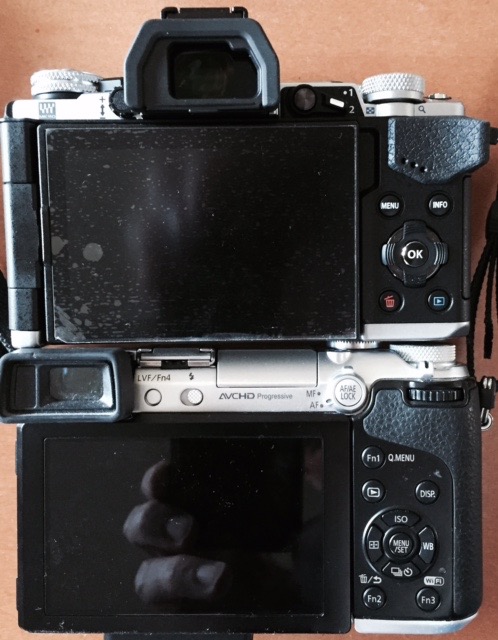

Oly adopts the fully swivelling LCD screen from the Panny G1, superior to the GX7’s limited one axis tilt variant. Best of all you can fold it down reversed so you no longer see your thumb and nose prints on the glass. Note the thumbgrip on the Olympus body.

As usual, my comments and use will address candid snapping so comparisons with the GX7 – the best street snapper in the business – are to be expected. I have zero interest in movie modes. So the first thing to do here was to switch the already very quiet (noticeably quieter than the GX7’s) mechanical shutter to the silent electronic one, where it is truly silent, like in the GX7. All you will hear is a low level whirring as the AF kicks in on first pressure on the shutter release. Then it was a matter of a moment to switch the functions of the two dials top right, making the front one aperture in A mode (or shutter in S mode) and the rear exposure compensation. That’s how I have my GX7s set up. These dials and their positions are beautifully engineered and fall perfectly under the thumb and forefinger. Further, there’s a nice included thumb grip rear right which helps in holding the camera. No, I will not be getting the asinine external battery pack or L grip. I do not wish to go back to the bulk of a flapping mirror SLR – these accessories defeat the MFT concept of ‘small body, small lens’.

Price? A lot, for what is a hot new item. $1,100. You can pick up a new GX7 body for $550 (half the amount!) and there’s no way the Oly is worth the asking price unless you really need the 5 axis IBIS or the HD pixel shifting technology. While the Oly will fall in price, as these things do, Pannys can always be expected to depreciate faster as the maker is cursed with the image of consumer electronics from toasters to TVs, whereas Olympus is seen as a ‘serious’ snapper’s brand. The winner here is the GX7 buyer, a body which I continue to recommend unreservedly, especially with Olympus prime lenses. Neither body has 4K movie capability. For that get a Panasonic LX100 with its excellent 24-75mm Leica-designed lens.

More in Part II.

Death knell tolls

For the full frame DSLR.

One of the thrilling aspects of the just announced Olympus E-M5 Mark II MFT SLR (see previous column) is the HR mode which blends 8 images into one 40mp file, delivering the resolution of a Nikon D800/810 in a pint-sized MFT body. Olympus has downplayed the significance of this technology, and there are some practical limitations. It takes one second for this magic to happen so moving subjects will mostly not work.

But Oly is clearly not resting on its laurels and seems determined to extract a quart from its pint pot. Click the image of General Manager Setsuya Kataoka below to read about the thrilling coming enhancements in a fine DP Review interview:

Click the image.

Simply stated, Oly proposes to make this a much speedier process, delivering the blended composite in 1/125 second. The miniscule sensor movements involved are truly an engineering masterpiece.

Given that the E-M5/II sample blended images linked in the previous column are better than those from the Nikon D810 (same resolution, no moiré effects), this seems to announce the death knell of the DSLR flapping mirror behemoth and its ridiculously large and heavy optics. The warbler is about to boot the cuckoo from his nest.

Another no less exciting possibility is that of a minimalist variant without all those wretched buttons and dials.

I am on the waiting list for the E-M5/II. So what if it’s rapidly obsoleted? Oly deserves my dollars for its development effort. The genius of Maitani, the designer of the OM1, lives on at Olympus. Not since Oskar Barnack and Walter Mandler at Ernst Leitz have we seen anything like this.

Olympus E-M5 II

Thinking outside the box.

Olympus may have committed one of the larger accounting frauds in recent years, to the tune of over-reporting income by $1.5 billion, but mercifully no such stupidity pollutes their camera design team which has generally been original and stellar in execution for decades. The Pen F brought a high quality half-frame (72 snaps on a roll of 35mm film) body with interchangeable lenses to the film world and the OM1 and successors saw Oly’s jeweled execution conferred on one of the most lovely film SLRs ever made. When they persuaded famous British bird photographer Eric Hosking to dump his heavy Zeiss Contarex gear in favor of their light and capable system, sales took off. No wonder that they have modeled the OM-D MFT DSLR range on the OM1.

When MFT digital came along both Oly and Panasonic were there from inception, rolling out a succeedingly better body seemingly annually. I went with the Panny G1 which was a groundbreaker, sold well before Oly came to market with its first MFT DSLR body. When I recently moved from a G3 to a pair of GX7s the main appeal of Panny over Oly was the availability of the silent electronic shutter in the GX7, a body which finally added IBIS, another first in the Panny line and something Oly had incorporated all along. Now I could get vibe free images at slow shutter speeds using the 17mm and 45mm Oly fixed focal length prime lenses which are excellent quality, fast, faster focusing than anything Panny sells and very compact indeed. The 17mm resides on one GX7, the 45mm on the other, and they are never removed. I also much prefer the unobtrusive ‘Leica M look’ of the GX7 over the OM-D with its intrusive and purposeless hump.

But let’s give credit where it’s due, for Oly has just announced it’s latest MFT DSLR body and it again reminds us that the mental sloths at Canon and Nikon need a good going over with with a cattle prod to wake up, smell the market and come out with FF mirrorless DSLRs in lieu of their antiquated, senseless bouncing mirror/glass prism, noisy monstrosities. Their continued complacency will see someone do this for them (Sony does not count – no credibility, like buying a Hyundai and pretending it’s German), with Fuji rumored to be working on one right now. Before they know it, Canon and Nikon will be yesterday’s news. Kodak anyone?

Imitation may be the sincerest form of flattery, and the sensor shifting HD technology in Oly’s new body is a variation of that used by Hasselblad in its $50k HD50 body which takes multiple images, stitching them together in post, each image seeing the sensor displaced a tad so that the overlaps fix what ails digital sensors – moiré, color issues, grain. Oly does this in the E-M5 II by combining 8 images which can be processed using an included plug-in in Photoshop. True the technology – whether Hasselblad’s or Olympus’s – can only be used with stationary subjects, but check out this fine analysis by Imaging Resource, clicking through to their test chart images, and I think you will be challenged to distinguish the OM-D’s images from those taken using a 36mp Nikon D810. One easy way to spot the Oly images is by the complete absence of moiré effects in the material swatches even though the Oly sensor, like that in the D810, lacks an anti-aliasing filter. Extraordinary. Don’t waste time looking at the Sony images – the model/mount/lens range will be replaced three or more times by Christmas.

The other appealing thing is that finally an OM-D body includes a silent electronic shutter, something I use exclusively on my GX7s where it really is silent and results in far less mechanical wear than is the case with the mechanical one. (If you want a loud and slow focusing 35mm FFE lens, by all means try the execrable 20mm Panny offering – by the time it focuses your subject has crossed the nearest state boundary). The only sound you can hear when the shutter is released is that of the lens focus motor and the motors in the Oly primes I favor will be audible to you only. And by all accounts the multi-axis IBIS in the OM-D bodies is quite a bit better than that in the GX7 (not that I’m complaining) which otherwise resorts to in-lens vibration reduction, meaning Panasonic lenses only. Until the GX7 came along, the Panny user could only get vibration reduction with Panny lenses.

I don’t need the HD function of the new OM-D or any of the dozens of movie modes, but many landscape and architecture snappers will jump at the HD opportunity. Having schlepped their gear miles into the wilderness for yet another mind-numbingly inane image of Half Dome, these erstwhile mavens of the landscape world will welcome the new found lack of bulk and weight as they try yet again to imitate the famously mediocre Saint Ansel when they are not getting off arguing over hardware at LuLa. For snappers needing FF DSLR image quality from an MFT kit, the new OM-D is just the ticket.

The Panasonic LX100 – a closer look

An outstanding lens.

My first experience with the LX100 is here.

Since then I have looked through the menu options more carefully and found some very handy things, and one disappointment.

The handy things include one setting to turn off all sounds – the focus beep and the shutter ‘clack’ – switching to the silent electronic shutter, the street snapper’s favorite. Another is the ability to set the lens so that it extends to a favorite focal length when the camera is turned on. The default is 24mm; I have it set to 35mm where it takes maybe an additional 0.5 second to extend compared with the 1.0 second for the default. No big deal.

One feature which really got me excited is the ability to change the function of the focus collar on the lens. There are several options but the most useful is to make it into a zoom ring, rather than using the small control concentric with the shutter release. Nice idea, Panny, but horribly implemented. You really want the focal length range (24-75mm) to be spanned in at most a quarter turn of the ring, maybe one eighth, but in practice it’s very low geared needing over 360 degrees to go through the range. Useless. Still, the shutter button control is fine and in practice it jumps between the most common settings – 24, 28, 35, 50, 70 and 75mm – and does so quickly. (Non-stepped focal length selection is also an option). Maybe Panny can fix the collar ‘gearing’ in a firmware upgrade?

The other finding, if hardly a disappointment, is that for critical focus the default multi-area focusing is also useless. But I have found this to be the case on every camera I have used with this dumb feature. It bears repeating the question. How can the camera know what the critical point of focus is?

Let me illustrate. Here’s my son at lunch the other day.


LX100, 35mm, 1/80, f/2.4 ISO1250.

Lovely lighting and note how the fast lens throws the background out of focus. This was taken using the multi-area focusing. Now zoom in and you get:


Unsharp Winston.

The point of critical focus selected by the multi-area technology, and it is very sharp indeed, is three inches behind my son’s eyes. So the first thing to do is to turn off this solution looking for a problem and set the body for single area central focus, using ‘focus and recompose’ with a first pressure on the shutter release to lock in correct focus, where it works as perfectly as on every previous Panny MFT body I have used.

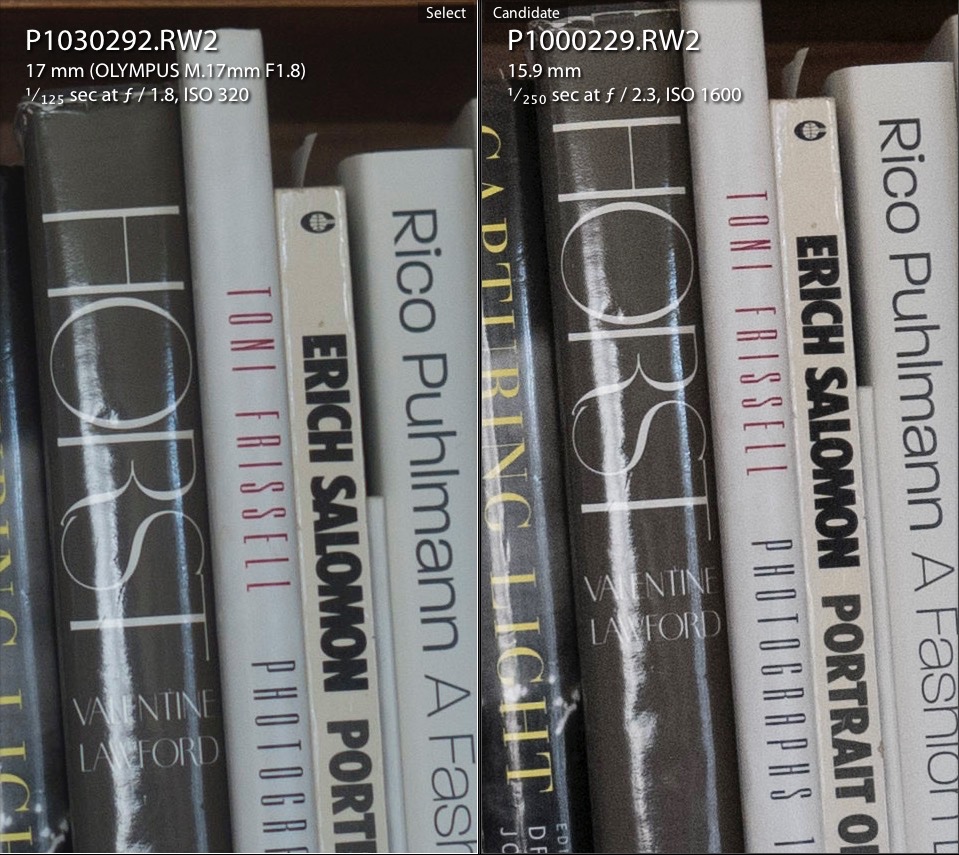
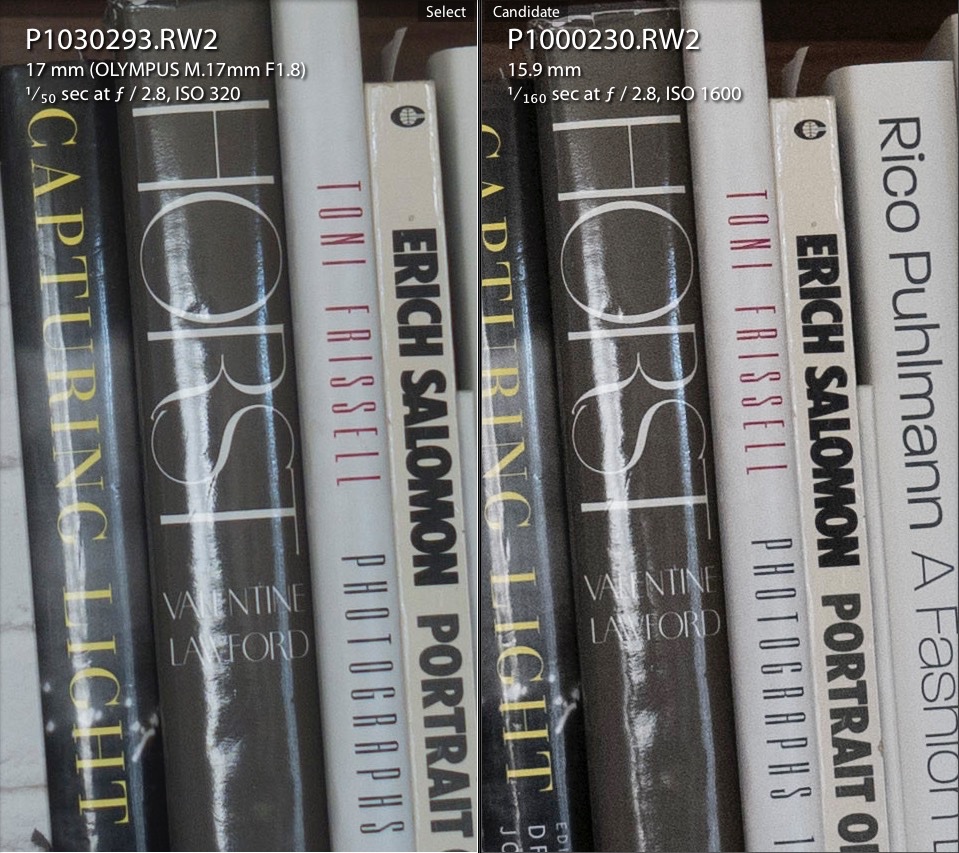
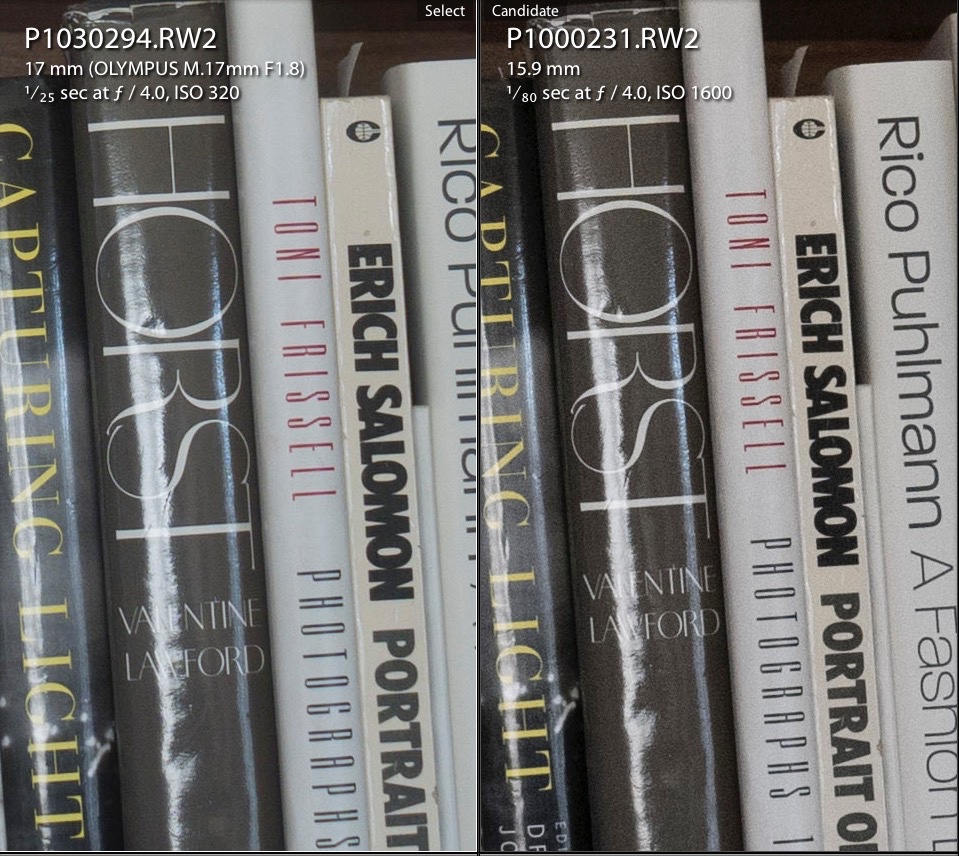
Now here’s the real shocker. Long time readers know I favor a GX7 with the 17mm f/1.8 Olympus MFT Zuiko most of the time, with a second GX7 body with the 45mm f/1.8 Zuiko MFT in a shoulder bag for the occasional close-up. Given that I favor the (17)/35mm lens, it made sense to do a comparison under controlled conditions to confirm what I suspected. And that is that the Leica optic on the LX100 yields nothing to the outstanding Olympus 17mm lens. Using a bookshelf at home here are the comparisons. The GX7 is at the left in all these examples and no processing or sharpening of any kind was applied in these RAW images, shown in LR5.

Center at f/2, f/2.8 and f/4:

Corner at f/2, f/2.8 and f/4:

The 35mm setting on the LX100 comes with a maximum aperture of f/2.3 against the Zuiko’s f/1.8, an immaterial 0.5 stop difference.

Overall the Leica zoom on the LX100 is marginally better at all stops in the center, the Oly Zuiko marginally better in the corner, but as you can see from the above sections of what would be 30″ x 20″ prints, the differences are vanishingly small. I used 1600ISO for the LX100 snaps (by mistake) and the absence of grain and noise is remarkable. The cameras were on a very sturdy tripod, the vibrationless electronic shutter was used, and the shutter was released with the self timer to make sure all was still. Central area, single point AF was used for all images.

The different baseplate design of the LX100 means that you will be unable to open the battery/SDHC card door with even the smallest of Arca tripod plates fitted. It has to be removed if either is to be swapped. The GX7 has an angled door which clears the plate.

So if the 24-75mm zoom range solves for you, there is little justification in buying a body with interchangeable lenses with all the futzing around and dirt issues that entails. The LX100 has all you need with a lens that matches the best fixed focus optics available for the MFT format, is a very wide 24mm at its widest setting and the whole package can just be squeezed into a generously sized pocket with the lens collapsed.


Though smaller than the GX7, the LX100 (lower) has superior ergonomics owing
to the plethora of manual controls and the extended thumb grip on the rear.
The serrated dial at lower right is also a rotary control.

The modern Leica is here, and it’s made by Panasonic.


Indeed. This is true.

The Panasonic LX100 in use

Outstanding.

I first made mention of this camera a while back when it was introduced. The appeal was obvious – a fixed lens with a 24-75mm zoom range comes with a very fast aperture range of f/1.7 to f/2.8 at the long end. The zoom range is ideal, with the short end being very wide indeed and the long perfect for head and shoulder portraits which isolate the background. That’s not easy to do with most MFT lenses where smaller apertures tend to leave everything in focus.

Search the lens range for better quality zooms for Panny and Oly MFT bodies and you can have the Panny 12-35mm f/2.8 for $1,000 or the Oly 12-40mm f/2.8 for a like amount. By contrast, the LX100 with a lens which is 1.5 stops faster at the wide end, and the same speed when extended, runs just $900, plus another $30 for the nifty petal lens cap which opens and closes automatically as the camera is turned on or off. All of this comes in a far smaller package than with a detachable lens, with the added benefit of dust sealing. The lens cap mechanism is purely mechanical, the sprung leaves being pushed open by the front of the lens barrel and while somewhat ungainly looking when open, the petals do not compromise handling. The LX100 weighs 13.9 ozs, whereas the two detachable zooms for the GX7 weigh 10.8 ozs and 13.5 ozs, respectively. So the LX100 complete with a faster lens – a Leica design made by Panny – weighs considerably less than a body plus detachable zoom.


Panasonic LX100 beside the GX7 with the 17mm f/1.8 Olympus Zuiko fitted.
The AF/MF lever is just visible to the right of the aspect ratio one.

The LX100 shown above is my son’s, a Christmas gift to recognize his growing prowess as a photographer. Winston had a chance to wring out the camera over the holidays and every exposure on his first ‘roll’ was perfect. We left the camera as shipped, which means everything on Auto, with the sole change that images would be recorded in JPEG + RAW. The 64GB UD SDHC card will accommodate over 2,200 of such image pairs, and the limitation is the small battery, the same as the one used in the GX7. That’s good – an identical charger is used – and bad – the capacity is not great. Spares are a must, especially if making movies.

There are a couple of differences compared with the GX7. There’s no tilting LED screen or eyepiece (I find the latter of little use), and the flash is a clip on accessory, rather than being built in. That’s a shame. As with the GX7, ergonomics are superb, the body handling well in large or small hands despite its small size. Best of all the lens barrel extends (to 24mm) when the camera is turned on in a very fast 1 second, meaning that by the time you have it raised to your eye the body is ready to shoot. The zoom lever is atop and nicely balanced between speed and control. A manual zoom ring would be even nicer – perhaps on the Mark II version?

Where the ergonomics really excel is in the raft of manual controls – aperture, shutter speed, exposure compensation (so welcome, that one), aspect ratio, focus and shutter speed, all clearly visible in the image above. All the controls are ‘Leica quality’, the detents being engineered just so and a pleasure to operate. Mercifully the ugly black barrel on the chrome version (see the linked earlier piece, above) has been replaced by a chrome one in the production camera and Winston opted for chrome when asked whether he preferred the black body. The lens collapses shut after a couple of minutes of non-use. Engineering quality, fit and finish throughout is as good as it gets, the whole camera having a jeweled precision seldom encountered in consumer products. I would say that it is subjectively a step up in quality from the already excellent GX7 body.

Manual focus has to be the best implementation yet. Switch to MF and as you twist the focus ring the image is magnified making correct focus a breeze. This is further helped by focus peaking, the sharp parts of the image outlined in blue shimmering lines. Perfection and very fast into the bargain. I much prefer AF ‘focus and recompose’, which is an available option, but for the manual focus maven this is as good as it gets.

With the growing complexity of modern digital cameras there’s some sense to sticking with one manufacturer’s products as the chances are that menu designs will be similar. Such is the case here and after years with Panny’s G1, G3 and a brace of GX7s I felt immediately at home, making instructing Winston a breeze.

Optical quality is excellent at all apertures and focal lengths. It’s easy to switch to manual aperture where the f/2.8 setting at 75mm easily isolates backgrounds.


Winnie plays hard to get. At 75mm and f/2.8 – backgrounds blur easily.

Winston is learning to process images in Lightroom, and version 5.7 of that application recognizes and processes the RAW format from the LX100 seamlessly. It’s rally hard to think why any user would not opt for the superior flexibility of RAW file capture.


Pine Inn, Carmel. Image taken on the LX100 and processed in LR by my son.

It’s hard to think of a more capable camera for many genres of snappers. Be it street snapper, manual control aficionado, landscape artist, movie maker, you name it, the LX100 comes with a crackerjack, fast zoom, fluid operation, wonderful ergonomics, outstanding engineering and manual controls, all at a bargain price. For silent operation the superb electronic shutter option from the GX7 is carried over and works every bit as well. The funky lens cap obviates the need for protective filters on the outstanding Leica-designed fast zoom.

Unless you need ultra wide or very long optics, the LX100 provides an optimal focal length range with fast apertures throughout. Until the iPhone comes out with an optical zoom – likely very soon – it’s hard to imagine a more capable camera in so small a body. Large prints from MFT, as oft illustrated here, are a breeze.

For a closer look, with lens comparisons to the GX7 with the excellent fixed focus 17mm Zuiko MFT lens, please click here.