Computer of the Year

It’s the one you always have with you.

Forget Apple’s overpriced offerings, high heat output and poor reliability. Get a netbook for a fraction of the price and enjoy the matte screen with which it comes standard.

The netbook is my Computer of the Year for photographers and anyone whose life is data intensive. Mine is the MSI WInd but any netbook pretty much does the trick.
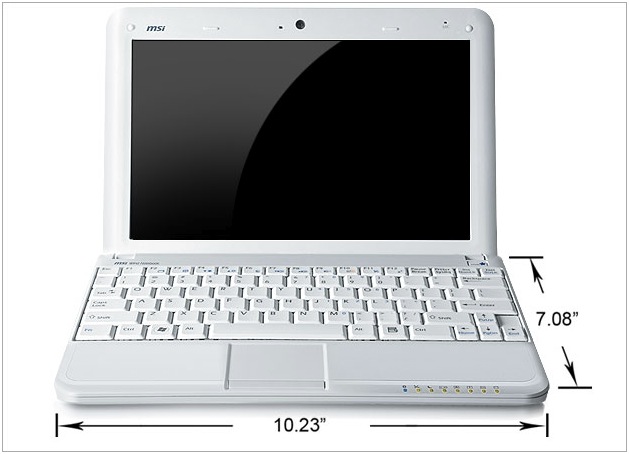
The MSI Wind U100

Your $330 gets you a 10″ screen, a 5 hour 6-cell battery, three USB2 and one Ethernet port, a webcam and microphone, wi-fi, VGA out, external speaker and headphone sockets and an SDHC card reader, together with a carrying case and weighing all of 2.8 lbs. It’s almost light enough to take anywhere. Doubtless next year’s model will be even lighter. And the hard plastic case absorbs knocks far better than a metal one, does not dent and wears exceptionally well. And you get a choice of colors. Mine is pearl white.

‘Experts’ – who never seem to use the devices they pontificate about – will tell you its garbage, falls apart in no time, has a lousy screen, is slow, etc. Let me correct all of that. I have 53 weeks of extremely hard use on mine as of the time of writing and, except that the logos above the status lights on the lower right of the palm rest have worn off, it works as perfectly as when it was new. The screen is simply outstanding, the near-full size keyboard almost as good, it runs very cool and the reliability has been faultless.

How abut the OS problem? The Wind, like most netbooks, comes with Windows XP, though you can get it with Ubuntu if Unix is your thing. If you must run OS X the Wind can be hacked with some effort. (How? It’s called Google.) If you want to make things even easier get a Dell Mini 10v and hack that – much simpler (I am assured by people far smarter than I in these things) and even cheaper at $279, postage paid from Dell. The Dell will even run wifi using Airport, without any need to change the wifi card. New netbooks are now sporting Windows 7 which has garnered good reviews – who knows, maybe Microsoft finally got it right?

What is the purpose of such a device? It’s quicker to say what it is not good for. Long Photoshop or Lightroom sessions or movie editing which dictate processing power and a properly profiled screen are not its forte. But as a truly portable device which will store any number of photos from your digital camera on the road and allow proper preview and culling of bad snaps it excels, using the built-in SDHC card reader. For CF cards from my 5D I use a small adapter which ran me a few dollars.

There is little justification in buying one of those small screen downloaders cum hard disk devices when you can have the 10″ widescreen a netbook offers. Best of all, its half the weight of a notebook computer and its low power consumption Intel Atom CPU puts out very little heat, meaning your lap does not fry after 10 minutes of use. With the Wind you can crank up the 1.6gHz Atom CPU to run at 2.0gHz at the touch of a button when connected to the mains. That’s a feature supported by Intel and does not void the warranty. And you can swap out the battery in a few seconds for a fresh one.

I use mine mostly for following news and stocks on the road and have lost track of the number of trades I have placed using this fine tool. And at $330 if you lose it who cares, as long as you use password protection for your accounts and data? By default it comes with a 160gB HDD but I swapped mine for a 500gB one from my MacBook and upped the standard memory from 1gB to 1.5gB – it will handle 2gB. Lightroom 2 runs fine if not super fast and I have even used CS2 on occasion. The speed of both applications is comparable to what I remember enjoying on my G5 iMac a few years ago.

MSI Wind running Lightroom 2 quite happily.

There are lots of choices in the netbook market at around the same price, and I have no axe to grind for MSI’s version (of which there seem to be many) other than to say that it works well, and that I sold my MacBook within one month of getting my Wind. Make of that what you will. I do not believe it makes sense to buy a costlier device as something better will come along in a year and you will have lost more than you should. Give it to your kids and buy the latest model in a year. The only aftermarket accessory I added to mine, after the HDD and RAM, was an international power brick which will work with non-US sockets – a few dollars on eBay.

Netbooks have no optical disk drive so if you must view movies on the road simply rip them to the HDD using your desktop computer. Place them on an 8gB $20 SDHC card which will hold several. Mine will play two full length uncompressed movies on a charge and delivers excellent sound quality using earphones. The screen is 1024×600 pixels which is identical in aspect ratio to the widescreen format adopted by most movies today. The on board speakers are worthless if good sound is required. An add-on drive is too power hungry and too bulky, defeating the point of a netbook – instant computing anywhere.

The built in camera won’t make you look like a supermodel but works fine for video chats.

The netbook computer has destroyed profit margins in the small computer business – the reason Apple refuses to make one – and I recommend it without reservation if you value utility over fashion and believe, as I do, that real computing is done at home using a big screen, not a laptop.

Note: This site is optimized – as best as possible – for viewing on a 1024 x 600 notebook screen. That’s a bit of a squeeze as my preferred picture size is 800 pixels on the long side – meaning I can just about get it all in with landscape snaps – but dictates some scrolling with portraits. If you turn off the status (bottom) and bookmark (top) bars in your browser it’s even better. Laptops are generally 1280 x 800 or so, and should pose no issues.
Software of the Year

For anyone suffering from data overload.

There’s that old saw which has it that two workers turn up at your house to build a new wooden staircase. One is from the old world, makes a big pitch about how he only uses hand tools and the crafts he learned from his grandfather and probably has a missing digit to prove it. The other asks where he can plug in his saw bench. Which do you hire?

The investment world’s version of this tale is the old line manager who consults the paper copy of the Wall Street Journal, gets the Financial Times delivered for world news and reminds you that’s how they used to do it on Wall Street when he was learning the trade from his dad. The new kid refuses to meet with you, stating his time is too precious, and sets up a videoconference instead, during which he constantly consults one of a half dozen monitors to see how things are going in the markets.

Well, the answer is the same in both cases. The old guy loses the job. Time is money and he will end up costing you too much of both. And the young guy’s work will not only be faster and much more accurate, he can correct three mistakes while the old boy is still sharpening his hand tools.

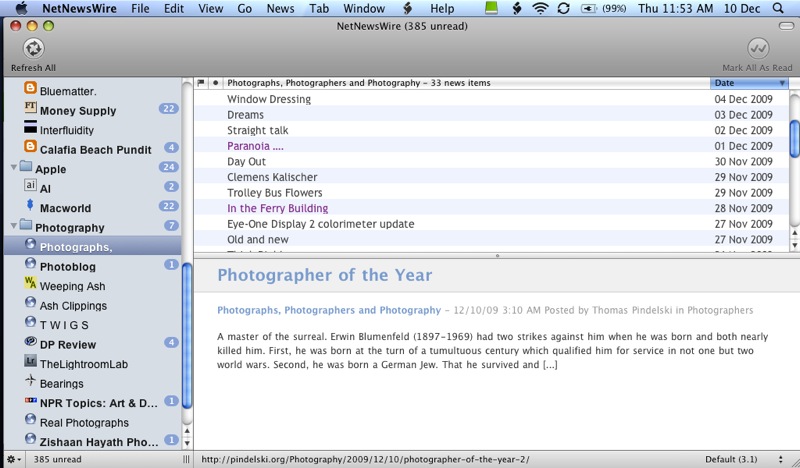
This preamble is perfectly in context of this year’s Software of the Year award which is for NetNewsWire.

NetNewsWire

No matter what your interest, NetNewsWire will leverage your time just as effectively as the electric saw leverages the carpenter’s.

A case in point is the increasing frequency with which camera and lens software is updated by manufacturers. New features are added and existing problems fixed. If you have NetNewsWire tuned in to any of the many web sites addressing these things, using an RSS feed you can be assured of not missing these important updates. For example, Panasonic and Canon – whose products I use – have released several camera and lens software updates this year alone. I may not need them all but it’s nice to know they are installed if I do. On a related topic, keen photographers read many web sites and can avoid wasting time checking for new articles through the simple process of using NetNewsWire and a site’s RSS feed. If the site lacks an RSS feed, why bother with it? Clearly, the author cares little whether you read it or not as he cannot be bothered to draw your attention to new content.

This year NetNewsWIre started using Google Reader as its feed engine and has, as a result, become much more reliable. In particular its syncing of feeds between multiple devices is greatly improved. Thus, when I read an article on, say, my netbook, I am assured that its ‘read’ status is updated on my desktop and iPhone. That’s worth a lot to me.

After a while you quickly filter your feeds, separating gold from dross. And if, like me, you manage money for a living, you are in seventh heaven, because that’s a business where dross is dominant.

NetNewsWire is a free download and is this photographer’s Software of the Year. It only runs on Macs but there are doubtless like products for users of other operating systems. Whether you are a photographer or a data fiend who values his time, this application deserves to be on your computer(s).

Once you have loaded NetNewsWire on your Mac, just click the RSS logo in the toolbar of your browser and the feed will be automatically added.

Photographer of the Year – 2009

A master of the surreal.

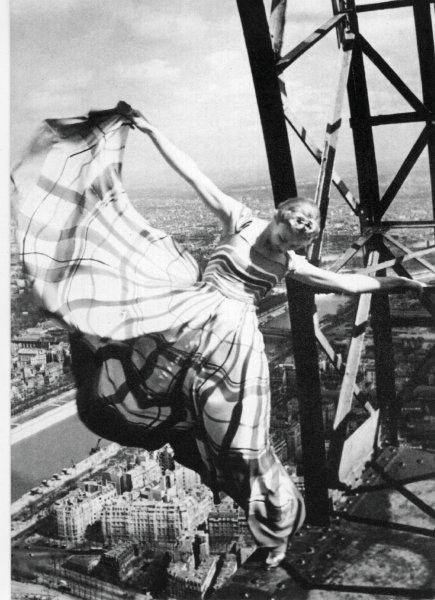
Erwin Blumenfeld (1897-1969) had two strikes against him when he was born and both nearly killed him. First, he was born at the turn of a tumultuous century which qualified him for service in not one but two world wars. Second, he was born a German Jew.

That he survived and went on to become maybe the most original fashion photographer of the 1950s is a miracle best understood by reading his autobiography Eye to I, which is not so much about photography as it is about survival. The most arresting fact in his memoir is that not for one moment is there a scintilla of self-pity in a life whose privations exceed anything anyone reading this could possibly imagine or experience.

That Blumenfeld survived his Prussian upbringing, under a mother who would rather see him die in the five year long massacre known as World War I than desert to Holland, is amazing enough. Quite why his mother felt this way in a nation of rabid anti-Semites is hard to understand, yet that was her reaction when the young Erwin declared he was going to get the hell out of hell. In the event he failed, barely surviving execution only to see the armistice declared soon after. As he relates it, despite seeing the worst possible service as an ambulance driver, he fired his revolver but once, killing a Saint Bernard dog carrying a boot in its mouth. The owner’s leg was still inside ….

The next 15 years were spent aimlessly in a Bohemian existence in Holland with his wife where the only thing of note that happened is that his handbag store went broke and he discovered that it used to be a photographer’s studio. The nascent photographic soul was ignited. That’s so typical of much of his life where little was planned and much happened. Shortly after he decides the foul climate and unstimulating cultural atmosphere of this nation of burghers was too much and decamps to Paris, where he starts to make headway as a portait photographer. So he comes to photography more than half way through his life!

Miraculously, Cecil Beaton sees one of his society portraits and next thing Blumenfeld knows Beaton has opened the door to Vogue Paris for him. Thence he segues to Harpers’ Bazaar in New York where his work is instantly recognized for its originality and vision, but he returns to Paris tragically just in time to see World War II break out. Timing was not his strong point. Before he knows it he’s in a concentration camp for German nationals run by the French who are about to be overrun, which would have meant certain death for the photographer. He somehow makes his way to Marseilles and after a journey from hell ends up again in New York City. His picture of a murderous Hitler is subsequently dropped by the USAF on Germany by the bushel in the mistaken belief that decent people would revolt at what their government was doing. Quixotic in the extreme when you realize it was that same citizenry who let their government come to power, watching with approval as Europe was overrun. The rest is history as he goes on to fame and fortune as one of the most renowned photographers at Harpers and Vogue the world has seen. Not surprisingly, he shared his New York studio with fellow refugee Martin Munkácsi. Can there ever have been so much talent in so small a space?

Here, then, are some examples of Blumenfeld’s work to savor. There are few books about his work, one of the best being the one I reviewed here.

A lyrical image from 1938.

Political propaganda picture used by the US

Red cross

Typical Blumenfeld vision.

Maybe Blumenfeld’s most famous cover picture. Simplicity defined.

Erwin Blumenfeld is this photographer’s Photographer of the Year.

Camera of the Year

A slam dunk.

It’s rather disingenuous to pronounce any camera as my ‘Camera of the Year’ as that implies I buy dozens of different ones and use each extensively. That’s obviously not the case. Not only do I have a day job, but I question how any photographer can really thoroughly wring out more than one or two cameras a year and lay claim to expertise on the subject.

If your thing is comparing the definition of brick walls and optical test charts for equipment, you need to go elsewhere. I am anything but an equipment tester or collector, and use my cameras to take pictures. When something more suitable comes along, I get it. Through 2008 I have been using – and continue to use – a Canon 5D (for big prints) and a Panasonic LX1 for small pockets.

No one camera can do everything, further casting doubt on the ‘Camera of the Year’ appellation. My primary interest is street photography and the dictates for my street camera are:

  • Speed of response
  • Choice of automation
  • Small
  • Light
  • Low noise – the camera and its images
  • A decent zoom lens which obviates lens changing
  • Well enough made to survive the occasional knock or two
  • A design that thinks outside the box

The result is a slam dunk and no surprise to frequent visitors here.

Camera of the Year – the Panasonic G1

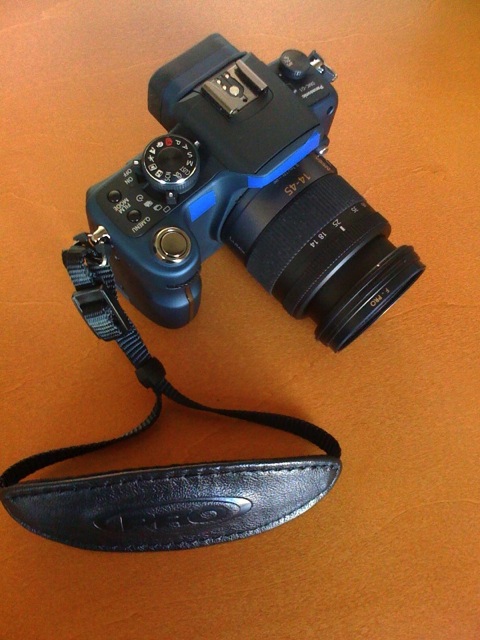
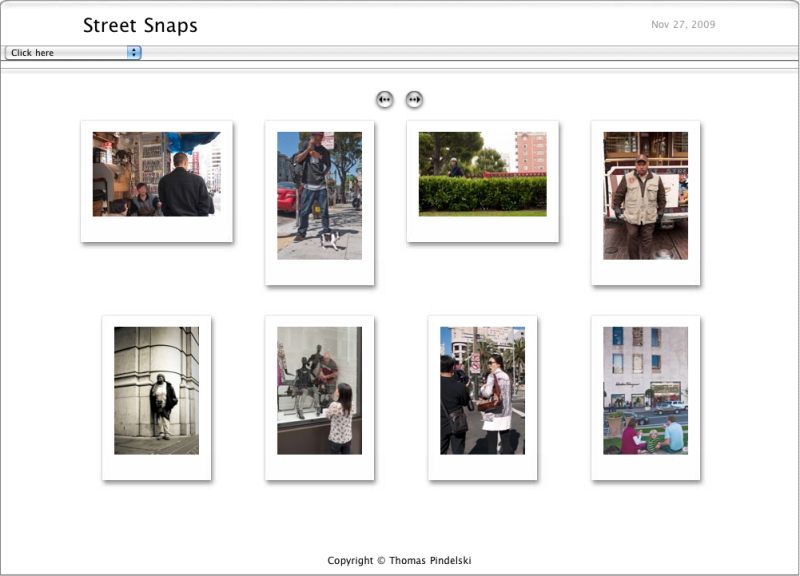
Regular readers will know that the Panasonic G1 with its superb kit lens has become a firm favorite for street snaps here at chez Pindelski. I like to put money where my eye is, so to see a selection of snaps taken over past few months using my blue (!) G1 please click the picture below.

This camera, with its outstandingly small size and excellent electronic viewfinder, easily fulfills the above check list and, best of all, it works better than any street camera I have used over the past four decades, most of which were spent with M2 and M3 Leicas, the previous standard. I have taken four thousand pictures with mine and the only sign of wear is that a small bit of the blue rubberized covering has rubbed off on the lower left rear LCD hinge. Incidentally, I never use the LCD for taking pictures, just the EVF. Otherwise, all is well.

Could it be better? Of course. Scrap the faux prism hump and the flash unit and move the EVF off to the left of a flat top plate. Then drop all the silly settings (landscape, portrait, etc.), and make the front dial less susceptible to accidental movement. Move the ISO setting to a physical dial on the top left. A faster lens? Well, if Panny sees fit to add OIS shake reduction to the 20mm f/1.7 put me down for one. Meanwhile, I need all the OIS I can get so the 14-45mm OIS kit lens does fine. It just happens to be one of the best lenses I have ever used, given its design compromises, and I mostly use it at full aperture. Best of all, if you get mugged and lose the camera, your loss is modest if not painless. Mine cost under $650.

Processing? I have not tried the included software, simply importing all images into Lightroom 2 on my Mac. Whatever processing the camera and Lightroom perform, the distortion levels in the imported images are the lowest for a zoom lens I have encountered. I always use RAW and with Lightroom it’s as easy as using JPG with all the advantages RAW offers. If you decide to get a G1 and use Aperture, get Lightroom. Aperture still does not support the G1/GH1/GF1 which, given that the G1 has been out for some fifteen months now, probably means it never will. So unless you want to go through the time and space wasting process of converting all your files from RAW to DNG before import to Aperture, do yourself a favor and buy Lightroom, which will run far faster on your computer of choice and works as well in Windows as in OS X.

Some ages ago (30 months to be exact which is an age in the digital photography world) I wrote when ruminating about the future of lens design (paraphrased for the G1):

So, supposing I want a 24-105mm f/2. That would translate to a 12mm – 50mm lens on a small digital body which, fully corrected, would doubtless be a lot bulkier than the current kit lens. Now throw out the large front element, there to reduce vignetting. Get rid of several of the others there to confer minimal color fringing. And the hell with barrel distortion. Curvature of field and all those insurmountable problems with edge pixels and wide angle lenses? Nonsense. Just bow the edges of the sensor towards the lens as the focal length changes. Flexible sensors? Why not? Zoom? The next generation of sensors will obsolete optical zooming and do it all electronically. About time. Program around all of that with some smart software, fix the image on the fly when saving (or even when viewing if it’s that horrible to look at) and your 24-105mm f/2 zoom is now 1″ in diameter and 2″ long. Wow! So we gradually return to the days of the Box Brownie with its miniscule single meniscus lens, but with an image readily enlarged 12 times or more.

And who will be the genius designing these new ‘lenses’? It won’t be a god the likes of Max Berek or Walter Mandler in Wetzlar. It will be some kid who is really sharp at coding who happens to like a superb picture from the one ounce piece of plastic passing for a lens attached to his camera. The great days of optics are yet to come and their designs will emanate from the keyboard of some unknown master even now getting his lips around the teat on that plastic milk bottle.”

Panasonic and Adobe have opened that door with their software processing for the G1. The future is exciting and the G1 is on the cusp of that future. One of the advertising slogans for early 35mm film cameras was “Small camera, large picture”. The rangefinder Leica improved on that with robust engineering which could sustain extended hard use. I believe that Micro-4/3rds format cameras like the Panasonic G1 update that concept for the digital age and enhance the flexibility and versatility of those Leicas of old by an order of magnitude.

If street candids are your thing and you like your equipment responsive, automated, small and exceptionally unobtrusive with a wonderful kit lens, I recommend a G1 without qualification. For the jaded street snapper who wants the best there is for relatively little money, this is one camera for the short list. It is simply a breath of fresh air and will get your creative juices flowing once more.

The Power of Contrast

It heightens comparisons.

No one seriously interested in women can have failed to notice the disproportionate frequency with which a gorgeous one will be seen with, well, a real dog.

This is no accident.

The dog wants to be seen with beauty, hoping some rubs off, while the stunner heightens her appeal by comparison when hanging out with the woofer.

Case in point:

G1, kit lens.

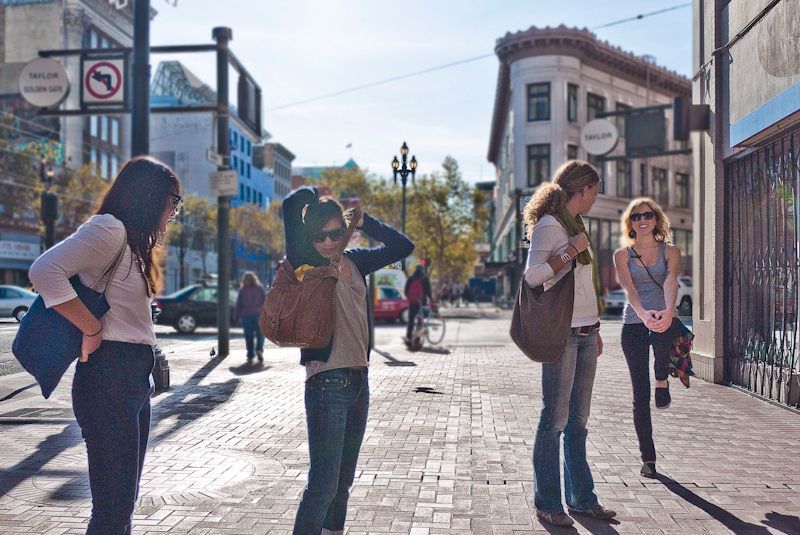
This gorgeous young woman had some sort of crick in her knee – or not – and was making quite a production of it. Her three dowdy friends were knocking her performance, but they were not her audience. I was.

Most enjoyable. And the lovely light, right into the lens, only heightens the impression.