Photographs, Photographers and Photography

August 3, 2009

From light to bulk

Filed under: 5D, G1/G2 — Thomas Pindelski @ 5:23 am

Quite a contrast

I took our boy to a show of Russian and Chinese 1950-era aircraft the past weekend and, because detail was the order of the day, took along the 5D and a couple of lenses.

Quite a change from the G1 when it comes to bulk and weight!

The 5D has marginally better shutter and focus response, though unless sports action is your thing, it’s not a significant difference. On the other hand, the 5D is much noisier (the camera, not the images!) and of course weighs several times as much. The 5D’s viewfinder seems positively dim after the G1’s EVF, although it renders colors and dynamic range more realistically outdoors. Indoors, while the G1 may show some noise, it is in a different league. I simply fail to understand why so many commentators have criticized the G1’s EVF for noise in poor light. Which would you prefer? A dim image in a 5D or like camera, or a really bright and easily discerned one in the G1 with a touch of noise? No contest. Maybe these critics should try to take pictures with their charges?


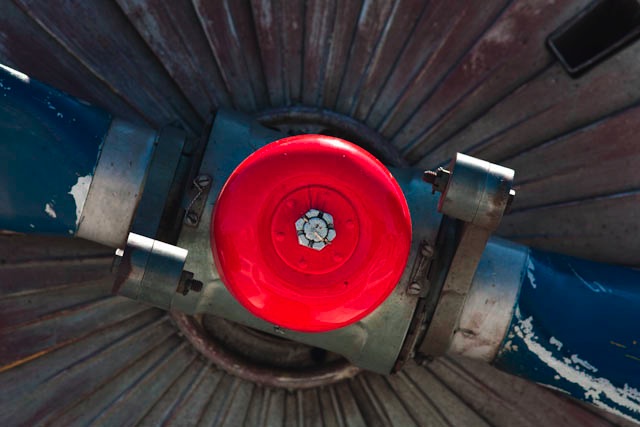
Commie prop. 5D, 200mm ‘L’ at f/3.5, ISO 250

It was an interesting exercise. Simply stated, comparing digital and film eras, the 5D is to medium format what the G1 is to the Leica M. With the 5D grain is not an issue and just about anything you snap will enlarge to a print size of choice. The G1, like 35mm film equipment, needs greater care. If you are going to push the size of your prints and the ISO setting, be prepared for compromises. The difference is likely to be less as time passes and technology marches on. While film peaked in quality years ago, digital is just getting started.

Which reminds me. I have to send the 5D in for cleaning. The viewfinder is now so filthy from three years’ accumulated dirt, that it’s getting quite bothersome to use. The dust sealing in this camera is seemingly non-existent. Let’s hope the G1 is better. At least I’ll have something to bang away with while the 5D is in hospital.

January 13, 2009

SDHC cards in the Canon 5D

Filed under: 5D — Thomas Pindelski @ 8:36 am

Some surprising results.

SDHC cards are, let’s face it, the happening thing. With capacities up to 32gB and multiples of that in the offing in a postage stamp-sized medium, CF cards are not going anywhere. Add the fact that one vendor even offers an SDHC card with wireless transmission capability (though it does not support RAW files at the time of writing) and there’s reason to think that the greater bulk and inferior contact mechanism of the CF card (which depends on mating fragile pins with the card as opposed to the SDHC’s far more robust broad wipers) are headed for the technology waste bin. Finally, the burgoening netbook and flash memory markets are not about to use CF cards whereas every netbook and more devices have built-in SD card slots.

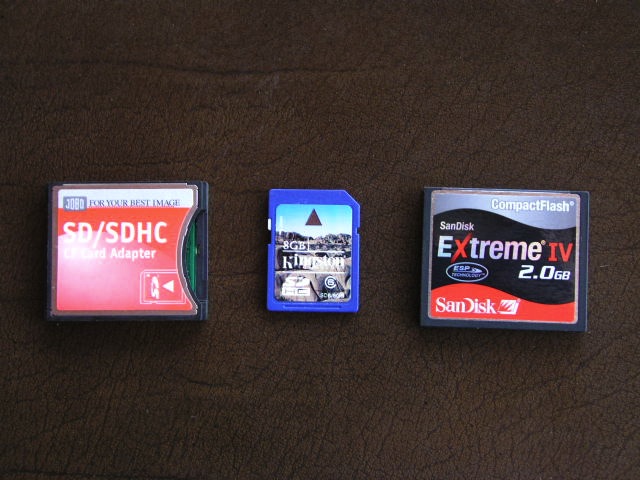
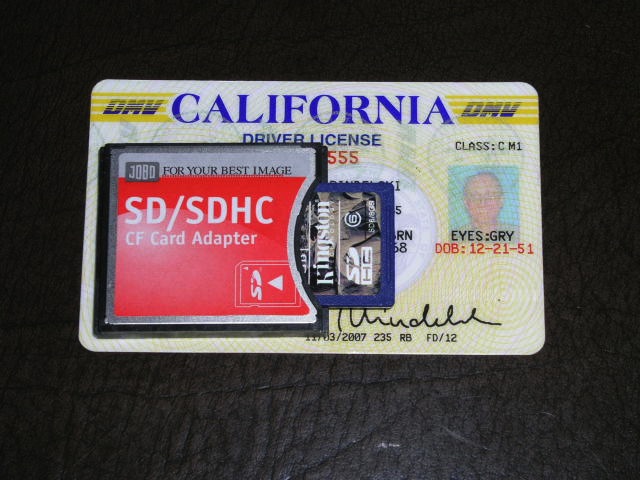
So, just for fun, I procured an inexpensive CF-SDHC card adapter ($25) and a bottom-of-the-line Kingston 8gB SDHC card ($18) and tried it in the 5D.


CF-SDHC Jobo card adapter, 8gB Kingston SDHC and 2gB Sandisk CF cards


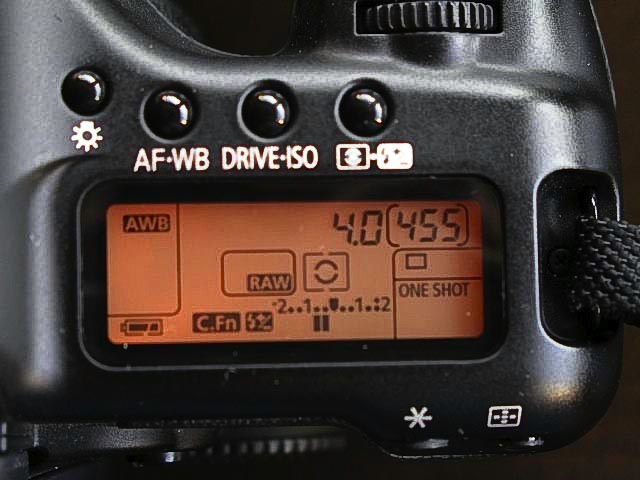
455 RAW images on one card!


Side loading of the SDHC card in the adapter


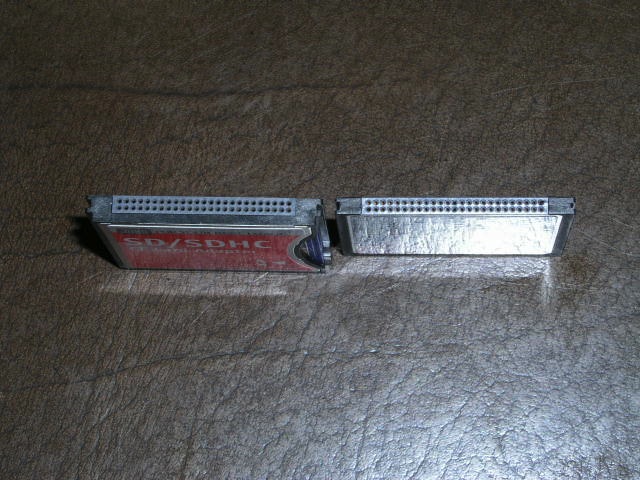
While thicker than a CF card, the adapter fits the Canon 5D fine

The comparison, for timings, was a top-of-the-line Sandisk Extreme IV. I expected write times to be much faster with the Extreme IV, and they were. Taking 10 snaps in rapid succession in RAW on the 5D, the red light (indicating write status) on the rear of the camera remained on 16 seconds with the Sandisk compared with 39 seconds for the SDHC+adapter combination after taking the last picture. So if serial shooting in vast quantities is your thing, look elsewhere – the 5D has a 17 image RAW buffer so rapid shooters will find themselves bumping up against this – and slowing snap to snap times – with slower cards.

However, when it came to importing the images into Lightroom 2 (I used a Firewire CF card reader for the Sandisk and a cheap Transcend USB reader for the Kingston), import timings were 28 seconds and 26 seconds respectively. The SDHC card was faster! By contrast placing the SDHC card in the CF adapter and using the Firewire reader took 34 seconds – slower still. So SDHC import using an SDHC USB reader beats CF in Firewire!

Why bother? Because I like to use a netbook (with its SDHC slot) on the road and the built in SDHC card reader is a joy to use – no card adapter to forget. And because fast write times mean little to me, I am quite happy to have 450+ pictures available on one card which also fits a broad gamut of other devices in the home. And, maybe one day, Eye-Fi will produce an SDHC card with wifi built-in which supports RAW files. You won’t be seeing that in the CF format any time soon.

My only niggle is that it would have been nice had the adapter been end- rather than side-loading as the design requires removal of the adapter from the 5D to permit removal of the card. But overall, this is a fine value and I would guess the slower write speed in the camera would be made up for by the use of faster cards, if that matters to you. For me, it’s not an issue.

November 13, 2008

Sensor cleaning on the cheap

Filed under: 5D — Thomas Pindelski @ 8:16 am

Don’t be ripped off.

It’s no great secret that the sensors in earlier DSLRs can get awfully dirty, the resulting blobs of black on your image testifying to the need for lots of retouching. Just like in the film days when you received your precious emulsion back from the processing place only to find that they had a party during which they stomped on your images with hobnailed boots.

So those of us not blessed with the latest in sensor dust removal technologies (meaning 5D Mark I and like vintage camera users) have to subject their camera to a nervy-dervy sensor cleaning to get the muck off and obviate the retouching. In the Canon 5D the sensior is protected by a sheet of quartz crystal – both hard and dust attracting. Now you can play into the hands of those marketers selling you Genuine Sensor Cleaning Kits for hundreds of dollars and what do you get?


A fool and his money are easily parted.

Why, a brush with some mumbo jumbo about how it’s grease free and assembled by Chinese virgins, and a bottle of isopropyl alcohol. Enough for ten cleanings.

Well, let me introduce you to Dr.Pindelski’s $15 DIY Economy Sensor Cleaning Kit. Enough for 10,000 cleanings.


The Dr. Pindelski $15 Sensor Cleaning Kit. The moiré pattern on the sensor is caused by the point-and-shoot used to take this.

Start with a Pearstone brush for $10, add a bottle of 91% Isopropyl Alcohol (you want the most concentrated, to avoid water deposits) and some Q tips from the bathroom – the genuine soft ones, not the hard generics. Do not use Kodak Lens Cleaner – this is a very poorly thought out product and is guaranteed to leave water stains on your sensor and those will be clearly visible, and near impossible to retouch, in your images.

Go outside, take a snap of the sky at a small aperture (set the camera to manual focus if the shutter refuses to fire) and load your CF or SD card into Lightroom. Increase contrast to the maximum and all the dirt blobs and deposits will show up clearly. Remember that what you see at the top right of the picture indicates dust at the lower left of the sensor and so on, as the image on the sensor is flipped and reversed once it has passed through the lens.

Now moisten a Kleenex (use plain ones, not those infused with lotions) with the Isopropyl and dab a Q tip in the moist area of the tissue, so that the Q tip is just moist. Do not touch the cotton on the Q tip with your dirty, greasy fingers. Sensors don’t like grease – or maybe they love it too much. Set the camera to Sensor Cleaning, remove the lens and dab the area concerned based on the sky picture you just snapped.. Then, holding the camera upside down, sensor pointing to the floor, brush the sensor with a flicking action using the brush. Reinsert the card and lens and take another picture. Repeat until clean.

My last cleaning dictated no fewer than four passes, the sensor cover glass being simply filthy after a couple of days snapping at the beach.

How hard to press on that Q tip? Well, the cover glass on the sensor is very tough and it would take a Mack truck driver to damage it, but pressure is not the answer. Gentle application in the right area is the secret. You want to dab and flick, not scrub. What I studiously avoid is using a blower brush on the sensor. All that does is stir up any existing dust in the body cavity only to propel it at 100mph+ into your sensor. You don’t really want to do that, do you?

Now you can apply that $245 saved to that new lens you were dreaming about.

If all you do with your images from that wonderful DSLR is to place them on the web at some 640×480 pixels, well, you can dispense with sensor cleaning as the dust spots will not show. Your DSLR is just like the Ferrari of the guy who runs it to the supermarket to be seen and to get some milk. Feels nice. Waste of money. Probably can’t drive either.

Warning to Leica M8 users: Early versions of this faux pas of a camera came with an unprotected sensor, under the guise of superior image quality or some such rot. If you have one of those, enjoy paying Leica $500 for a sensor cleaning because I doubt I would try that on an unprotected sensor in a $6,000 body. Later M8s come with a protective glass (New! Improved! etc.) once the factory realized its error, so the above technique should be fine. You will have to do something because the chances of Leica coming out with a self-cleaning sensor are about as likely as a black man in the Oval Office. Hey, wait a minute ….

October 28, 2008

A bargain and a classic

Filed under: 5D — Thomas Pindelski @ 7:54 am

The first classic of the digital age

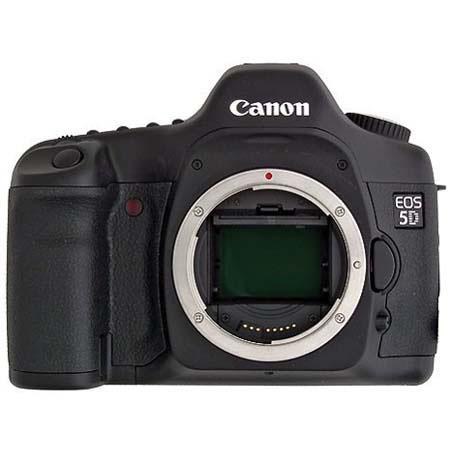
The Canon 5D was the first camera to bring semi-affordable full frame sensors to digital photographers and, I believe, will go down as one of the great classics of the early digital photography age, much as, say, medium format was defined by the Rolleiflex and 35mm film by the rangefinder Leica. The leap in image quality it offered from 35mm and the ability to regularly match medium format film for definition and detail with none of the pain of operation make it the greatest camera design of its time.

The new 5D Mark II is slated to arrive in the US around December and yet there is already a slew of lightly used 5D Mark I models for sale on the web. Maybe it’s the economy, but I would think the price will soften further once Mark II generates some serious upgrade volume.

Check the eCrook (aka eBay) site and you will see that completed auctions average about $1,300 for a mint condition lightly used body.

But I want the 21+ megapixel sensor in the new 5D Mark II, I hear you say, which begs the question why?

Do you propose making prints larger than 24″ x 30″? Do you want to use the movie mode? Is cleaning the dust off the sensor a real pain? Well, if you answered Yes to these, you may need the Mark II. No one else does.


Two classics – Canon 5D and Leica M3

September 29, 2008

Grain is dead

Filed under: 5D — Thomas Pindelski @ 10:30 am

From the Canon 5D Mark II.

Vince LaForet’s work with the new Canon 5D Mark II at 1600 and 3200 ISO confirms that, for all practical purposes, grain is dead.

Click the picture for large JPGs at high ISO speeds from the new Canon body. In many you will see color fringing near the corners suggesting Canon has some way to go to better Leica in its optics, albeit even L lenses are mostly chump change compared to those from Germany. The fringing (correctable in post processing in Lightroom or Aperture) is especially noticeable in the snaps taken with the 45mm TS-E and the 15mm Fisheye (which I own and love). High time Canon started adding in-camera processing to fix this sort of thing. Obviously, the body ‘knows’ which lens is mounted and it’s not like Canon is ignorant of the aberration patterns in their optics. Adding a lens ‘map’ for each lens doesn’t sound like nuclear physics.

What you will not see is grain.

It would seem that the resolving power of Canon’s latest sensor significantly exceeds that of many of its lenses. I would suggest that use of any of the consumer zooms on this body is a complete waste of time – the proverbial Coke bottle lens on a Hasselblad. The cheaper non-L primes are fine (I love the fisheye, the 50/1.4 and the 85/1.8) but ‘kit’ lenses are a no-no. Garbage in, garbage out.

So, if you want grain, you are going to have to add it at the processing stage!

September 21, 2008

Vince LaForet on the Canon 5D Mark II

Filed under: 5D — Thomas Pindelski @ 9:33 am

A real user – that I trust.

I haven written before of the exceptional commercial photography of Vince LaForet.

Click the picture to see LaForet’s first impressions of the still and movie modes of the 5D Mark II.

When a great commercial photographer extols the image quality of a camera, (”The 5D MKII camera produces the best stills in low light that I’ve ever seen – what you can see with you eye in the worst light (such as sodium-vapor street lights at 3 a.m. in Brooklyn) – this camera can capture it with ease.“) I tend to be somewhere between belief and skepticism. Is the writer conflicted? Does the manufacturer pay him with free gear or hard or soft dollars?

In LaForet’s case I trend to the belief end of the scale. He has too much great work out there to risk his reputation.

The intriguing thing about his blog entry is that he seems most enthused with the movie mode of the new camera. Who would have thought it? If he is right, then it is indeed a game changer – 1080p HD video from a DSLR! I don’t make movies (though the genre fascinates me) and don’t need the awesome low light capability, but for many these facets of the new body may put them on the upgrade path.

September 17, 2008

Canon EOS 5D Mark II

Filed under: 5D — Thomas Pindelski @ 7:49 am

No more speculation.

Hop over to DPReview for all the details you could possibly want on the new Canon EOS 5D Mark II.


The new camera looks less well balanced than the old, looking top heavy to my eyes

I speculated about the features a few days ago and was dead wrong in some important ways.

  • The sensor is 21 mp, similar to that in the top of the line 1Ds Mark III. Wonder how they are addressing the cannibalization of sales?
  • Price. $2,700 in the US, not $3,000. This will clobber used prices for the 5D, making that a very attractive entry into full frame digital.
  • Full weather sealing. Seems like they added it.

Here are some other features which add value:

  • Movie mode. If you don’t like it, don’t use it. Nice to have.
  • Highlight tone priority – cuts down on burned-out highlights.
  • An allegedly improved LCD screen. Given how awful the one in the 5D is it’s hard not to believe Canon on this one.
  • Three Custom modes, up from one. Great. Especially as that Print button is still there and still useless, though it now doubles for Live View.
  • ISO 25,600 maximum, which may work well with the improved sensor. We will see. If so the expense of ultra large aperture lenses can largely be avoided, as this is three stops faster than the 3,200 on the 5D.
  • Wireless file transmission using the new removable handgrip. Great for studio previews.
  • The ability to fine tune the focus setting for up to 20 lenses – a great way of keeping lens cost down by forcing the user to tune the lens to the body.

And yes, Canon has still to Fix that flap!

All in all, a worthwhile update and a boon for those looking to get a 5D whose used price will likely head south of $1,500 with the glut of amateurs updating for the latest and greatest. Don’t knock them. These gear heads are your friends. If you can live without the new features (sensor dust removal is nice!) then save $1200 and get a 5D.

September 10, 2008

Not in the Canon 5D Mark II

Filed under: 5D — Thomas Pindelski @ 9:46 am

Rumors abound – these you can be certain of.


Teaser ad on the Canon site

With all that speculation about the iminent replacement for the Canon 5D, here’s my list of things I can pretty much guarantee will not be in the 5D Mark II:

  • A 21mp sensor. No way. That would immediately cannibalize sales of the ultra-high margin 21mp 1Ds Mark III which goes for $8,000 a pop. And with the 11 mp in the 5D being as good as it is, reckon on no more than 16mp. Let’s hope they don’t muck up resolution in the process.
  • Ultra-high framing rates like in the 40D and 50D. Same reason as above.
  • Full weather sealing. No way no how. This camera is aimed at the advanced amateur snapper, not the pro in rain forests, even if a few rubber gaskets cost $1.50 to add.
  • Eye controlled focus. That’s the fabulous technology available in some late Canon film SLRs. The camera focuses where you look. (This still seems like magic to me). For some reason Canon have never added it to any of their DSLRs. Just imagine using something like Helicon Focus with eye controlled focus. Sight down your subject – click. Look a little further – click. Oh! wow. But not to be in the Mark II.
  • A smaller body. That would cost too much to re-engineer. Canon will add already mature and developed technologies like sensor dust removal and live view (ugh!) but a comprehensive re-engineering of the body would cost too much.
  • A change for that dumb Print button to make it useful – such as a mirror lock-up control. Someone at Canon has a real axe to grind for their printers (surprise!), so expect more of this silliness.
  • Lens aberration correction inside the camera’s software. See the first bullet point above.
  • A permanently attached vertical hand grip. That would look too ‘professional’ and adds needless bulk to an amateur’s camera. Indeed, one of the appealing aspects of the 5D is that it does not look professional – especially if you add some electrician’s tape to all those gauche logos.

Expect the announcement in late September at Photokina in Cologne.

August 27, 2008

Another 10 years?

Filed under: 5D — Thomas Pindelski @ 7:41 am

The law of diminishing returns kicks in.

A couple of years ago I wrote, with something approaching amazement, about the longevity of the Epson 1270 ink jet printer, dubbing it a Ten Year Digital Device. Indeed, that printer’s current owner will testify to the Epson’s longevity having just picked up a prize for one of his pictures printed on it. Sure, the nozzles clog if you don’t use it frequently and the inks fade in bright sun, but the quality of the prints cannot be disputed.


Canon 5D and friends. A ten year kit?

All of which prompts the question whether the Canon 5D has a similar life expectancy. Sure, it remains a current model and certainly it is not as fast or as slick as newer offerings from DSLR makers. It coasts along at a modest three frames/second, has no dust removal and lacks silly features like live previews. Now given that 3 fps is meaningless to me as I take one picture at a time and avoid sports photography, I can only question who really needs the insane framing rates available today, sports and fashion snappers apart? Live previews are a solution looking for a problem with DSLRs but, yes, dust removal from the sensor would be nice to have. But I can live without it, just as I learned to live with the 1270’s clogging nozzles.

Wear is not an issue for me. After 30 months with the 5D it reports that I am on frame 6,873. That figures to some 25,000 frames over ten years, well below the 100,000 life expectancy of the 5D’s shutter.

Definition is not an issue. The law of diminishing returns suggests that all those latest pixel-heavy sensors are running into noise issues, and that the modest 12.8 megapixels of the 5D make for a perfect compromise between definition and noise.

Sensor size is an issue. I like what I have. As I want my 20mm lens to be 20mm, not the 32mm that I would get with a cropped sensor, and I like the depth of field a standard lens offers on the big sensor, my alternatives are limited to full frame cameras of which there are but two from each of Nikon and Canon. It’s clear we will have more large sensor DSLRs (Sony is rumored to be releasing one soon) and choice is always a good thing but the bottom line is that the images from the 5D’s sensor are so crisp, noise free and well defined that trading for more pixels or a medium format sensor make no sense.

Build quality is fine, too. Doubtless the big Canon and Nikon offerings are tougher but I’m an amateur snapper, for heaven’s sake, and not a photojournalist in a war zone.

Lens choice is fine and will only get better. A really good 20mm would be nice, Canon’s wide primes being less than thrilling unless you get the ridiculously bulky and expensive ‘L’ variants. Unless Canon does something truly dumb – like changing the lens mount – I am set.

Dynamic range, the biggest bugaboo of digital cameras (as in they have too little), is something I have worked around. Under-expose 1/2-1 stop and bring things back as needed in Lightroom, and all is well. Further, there will have to be some serious breakthroughs in sensor technology before DSLRs start exhibiting enhanced dynamic range. So for now I watch the highlights and let the shadows look after themselves at the exposure stage. Much as in the Kodachrome days….

Given that digital was a joke ten years ago and has now plateaued at a level significantly higher than film, it’s foolish to try to predict what will be on offer ten years hence. That plateau was reached a few years back by the Canon 1Ds Mark I and the 5D. So until some shattering new technology comes along that offers the image quality of the 5D in a package half the size, weight and noise – and I’m not holding my breath – I’m going to stick my neck out and suggest that maybe the Canon 5D really is a ten year digital device. That’s assuming I am not completely gaga 7 years hence and can still lift a camera to eye level without wetting myself. No calling that one.

July 26, 2008

Canon sensors and the 5D

Filed under: 5D — Thomas Pindelski @ 10:45 am

Old but still topical.

I came across these two on my hard drive – both white papers were released by Canon about the time of the 5D’s debut and still make fascinating reading.

Download either PDF by clicking the pictures below.

Both are fairly lengthy, with the first having an especially interesting discussion of the development of CCD and CMOS sensors, clearly explaining the differences.

Why publish this now when the 5D is about to be updated and obsoleted? Because if you can live with the modest maximum framing rate and the absence of dust removal, I believe the 5D lightly used market will be flooded with cameras from upgraders and will, as a result, offer an enticing opportunity to enter the world of full frame imaging at a very attractive price. If your print size is limited to 24″ x 30″, you cannot go wrong with this body and sensor – just don’t use Canon’s truly execrable cheap zooms on it. A good sensor deserves the best glass – primes if you can swing it as no zoom compares to a like prime for definition and overall performance. Plus most of Canon’s primes are far cheaper than their L zooms and are generally superb – I use the 20mm (not so superb), the 15mm fish eye, the 50mm f/1.4, the 85mm f/1.8 and the 100mm macro. The last four are as good as anything I have used at any price and run $300-400 new, with lots of used bargains out there.

July 5, 2008

Bargain of the year

Filed under: 5D — Thomas Pindelski @ 7:57 am

The Canon 5D, that is.

The Canon 5D has now been on the market some three years. Mine, bought a few months after the introduction, cost $3,000 in 2006 money. Here’s B&H’s web site today:

Assuming 5% annual inflation (OK it’s really 15% but our government lies about it) I make that 40+% price drop, as the 5D Mk II replacement nears.

Given that, for this user, the difference between the Mark I and Mark II is a $10 sensor cleaning brush, given Mark I’s love of dust, that’s hardly a compelling reason to upgrade. After all, in the film days I made do with a 1960 Leica M3 for 30+ years, easily resisting the temptations of the M4/5/6/7 ‘upgrades’ which were less well made and cost a bundle. Sure, Mark II will have more pixels, but if I can get perfect large prints with Mark I why would I want one of these? The real enhancement digital sensors need is better dynamic range control and proper solution of that issue appears to be some way off yet. A smaller body like a Pentax DSLR would be nice, too, but I’m not holding my breath on that one. Recall that the small Olympus and Pentax film bodies – smaller than even cropped frame DSLRs today, were full frame snappers. I can only think that Macho Big outsells Chic Petite, hence the dearth of small DSLRs.

And for those looking to get into full frame digital at the lowest price, give Canon a short while to announce Mark II (likely identically priced as the new Nikon D700 competitor at $3,000) and you will be able to snap up a near mint used 5D for, what, $1,400 in the ensuing glut on the used market?

Just add $10 for that brush and you have the camera bargain of the year and large, sharp, grain-free prints to your heart’s content.


Bert the Border Terrier guards the latest batch of large prints from the 5D

Mark I shows every sign of being a decade-long keeper which, when you think about it, is an amazing statement given the rates of change in digital photography. It’s really that good.

March 31, 2008

Latest Canon 5D firmware

Filed under: 5D — Thomas Pindelski @ 7:17 am

Time to update.

Canon has released firmware 1.1.1 for the 5D.

Download is free and installation instructions are included.

Here are the changes:

Here’s the installation in progress:

For me the significant feature is that high capacity 8gB and 16gB cards are now supported. I’m not rushing out to buy these but it’s nice to know I can use them when Vogue calls for that special photo session with Elle McPherson.

The ‘new lenses’ referred to are these:

I somehow doubt any of these exotics will be darkening my gadget bag any time soon. And at the wide end, the Canon Fish-eye beats the pants off their 14mm ‘L’ lens at a fraction of the price and bulk – all you need is ImageAlign and Photoshop.

As for enhanced compatibility with DPP, I don’t use that so it adds no value in my case.

By the way, if you are contemplating purchase of a new camera, most manufacturers now make instruction manuals available on line and it is a good way of learning about features and limitations.

March 21, 2008

The real capacity of storage cards

Filed under: 5D — Thomas Pindelski @ 6:25 am

A welcome ‘feature’ of the 5D.

I mentioned a while back that I was moving to 2gB cards in the 5D, from the 1gB I started with.

The welcome capacity increase and falling price made sense.


With an empty 2 gB card

The 5D continues to dutifully reports room for 120 RAW pictures on a blank card, yet the other day I again noticed how low that estimate is. Obviously, the size of RAW files will vary depending on the scene, but the difference I noted is anything but insignificant.

Apple’s Disc Utility reports available space of 2.039gB on a formatted 2gB Extreme IV card, so that means Canon is assuming an average file size of almost 17mB per image in computing the above count. Nice that they use so large a size as it means they are erring on the side of safety.

Here’s the scoop:

That’s actually 140 images plus a count of two for the containing folders. And there’s still 350mB of free space left! Do the numbers and you come up with a capacity of 171 pictures, or 42% more than that original estimate. Of course, this will vary with the scene photographed, as more detail and color translates to a larger picture file size.

Now that’s a ‘feature’ I can handle any day.

Follow-up:

Check Comment #1 for a very interesting discussion of some of the underlying reasons for varying file sizes.

The pictures I was writing about in this case were studio photos taken with studio flash with just the subject’s eyes critically sharp (the 85mm Canon f/1.8 lens was used and 18″ x 24″ prints were a breeze to make and superb in every way) and everything else pretty much out of focus, so it seems the low ’sharp content’ correlates with the small file sizes. The 10mB file above was a blank where I pressed the button before the flash was ready to fire, so that would appear to be the base file size of a 5D image. The Comment suggests that, for identical subjects, two lenses of like focal length will result in the one with higher micro-contrast generating a larger file size – an interesting ‘test’ method for this variable.

March 20, 2008

Two years with the Canon 5D

Filed under: 5D — Thomas Pindelski @ 8:01 am

What’s good and what rankles.

It’s been some two years since I bought my Canon 5D, an appropriate milestone from which to reconsider what is good and bad about the decision.

Since then the price has come down significantly, meaning almost a 30% drop yet, amazingly, with other market segments seeing many model changes since, the 5D remains available and has not been upgraded. I have no idea how sales of this model compare with Canon’s other offerings, and I suppose you could argue that they haven’t made a replacement because sales are very high …. or very low.

I don’t care. It remains a quantum leap in making the picture taking process an easier one. Forget all the mind numbing choices in all those menus, the reality is that the chances of making a technically solid picture, sharp, properly focused and grain free have risen manyfold owing to this superb machine. Plus you can make a perfect print of any size you want from just about any frame. More time for seeing, less for worrying.

Things I like:

  • The 3:2 aspect ratio of the frame. I grew up with Leicas. It would be even nicer at 16:9 widescreen.
  • The large, uncluttered, near life-size, viewfinder.
  • The fact that the depth of field and coverage of a 50mm lens …. remain the depth of field and image coverage of a 50mm lens on a film camera.
  • The grain free sensor – the ISO adjustment is just another way of controlling aperture and shutter speed. I never worry about grain. If I need grain, something like this works.
  • The great selection of inexpensive Canon lenses – the non-zooms I own are mostly wonderful.
  • The lack of shutter lag – as good as a Leica M2 or M3.
  • Autofocus. With mediocre eyesight like mine the fabulous rangefinder in the Leicas is improved upon by modern technology. And it’s faster.
  • Spot focus/lock/recompose. Never another unsharp studio picture.
  • Auto exposure. Another impediment removed.
  • Spot exposure measurement for those difficult occasions.
  • The reliability. The 5D’s OS makes a Mac look like a dog. You never have to reboot.
  • The battery life. Simply incredible. Carrying a spare hardly seems necessary.
  • The 85mm f/1.8 EF Canon lens. The Leica Apo-Summicron Asph at a fraction of the cost.
  • How all that automation makes use with a 400mm Canon ‘L’ lens so easy.

Things I dislike:

  • The bulk. Bigger than my Leica Ms, it’s no joy to tramp around with.
  • The noise. Not bad, but silence would be nicer. The 5D’s shutter is what you hear when you login to this site.
  • An LCD screen which is unusable outdoors.
  • Poor auto white balance indoors but easily fixed with one click in Lightroom.
  • The attraction the sensor has for dust. I mitigate that by using (superior) non-zoom lenses, but that’s not the answer. Actually, it’s more the pump design of Canon’s 24-105mm zoom and poor dust sealing in the lens that seems to be to blame here.
  • The advertising – that big white ‘Canon’ logo and crass ‘5D’ sticker – both easily fixed with some black tape. You want me to advertise your goods you pay me, OK?
  • That criminally inept stock strap. Criminal, as the first thing it will do is make sure your camera falls off your shoulder.


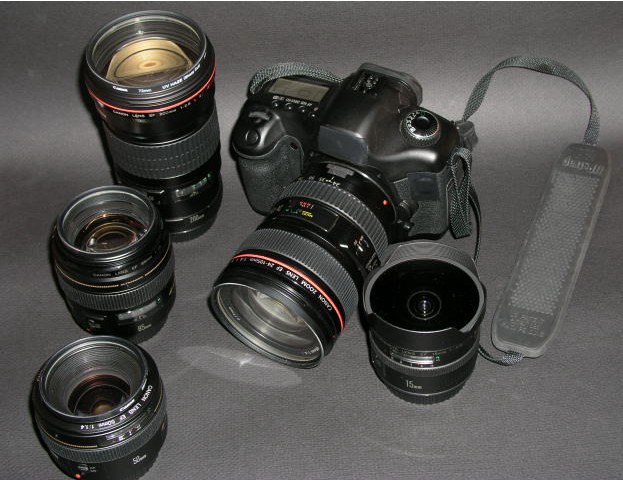
    5D and friends. Not a worthless lens hood in sight.

  • The fact that I take too many pictures. Digital makes you lazy, less selective. Good digital management in the likes of Lightroom helps. But nothing beats the Delete button.
  • That horrid flap.

But, taken as a whole, these really are minor gripes in exchange for the wonderful image quality.

The 5D will likely be updated/obsoleted any day now, but for this photographer it remains the bees’ knees. Would I buy it today in preference to anything else? Absolutely. The improvements in Mark II – sensor dust removal apart – will be visible to academics only. But the 5D (Mk. I or II) only makes sense if you like to make Really Large Prints. For web display even a 2 megapixel P&S is fine.


The Canon 5D. A new era in equipment.

February 23, 2008

A cheap remote for the Canon 5D

Filed under: 5D — Thomas Pindelski @ 8:11 am

Guess from where!

A wireless remote shutter release is a handy thing to have. I use one with an ancient Olympus 5050 for the Christmas family snap. That Olympus has more shutter delay than you want to know about, so it’s an exercise in frustration. Further, I would guess the much used Oly’s years are numbered (the plastic focus and zoom racks are the first to go in these P&S digitals) and whenever I want to include myself in a landscape picture it means resorting to the delayed action on the 5D (hell to find with all those buttons) and run for it to try and get my Olympian physique placed just so in the frame.

I ruminated about a Canon 5D remote but once I saw the price a beeline for the vodka bottle was called for.

And that one is wired! OK, so it has a timer and will probably make your breakfast, but at that price I’ll eat at MacDonald’s, thanks. I seem to remember they listed a wireless version for some $500 and if you read on you will cease wondering why it’s no longer available.

I remember thinking about the interminable delay of the Olympus when taking this year’s family snap (it’s been bugging me for years), and checked ePrey shortly after. Well for $10.99 and $11.99 shipping from Hong Kong I decided the risk was acceptable and as I have had nothing but success with the incredible studio flash remote I bought a while back, so I pressed the ‘Buy It Now’ button and forgot about the whole thing.

Well, it arrived today and I must say the gadget is totally awesome! It’s radio frequency, not line of sight, which translates to tremendous, non-directional range. And if interference is an issue (your brand new BMW starts itself and goes off the road, say) you have sixteen radio channels (16!) to choose from.

A CR-2 Lithium battery (provided) goes in the remote and the camera-end receiver comes with a 23A battery installed.

With the antenna extended the range is quoted at 320 feet! I gave up at 105 feet which is the length of my hallway (it’s raining outside so a longer distance was … out of range). With the antenna retracted, which makes the transmitter easily pocketable, I got 75 feet.


A couple of small pieces of Velcro keep the receiver attached to the LCD shade on the back of the 5D.

So if you need a wireless remote for your DSLR because you want to avoid shutter lag or you don’t want to risk a coronary while running into your landscape snap, blow $22.98 on one of these. I have not checked but I would bet that this device is made for most DSLRs out there. Heck, the DSLRs are made in China anyway, no? The picture on the box shows the receiver attached to a Nikon D200 and, if it helps, the inventory check-off tab on the box provides options for five different connectors, though I must disappoint you by disclosing that my Chinese is not up to snuff to make sense of these.

When you press the button on the transmitter, the first pressure gets you a green LED on the transmitter. That means the transmitter and its battery are working. This changes to red to on further pressure to indicate activation but be warned that it changes to red whether you are in range or not. To make the camera end functional, you do have to press the button on the receiver, one of whose LEDs will glow red when you do that. Fear not. The instructions state that the stand-by life of the receiver’s battery is 1,000 hours if you forget to switch it off. Based on my experience with the strobe remote, I tend to believe what they write. Further pressure on the transmitter button will make the second LED on the receiver glow red, indicating it has received the signal to fire the shutter.

Further, by pressing the button on the transmitter for 3 seconds with the camera set to bulb, the camera’s shutter will open and remain open until you press the transmitter’s button again. Use mirror lock-up and we are talking minimal vibration here.

There’s more. Set your camera for continuous shooting, hold the transmitter button for 3 seconds and the 5D (or whatever) will bang away until you press the transmitter button again. Maybe there is an option for making your breakfast after all?

It’s OK, you are not taking a job from an American by buying Chinese – the American can (and does) make more on unemployment.

Next year I get the wife to take the family snap and I get to tickle our son to make him smile. How’s that for pressure?

And yes, every time you try to open that wretched rubber flap on the 5D you will wonder how long it will take Messrs. Canon to Fix That Flap.

One final thought and a word of advice from the instruction sheet, and I quote: “When monitor light glitters, the battery will be vanished, change new battery”. You have been warned.

December 18, 2007

Canon 5D – time to wait

Filed under: 5D — Thomas Pindelski @ 9:07 am

A few months’ patience will save hundreds


It’s not hard to guess what the Mark II version of Canon’s 5D will be like. If the upgrades to the current pro (1D Mark III and 1Ds Mark III) and amateur (Digital Rebel, D40) models are any guide, expect to see sensor dust removal technology, a slightly faster frame rate and a 3” diagonal LCD screen replacing the current 2.5” one. Who knows, the new screen may even be readable in daylight.

Will the sensor be upgraded? Well, the full frame pro model (1Ds Mk III) migrated from 16.7 to 21.1 megapixels, so maybe the 5D Mark II gets an upgrade from 12.8 to 16.7? It really does not matter. First I think it’s unlikely as there is too much risk of cannibalization of the $7,000 top model compared with the $3,000 or so to be charged for the new 5D. Secondly, the 5D’s sensor is already recognized by many to be superior to the old 16.7 megapixel one in the 1Ds Mark II, so marketing may dictate the change, image quality does not. Canon’s sensors in their DSLRs are already so far ahead of the competition that incremental changes reflect the law of diminishing returns.

The point of all of this is simple. Today a new 5D (Mark I) body can be bought from a reputable retailer for $2,200. The used market sees mint bodies selling for $1,700, give or take $100. A 24% discount, say. Now I’m a huge fan of buying used as that means someone else has paid the depreciation for you and you save money at very low risk. If the new 5D comes out at something like the $3,000 I paid for my new Mark I (no used ones were available at the time), I can see the used market dropping another 10%, making a mint used ‘obsolete’ Mark I some $1,500, or half the price of a new Mark II.

“But there’s no warranty on a used product” you cry. Well, first read this then find a good mint used model. The odds are very much on your side. Remember, all insurance (e.g. warranties) is nothing more than a play on human gullibility and fear, the latter seldom supported by objective analysis.

If I’m right about the enhancements in the Mark II, unless you need dust removal or a larger (probably every bit as useless) LCD screen and those are worth $1,500 to you, have at it. I would suggest the better course of action is to wait 3-4 months and pick up a used mint Mark I for less than half the price of a new Mark II. The $1,500 can buy you two or three great primes from Canon which, I can assure you, are optically in a different class from the zooms, to say nothing of their compactness. Alternatively, you can blow the change on a few tankfulls of gas for your car ….

Back in May I wrote that a $2,500 budget couldn’t get you into a full frame DSLR kit. Well, that is no longer correct, which is great news. Your $2,500 gets you a mint used 5D body ($1,500, say, in a few months’ time), the ultra-wide 17-40mm L zoom (they are giving it away at $650 new) and the drop-dead fabulous 85mm f/1.8 portrait lens ($320). That’s $2,470.

December 13, 2007

A palliative

Filed under: 5D — Thomas Pindelski @ 7:59 pm

Most certainly not a solution.

OK, so I was feeling a tad spendy, as my wife would say, the other day.

And, yes, I have complained loudly and often of the awful LCD screen on Canon’s 5D. ‘Useless outdoors’ about summarizes it.

No problemo. I look up the splendid B&H catalog, you know, the one printed on rain forests or whatever, and I come across this Delkin gadget which claims to fix the crappy brightness of the Canon 5D’s LCD in anything resembling daylight.

Twenty-five bones and four days later, there was Marty, our UPS man, with the package. The Delkin Pop-Up shade ….

It’s actually very nicely made. A thin sheet of glass protects your LCD screen (off with that plastic film protector!) and the whole thing replaces Canon’s eyepiece with its (identical) eyepiece, plus the shade thing and a couple of pass-through buttons for printing and deletion. Here I am peeling off the plastic sheet protection for the glass plate.

Off with the Canon eyepiece and on with the gadget. It fits perfectly, meshing nicely with the base of the Manfrotto QR plate. The fit is very secure and the increased depth of the camera in no way interferes with the useability of the viewfinder.

Here it is after prying open with a figernail.

Does it work? Does it make the screen remotely legible in sunlight?

Well, here’s my subjective rating on a scale of 1 to 10, the latter being today’s state-of-the-art.

iPhone 10
5D + Delkin 5
5D naked 0 (meaning unuseable)

Ergonomics? The only complaints I have are that the On/Off lever is harder to get at (no big deal as you can leave the 5D ‘On’ for ever without significant battery drain) as you can see below, and that you have to angle the camera away from you a bit when trying to read the display in sunlight, otherwise all you will see will be your own nose.

Worth $25? Barely.

June 9, 2007

Canon 5D sensor dust

Filed under: 5D, Cameras — Thomas Pindelski @ 6:48 am

Could this be the reason?

I was Googling the subject of sensor dust, which so seems to bedevil the 5D, and came across a very funny criticism by one user who may well come from eastern Europe, given the grammar. What it misses in terms of the Queen’s English it gains in clarity.

“Is vacuum pump, not camera”.

So it got me to thinking. Could the lens design have something to do with it? After all, per square inch of sensor, the 5D should gather no more or less dust than its siblings, cropped or full frame, yet the 5D seems to be a problem more often than the other models.

Part of it may be that users of the full frame sensor in the 5D are either consistently making big enlargements or pixel peeping in Photoshop just to appreciate the gorgeous definition of which this sensor is capable. Bottom line, they enlarge more, because they can, and more magnification means more dust becomes visible. On the other hand, a like-sized print from a cropped sensor camera requires a 60% greater enlargement ratio, so maybe this is not a good explanation.

Yet why is it that I can put away my 5D with 24-105mm in place – my ’standard’ lens – only to find that sensor dust has reappeared even though the lens has not been removed?

So I took the 24-105mm off the camera and, holding the rear to my cheek, worked the manual zoom ring. Sure enough, a ‘whoosh’ of air could be felt when the ring was activated vigorously. You can gauge the stroke here with the lens set at 24mm and 105mm, respectively:


Focusing seems to generate no air rush, probably because the lens uses internal focusing. Likewise for my 85mm f/1.8 and 200mm f/2.8 lenses. By contrast, the 15mm Fisheye and the 50mm f/1.4 use traditional focusing, but the throw is so short that no detectable rush of air could be felt using the ‘cheek test’.

So let’s assume that cropped sensor Canon users for the most part avoid the 24-105 (the effective range of 38-168mm being far less useful to them than the 24-105mm on a full frame sensor). So 5D users, many of whom favor this lens, do indeed have a ‘vacuum cleaner’, or more correctly, an air pump, attached to their cameras. The only thing I cannot figure out is why 1D and 1Ds/Mark II full frame users rarely complain of this malady. Maybe they opt for the 17-40mm, 16-35mm and 70-200mm L lenses, all of which seem to have a superior reputation for dust sealing? In this regard, the 24-105mm is anything but ‘pro’ quality, though there’s no arguing with the superb optical performance.

For me the cure is probably to avoid using the 24-105mm in dusty, dry conditions, opting for fixed focal length lenses in lieu. Not very satisfactory.

Maybe someone out there has done some comparative testing of the issues and causes?

All this said, the net throughput even when sensor dust intrudes, is still exceptional, especially if a ‘roll’ needs the use of the stamp & clone feature in Aperture, which allows simultaneous removal of dust motes in the image from multiple pictures at the same time.

May 29, 2007

Canon 5D – can you say speed?

Filed under: 5D, Photographs — Thomas Pindelski @ 6:30 am

The fastest camera I have ever used

For over thirty years my camera of choice for street snaps was a Leica M2 or M3, typically with a 35mm or 50mm lens. This was the street snapper’s outfit par excellence.

Leica, of course is clueless about how to make a digital camera – they either badge engineer Panasonic’s and increase the price or make an overpriced, dated version of the fabulous M2 in the crippled-sensor M8.

In my experience, after using the 5D for some 15 months now, the 5D with the 24-105mm L zoom is faster in every respect. True, it’s a good deal bulkier than an M2 and not a bit noisier, but the automatic exposure and mind-numbingly fast and superbly accurate autofocus blows away the excellent Leica rangefinder in every way. We are talking operating speed here. Not high speed motor drives which are of little use in these situations. No I mean the speed of execution from seeing the picture to its recording.

Case in point. In continuing pursuit of pure color, and the hell with form and traditional composition, here’s the sort of thing which is second nature to this powerful lens/camera team (not to mention the operator):


Tattoo You. 5D, 24-105mm at 93mm, ISO 125, 1/350, f/4.5

It is hard to describe just how fast I had to be to snap this; the whole raising the camera/zooming/composing/snap cycle is just a blur in my memory. Exposure? Automatic. Focus? Automatic. Zoom? Manual – forget motorized zooms. Result? You be the judge.

And, while we’re at it, here’s another pair:


Twin Carb. 5D, 24-105mm at 105mm, ISO 250, 1/1500, f/5.6

May 28, 2007

Beating the burn

Filed under: 5D, Technique — Thomas Pindelski @ 6:00 am

In overexposed highlights, that is

I have written before of the tendency of digital sensors to burn out highlight details. While highlights can be recovered using the Highlights slider in the Aperture Adjustments HUD, this is limited to one stop using RAW, in my experience. Thereafter, not all highlight details can be recovered.

Accordingly, in high contrast situations like outdoor sun, it’s far better to underexpose and use the Shadows slider to bring up shadow detail, rather than trying to recover highlights. The technique is illustrated here. A low noise sensor, like in the 5D, can sustain a lot of shadow enhancement before noise rears its ugly head.

Strangely, I find the large sensor in the Canon 5D more susceptible to highlight burn than the miniscule one in the Lumix LX1. This may be because, as reported at dpreview.com, the 5D’s sensor is some 1/2 stop more sensitive than the indicated ISO, compared with the Lumix. Given that HDR cannot be used with dynamic subjects (the three or five images required dictate the use of a tripod on a stationary subject) I simply underexpose by 1-2 stops in high contrast situations. Single image tone mapping can help, but it adds maybe half a stop at best; any more and the effect is garish. Canon provides exposure compensation on the 5D but is is horribly documented in the miserable book with a miniscule typeface that passes for instructions that comes with this camera. For $3,000 for a body only, this has to be the height of cynicism. Canon, please exclude accountants from the design of your machines and instruction books.

The 5D has a two position power switch, illustrated above. (The peeling on the screen is my stick on protector, not delamination of the LCD!). Normally, the switch is clicked up one notch to ‘On’ when using aperture priority – Av on the top left dial. Click it up one more notch to the line and the rear wheel activates exposure compensation, visible on the bottom of the viewfinder. It’s also displayed on the top LCD screen which is much easier to see than the viewfinder readout. By the way, a Manfrotto QR tripod plate is visible in this snap, permanently attached to the 5D’s base. Highly recommended – this is the ‘Architectural’ version with an alignment lip to preserve its position on the relatively heavy 5D body.

Click the on-off switch to the line, take a first pressure on the shutter release button, and rotate the wheel while looking though the viewfinder or at the top LCD screen. You can elect 1/2 or 1/3 stop intervals using the custom functions in the camera’s software. 1/3 is confusing precision with accuracy in my book, so I have it set to 1/2 stop intervals. I dial in the camera to, say, -1.5 stops, then immediately move the switch back to the regular On position to preclude accidental adjustment – the compensation setting wheel is disabled in this way, although the setting you dialed in is preserved. Better still (or not, if you forget), the setting survives switching the camera off. Power up and there is your setting, preserved.

I prefer to use average exposure metering in fast paced outdoor settings (Canon’s matrix metering leave me unimpressed) as there’s rarely time to take a proper exposure reading in the interest of capturing the moment. With this approach, you gain a stop of highlight adjustment while preserving some three stops of shadow recovery. Now that’s what I call dynamic range.

Here’s an example taken in bright sun yesterday:


5D, 24-105mm at 70mm, ISO 250, 1/3000, f/5.6, one stop underexposed

Without the underexposure, the white sheet would have been comprehensively burned out. Here, detail is preserved.

Older Posts »

Powered by WordPress