Yearly Archives: 2006

Brassai

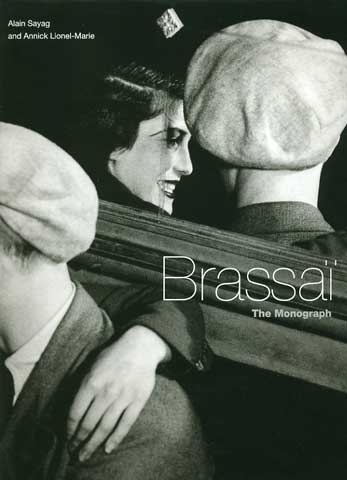
The Monograph – book review.

Paris de Nuit, a collection of Brassai’s pictures published in 1933, remains one of those books of photographs that are essential to understanding the street photography school of the early twentieth century. There is none of the acidity of Cartier-Bresson or the remoteness of Kertesz. Rather, there is a feeling that the photographer is one with his subjects in a city he loves dearly.

This tome, The Monograph, published in 2000 by Bulfinch, has much content from that classic, all of it reproduced in deep toned, juicy monochrome. While technique is never an issue with Brassai, always being superb, the large scale of this book only emphasizes just how good he was, considering the great limitations of the equipment of his day. This is 1933, for goodness sake, and no, there were no 5 frames-per-second digital cameras with shake reducing lenses available.

Something new for me, gleaned from this book, is how many of Brassai’s pictures were crops of a larger negative. Sometimes one negative would result in two or three separate images. Shocking? Absolutely. Justifiable? Totally. If it’s good, what do you care whether the whole frame was printed (what a silly pretentious idea) or not?

And if you thought the perversions of San Francisco, or earlier, New York and London, were in some way original, you need only check this book to learn that there is nothing new under the sun.

Degas was a fine photographer given the limitations of the medium in his time. His paintings speak loudly of the photographic world to come. Many images here conjure up memories of Degas’s L’Absinthe and the lives of the down-and-outs of cafe society. Had Edgar Degas lived another thirty years, these are the pictures he would have taken. Brassai realized that vision. See it in this fine book.

Taking Rube Goldberg for a spin

That’s Heath Robinson to British readers

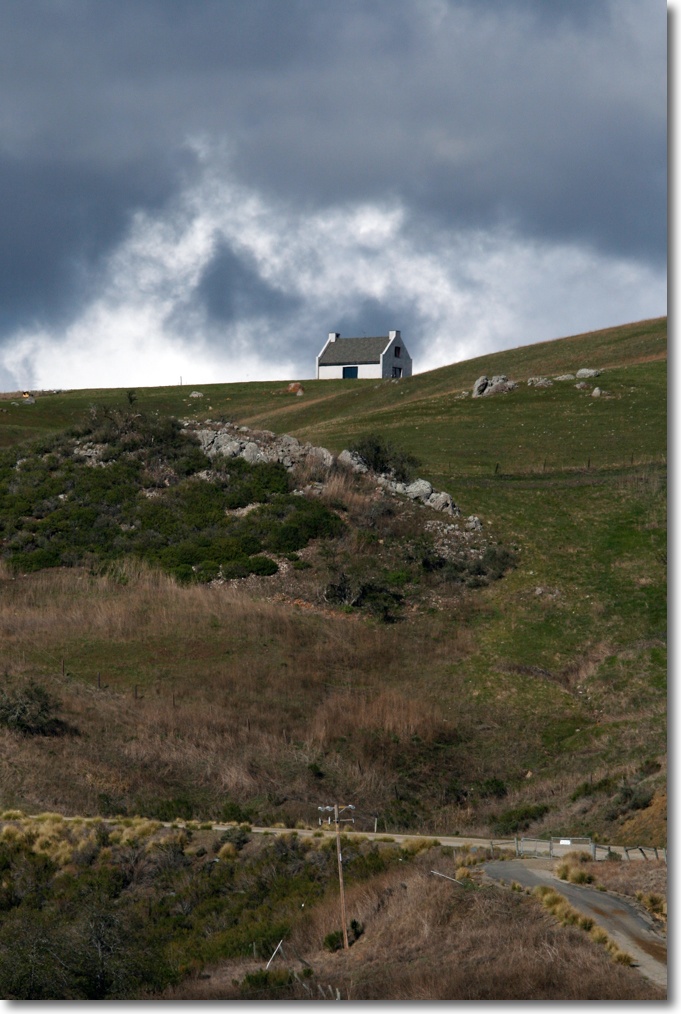
Having written about the complexities of getting my old Leitz 200mm f/4 Telyt to work on the Canon EOS 5D, I took the Rube Goldberg collection of lens, adapters and digital body combination for a spin yesterday, in that wonderful afternoon light you get right before a storm. Ergonomically the outfit handles unbelievably well and, mercifully, there is no wobble despite all those adapter rings.

I had the 5D set on ‘Av’, meaning I set the aperture (the lens is manual so you have no choice in the matter) and the camera sets the shutter speed. Anyway, at ISO 200 and f/5.6 the camera said 1/750 so I pressed the button. Here is the result:

I checked the screen preview on the 5D’s LCD and it looked two stops overexposed, so I took another at f/11. Now this did not smell right. Years with manual cameras have done a decent job of calibrating the exposure meter in my brain, and f/5.6 looked about right to me.

Getting home I dropped the snaps in iPhoto and, sure enough, the original at f/5.6 was right, the other two stops underexposed. What gives? Well, I had cranked up the brightness of the Canon’s screen to maximum in a vain attempt to make the thing visible in daylight. As a result, everything looks over exposed. So I have now reset the screen to the factory default.

The picture above is about half the original, yet is wonderfully well defined on a 13x enlargement. So those magicians at Leitz Wetzlar had it all right some forty years ago when this lens was first sold. A 40 year old lens on a 4 week old camera…. OK, so it’s not auto-anything, but I mostly use long lenses on landscapes, which tend to be fairly stationary beasts. I’ll leave sports photography to those far more expert than I will ever be. Or want to be, in that genre.

As for that LCD screen, I have adopted a one hundred year old technology to solve the problem. Diving into my 4″x5″Crown Graphic kit, I borrow the well worn black T shirt which I use to see the focusing screen on that behemoth and stick it over my head and the camera. This actually makes the LCD screen visible. Some things never change.

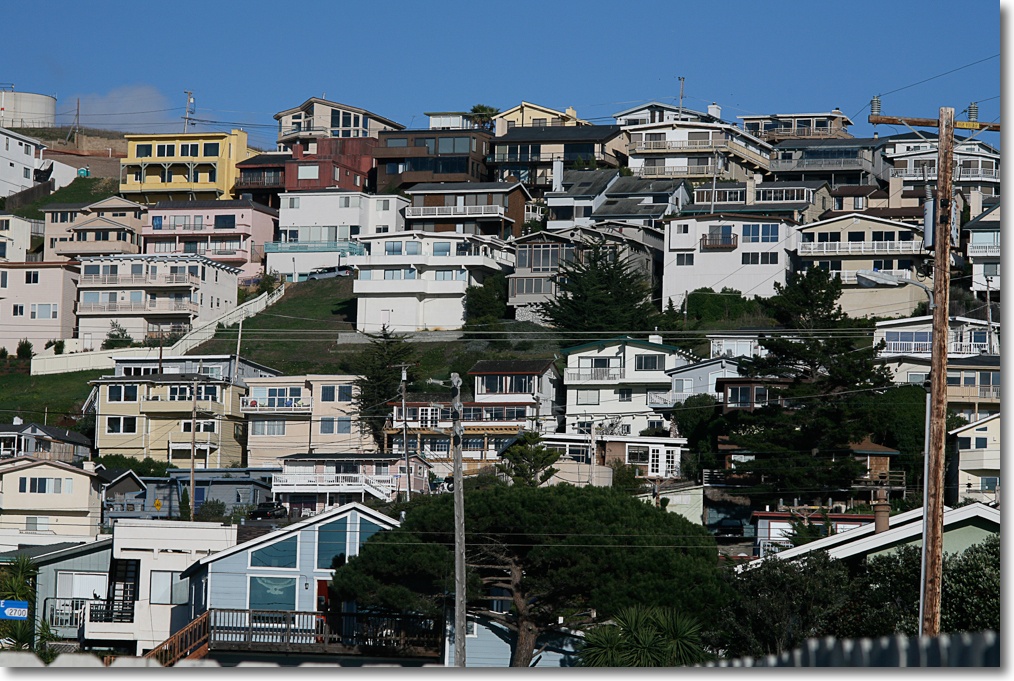
On the way home I spotted this gaggle of $1mm homes perched on a cliff overlooking the Pacific. Anywhere else these would be slum dwellings but here in California these are considered luxury weekend getaways. Right dead on the San Andreas fault.

Whatever you think of the architecture, you may agree that this old lens still does the job.

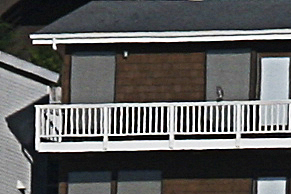
Here’s the center section at a 30x magnification ratio:

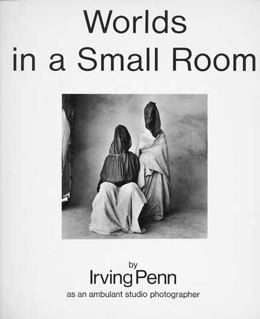
Worlds in a Small Room

Some of Irving Penn’s finest work.

Irving Penn is not just a great fashion photographer. Give him some spare time and off he goes on some personal project or other, frequently to the remotest places on earth, or the strangest. Like San Francisco.

This fine paperback shows pictures taken in his portable studio across the world, always by northern light. Published in 1974, it goes much further than August Sander’s cold, soulless work. Penn is vitally involved with, and sensitive to, his subjects, be they the mud people of New Guinea or Crete’s wizened old women.

If there are favorites then one has to be the group shot of Hell’s Angels with their women and machines, their leader looking like nothing so much as a Greek god. Then there are the Moroccan women so shrouded that only an eye protrudes.

I have been coming back to this book for some thirty years now and it never ceases to stimulate the senses and please the eye.

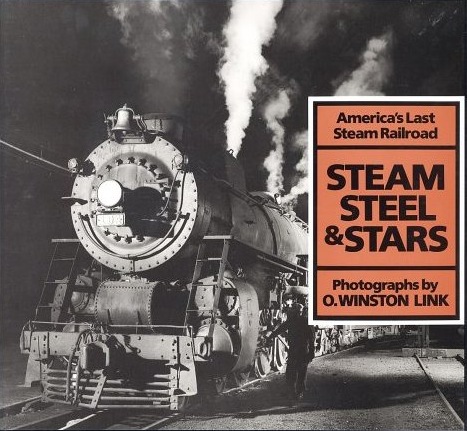
Steam, Steel and Stars

O. Winston Link’s masterpiece.


Click the picture for Amazon US. I get no payment if you do so.

Of all the books of railroad pictures you need know of only one. This one. Indeed, whenever photographs of breathtaking beauty are sought out, many in this book will be on the list of finalists regardless of subject.

Every picture in this book, all taken in the dying years of steam on the Norfolk and Western Railway of Virginia, is taken at night using flashbulbs, sometimes dozens at a time, using Link’s specially made apparatus.

Link shows that, to do something well, you have to be totally involved in, and in love with, your subject matter.

The composition, the insights into the last years of Norman Rockwell’s America, and the sheer love lavished on the work makes this book one of the very best picture books ever published, right up there with Cartier-Bresson’s ‘Decisive Moment’, though the subject matter could hardly be more different.

You don’t care about steam trains? No matter. If you care about drop dead, fabulous photography, you should have this book on your shelf.

Wetzlar goes to Tokyo

Leica or Leicaflex lenses on the EOS 5D

About the time I was ordering the Canon EOS 5D it dawned on me that it would be nice to be able to use my Leica Telyt long focus lenses on the digital body. I have a 200mm f/4 which is quite decent and a 400mm f/6.8, the one with the trombone focus action, which is very good. Both were made for use on the horrid Leitz Visoflex mirror housing for the Leica M body, but I had been using them on my metered Leicaflex SL SLR (now sold) with a Leitz M to R adapter, code 14127. I finaly got around to selling the Visoflex, but it wouldn’t go without kicking and screaming, as the first eBay buyer was a certified retard who decided he didn’t want to pay. How do these losers get through life? Mercifully, eBay recognized this nut for what he is and deleted his slanderous, retaliatory feedback. A small nod in the direction of decency and honesty!

Sniffing around the internet, it became obvious that there was quite a number of adapter manufacturers who promised that Leicaflex lenses could be mounted on an EOS body. Prices ranged up to some $200. I bought one from Kiev Camera in the USA for $50, but promptly had to return it as it had a faulty lens locking pin. The folks at Kiev Camera sent me another one and that one works really well.
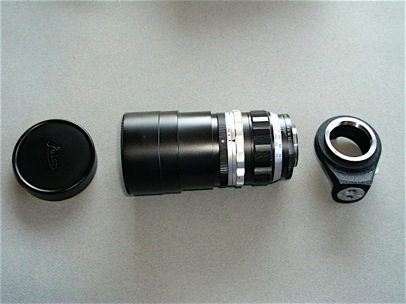
As you can see, the order of events is Telyt lens, M to R adapter and then R to EOS adapter. The 200mm Telyt shown here, being a truly ancient design, also has a Leica screw to Leica M adapter, # 14166. Despite all these adapters, the whole thing feels rock solid once assembled.
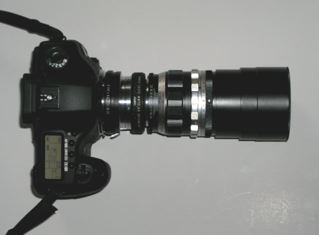
While the Telyt lenses are manual, indeed the 400mm does not even have preset stops, use is easy with the 5D on aperture priority. Indeed, that’s the only way you can use it as the camera has no idea what is fitted, as there are no electronics to feed it the information. So you set the shutter and the camera choses the shutter speed. Focusing is also manual, as once again the lack of electronics defeats the focus confirmation light ordinarily seen in the viewfinder. No matter. The standard screen in the 5D works just fine with these long, slow lenses. For this very occasional long lens user the setup suffices, even though Rube Goldberg might be proud of the design! Both lenses preserve full focus to infinity with this arrangement.

You can see some snaps taken with this combination here. For results with the magnificent 400mm Telyt, please click here.

But wait. The plot thickens. In going through all my gear trying to sell anything that was no longer used, I came across a near new El Nikkor 50mm enlarging lens which I had last used in those mercifully long past, dreary darkroom days. That would be 29 years ago. As any Leica user will tell you, sooner or later you end up in adapter hell, as Leitz made adapters for seemingly everything. They must love the art of machining in Wetzlar and, indeed, their adapters are things of mechanical beauty. The El Nikkor uses a Leica thread mount. A few seconds later and it’s converted to Leica M bayonet with an adapter from the dark recesses of the cupboard where all my remaining junk hides. A separate adapter, # 16596 if you must know, converts my old Leica Bellows II, another remnant of the Visoflex years, into Leica M mount. Attach the M to Leicaflex to EOS adapter on the back and you have a free macro lens:
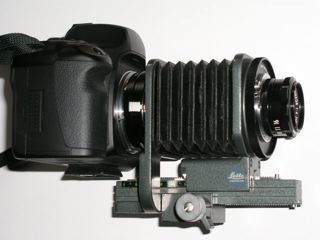
This gives larger than life images and, of course, infinity focus is not possible. Still, have you tried to sell an enlarging lens recently?

A better use is with the superbly sharp 135mm Leica Apo Telyt lens which gives images 2/3rds life size and also affords a far greater lens to subject difference allowing for better illumination of the subject. Nice to give these old warhorses a new lease of life.