Yearly Archives: 2014

Full frame bargains

From Canon.

One of the signal advances for photographers has been the continuous improvement in processing software. The enhanced capabilities for shadow recovery and highlight taming in products like Lightroom 4/5 (and doubtless in others like DxO, CaptureOne and Aperture – none of which I use, but competition always does its thing) give new life to old picture files.

Case in point, my first serious DSLR was the original Canon 5D (2006). When I pull up images from that body in LR5 they appear with an exclamation point lower right alerting me that an older version of LR was used to process them. Update those to the latest version (Develop Module->Settings->Process) and your images can enjoy the benefits of the latest in processing technology.

I have gone back and re-printed some of these and the results really are impressive.


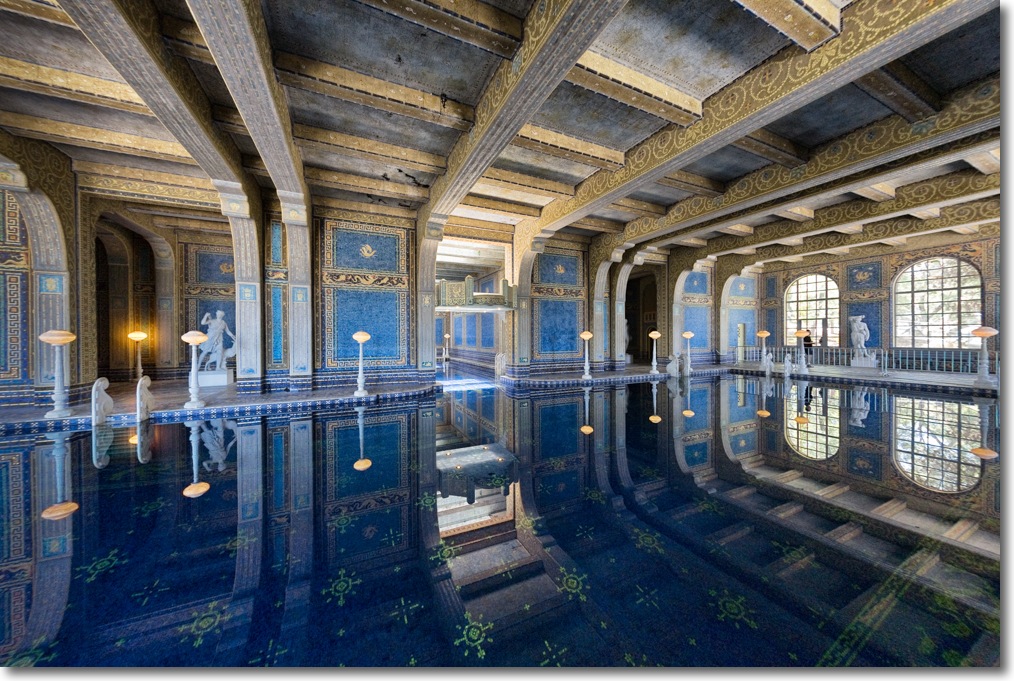
The indoor pool at Hearst Castle.

The above 5D Mark I image has high dynamic range. Updating to the 2012 Process from the original 2003 in LR5 allows easy recovery of the shadows and taming of the highlights with the related sliders. A touch on the Noise slider takes out what ails the shadows. A quick click in the Lens Profile section has the 15mm Canon Fisheye image de-fished for a linear rendition, into the Print module and the 18″ x 24″ print will knock your socks off.

Sure, neither the original 5D or its ‘pro’ equivalent 1DS Mark II had sensor dust removal, but I can assure you that my Nikon D700 did and it was almost useless. You still had to clean the sensor with moist alcohol swabs, as I now do with my Nikon D3x. The price of a lightly used, amateur owned 5D or 1DS Mark II? How about $450 or $800? If there’s a better bargain for a photographer looking to make really large prints from full frame negatives I do not know of it. And you can forget the overpriced ‘red ring’ Canon ‘L’ lenses. The 15mm f/2.8 Fisheye (discontinued), the 35mm f/2 USM, the 50mm f/1.4 USM and the 85mmf/1.8 USM ‘cooking’ variants deliver all the quality you need, at bargain prices. Just avoid the cheap and nasty zooms if you are printing big. For web display any FF DSLR is overkill.


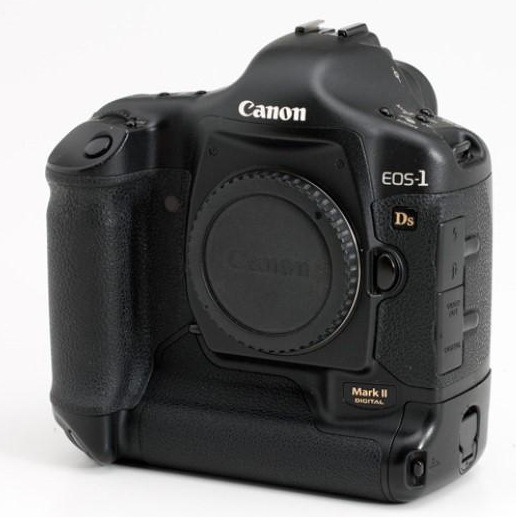
The exceptional Canon 1DS Mark II.

Nikon? There are no FF bargains yet. The D700, which has an excellent low noise sensor sells lightly used for a surprisingly high $1,300, the D3 (same sensor, pretty much) for $1,800.

New prices of the 5D and 1DS Mark II? How about $3,000 and $8,000, respectively? Do you really need the latest and greatest or would a small fraction of the extra money be better spent on a large format printer, paper, ink and some mounting supplies so you can really show your work for once?

Richard Steinheimer

A photographer of trains.


Click for purchase through Amazon. I get no payment if you do that.

Being a train photographer means your output will immediately be subject to comparison with that of O. Winston Link in much the same way a street snapper’s work will be hauled up against that of Henri Cartier-Bresson. Neither is a winning proposition.

Regardless of genre preferences, any photographer’s library should include Link’s Steam, Steel and Stars and HC-B’s The Man, the Image and the World.

On those grounds, Richard Steinheimer’s book of fine railway photographs would not be your first choice but even if you care little for railroad photography, it deserves serious consideration.

Steinheimer (1929-2011) was up against it from the start as relatively little of his long career coincided with the age of steam. A steam locomotive makes the machine the star, regardless of setting. Link’s genius was to personalize it in the guise of the proud operators in the last days of steam he so magnificently photographed. (‘Documented’ would be a rare insult, indeed). Steinheimer’s work is more detached, more focused on the machine in its expansive settings in the west. People are not his forte. Link, by contrast, added that something special with his social awareness.

Steam appeals to the romantic in us but I can assure you that there was nothing romantic about traveling in a steam train. I took one from London to Dundee, aged eight in 1959, to visit my eldest sister, then a student at St. Andrew’s University. Forgetting to close the window as we entered a tunnel, I exited covered in soot and smelling like a linebacker after the Superbowl. There was nothing romantic about it, other than to a distant observer’s viewing the Flying Scotsman’s patrician progress through the beauty of Scotland’s countryside, a head of steam defining the machine’s progress.

You could also argue that taking pictures of steam trains is rather like photographing Angelina Jolie. Even your bad ones are going to look pretty good. On that basis, O. Winston Link is the Irving Penn of train photographers.

Steinheimer certainly added a special something to his images, generally incorporating the expanses of the great American west with outstanding compositional sense. The book is well printed, if not as well as the Link one and, unlike the latter, can still be found new and unblemished. Unsurprisingly, the cover picture is of a steam train ….

Mounting Big Prints revisited

Cutting costs.

The ‘archival’ acid free issue:

When I first wrote about heat mounting of big prints over 7 years ago I advocated the use of premium priced acid free mat board and acid free mats. I have reconsidered that advice and have concluded that it is not correct.

A quick look at the specifications for Seal/Bienfang mounting tissue explains why, but first let’s take another look at the physics of the equation. The ‘sandwich’ comprising a mounted print consists of the mat on the top, the print, mounting tissue and the foam board. Heating the sandwich in a press causes the adhesive in the mounting tissue to melt on both sides, forming the bond between tissue and board and between tissue and print.

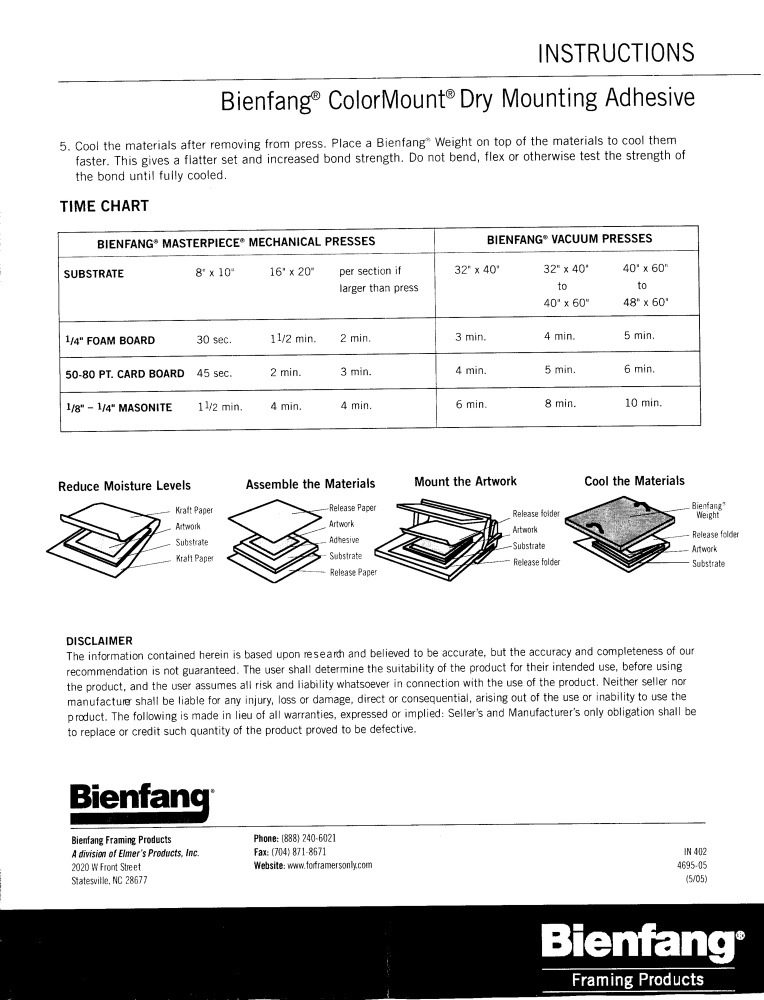
Here are the spec sheets for the mounting tissue:
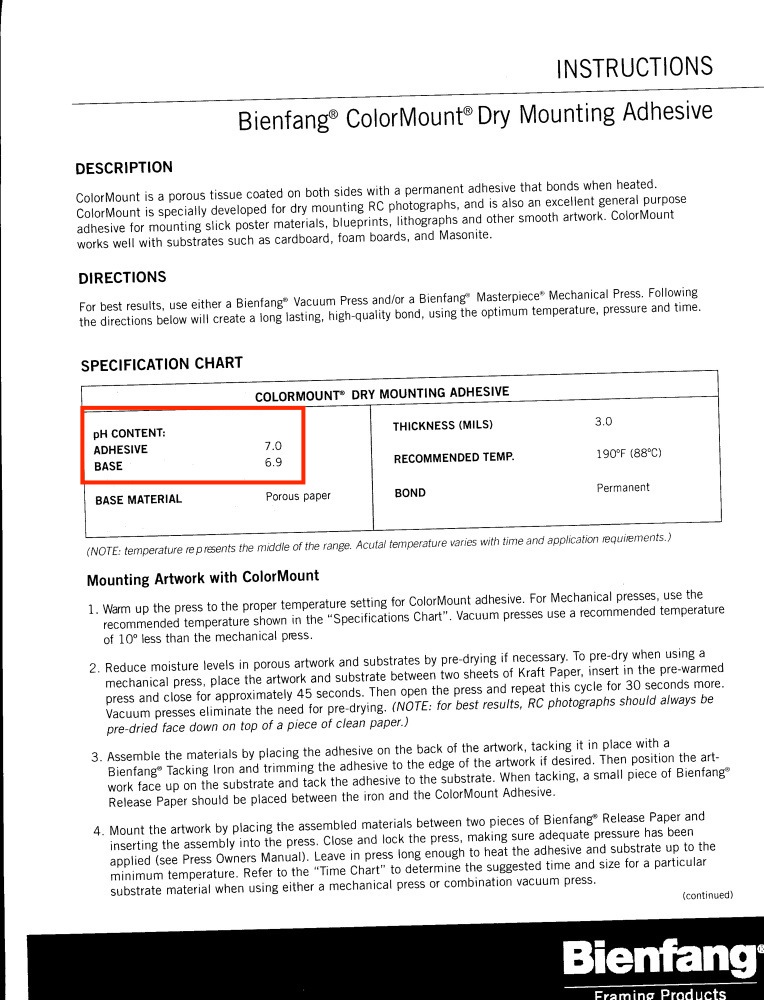


Note the pH rating of the adhesive which contacts the print and the board – it’s 7.0. Acid free. Neutral. The tissue itself is 6.9, very mildly acidic, and buffered by the neutral adhesive at that. About as close to neutral as you can get. As for the mat, the area of the mat contacting the print is minuscule – a small border contact, if that, as the mat is not in high pressure contact with the borders of the print.

Best mounting press temperature setting:

I now print exclusively on HP Premium Plus Glossy Photo Paper, preferring the punch to prints made on Matte paper. There are two drawbacks to glossy paper. First, every defect in the mounting process will show – loose hairs, dirt between print and board, creases in the release paper, any dirt on the heated platen in the press. All will leave a mark. This is bitter experience talking. Second, the warmer the press, the more of the gloss is lost in the process.

After much experimentation, I have found that a setting of 170F (compared with the 190F recommended by Seal/Bienfang for their Colormount tissue) is optimal. Is that a real 170F? I do not know as I have no way of verifying the accuracy of the temperature meter on the 160M Seal press I use. So you may have to experiment with yours. This low setting has two advantages. Much less gloss is lost than if you use 190F. And the mounted print can be pulled off the board for repositioning or removal of debris. The other day I had an ugly bump in the center of a glossy, mounted print. I peeled off the print, sure enough confirmed that a small piece of foreign matter had somehow crept in between print and mounting tissue, remove the offending dirt and reheated the print in the press. Perfect.
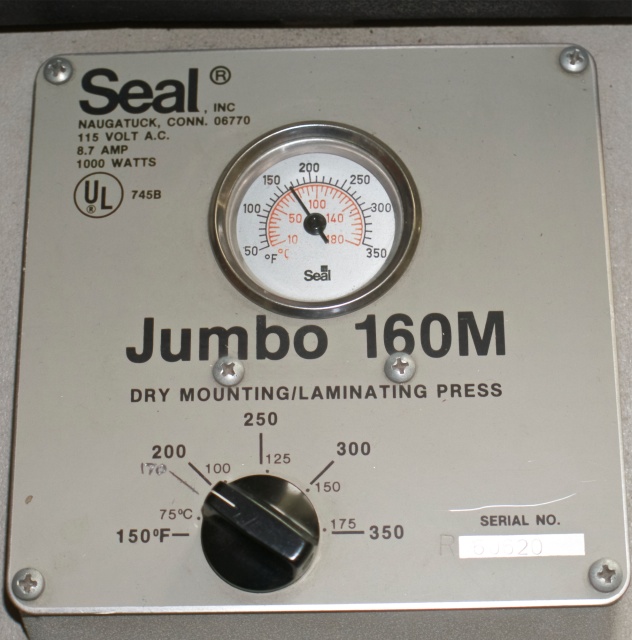

The 170F (77C) setting has been marked on the dial.

I always use release paper between platen and print and recently found some which has a very high gloss finish, which helps even further with gloss retention. And the release paper must be devoid of creases or they will become imprinted on the photo paper’s surface. It’s available inexpensively in long rolls from Artgrafix and highly recommended. Be sure to store the cut piece of release paper in a glassine bag between uses or it’s back to dirt, debris and printed surface damage again.

Even prints exposed to direct, long term sun have shown no sign of lifting from the mounting board using 170F for mounting.

Mat openings – key dimensions:

I typically mount both 13″ x 19″ and 18″ x 24″ prints on 22″ x 28″ boards. The HP DJ90 and 130 leave a 1/4″ border top, left (long side) and right (long side), with a bottom border of 9/16″ (short side). For the HP Designjet 90/130, after allowing another 1/8″ for safety,the mat openings are as follows:

  • 13″ x 19″: Opening is 12 3/8″ x 18 1/16″
  • 18″ x 24″: Opening is 17 3/8″ x 23 1/16″

Standard 1/2″ undercut mat openings will not work (17 1/2″ x 23 1/2″, for example) with the Designjet. Get custom cut mats from MatBoard&More. This vendor only stocks foam boards of 1/8″ thickness, so use Readimat for 3/16″ foam board supplies.

Conclusion:

1 – Foam mounting board:

22″ x 28″, 3/16″ thick, ‘Acid free’ foam mounting boards sell for $7.10 at Readimat.com. The non-acid free version is $4.10, or 42% less. I conclude that using ‘acid free’ boards is a waste of money with no material impact on longevity of the print. I continue to recommend 3/16″ thick boards over 1/8″, especially if, like me, you do not glass cover and frame your prints, opting instead for inexpensive mirror hangers to hold the ‘sandwich’ to the wall. The thicker board resists warping far better.

2 – Mats:

Acid-free mats 22″ x 28″ external, 17 3/8″ x 23 1/16″ opening cost cost $24.68 each. The non-acid free version costs $12.79, or 48% less. I recommend you use the non-acid free mats. Get custom cut mats from MatBoard&More.

3 – All-in price:

Excluding frame and glass, the cost of board and mat for an 18″ x 24″ print mounted on a 22″ x 28″ 3/16″ foam-core baord is $16.89 non-acid free, compared with $31.78 for acid-free. A savings of 47%. Buy in bulk and the savings grow.

The mirror hangers I use run $2.50 a set of four plus call it $0.10 for 4 x 3D 1 1/4″ nails, making the cost of a 22″ x 28″/18 x 24″ mounted hung print:

  • Mounting board: $4.10
  • Custom HP DJ 90/130 mat: $12.79
  • Mounting tissue: $0.50
  • Mirror hangers: $2.60
  • Paper and ink: $3.00
  • Total cost: $22.99 plus shipping costs for the mats and boards

That is a very attractive all-in production price for a large unframed print.
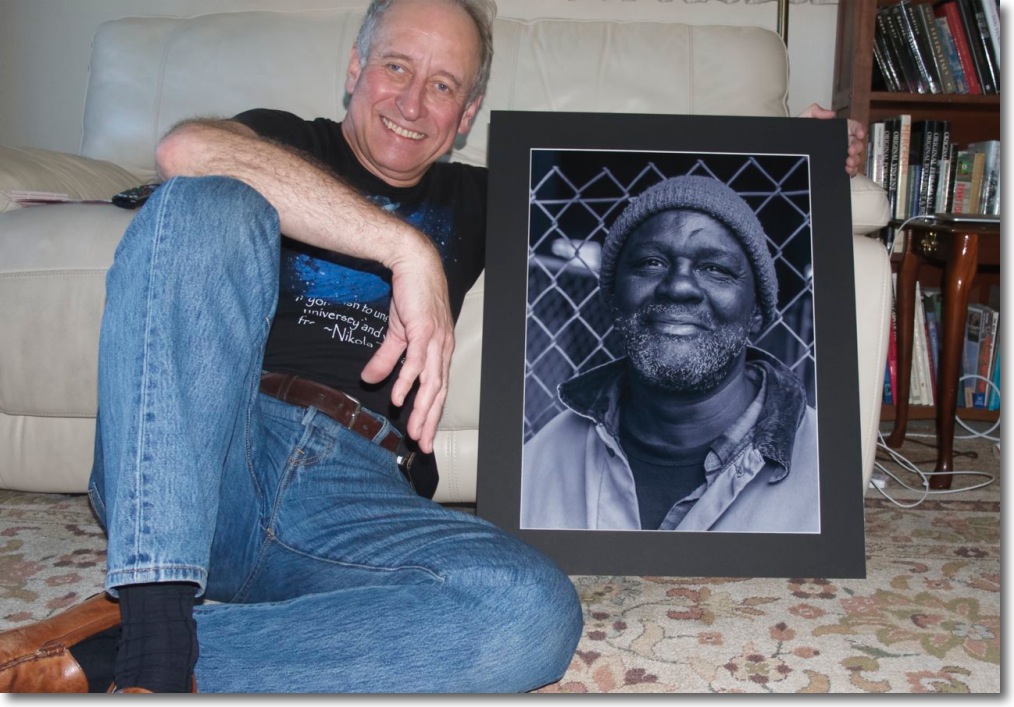

Nothing beats a big print.

D & K:

D & K bought Seal/Bienfang, the press maker, in 2010, so it may help to also search under that name when looking for supplies.
Nature’s dryer

North Beach.

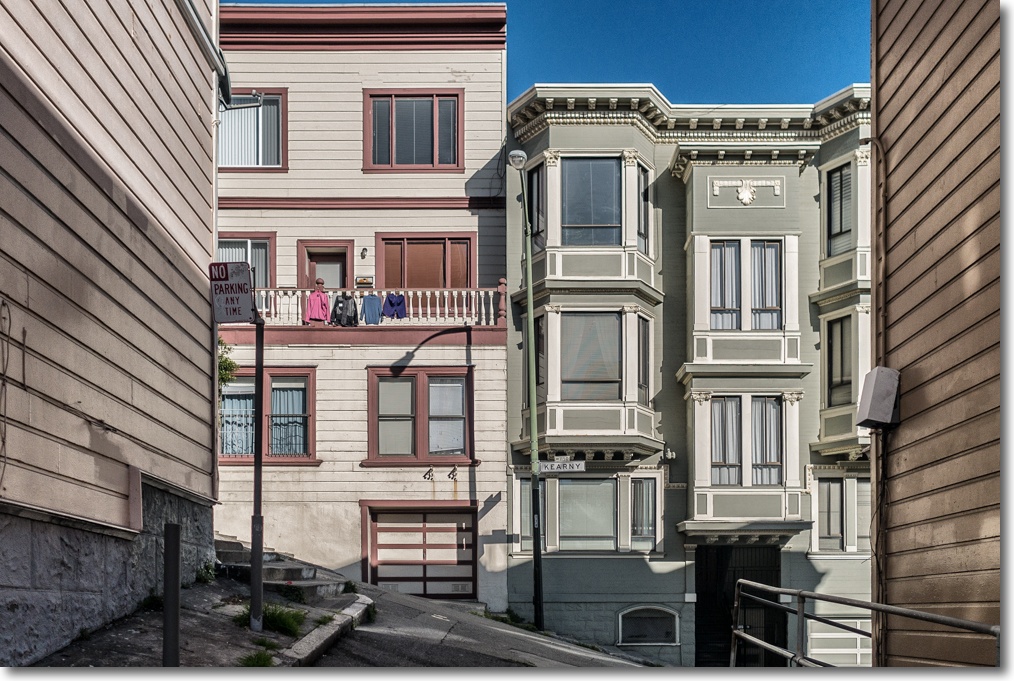
So wound up was I in the atmosphere of this scene that I forgot all about twiddling the dials. Turns out the snap was taken at f/1.8, 1/8000th! Well, at least there’s no camera shake and the original testifies to the full aperture capabilities of the superb Olympus 17mm MFT optic.

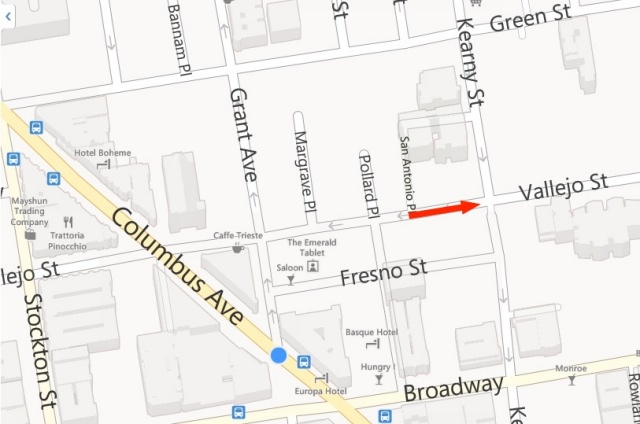
Here’s the SF location:

Shadows helped along with Snapseed.

Panny GX7, 17mm Zuiko.