Yearly Archives: 2020

Tessina

A quirky, miniature 35mm camera.

If the spy camera special, the Minox, had a focused target audience, it’s harder to say what the purpose of the Tessina was.
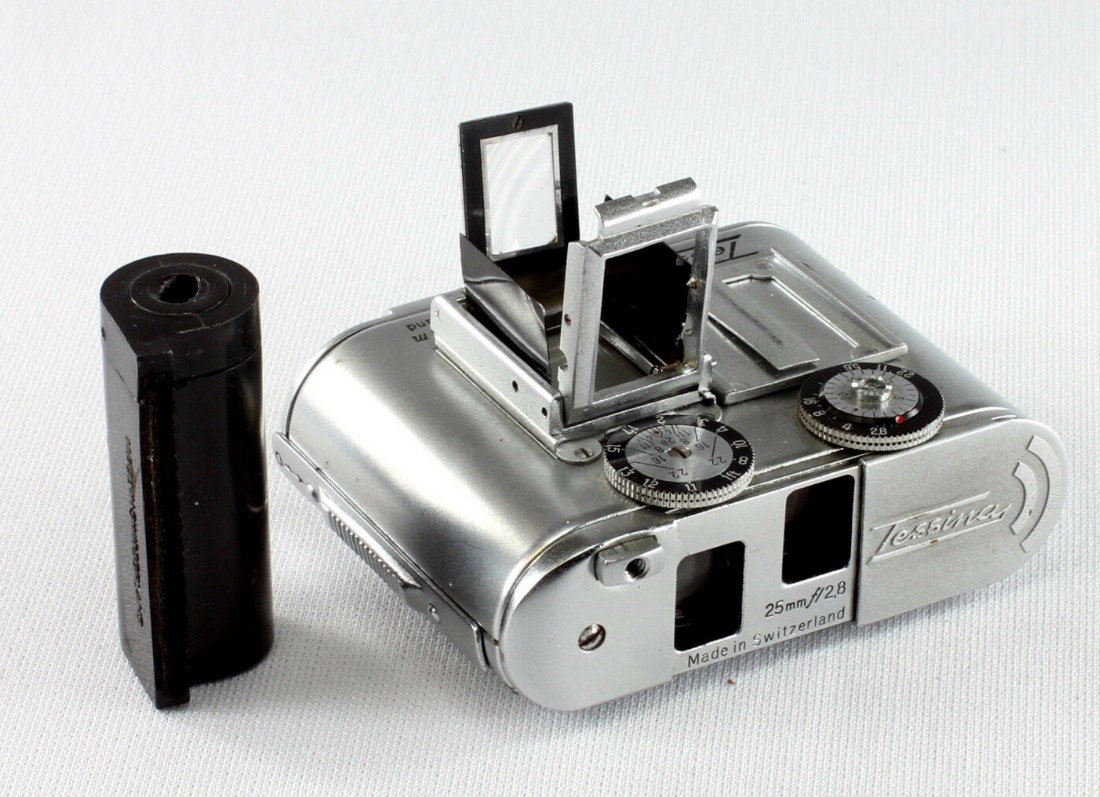


A wrist-sized twin lens reflex.

Made between 1957 and 1996, the Tessina used regular 35mm sprocketed film stock, but this had to be loaded in special cassettes. The camera was just 2.5″ x 2″ x 1″ in size. The image was 14mm x 21mm (compare with the 8mm x 11mm of the Minox) making the area more than three times the size, and 34% that of the full 24mm x 36mm regular 35mm film frame. A cassette was good for some 24 exposures.

Accessories included a wrist strap, minuscule selenium cell exposure meter and a pentaprism for eye level viewing, the default being waist (wrist?) level through the composing lens. The taking lens is off to the side – like a miniature Rolleiflex TLR turned through 90 degrees. Film advance was by spring, good for 8 exposures, wound like a watch, testifying to the Tessina’s Swiss heritage.

There’s no arguing with the quality of the machine, and I recall selling a couple when working a summer job at Dixon’s in London in the late 1960s. But why you would buy one of these costly pieces of jewelry beats me to this day.

Nautral beauty

From my front porch.

While I have yet to figure out exactly what purpose rattlesnakes or scorpions serve in the natural world, I know better than to knock these two bad guys. Everything in nature seems to have a purpose, and the greater challenge is sometimes determining what that purpose is.

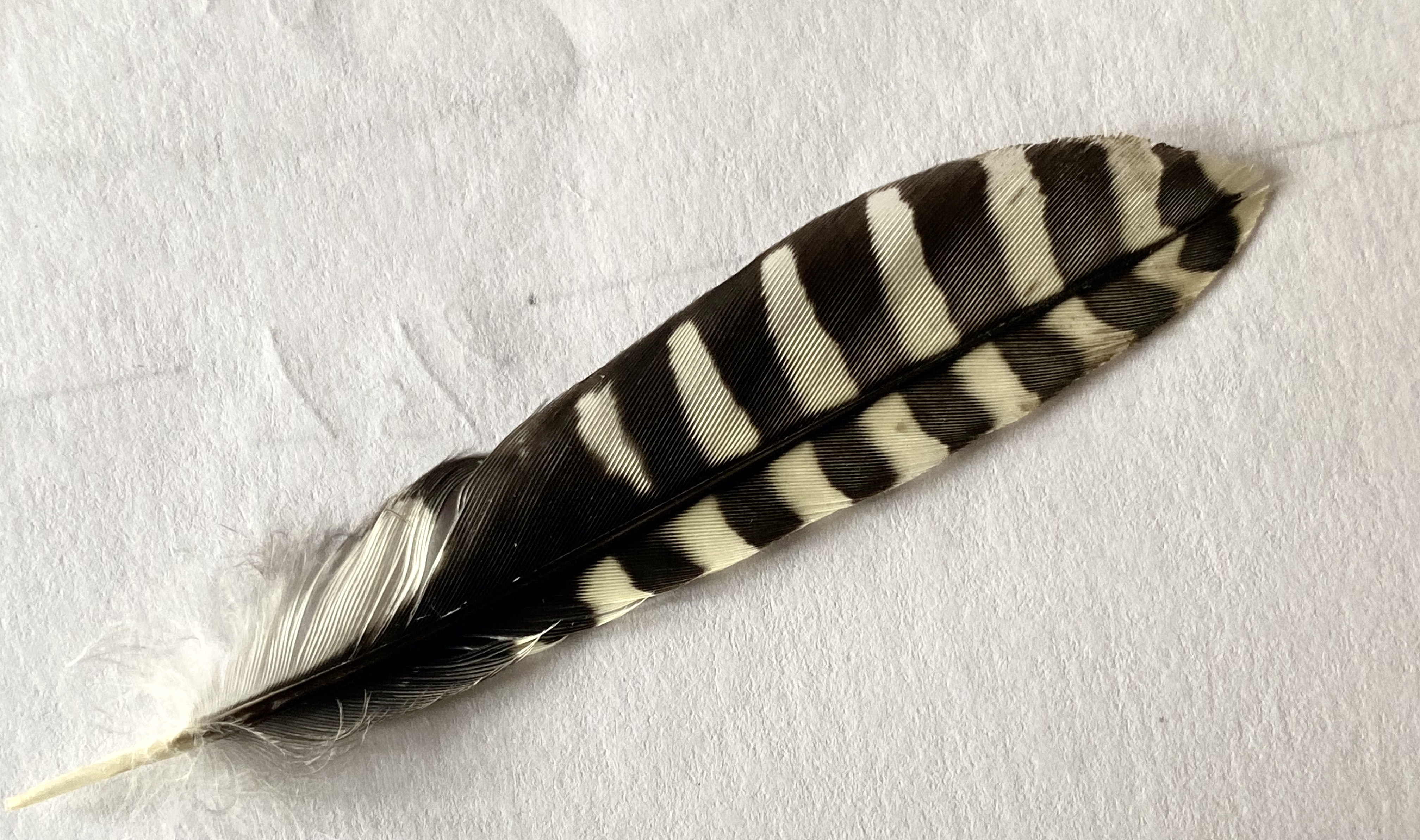
I found this bird’s feather on my front porch just now and am fascinated by the asymmetrical design of the striae. The original is some 3 inches long. Maybe it came from a roadrunner, a common bird in these parts?


Click the image for a large version.

iPhone 11Pro image.

Traditional British Cooking

Beautiful stodge.


Sure, British cooking is not about to challenge France for culinary domination. Much of it is unimaginative, strong flavors are avoided, spices are strangers and carbohydrates and frying dominate.

But check out some of these delicacies: Bangers and Mash, Toad in the Hole, Steak and Kidney Pie, Braised Brisket with Dumplings, Roast Beef with Yorkshire Pudding, Shepherd’s Pie, Beef Wellington, Liver and Onions, Lamb with Mint sauce …. well, you get the idea. Classics all. And the greatest, Fish and Chips.

And one of the finest ways of discovering these meals, many predating Shakespeare, is in the book illustrated above. Copies are occasionally available from the usual used sources (Abe, Alibris, Powell’s, Strand) and the illustrations are, well, mouth watering. The photography is beautiful.

But I cannot pull this tome from my cookbook collection without a merry chuckle, for I am always reminded of the remark of an American friend to whom I was extolling its virtues. After glancing at the title, he carefully weighed it up in one hand, remarking “Strange that it’s so thick, really”. Ha!

Whatever you think of English cooking, if you need to enslave unarmed nations, sell opium by the boat load or import tea on the cheap, this book has what you need before setting out to pillage, plunder and steal.

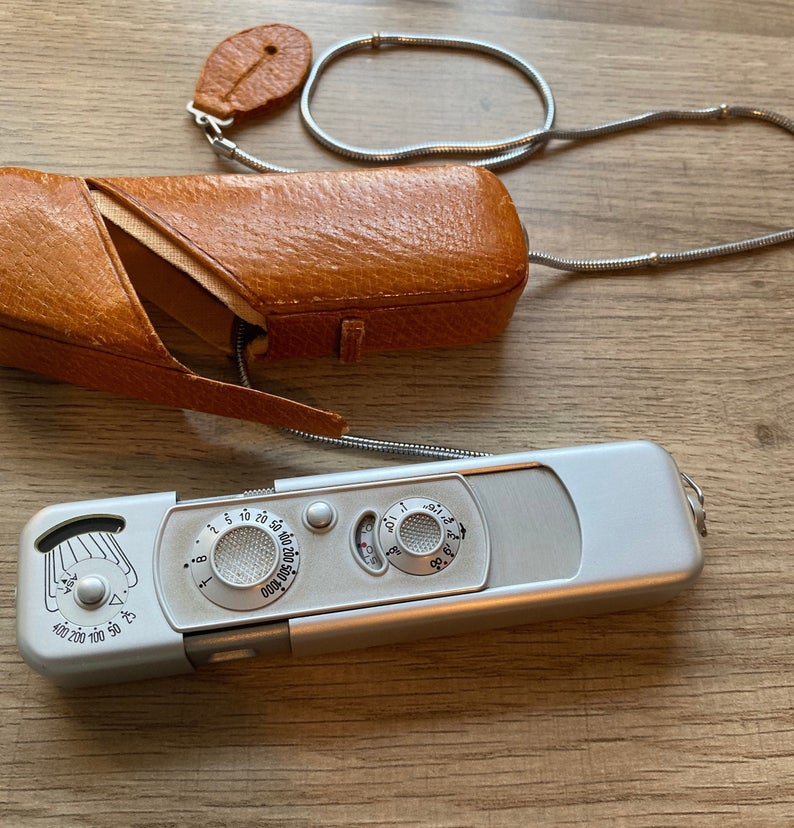
The Minox

Spy special.

Spying is not what it used to be. Today’s Russkie steals data after hacking your cloud server or uses his cell phone. The images are perfect, sent by encrypted cellular mail and infinitely enlargeable.

Ponder then the pre-war and cold war spy’s challenges. He had to make images of those stolen military secrets in poor lighting, had a limited number of snaps on a roll and the chances are that his exposures were off, his shutter speeds too slow and the result a grainy mess. Then along came the Minox camera in 1936 and his life was made considerably easier. For the first time a truly pocketable, high quality camera could make half decent images and the minuscule 50 shot film cartridge was not that hard to secrete away. The original Minox measured just 3.1″ x 1.1″ x 0.6″, and weighed but 4.6 ozs. The cartridge was smaller still. The 8 x 11mm negative, just 10% the area of a 35mm film original, was useable in the right hands.


Small and stealthy. Shown extended and ready for action.

Appropriately enough the first Minoxes were made in Latvia, one of the three Baltic states sharing a border with Comrade Ivan and forever looking over its shoulder at the gathering Russkie hordes on its border, waiting to invade. They used AK47s, not Minoxes, to do their thing. So production was moved to – where else? – Germany after the war, and the Russkie spies were no longer home grown but came from Cambridge (Burgess, McLean, Philby, Blunt) or Los Alamos (Klaus Fuchs). But nationality notwithstanding, the Minox soldiered err, spied, on.

The Model B shown above included a selenium exposure meter and the neat metal lanyard provided just the right distance measure for a sheet of A4 with nuclear trigger drawings. A complete subsystem grew up around the camera including an enlarger and projector (to better enjoy your holiday snaps from Chernobyl) and there was even a binocular attachment for when you needed a real close up of Comrade Stalin’s murderous mustache.

Once the Cold War faded the Minox faded with it, later attempts at compact 35mm cameras a flop. At one point Leica bought the maker, proving that German financial acumen was not bred at Harvard Business School. But it was the spy camera of choice for some 50 years and is quite beautiful to operate and behold.

Louche Annie

A cheat is a cheat is a cheat.

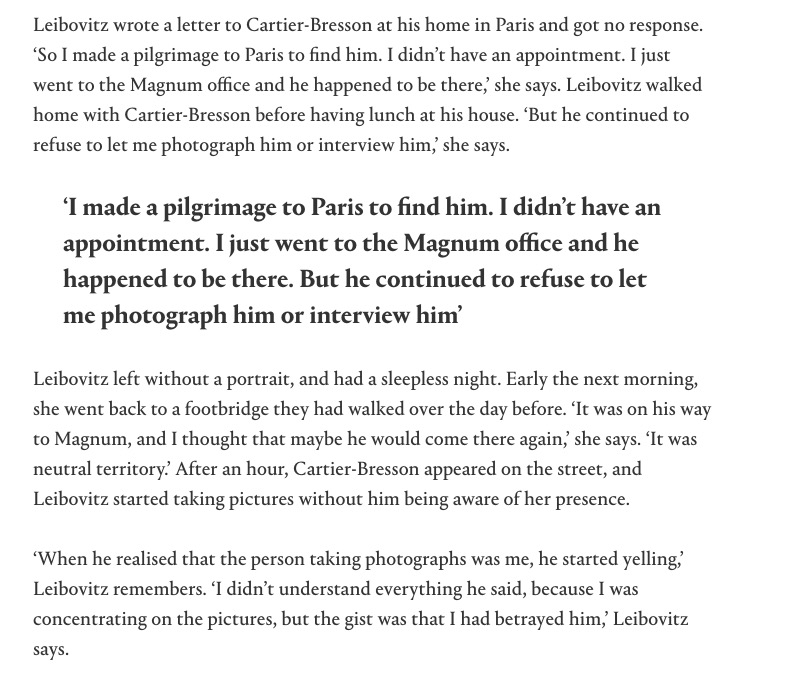
So Annie Leibovitz claims ignorance of HC-B’s insistence that she not photograph him, trying to sneak a few snaps while she thought he was not looking:


Yeah right.

Now every serious photograpger on the planet – and Leibovitz was nothing if she was not serious – knew of HC-B’s paranoid dislike of being photographed. But, ever in search of the mighty dollar, she chose to swallow her integrity and have at it.

You can read the whole disgusting story here.