Monthly Archives: June 2025

Konnwei battery tester

Handy and inexpensive.

I have hit a bad battery spell. The one in the two seater died, no start. The one in my 1975 BMW R90/6 died despite being just 14 months old. And the one in my scooter was beginning to sound weak. All batteries are maintained on a trickle charger in a heated garage.

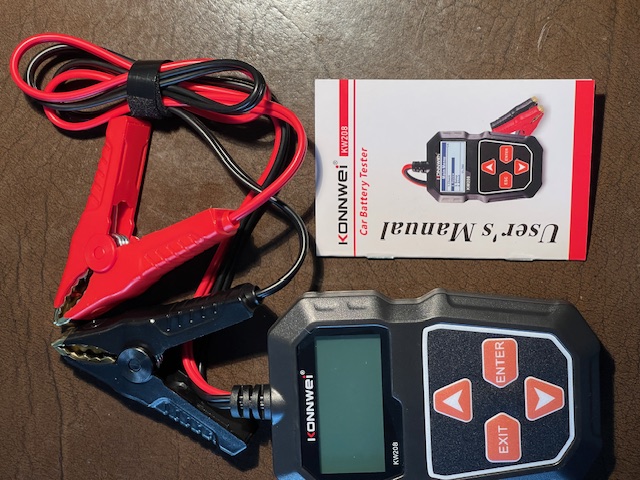
Now I have been very lucky as all my recent battery failures have occurred at home, meaning I was not left stranded on the road. But this spate of failures left me determined to become more proactive about knowing the state of health of my vehicle batteries so I splashed out $23 on a Konnwei KW208 car battery tester. Maybe not the greatest choice of name, true, more like something you expect of the White House, but at that price hardly a great risk either.


First, the manual, in half decent English is printed in minuscule type. Click Konnwei instruction manual and you can enjoy a proper sized version.

The device can test batteries in or out of the vehicle, and this model is limited to 12 volt cells. If in the vehicle and still working you can also test the cold cranking amps (CCA) as a percentage of the rated value (it’s on the battery’s label under ‘CCA’). This is a key measure as CCA is the high current delivery required to activate the starter and turn the engine. Additionally you can test the alternator’s power delivery (the alternator keeps the battery charged when the vehicle is running) as well as the starter’s cranking efficiency. I tested all of these on a failing and then on a new motorcycle battery and the measurements accurately reported ‘Replace’ and ‘Good Battery’, respectively. For the good battery state of health (SoH) and state of charge (SoC) were both reported as high, as expected.

The cables are nice and long so there is no difficulty installing the clamps (remember to connect the red – positive – first and disconnect it last) and the clamps grip well. No battery is required as the tool uses the vehicle’s battery for power. The LCD screen is easy to read, unlike the instruction book.

As for getting stuck on the road with a dead battery, I carry one of these jump starters – it delivers the instantaneous high cranking current which a failing battery cannot deliver and, once the vehicle is running is disconnected as the alternator can pass sufficient current through the dying battery to keep the engine running.

I now feel better prepared for the inevitable battery failure(s) down the road …. or in the garage!

BMW R90/6 – 35 and 50 years on

Thirty five years of happy wrenching and riding.

I became the custodian of my 1975 BMW R90/6 ‘airhead’ motorcycle 35 years ago today, buying it for $2,000 in Los Angeles from the original owner with just 15,000 miles on the odometer. René, the wonderful Chilean seller, was returning to the country of his birth and assured me that riding a single track vehicle on local roads was not a prescription for a long life. He also informed me that he had turned down two earlier offers from ‘irresponsible kids’ who would not accord his machine the duty of care it was due. I do not think I have let him down.

This beautifully made machine, an exemplar of the best mid-twentieth century technology – and not all that much changed from the 1931 original design – is notable for its near total absence of electronic gizmos, a source of considerable joy for this mechanical engineer. Any self respecting mech eng will tell you that electricity is the work of the devil. And this is very much an engineer’s dream for the machine is easy to work on, most parts easily accessible with few special tools required. Best of all the machine’s enthusiastic following sees to it that most replacement parts remain available, 30 years after the last airhead left the German assembly line. Yes, there’s more maintenance than with a Honda but reliability is comparable to that of those fabulous Japanese designs.

What follows is a pictorial history of my time with the bike over the past 35 years. I continue to ride it regularly.
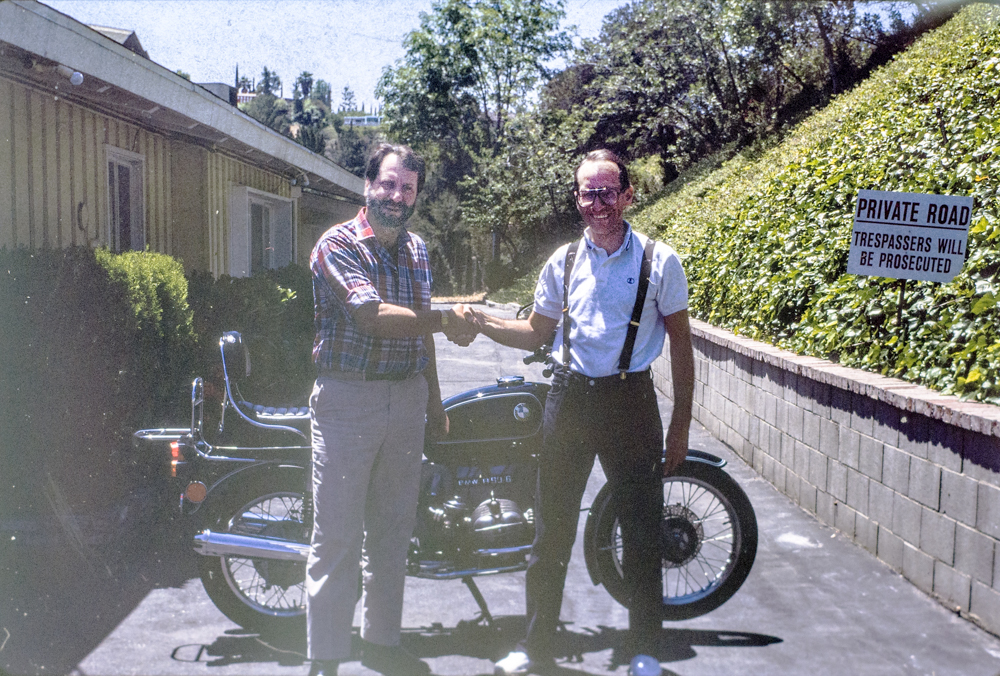


June 16, 1990. Accepting delivery in Encino, CA from
the first owner, René Francisco Lama.
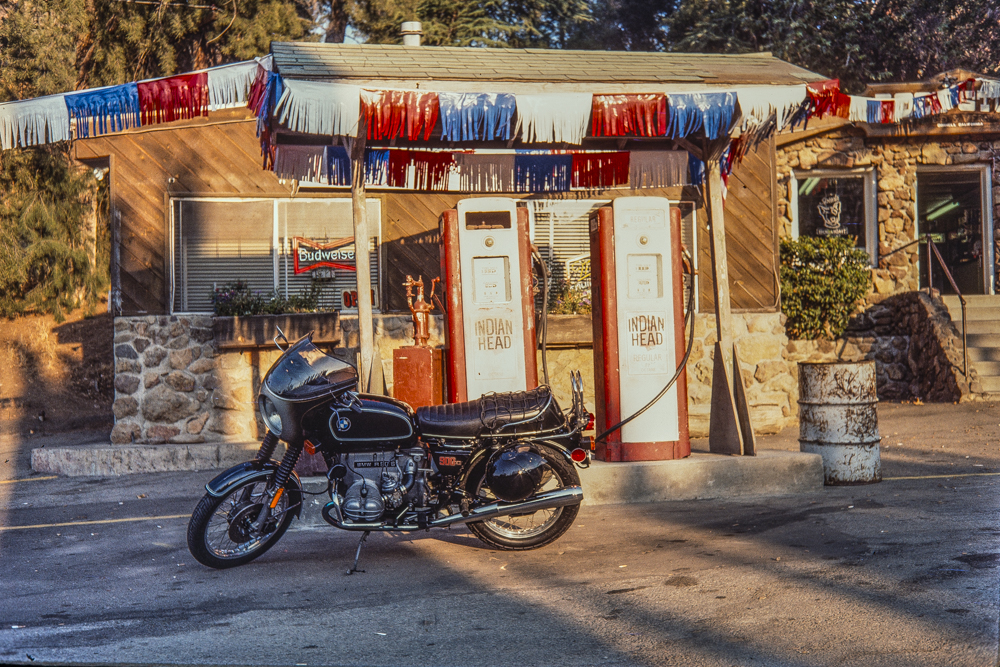

At the fabled Rock Store in Malibu in 1990.
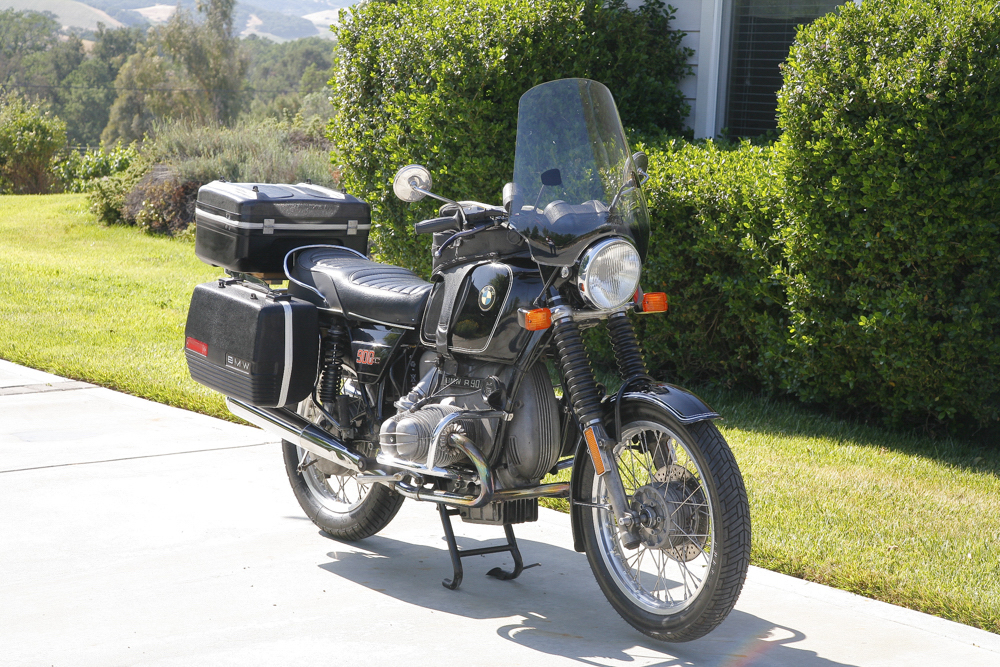

Ready for touring with bags and a small windshield.
The original café fairing broke when the bike fell over
in my Encino garage during the Northridge earthquake,
January 17, 1994, the only time it has been down.
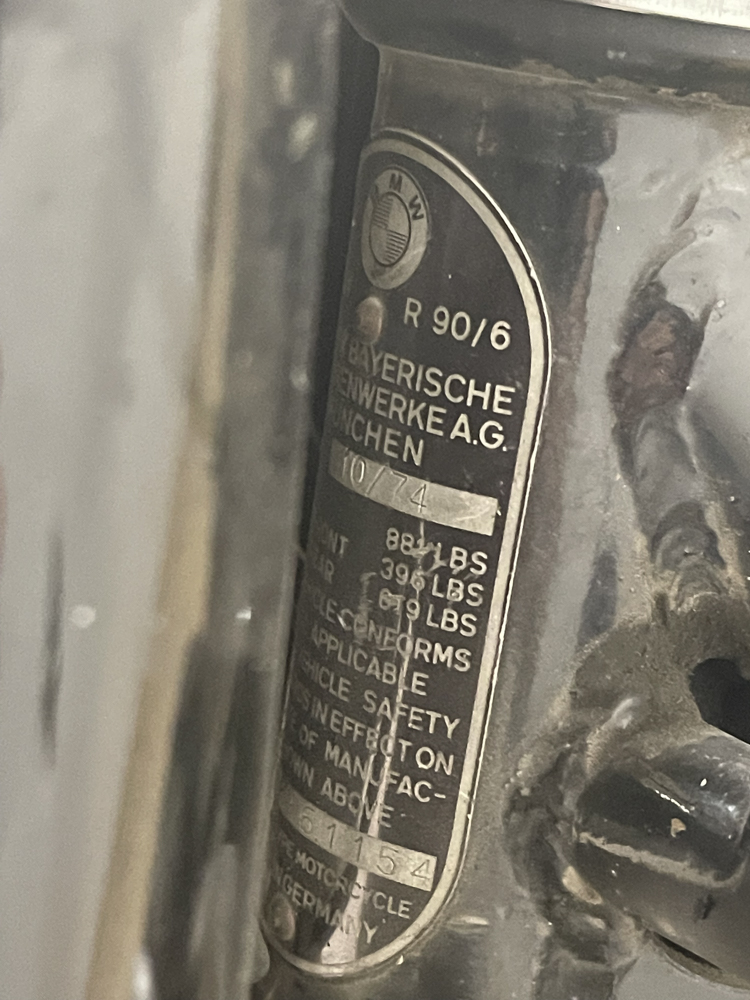

Manufactured in October 1974, the bike was sold by
Bob Brown’s Motorworks in Pomona to the first owner in 1975.
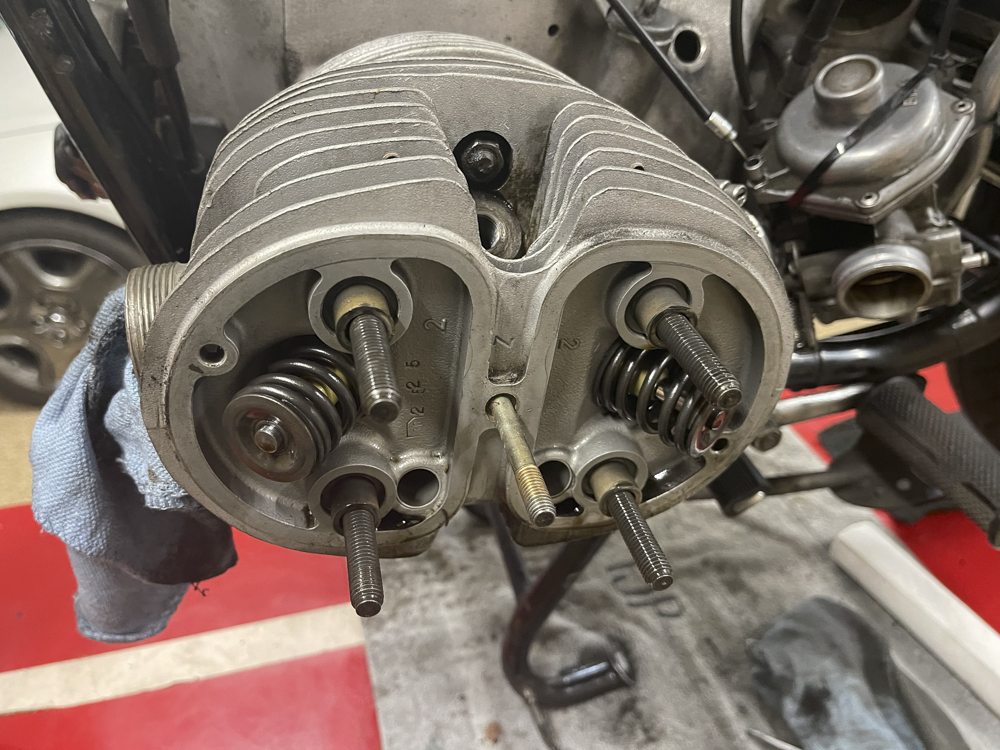

The motor is a simple two valve pushrod design.
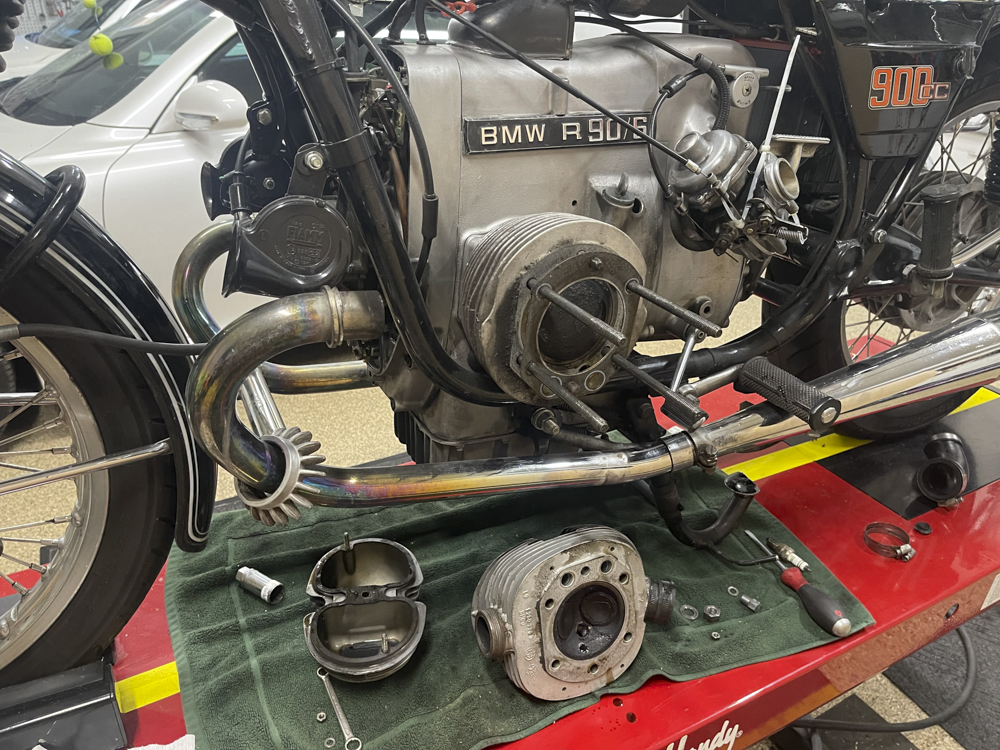

Engine maintenance is easy owing to the horizontally
mounted ‘boxer’ cylinders. The valve cover and valve
head have been removed here.
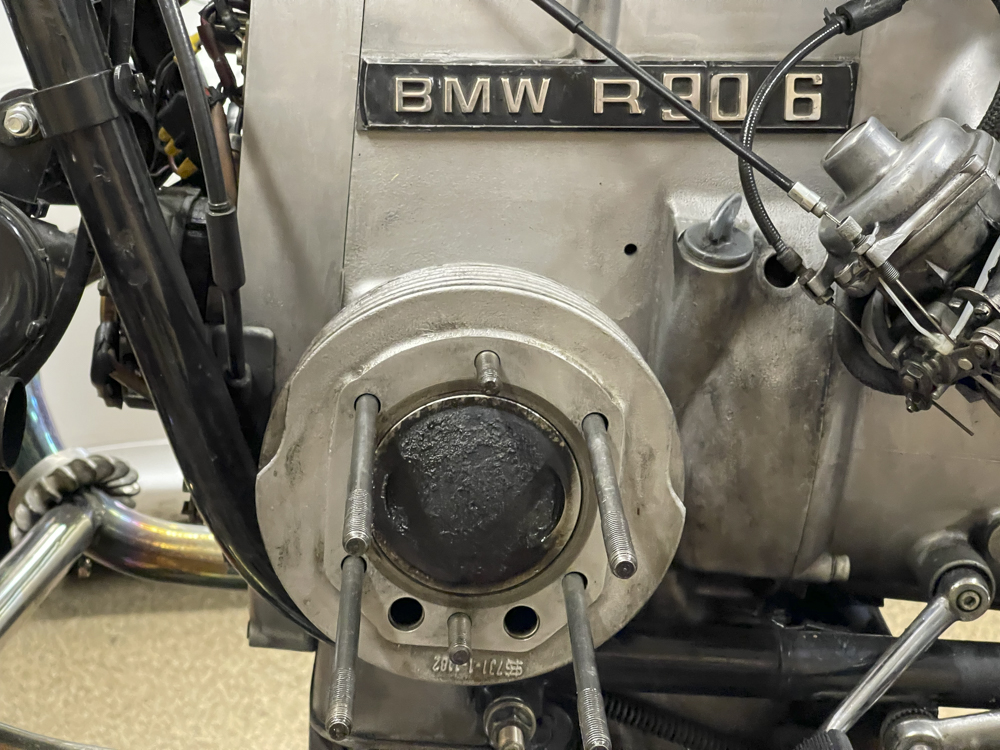

Resealing the cylinder with new gaskets is a simple task.
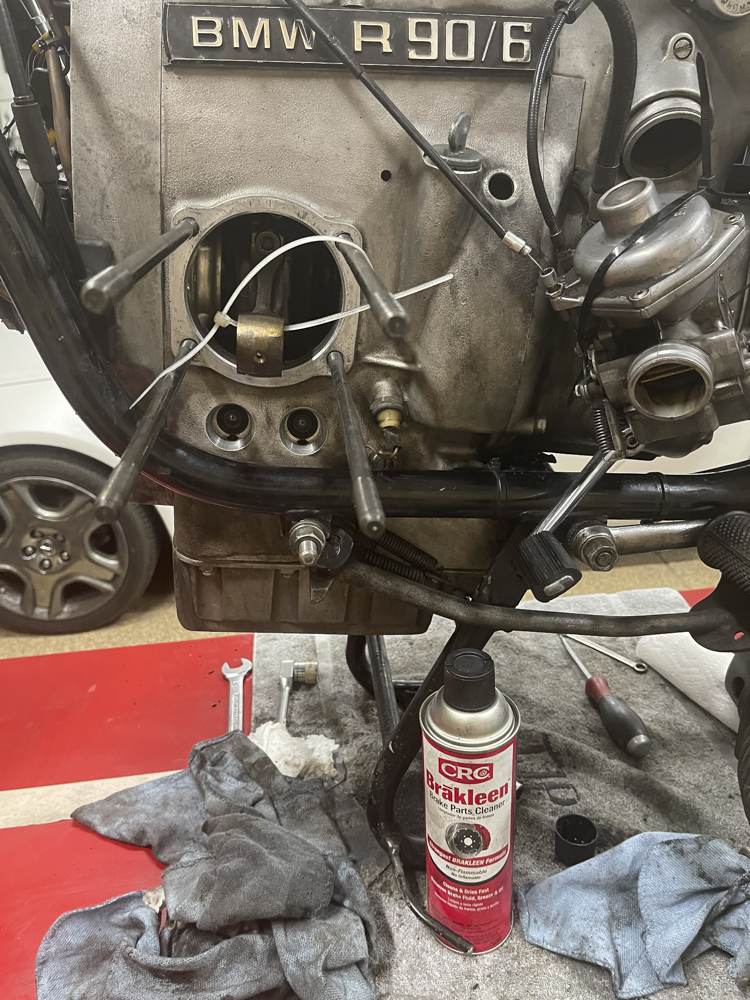

With the piston removed the con rod is held safely
in place with a cable tie. Nicks on the base gasket mounting
surface are not a good idea. The rubber pushrod seals
are replaced at the same time – they harden with
age and heat and leak.
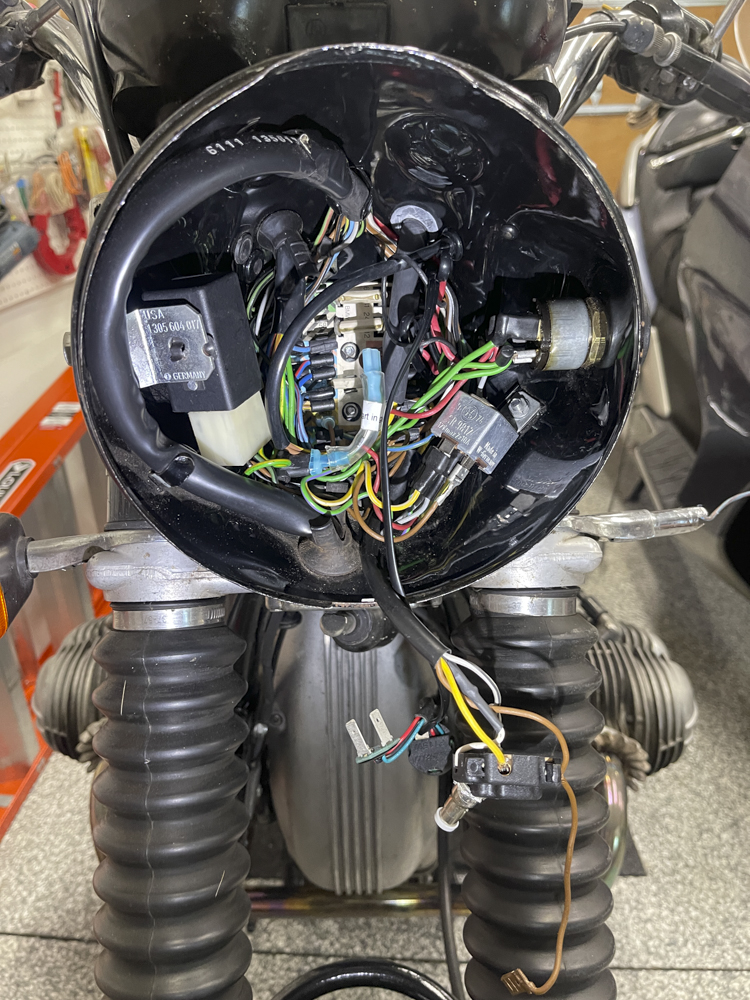

Spaghetti junction. Not BMW’s proudest moment.
The wiring meets up with a small distribution board
in the head shell
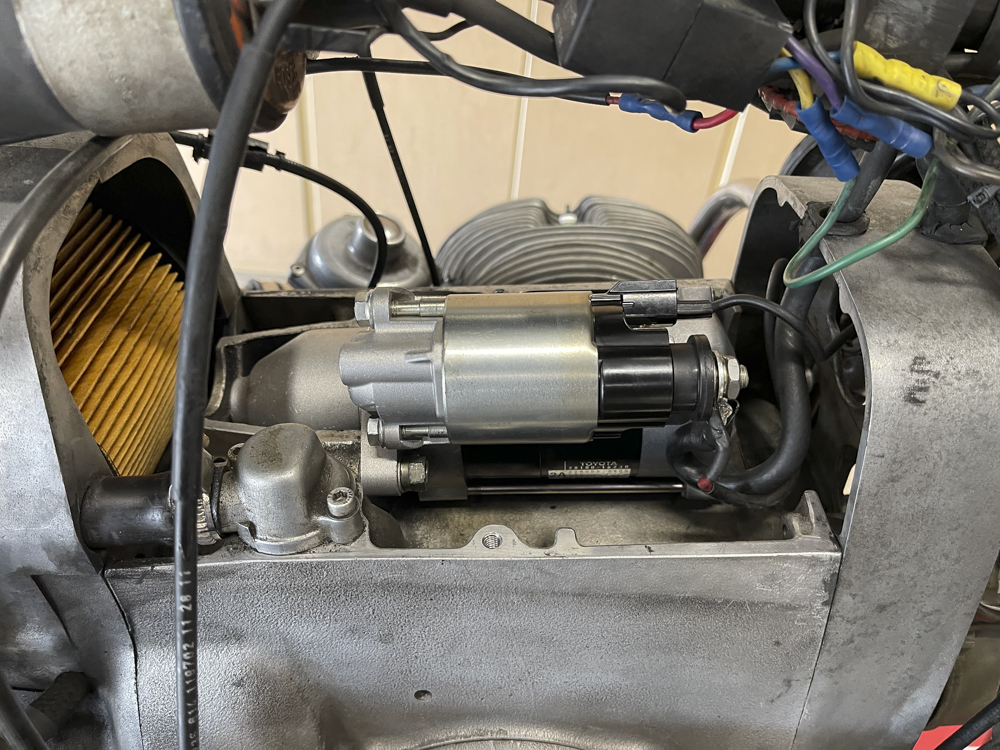

The stock Bosch starter motor is awful, struggling to
turn a cold engine. After having it rebuilt twice over
the years I replaced it with a Toyota truck starter with
an adapted Bendix. Twice the power, half the weight and
current draw. The bike’s modular design means that the
starter can be removed in under 15 minutes.
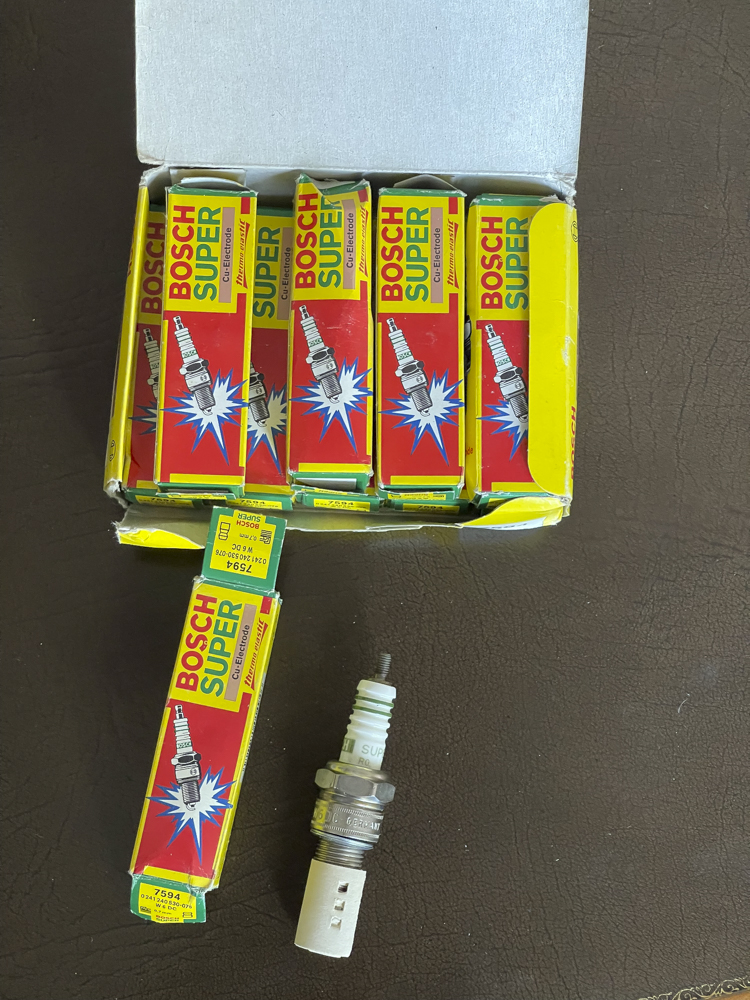

Look hard enough and you can still find original German
Bosch copper spark plugs. That’s all the bike needs in
the ignition department. And ignition timing is 100%
mechanical, no electronics.
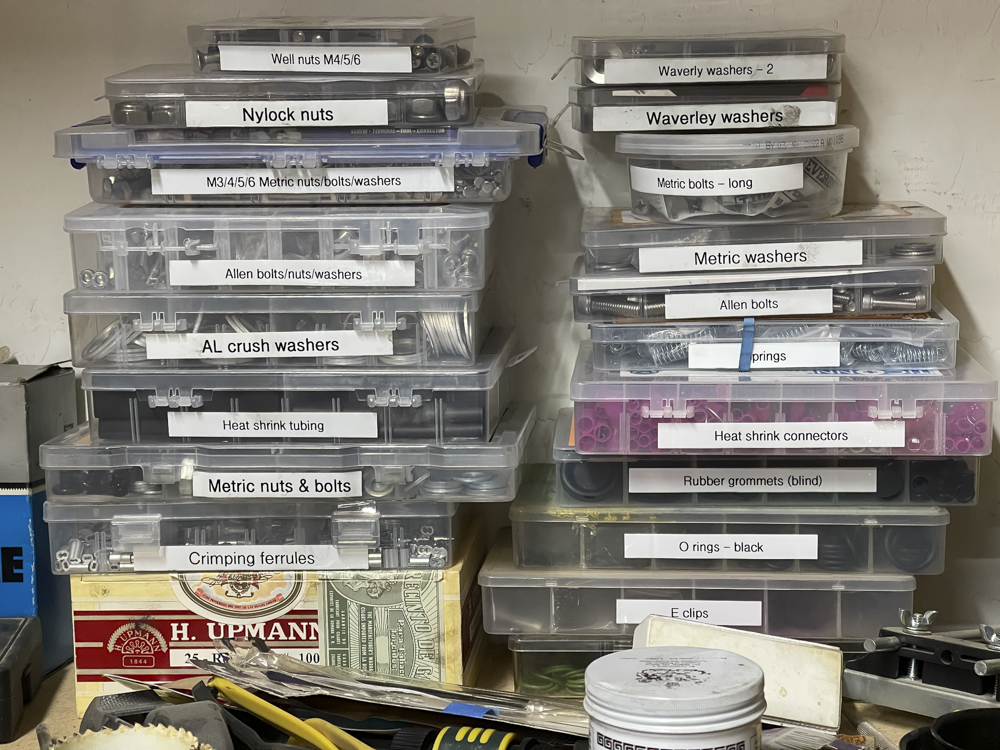

A collection of metric fasteners is essential.
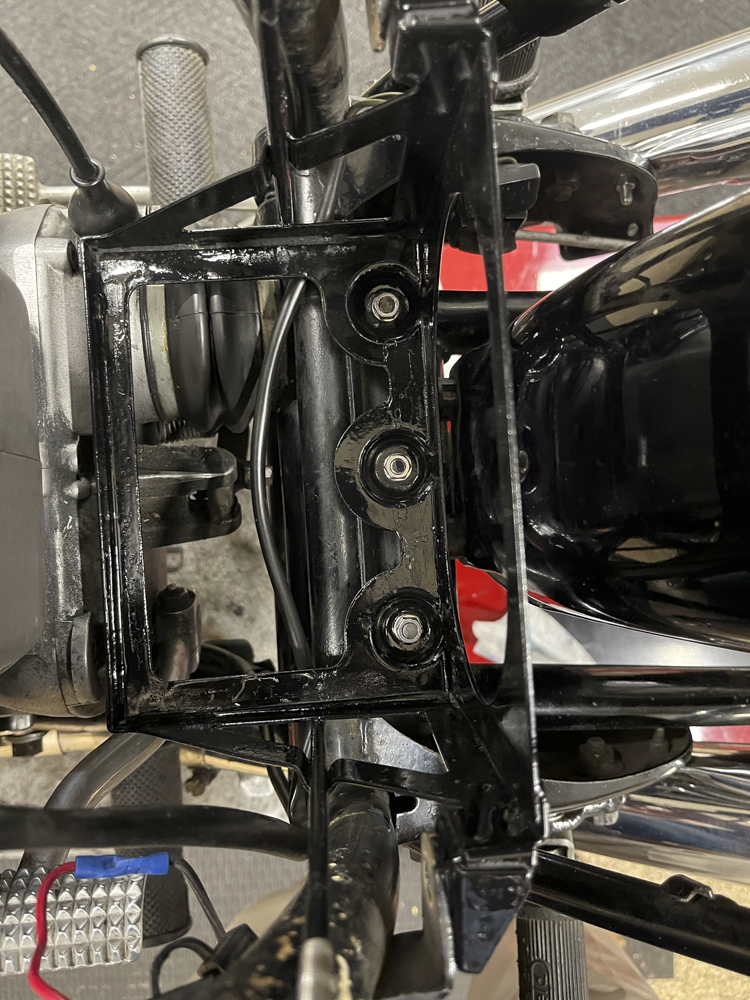

Back in the day batteries came filled with liquid acid, which
would inevitably leak, corroding the battery tray.
The tray has been removed, wire brushed and repainted here.
Modern gel cell batteries do not leak, so this is a lifetime fix.
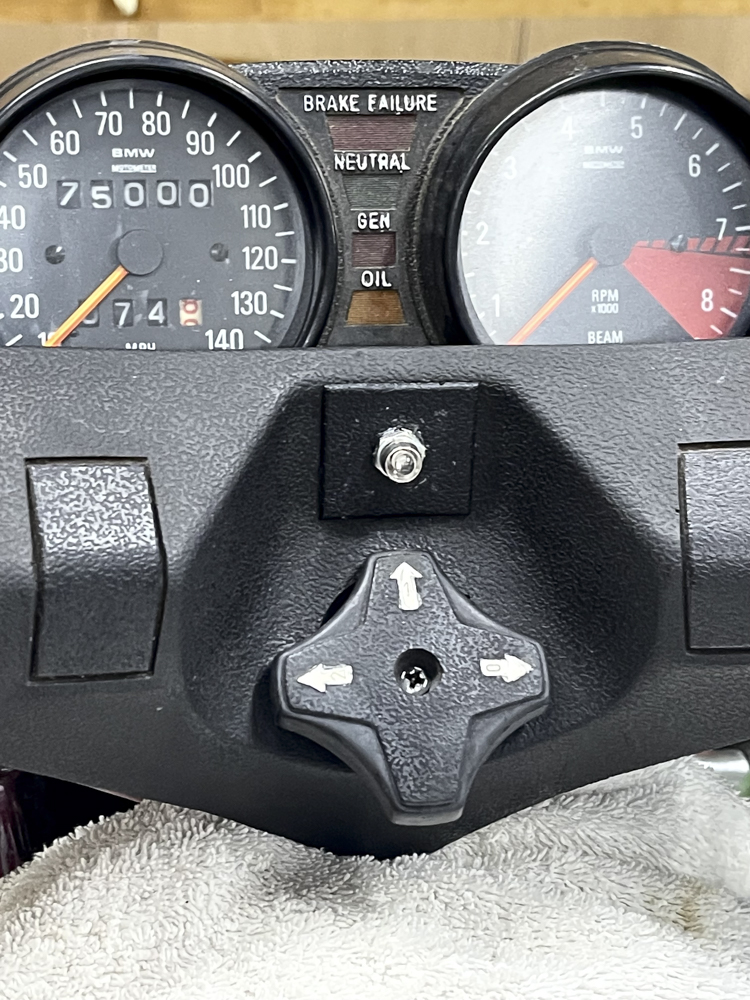

Well, I do have one electronic part in the bike. Here’s
the daylight sensor for the Kisan headlight modulator which
flashes the headlight in daytime riding, enhancing the rider’s
visibility to motorists focused on their cell phones. The
three position steering damper is below.
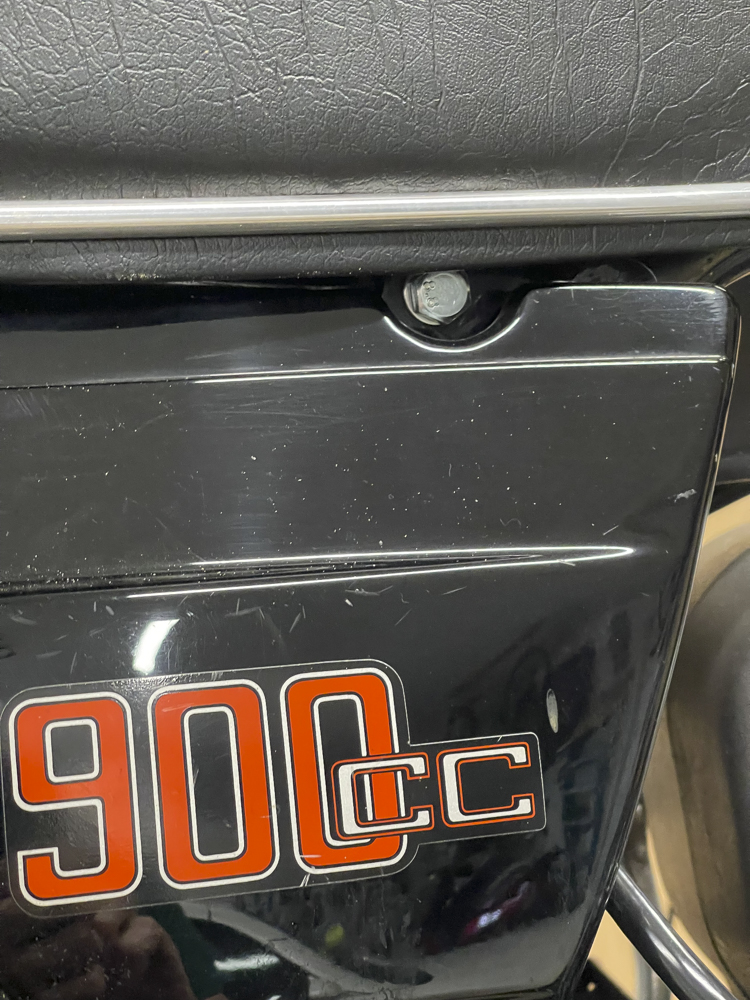

Over the years I have replaced most of the steel fasteners
with stainless ones.
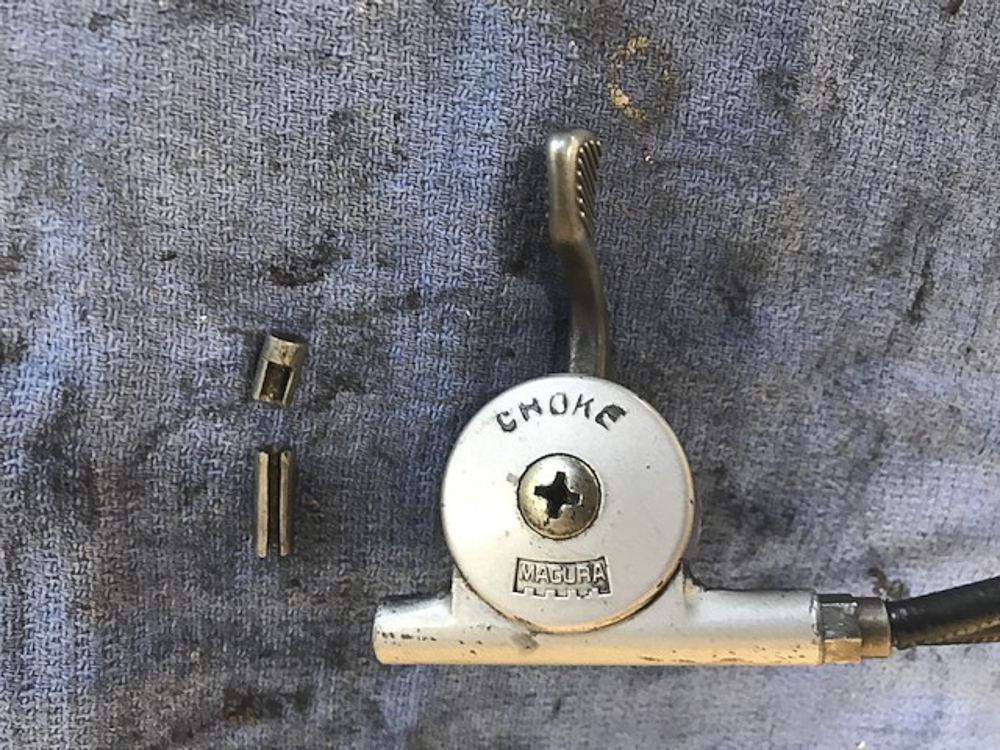

A rare failure – the choke cable toothed follower snapped
rendering the choke inoperative on one side. A fellow airhead
kindly gave me the replacement part which is NLA from BMW.
Magura could learn from Rolex when it comes to engraving.
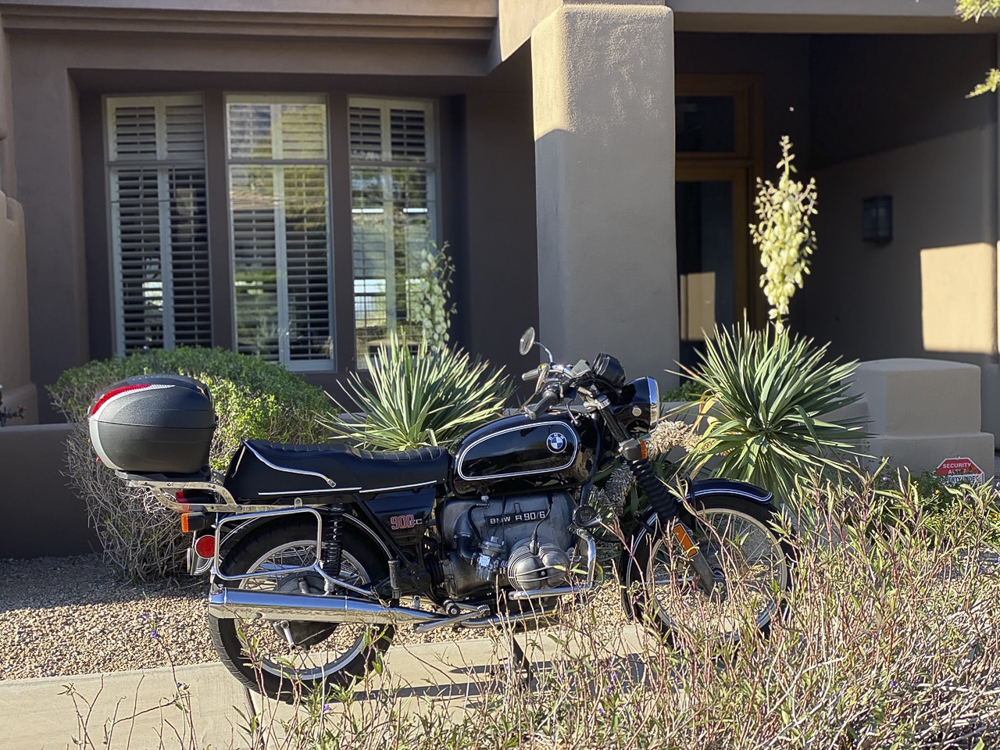

The bike came with the smaller 18 liter tank,
beautifully pinstriped by the ladies in Berlin.
The QD trunk is by Givi of Italy, and holds a full face helmet.
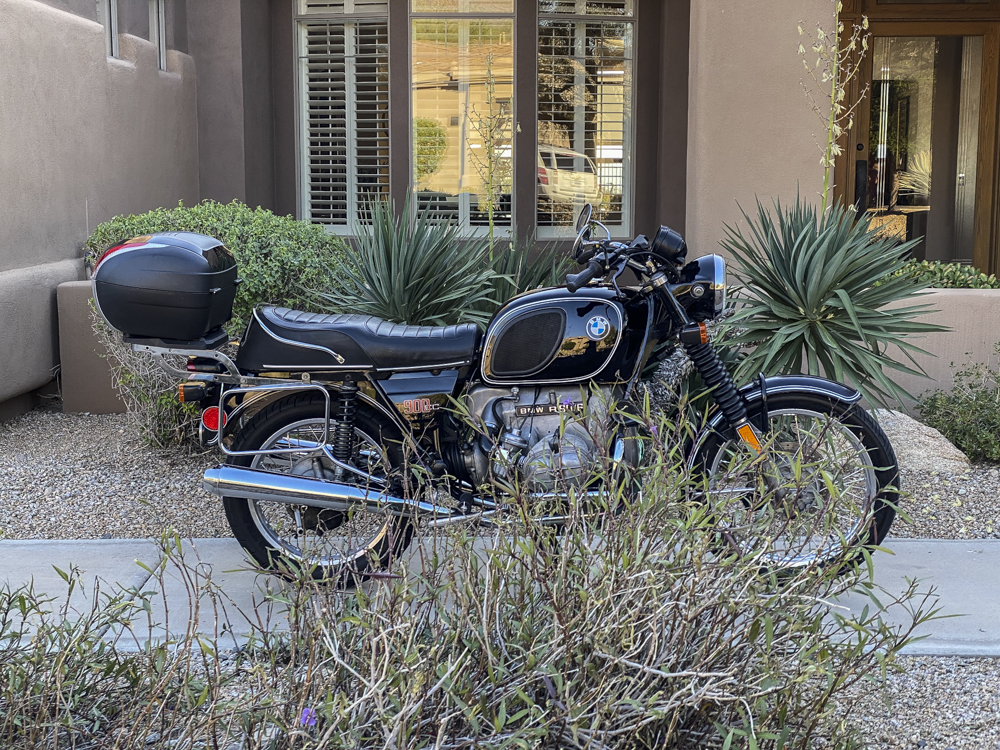

A few years ago I finally got my beaten up 22 liter larger
tank refurbished and the pin striping, done in
Scottsdale, is beyond perfect. I think it
looks far better than the small tank.


Way ahead of its time, the largely modular design makes
accessing most assemblies easy. Here the rear wheel,
driven by a shaft – no chains here – has been removed
for tire replacement. Sadly the wheels require
tubed tires, far less safe than modern tubeless ones.
The shocks are aftermarket Konis, superior to
the stock ones, and recently rebuilt.
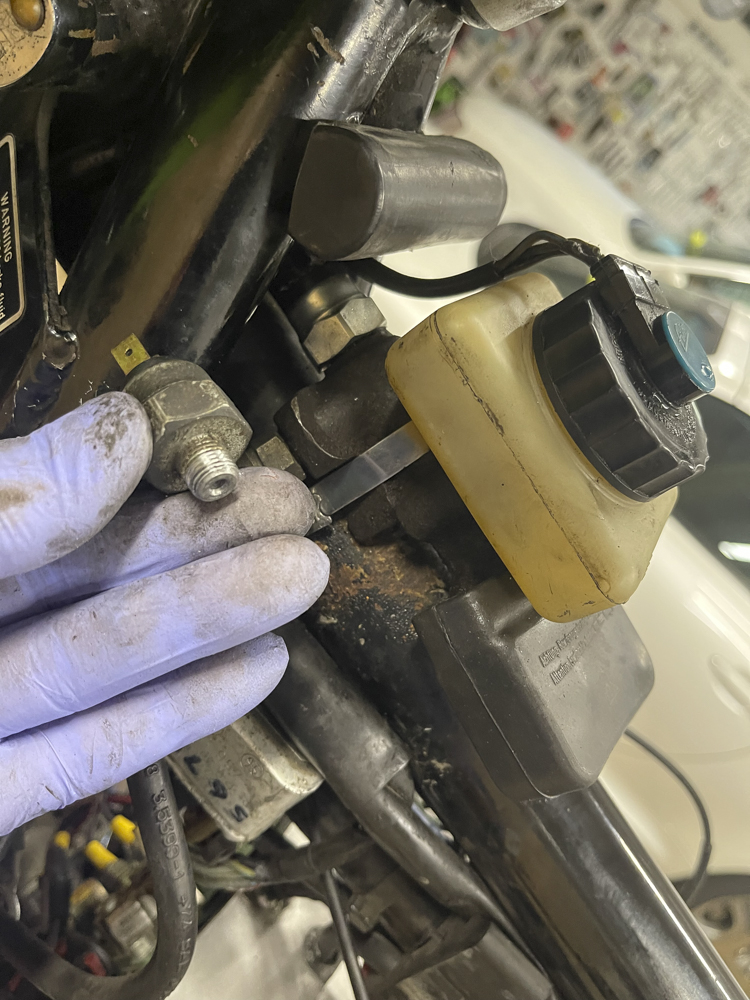

The brake light sensor is a simple pressure switch.
Here I am replacing it as it failed after 30 years.
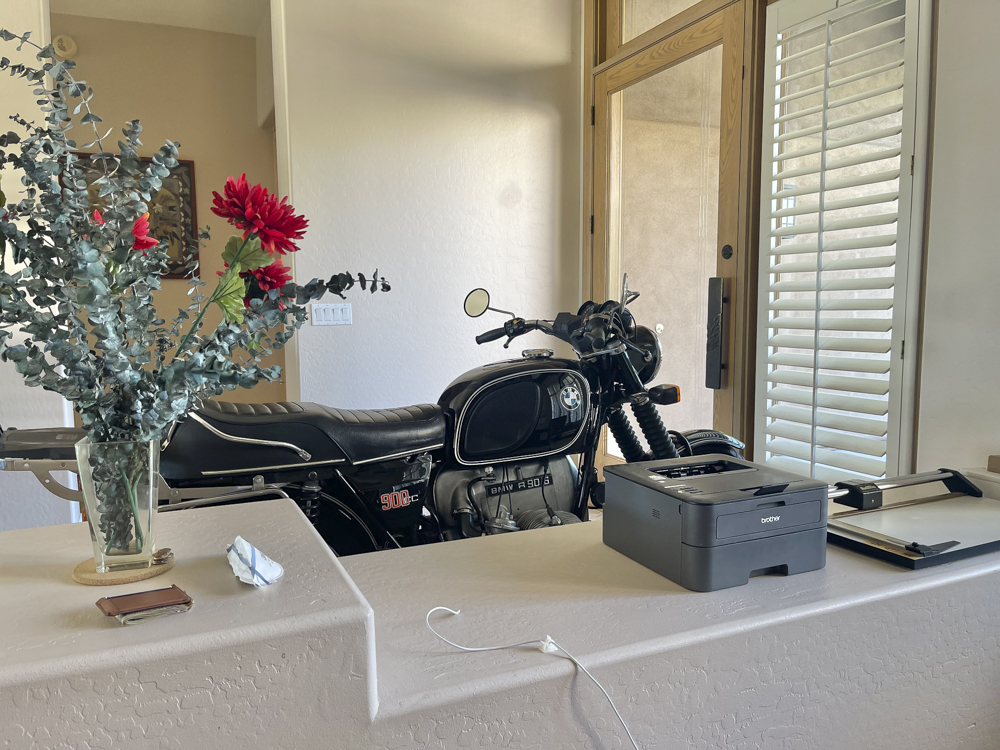

During baking Scottsdale summers I kept the bike indoors
to avoid premature rotting of rubber parts. Eventually
I insulated and air conditioned the garage to make for
better summer storage.
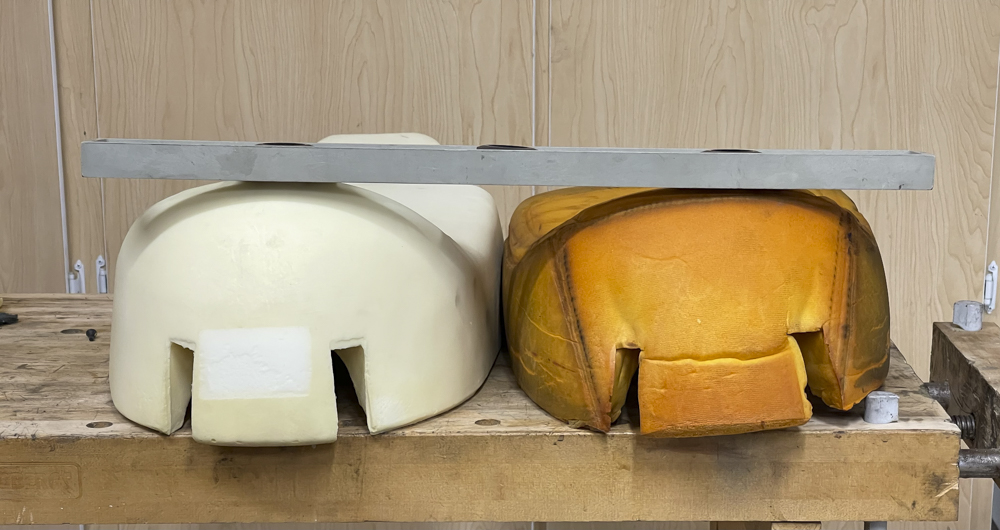

After 30 years the saddle foam was shot and the vinyl
seat cover was cracking. New foam from the Fatherland
on the left.
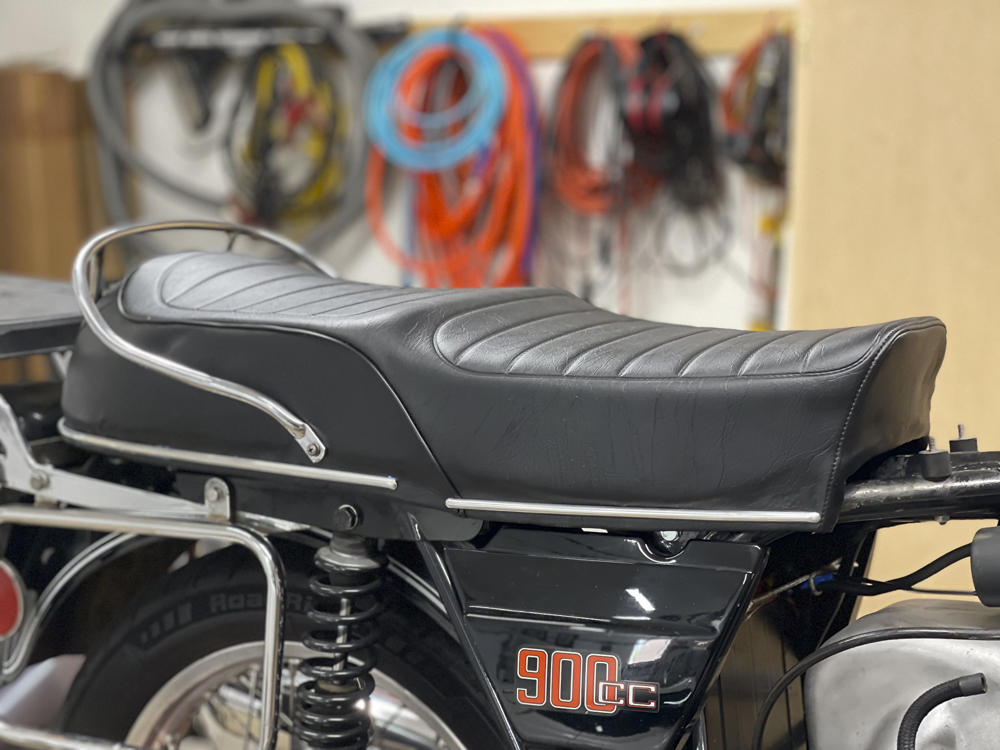

New seat cover installed over new foam
A very time consuming job, but very satisfying, and
easier on the bottom to boot!
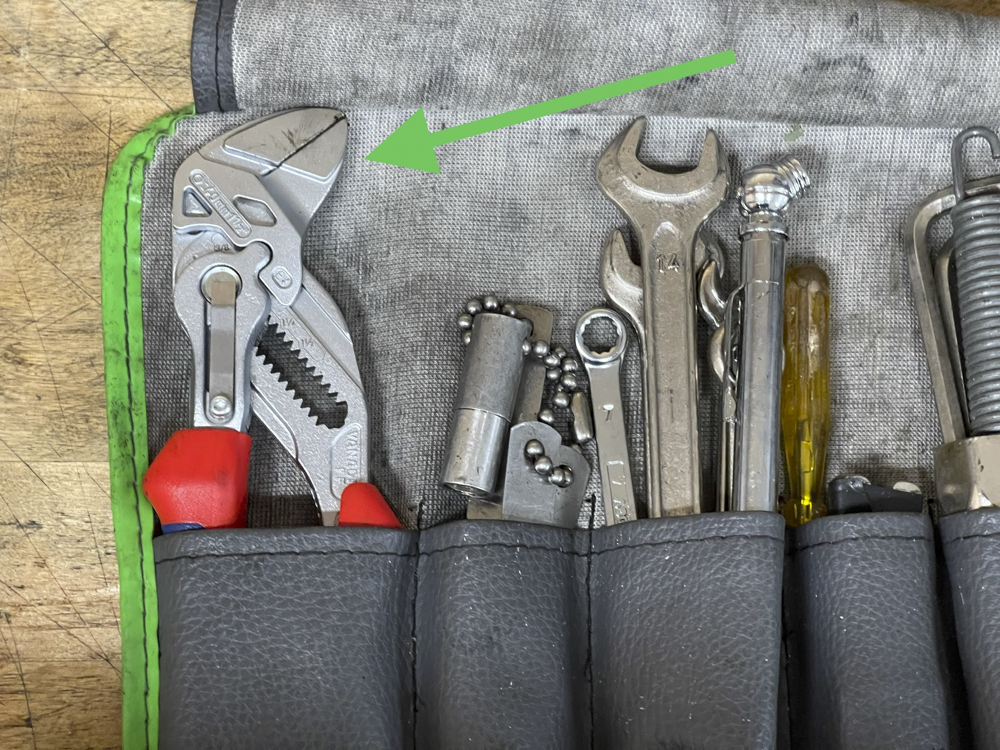

While the stock tool kit is excellent the pliers
are poor quality. A superb pair of Knipex adjustable
pliers
does the trick far better. The cylinder on
a chain emulates TDC when adjusting the mechanical points
ignition when installed on the nose of the cam.
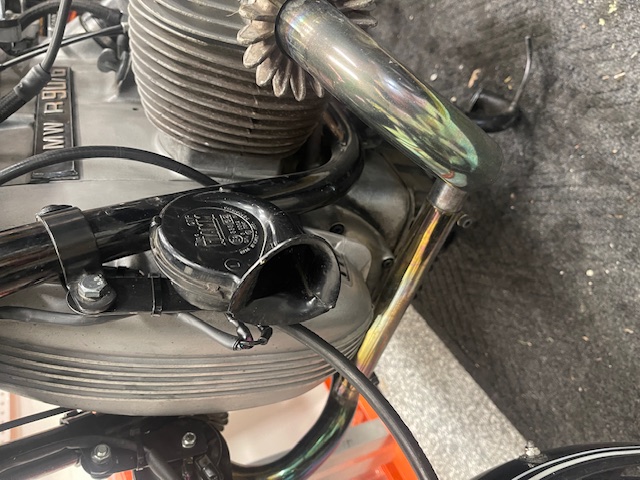

The twin FIAMM Italian horns are not only much louder
than the weak stock offering, they are also paired out of
tune, the resulting interference effect on the two sound waves
making the output truly obnoxious. You want that in
a world which often does not see or hear bikers,
especially those on quiet BMW airheads. As the horns
draw high current I added a relay to avoid frying
the relatively lightweight horn button circuitry.
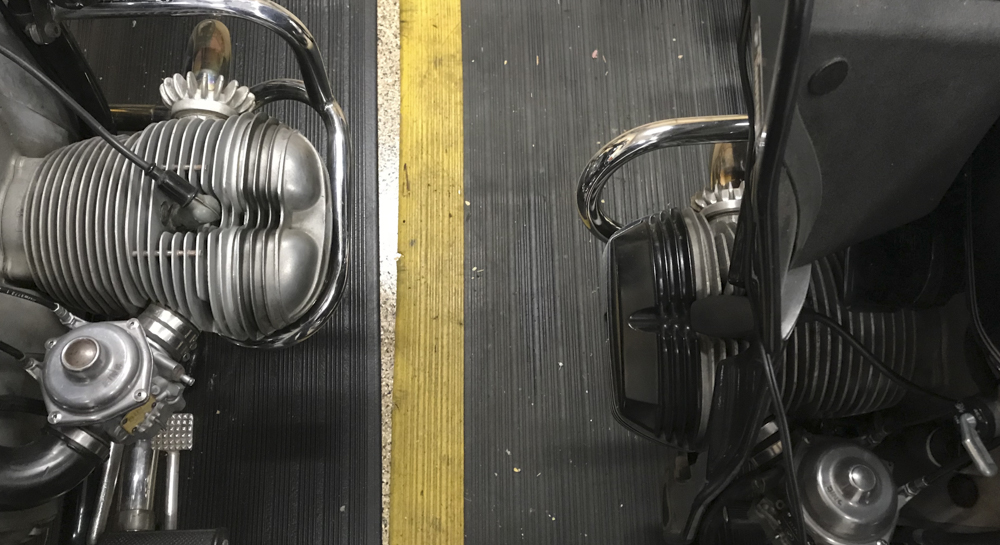

The horizontally opposed boxer engine design lasted through
1995, but remains available in some of BMW’s latest
machines where it is now oil and air cooled. Here the
1975 valve cover compares with that on a 1994 R100RT
touring machine. No prizes for guessing which I prefer.
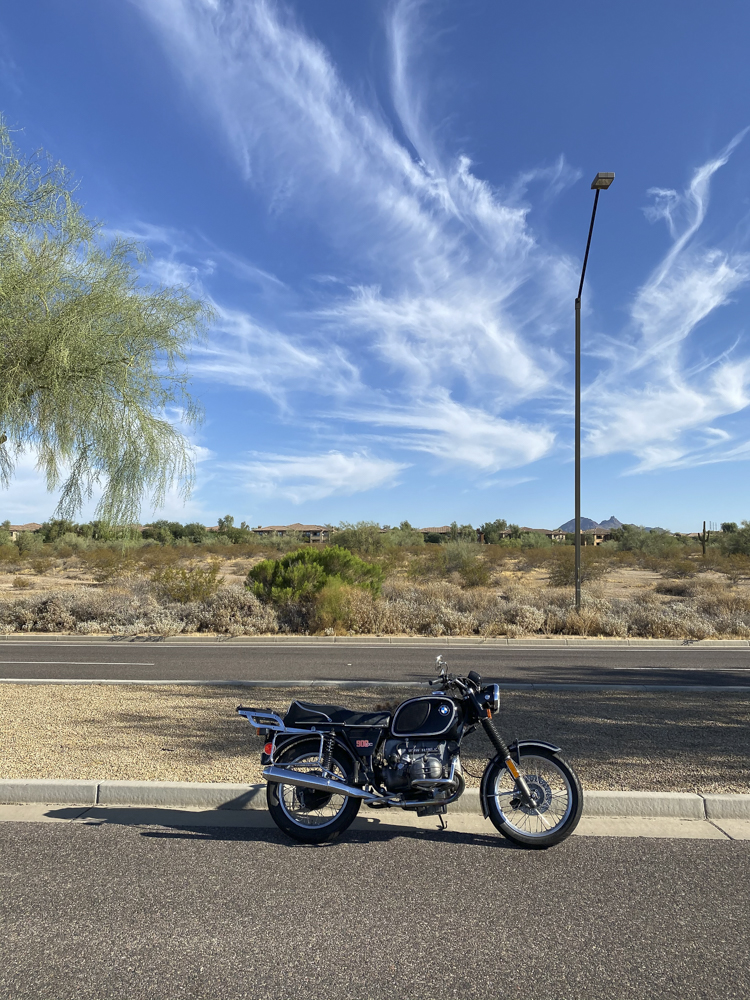

In Scottsdale, Arizona.
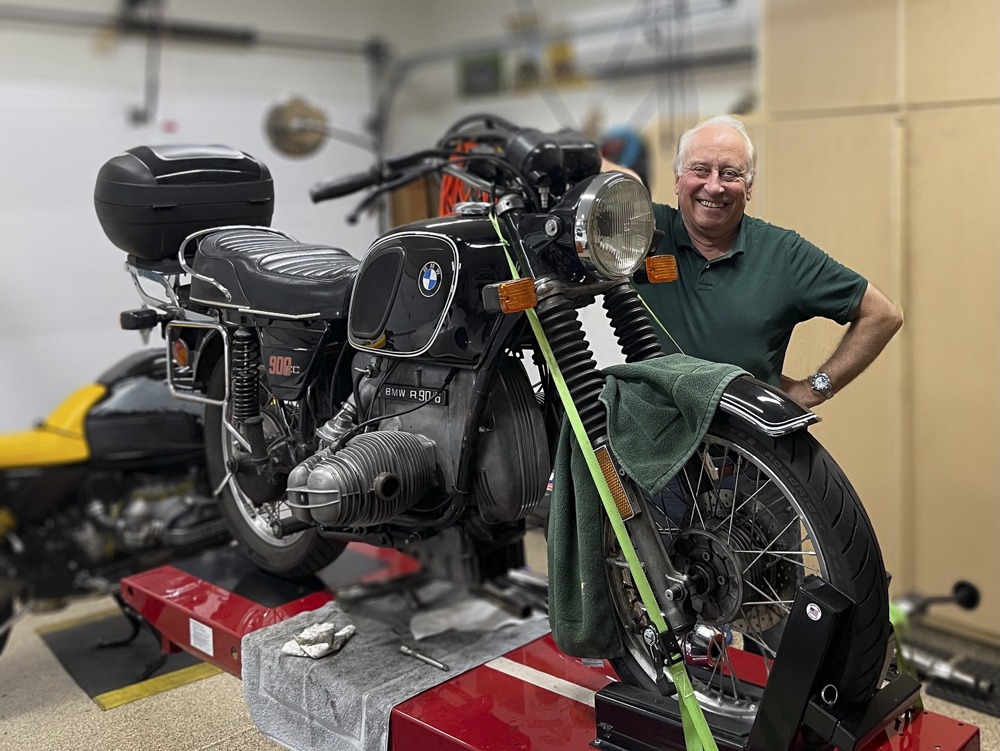

A happy owner, with the bike on an all American
Handy bike lift. The hair is greyer but the smile is
every bit as wide.

I wish I could tell you that I am looking forward to the next 35 years with this beautiful machine but statistics and anno domini suggest otherwise.

Amaranth flour waffles

Super healthy.

For an index of cooking articles on this blog click here.

One simple rule of healthy eating is to avoid any product with ingredients whose names you struggle to pronounce. That pretty much includes all ultra processed foods and store bought pancake mix for waffles.

In my piece profiling the Presto waffle maker I mentioned that I used Aunt Jemima pancake mix. (In deference to modern times, the ‘Aunt Jemima’ black mammy branding has been retired in favor of ‘Pearl Milling Company’ but the product remains the same). Well, applying the above guideline I note that that mix contains a slew of nasty sounding chemicals, so in the garbage can it goes. Garbage to garbage.

And say ‘Hullo’ to Amaranth flour, a five pound bag costing $30. I had to buy from Amazon but if you can source it locally it will almost certainly be cheaper. That’s roughly twice the price of the Aunt Jemima poison but, hey, that’s the cost of healthy eating. Do you think all those superbly toned Hollywood stars subsist on Big Macs, America’s biggest killer?

The recipe I use is here with the following changes:

  • Do not bother beating the eggs and milk, or pre-mixing the solid ingredients. Just put the lot in a bowl and stir/beat.
  • There is no need for the 15 minute cure period for the batter. It can be used immediately.
  • Do not add ANY granulated sugar or salt. There is absolutely nothing good about refined sugar or salt and the maple syrup will add all the sweetness you need.
  • I add dark chocolate chips to the batter – a solid handful
  • You should substitute Avocado oil (smoke point 515F, no saturated fat – good) for the vegetable oil (smoke point 400F, loaded with saturated fat – bad) or butter (way too low a smoke point) for a healthier mix. The high smoke point of the healthy avocado oil makes sure the pancakes do not get charred – avocado oil has the highest smoke point of any commonly used cooking oil, and is by far the healthiest choice
  • You must use a touch of anti-stick spray or the waffle will stick to the waffle maker’s platens – not ideal but the Pam spray I use mostly contains oils, with a touch of anti-smoke and anti-sticking chemicals. The waffler runs at 395F which is right up there with the smoke points of the three oils in the spray, hence the need for an anti-smoke agent.
  • After a requisite 3 minute warm up period I heat the batter for 3 minutes, flip the waffler, then heat for 3 minutes more, for a total of 6 minutes.
  • A five pound bag of flour will make 14 waffles in the Presto waffle maker.

The health benefits of amaranth are described here. It’s an ancient grain first used for food by the Aztecs! Perhaps most significant is the fact that amaranth flour is gluten free, a blessing for those who are wheat intolerant. The health benefits of avocado oil are described here.

For a fully formed waffle in the Presto waffle maker you require 1.1 cups of batter, meaning the following amounts should be used to make 2 waffles:

  • Egg – 1 large
  • Milk – 285 grams
  • Avocado oil – 45 grams
  • Amaranth flour – 155 grams
  • Salt – NONE.
  • Granulated sugar – NONE
  • Baking powder – 1 teaspoon (a dry chemical leavening agent, a mixture of a carbonate or bicarbonate and a weak acid which releases carbon dioxide into the waffle to make it rise)
  • A handful of dark chocolate chips (avoid the white variety which is loaded with saturated fat)
  • A handful of walnuts on top
  • Real maple syrup to taste
  • For a crisper waffle use a 50/50 mix of amaranth and bread flour

You can see that most of these measures are stated in weight rather than volume, which is the accurate way to go.


The result.

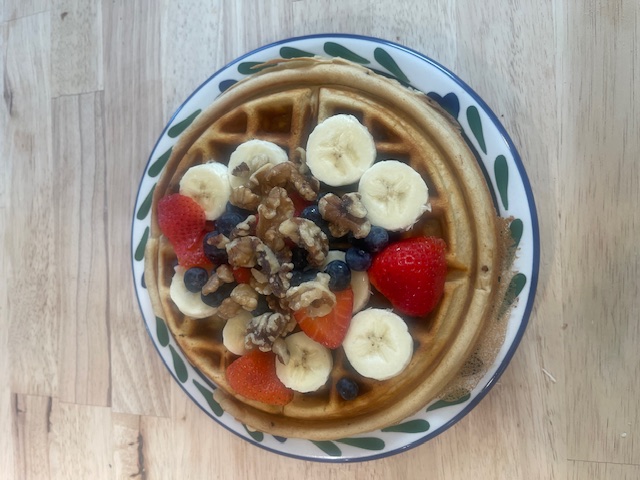
Here is the result using 1.1 cups of batter in the waffler:


One perfect waffle.

A single waffle topped with bananas, strawberries, blueberries and walnuts, chopped hazelnuts or slivered almonds makes for a healthy sub-300 calorie meal and please, only use real maple syrup. Sure, it’s costly but your body does not need the many poisons and imitation sugars in the cheap stuff.

By the way, the beautiful country style plate shown above is proudly made in America by H F Coors, in Tucson, Arizona, and is highly recommended for its provenance, quality and toughness.

Roger Prigent

Photographer and antiquarian.

Roger Prigent, a prominent 1960s Vogue photographer, passed away at age 89 the other day. When his eyesight started to fail three decades ago he devoted his life to dealing antiques in Manhattan, proving that there are second acts.

Some examples of his work, the severe and simple settings reflecting the work of his rôle mode Richard Avedon.