Oh! boy.
Click the image for a larger 24mp version.
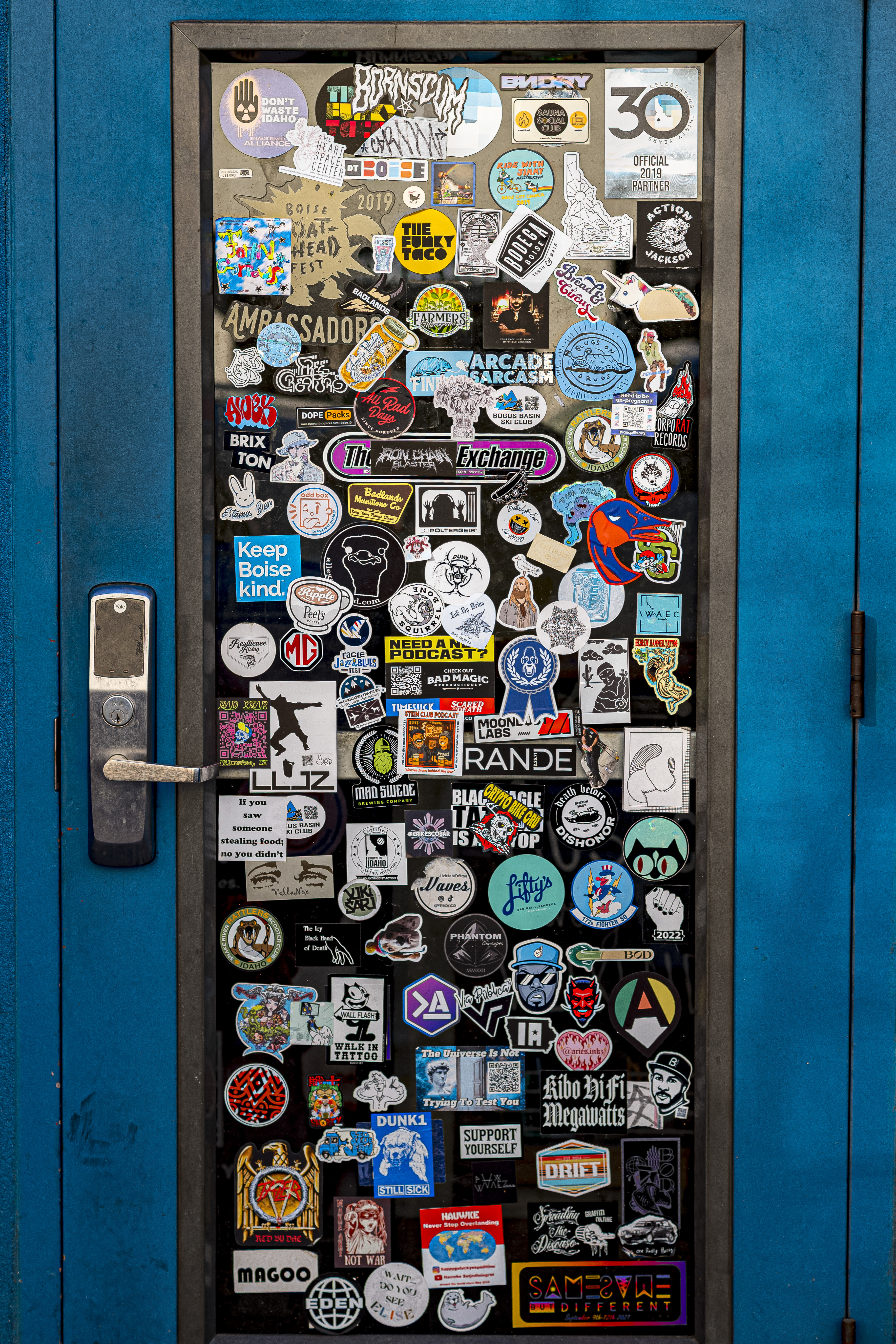
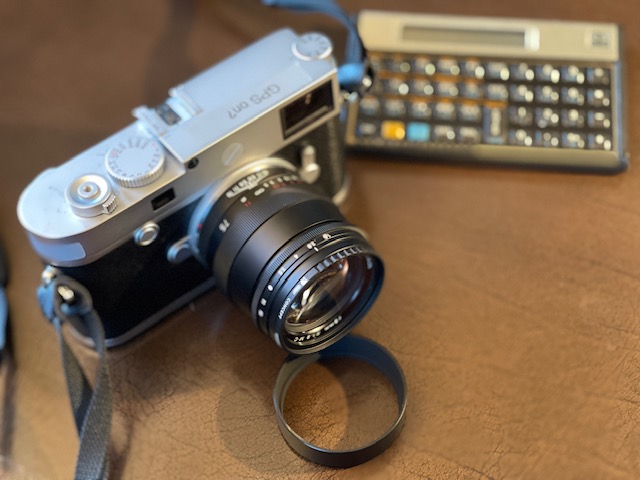
Leica M10, 75mm f/1.9 Ultron at f/2.8.
Oh! boy.
Leica M10, 75mm f/1.9 Ultron at f/2.8.
Felons in the Oval Office do the opposite.

A compact and fast medium length lens for the Leica M.
For an index of all Leica-related articles click here.
A brief history of Leica and Voigtländer 75mm lenses:
Leitz made a super fast 75mm f/0.85 lens in the 1930s. The true speed, in the absence of anti-reflection coatings, was likely a stop less but it was an impressive achievement. How you were meant to focus this accurately at full aperture using the iffy rangefinders of the day remains a mystery.

The Leitz 75mm f/0.85 Summar.
From Theo Scheerer’s ‘The Leica and the Leica System’,
Fountain Press, 1962
In 1980 Leitz introduced its first post war 75mm lens for the M body, the f/1.4 Summilux-M (Version 1 – 17.3oz, version 2 – 21.2oz, neither exactly a lightweight). The f/2 Apo-Summicron-M followed in 2004 (15.2oz), and remains available new, with an economy model f/2.5 Summarit-M introduced in 2007 (11.5oz), rubberized focusing collar and all (ugh!) and now discontinued as Leica prefers to offer only crazy expensive lenses. This was later revised to f/2.4 (12.3oz). Finally a super-fast f/1.25 Noctilux-M (a whopping 36oz) was introduced more recently and you can buy it for the price of a good used Japanese car. All came in a black finish except for the Summarits which came in black or chrome.
Imitating the look and feel of the Leica optics, the Japanese company Voigtländer/Cosina started with a 75mm f/2.5 Color Heliar (a scant 8oz) in 1999 which came in a Leica Thread Mount, easily adapted to the M bayonet body, and available in black or chrome finish. An f/1.8 Heliar version followed in 2010, bayonet mount and black only (15oz – heavy, so likely using a good deal of brass, black only), and a fast f/1.5 Nokton Aspherical (12.4oz) followed in 2019 in black or silver. Like the Noctilux-M this optic’s considerable bulk is anathema to the aesthetic of the Leica M body, and focus at full aperture using the rangefinder is a hit and miss proposition, and finder blocking by the bulky optic is significant. An eyepiece magnifier is probably a good idea.
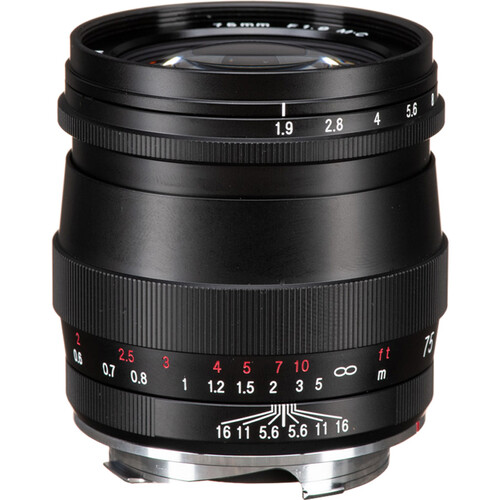
The latest Voigtländer offering is the improved 75mm f/1.9 Ultron (10.2oz), uses an aluminum alloy body which comes in either multi-coated or single-coated versions, the latter allegedly providing more of a ‘film look’, and likely producing more flare shooting into light sources. The lens has no aspherical surfaces, a design which often gives that clinical, modern rendering. The lens was introduced in 2023. Sadly the scalloped focus ring of the earlier versions was replaced by a tapered, fluted design, reminiscent of the fine Zeiss Ikon lenses for the Contarex. Design consistency and naming conventions are clearly a low priority at Cosina.
Purchase:
It being Christmas and having a hankering for a focal length I have not used on the Leica M10 I found a nice lightly used example of the Ultron at B&H for a reasonable $465. New Voigtländer lenses are no longer the bargains they used to be. For that you probably have to look at the increasing number of Chinese offerings some of which can be had for a good deal less money. While B&H’s listing stated “shows light signs of wear” in practice the lens arrived in absolutely mint condition with front and rear caps, lens hood and lens hood cap, along with the original box. The controls are just so – a nicely click-stopped aperture ring (with half stop clicks – ugh!) and a smooth and light focus collar. The vestigial lens hood does not look like it will make much difference in use, and for protection I use a 49mm multi-coated UV filter for all of $10 – don’t waste money on costlier ones – just see the images below. The center of the front element of the Ultron protrudes significantly, close to the plane of the front ring, so a protective filter is a good idea. The included hood is probably redundant. The lens focuses down to 0.5m but the M10’s rangefinder only works down to 0.7m, so below that distance you would have to use Live View to focus on the rear LCD screen (double ugh!). Feel and operation of the lens are both easily up to Leica standards. I got a bargain.
Disassembly:
Yukosteel has a fine disassembly pictorial here which testifies to the high quality of the design. Well worth perusing, especially if your used example has dust collected inside.
Lens coding:
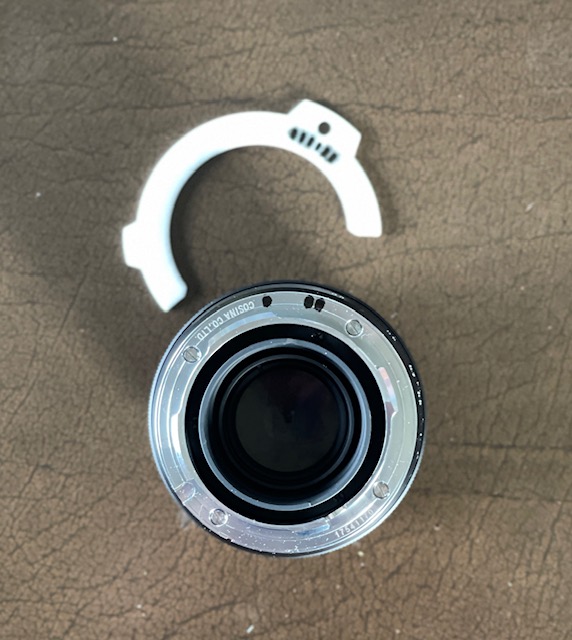
The M10 provides lens correction profiles for two 75mm Leica lenses – the 75mm f/1.4 Summilux-M and the 75mm f/2 Asph Apo Summicron-M. Snapping a clear blue sky I found that the profile for the Summilux provided the least vignetting though there is very little in it, so I coded the lens 100011 in accordance with this table. The arcana of lens coding are detailed here. The rear flange of the 75mm Ultron has a recess around the mounting surface which neatly accepts coding from a felt tip pen with no abrasion wear when the lens is mounted or removed. You can obtain the coding template shown below by reading this.
Size:
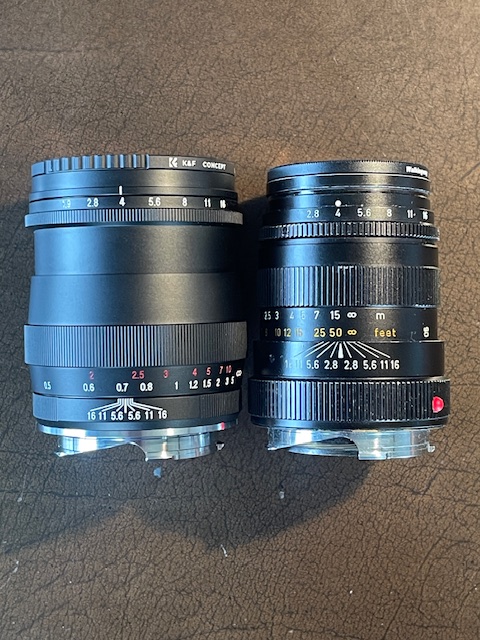
Weighing a few grams more than the wonderful 90mm f/2.8 Tele Elmarit (one of the few affordable used Leica lenses) the size is virtually identical as regards length with the Ultron a tad chubbier. Weights are 10.2oz (Ultron) and 7.9oz (Tele Elmarit):
Mounting index:
As with the 21mm Voigtländer Color-Skopar, the lens indexing red indicator is small and hard to see, so I have drilled the rear ring for a larger red plastic index dome which confers both visual and tactile location information. See the end of this piece.
Import into Lightroom and correct naming:
On importing images to Lightroom follow the process here to automatically invoke the correct lens correction profile. Then rename the lens used to ’75mm Ultron’ using the instructions here. Lightroom does not currently include a profile for the 75mm f/1.9 Ultron so I use the profile for the Leica-M 75mm f/2.5 Summarit. It works well, correcting for a very small amount of pincushion distortion.
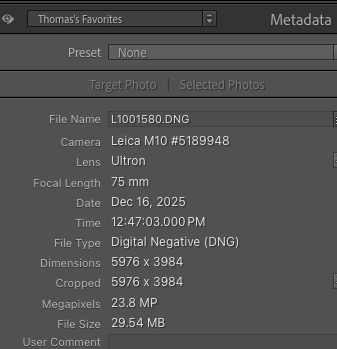
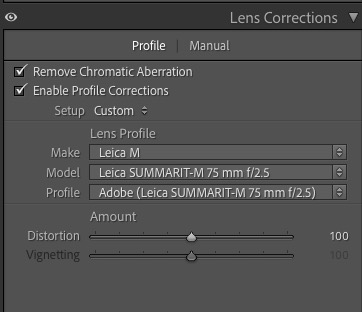
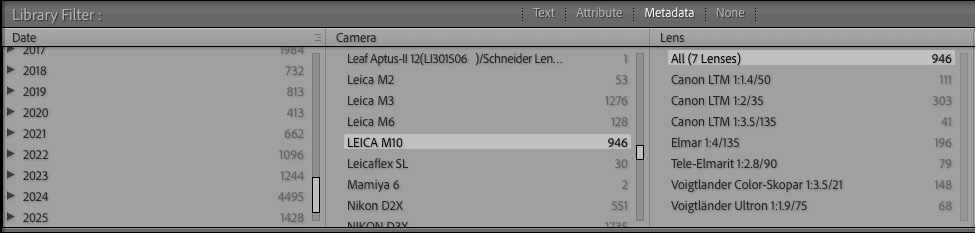
Why bother with correct lens naming? Because I find I frequently search images by equipment used, so using Lightroom’s Metadata panel in the Library model makes searching for ‘Leica M10 – 75mm Ultron” easy.
Images:
Here are some images from a first outing – three have click-throughs to the 24mp original files. On a desktop or laptop computer, click again on the big image to get a real whopper. All were taken in poor, overcast light:

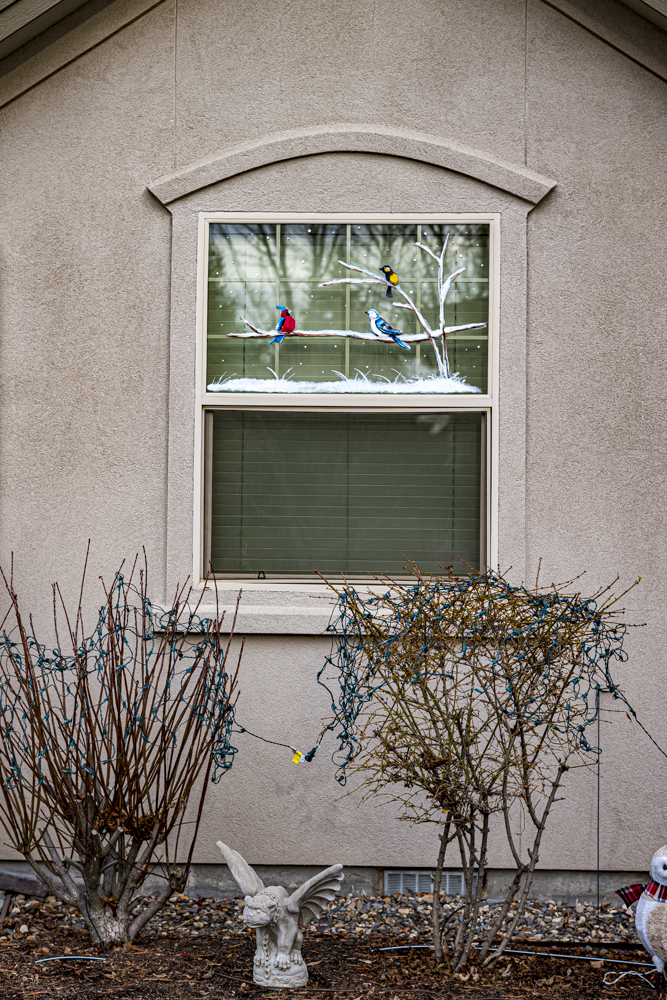
Painted window.
At f/1.9. Click the image for a larger version, and read Rangefinder adjustment below.
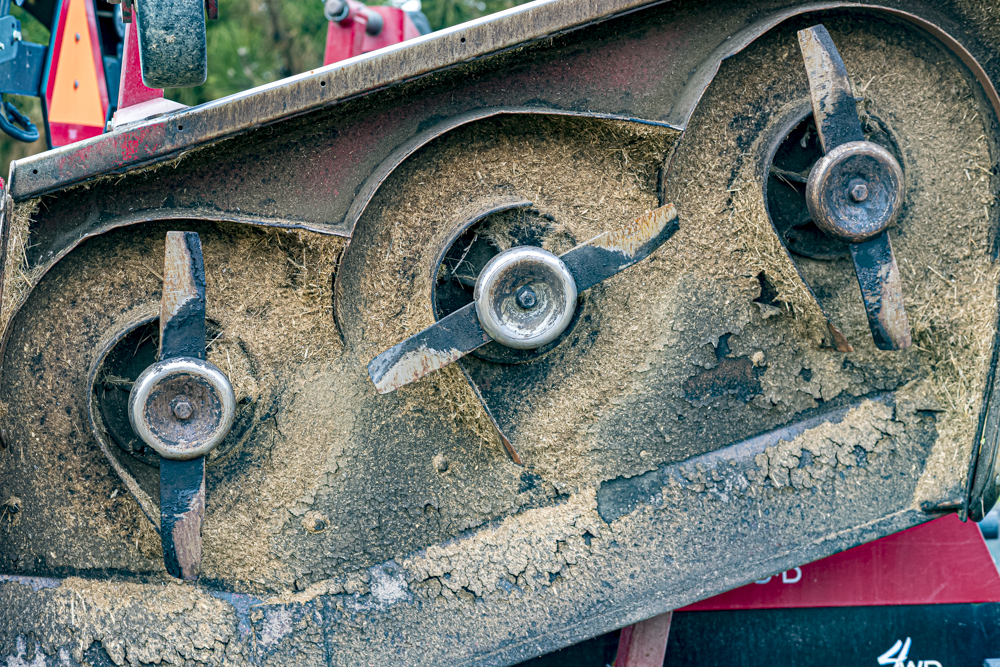
Farm equipment.

Barn door.

At f/2.8.Click the image for a larger version.
Rendering of out-of-focus areas is pleasant and the lens is sharp wide open – provided you nail focus. I did not use an auxiliary magnifier on the M10 and had little difficulty focusing accurately. By f/2.8 the lens renders images tack sharp all over, and prevails all the way down to f/16. F/1.9 is fully useable – see below. The focus collar throw is some 100 degrees and is just right for speedy focusing. Balance on the M10 (or M3, or M2, etc.) is well night perfect, but note that only later versions of the Leica M film bodies have a built-in 75mm finder frame, so an external finder may be called for when it comes to accurate composition. The lens will invoke the 50mm finder frame on those earlier film bodies. The M4-P was the first film body equipped with the 75mm finder frame. All digital M bodies have it.
Conclusion:
Recommended, if you like the 75mm focus length – an ideal partner to the 35mm for street snapping – and can find one in the market. I see little point in getting the single coated variant – you can always confer ‘glow’ in post processing if your original file is too sharp.
Rangefinder adjustment:
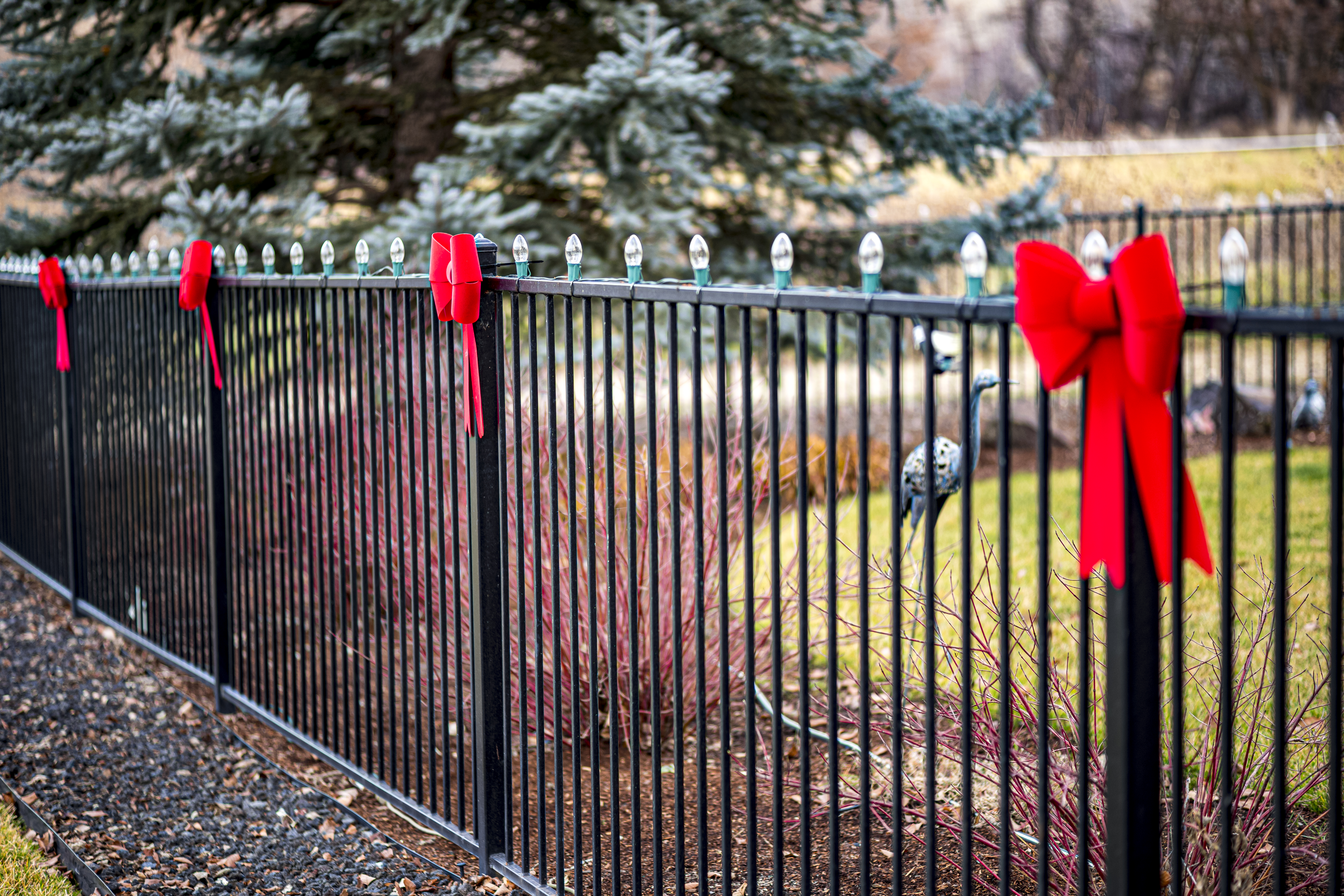
Click on the third image above, the one with the string of light bulbs and red ribbons, and on critical viewing you will see that the focus point is ever so slightly nearer than the central ribbon. A matter of a mere couple of inches, but not correct nonetheless. It is that ribbon I focused on.
When writing about critical adjustment of the M10’s focusing mechanism I explained how to adjust the eccentrically mounted cam roller using the 135mm f/4 Elmar lens at full aperture, aided by an eyepiece magnifier for accurate rangefinder focus. A fairly critical test.
But not critical enough.
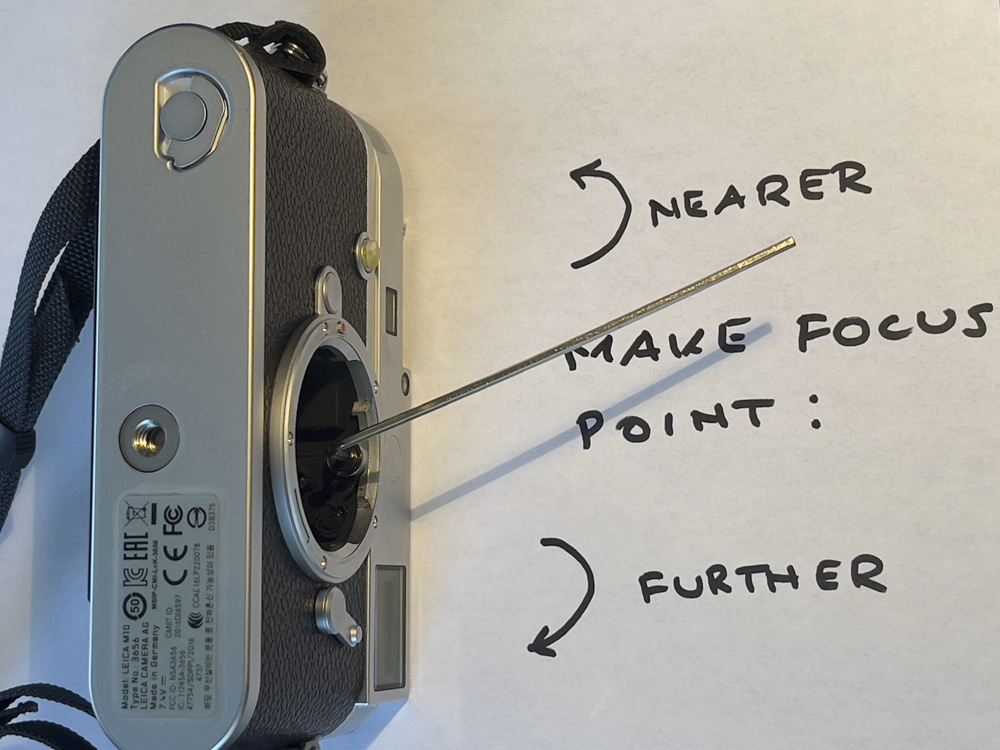
Consulting depth-of-field tables it transpires that the DoF for a 135mm f/4 lens at 5′ (its closest focus) is 0.31 feet. By contrast, the DoF for a 75mm lens at f/1.9 at 3′ (much the same magnification) is a scant 0.05 feet. That’s under one inch! So given the more critical focusing cam adjustment for the 75mm lens I set to adjusting the cam roller as illustrated here, making the most minuscule adjustment using the 2mm Allen wrench to move the focus point away from the camera. A ‘bookcase test’ – wherein I photographed a row of book spines at 45 degrees to the camera at the 0.7 meter (2.3 feet) minimum focus distance before and after this adjustment – confirmed that the focus point was, indeed, too near and the small adjustment nailed it. So if you are unhappy about the focus accuracy of your M body at full aperture, consider this simple process.
Adding the red dome mounting index:
Because the small engraved red line on the mounting ring is barely visible, a red plastic mounting hemisphere is added. This greatly enhances visual location when mounting the lens on the camera and adds tactile recognition for use in very poor light.
My red hemisphere has a diameter of 0.129″ so I used a #30 drill whose diameter is 0.138″, a small amount oversize to permit proper location and space for a minuscule amount of glue squeeze out. I used two part J-B Weld epoxy which takes 24 hours to cure. This is a lifetime fix so avoid quick setting glues which are weaker.
The lens is wrapped in a couple of layers of protective cloth before installation in the vise on the bed of the drill press and everything is aligned and snugged down just so.
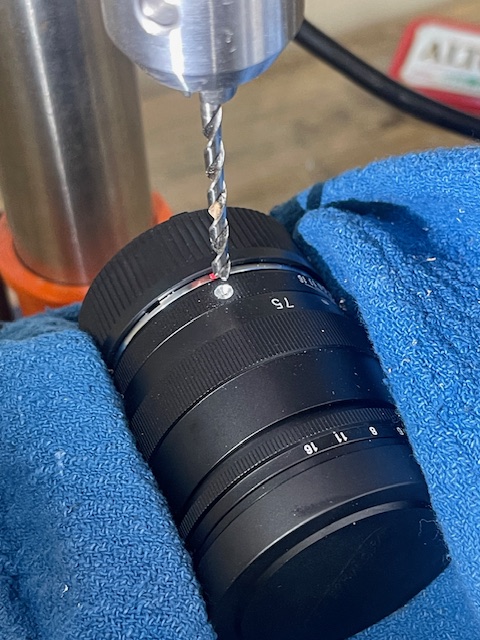
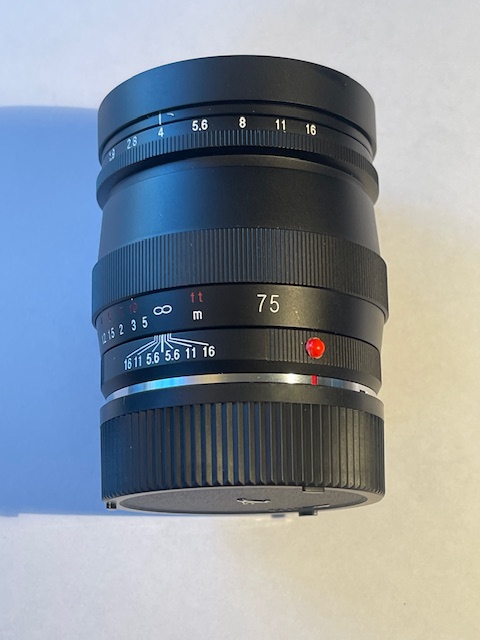
The area surrounding the drilled recess is masked before applying the epoxy to prevent glue getting in the wrong places and a pair of fine tweezers is used to locate the dome once the glue is in place in the machined recess. Do not try doing this at home unless you are confident in your machining skills. A messed up lens will haunt you forever.
Construction quality:
Yukosteel has a disassembly pictorial here which testifies to the high construction quality of this lens.
Rockwell’s finest.
For an index of articles on art illustrators, click here.

Painted in November, 1942, Norman Rockwell’s most famous illustration shows the American family gathered around the Thanksgiving table, with the cook delivering an enormous bird, to the delight of the assembled family and friends. It’s a masterpiece of ‘white on white’ painting. You can read the full history here.
This painting, its kitschy and exclusively white aspects notwithstanding, holds a special place in my mind for it always reminds me of my first Thanksgiving in America, after immigrating in November, 1977. I confess I had never heard of the feast, my native England not exactly a place which celebrates agricultural plenitude. You can read more about my first experiences in my new home here.
Quite how Americans managed to afford such a generous meal in times of war time austerity mystifies me yet today, in Pig’s America, 40 million poor people are being forced to choose between paying for food or for shelter. May he rot in hell.
Rockwell was a superb illustrator, For more on art illustration click here.
Curious.
For an index of all Leica-related articles click here.
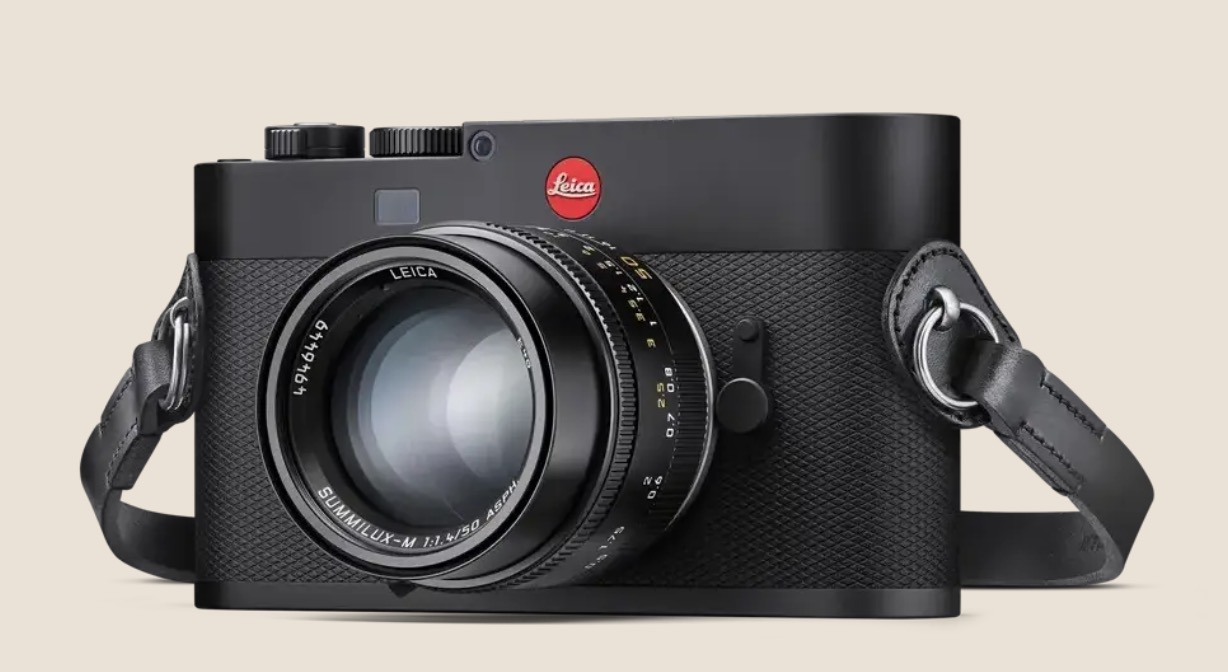
Introduced in 1954 the Leica M3 brought the best optical viewfinder experience to 35mm photography. Comparing that finder with the one in my digital Leica M10 shows that a good thing can be made better. The greater eye relief of the M10’s finder along with the electrically illuminated finder frames which adjust to the level of ambient light made things even more useable.
But even with digital M bodies – and the sensors in the M10 and M11 are superior to anything film can deliver – the age old limitations of the body’s design remain. That means no autofocus, no in-body vibration reduction and a limited range of finder frames for different focal length lenses. The M10 and M11 display 28, 35, 50, 75, 90 and 135mm frame lines, in pairs. The 28mm is barely visible to eyeglass wearers and focus with fast 90 or long 135mm lenses is a decidedly iffy proposition at larger apertures, necessitating the addition of an eyepiece magnifier. So while the limitations of the M’s optical finder are many the advantages more than compensate for this snapper. That means seeing outside the finder frames for what is about to enter the picture and the wonderful absence of myriad data displays in the finder which detract from the pure picture taking experience. All you see is the shutter speed and a small indicator telling you if exposure compensation has been dialed in. And, of course, that wonderful central focusing rectangle. Perfection.
However, someone at Leica determined that the world needed an M body, with all its svelte appeal, married to an electronic viewfinder. That’s nice as you can use any focal length and get accurate framing, even if you lose the ‘see outside the frame’ function of the optical version. For a premium price, barely discounted from the regular M11, you retain the ability to change lenses but still get no AF or IBIS. Yes, you can dial in finder magnification with the lever located where the frame selector lever normally resides, but it’s unclear whether this springs back when released or clicks in and stays in position. If the former, then it’s poorly designed as you need your left hand under the lens to effect focus operation. None of the reviews I have read indicate how this works.
One possible advantage of the EVF over the optical rangefinder, the latter with its considerable complexity and fragility, is that the EVF should be more resistant to knocks and bumps. The Leica M’s optical finder/rangefinder does not take kindly to being jarred and while adjustment back to the proper setting is easy, this is pretty far from the robustness of, say, a Nikon body. (I show how to adjust the rangefinder here).
The sensor? It’s the same as in the M11, meaning 18/36/60 mp options, as good as it (Sony?) gets, with the addition of microlenses to correct for axial ray aberrations of very wide angle optics.
Options? You can add the electronic Visoflex finder to an M10 or M11 for almost $1000, adding a clunky top plate protrusion but retaining the features of the separate optical finder. Or you can opt for a Leica Q3/Q3 43 which adds IBIS and AF but loses the interchangeable lens feature, meaning you get either a 28mm or 43mm lens. And while the Q3 is not cheap at around $7,000, it’s chump change compared with the $9,000 M EV1 plus $4,000 and up for a lens.
In conclusion, I rather doubt the M EV1 will have much appeal to traditional Leica M snappers but if it carves out a new niche for Leica …. well, good luck to them