Curious.
For an index of all Leica-related articles click here.
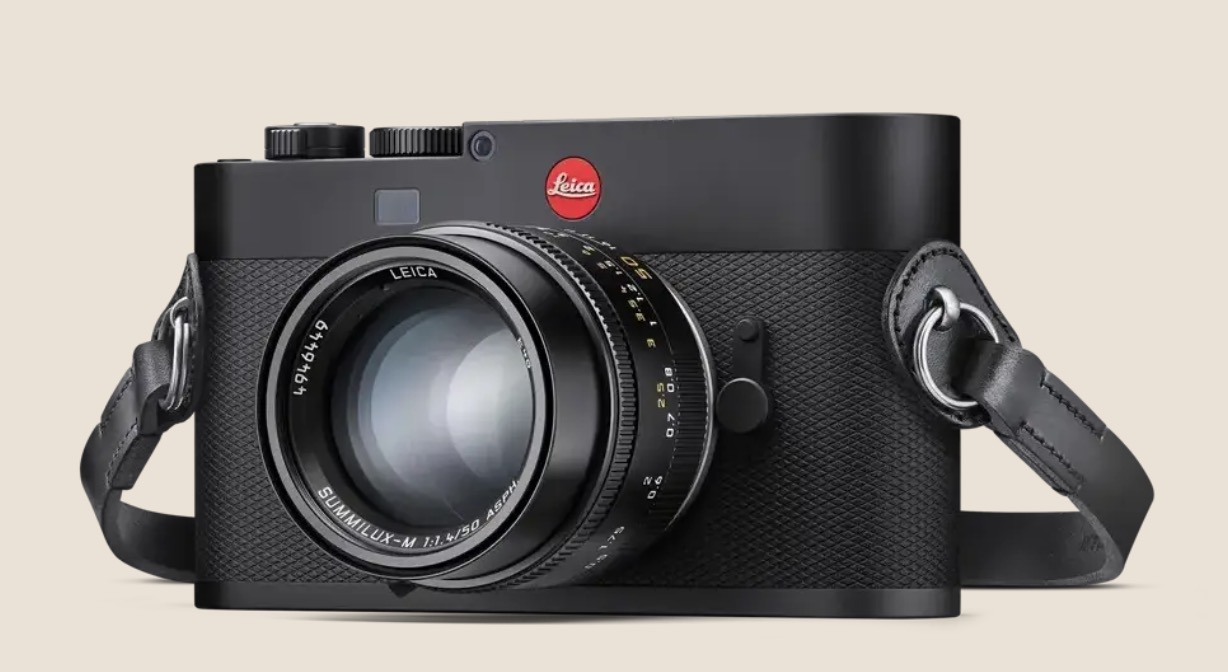
Odd looking with no finder window.
Introduced in 1954 the Leica M3 brought the best optical viewfinder experience to 35mm photography. Comparing that finder with the one in my digital Leica M10 shows that a good thing can be made better. The greater eye relief of the M10’s finder along with the electrically illuminated finder frames which adjust to the level of ambient light made things even more useable.
But even with digital M bodies – and the sensors in the M10 and M11 are superior to anything film can deliver – the age old limitations of the body’s design remain. That means no autofocus, no in-body vibration reduction and a limited range of finder frames for different focal length lenses. The M10 and M11 display 28, 35, 50, 75, 90 and 135mm frame lines, in pairs. The 28mm is barely visible to eyeglass wearers and focus with fast 90 or long 135mm lenses is a decidedly iffy proposition at larger apertures, necessitating the addition of an eyepiece magnifier. So while the limitations of the M’s optical finder are many the advantages more than compensate for this snapper. That means seeing outside the finder frames for what is about to enter the picture and the wonderful absence of myriad data displays in the finder which detract from the pure picture taking experience. All you see is the shutter speed and a small indicator telling you if exposure compensation has been dialed in. And, of course, that wonderful central focusing rectangle. Perfection.
However, someone at Leica determined that the world needed an M body, with all its svelte appeal, married to an electronic viewfinder. That’s nice as you can use any focal length and get accurate framing, even if you lose the ‘see outside the frame’ function of the optical version. For a premium price, barely discounted from the regular M11, you retain the ability to change lenses but still get no AF or IBIS. Yes, you can dial in finder magnification with the lever located where the frame selector lever normally resides, but it’s unclear whether this springs back when released or clicks in and stays in position. If the former, then it’s poorly designed as you need your left hand under the lens to effect focus operation. None of the reviews I have read indicate how this works.
One possible advantage of the EVF over the optical rangefinder, the latter with its considerable complexity and fragility, is that the EVF should be more resistant to knocks and bumps. The Leica M’s optical finder/rangefinder does not take kindly to being jarred and while adjustment back to the proper setting is easy, this is pretty far from the robustness of, say, a Nikon body. (I show how to adjust the rangefinder here).
The sensor? It’s the same as in the M11, meaning 18/36/60 mp options, as good as it (Sony?) gets, with the addition of microlenses to correct for axial ray aberrations of very wide angle optics.
Options? You can add the electronic Visoflex finder to an M10 or M11 for almost $1000, adding a clunky top plate protrusion but retaining the features of the separate optical finder. Or you can opt for a Leica Q3/Q3 43 which adds IBIS and AF but loses the interchangeable lens feature, meaning you get either a 28mm or 43mm lens. And while the Q3 is not cheap at around $7,000, it’s chump change compared with the $9,000 M EV1 plus $4,000 and up for a lens.
In conclusion, I rather doubt the M EV1 will have much appeal to traditional Leica M snappers but if it carves out a new niche for Leica …. well, good luck to them