Pixel shift technology.
For an index of all Leica-related articles click here.
If memory serves it was Hasselblad, a few years ago, who came up with the idea of pixel shift technology to make multiple exposures at very high resolutions, combining the images each of which is shifted 1 pixel by the IBIS sensor. Much loved by curators of oil paintings. Lots of higher end mirrorless cameras with IBIS now offer this, of course, as does my (now discontinued) SL2-S, so as it’s raining I decided to give it a try inside. You need a stationary subject anyway.
The super resolution mode is found at Menu->Page 1->Drive Mode->Multi-Shot.
Here’s the bookshelf scene – the red box highlights the enlarged versions below:

The target.
Camera on a tripod, the Leica gives you the option of 2s or 12s delays between snaps to let the vibes die down. I went with 12s. I probably should have used the electronic shutter for even fewer vibrations, but made do with the mechanical shutter. As Auto-ISO selected ISO3200 I also applied the LRC Denoise algorithm to both images which are shown at 300% magnification below. That figures to a 120” x 80” print. Critical manual focus using the EVF magnification feature was very easy. The multi-shot image is at left:
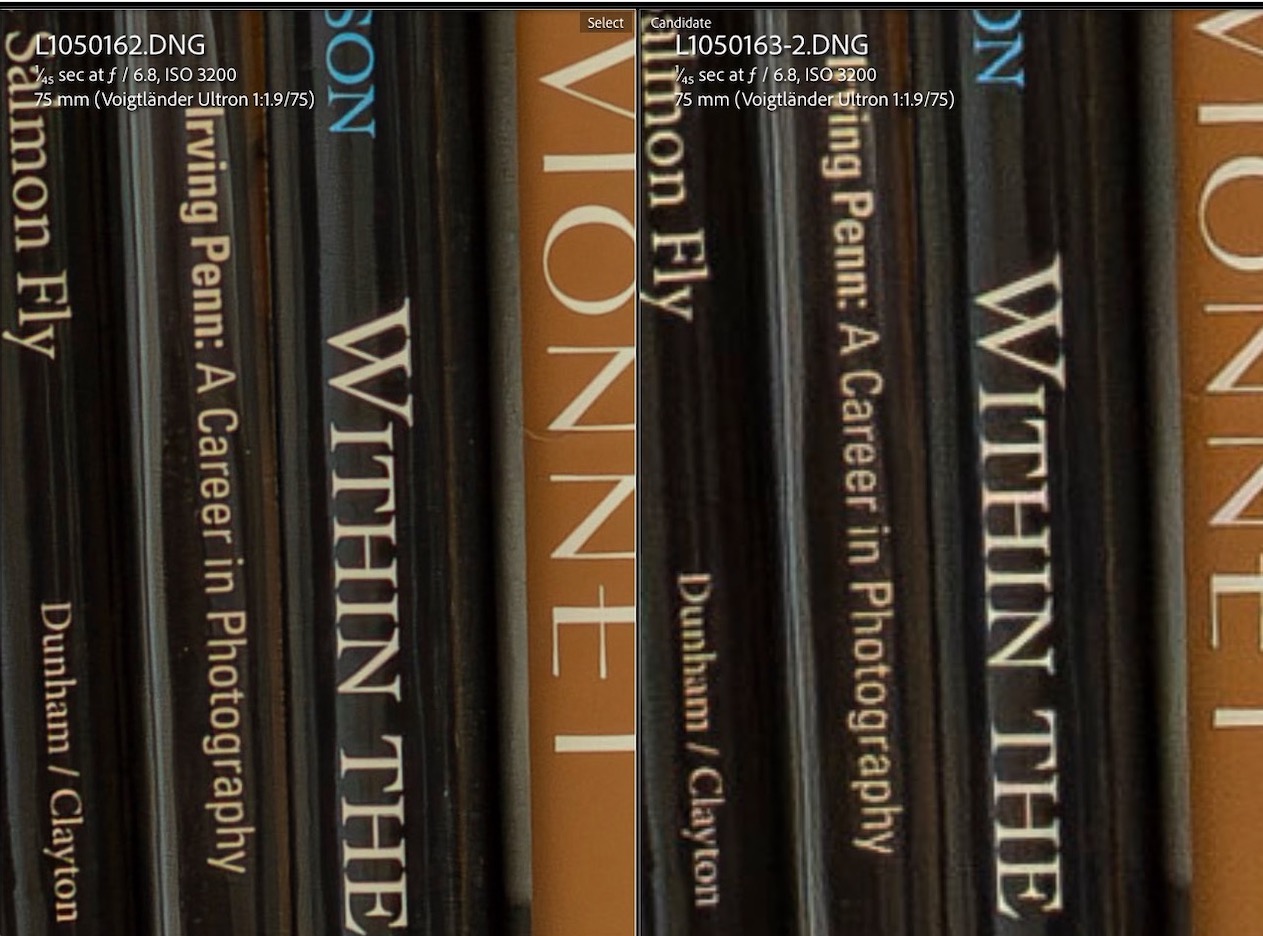
Super resolution at left, regular on the right.
Fun bit of technology. The multi-shot file came in at >170mB, though the resolution is reported at 96mB, four times the stock 24mB. I used the 75mm Voigtländer Ultron as it’s probably the highest resolving power optic I own. Actual aperture was f/8 – the SL2-S does a poor job of guesstimating the aperture, reported above. The camera warns you if your support is wobbly.
The multishot image looks perfect at 300% at a 24” viewing distance. I believe that in the current SL3-S (up to 60mp from 24mp) Leica has enhanced the technology to allows multiple images to be snapped hand held!