Making an LTM 135mm Elmar perfect on the Leica M10.
For an index of all Leica-related articles click here.
I confess I am much enamored of the Leitz 135mm Elmar lens. My bayonet mount version is sharp at all apertures and a star performer when the optical unit is removed for macro work on the Leitz Focusing Bellows II. It’s also the perfect optic for close-up snaps of architectural details.
But I do like all my M lenses permanently 6-bit coded and while I have no compunction about milling the lens mounts to confer the necessary code pits, I cannot do so on the 135mm M mount Elmar because my small drill press cannot accommodate the length of the focusing barrel! And that’s been bugging me for a while, so when I saw a 135mm Leica Thread Mount (LTM) Elmar for sale on eBay I snapped it up for all of $125. The lens was incorrectly listed as being an M-mount version but it was obvious from the listing images that a LTM-to-M adapter was fitted. Leica made 23,678 135mm Elmars in the years 1960-65 and only 3,282 of these were made in LTM.
On receipt the LTM-to-M adapter proved to be a high quality Leitz original, albeit intended for use with a 50mm lens, not the 135mm. The lens also came with the original Leitz Wetzlar leather case in decent shape. As sold the adapter would bring up the incorrect frame lines in the M10’s finder. No matter, as I was not planning on using the uncoded adapter in any case, and it will sell for $50, making my net investment in the LTM Elmar even less.
I have a six-bit coded LTM-to-M adapter in my box of bits and pieces, but fitting it to the Elmar immediately disclosed that the thread was incorrectly machined, not being deep enough. The flange thickness at 0.92mm is identical to that of the Leitz original adapter but the lens does not screw in far enough, making a nonsense of rangefinder focusing. Here’s what I mean:
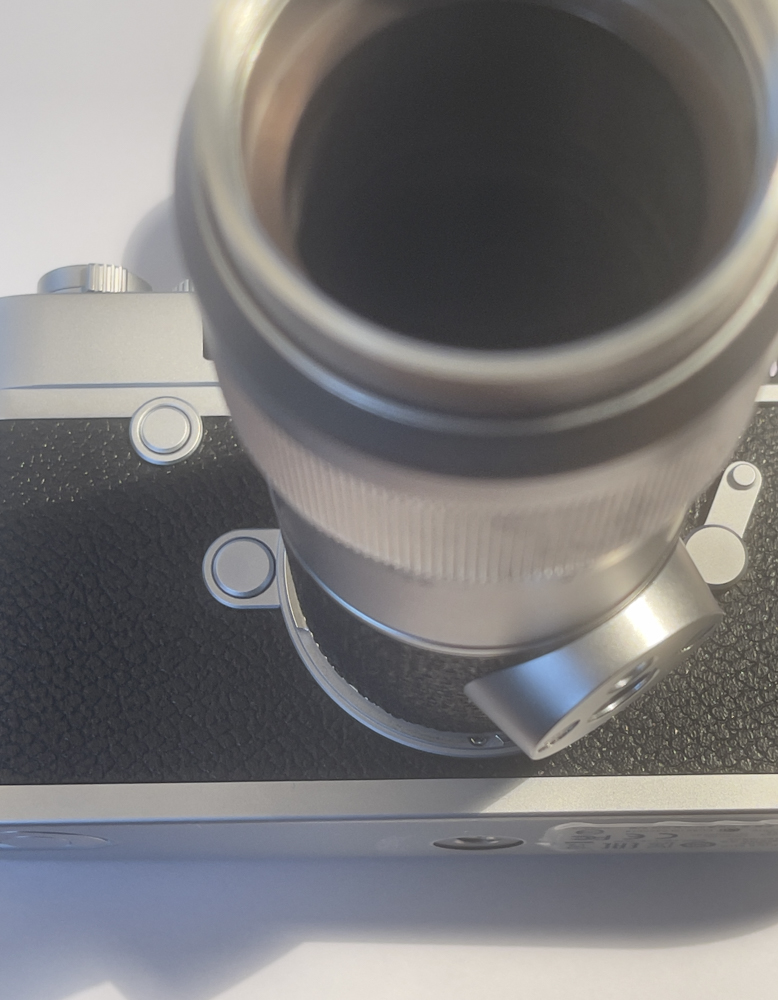
Ill fitting aftermarket adapter on the LTM 135mm Elmar.
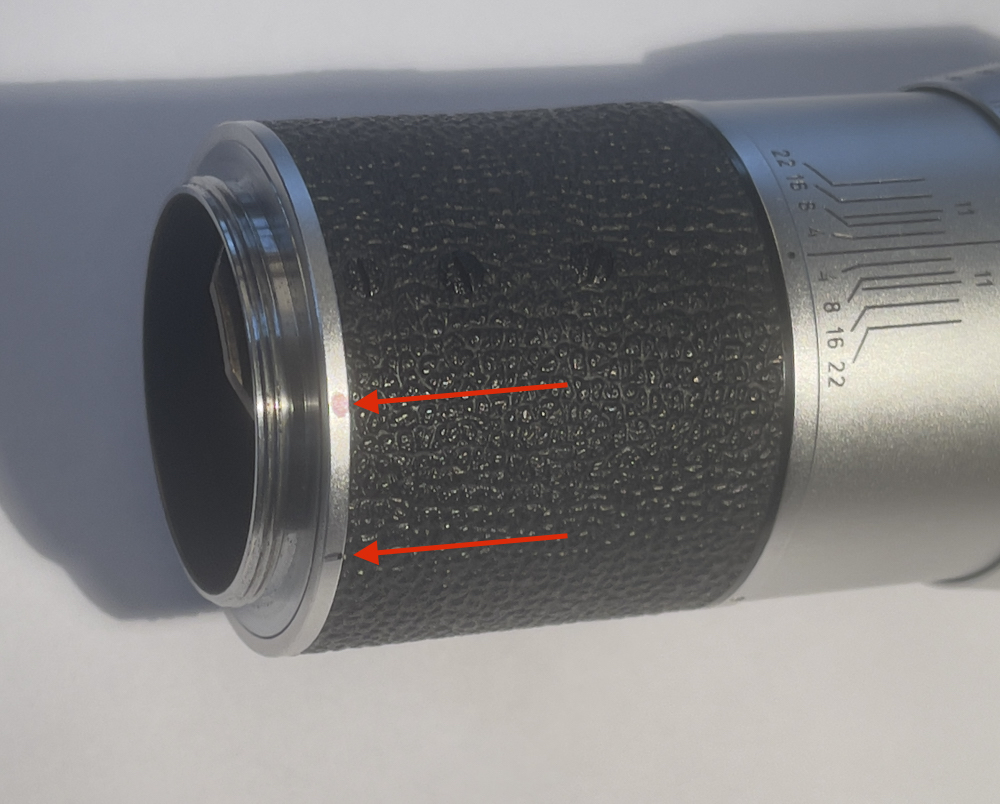
The red mounting index on the adapter – when fitted – is at the lower arrow. It should be at the upper arrow.
You want the tripod bush base on the lens to be parallel to the bottom of the baseplate of the camera. Shockingly even some M mount versions of the 135mm Elmar get this wrong and there’s no easy way to fix the bayonet mount. Obviously the LTM-to-M adapter, above, is way out and will result in incorrect focus using the rangefinder. As I cannot machine the thread for the correct depth, the alternative is to reduce the thickness of the adapter’s mounting flange to remedy this situation.
To machine the adapter I used a Makita belt sander, mounted upside down in my workbench vise, thus:
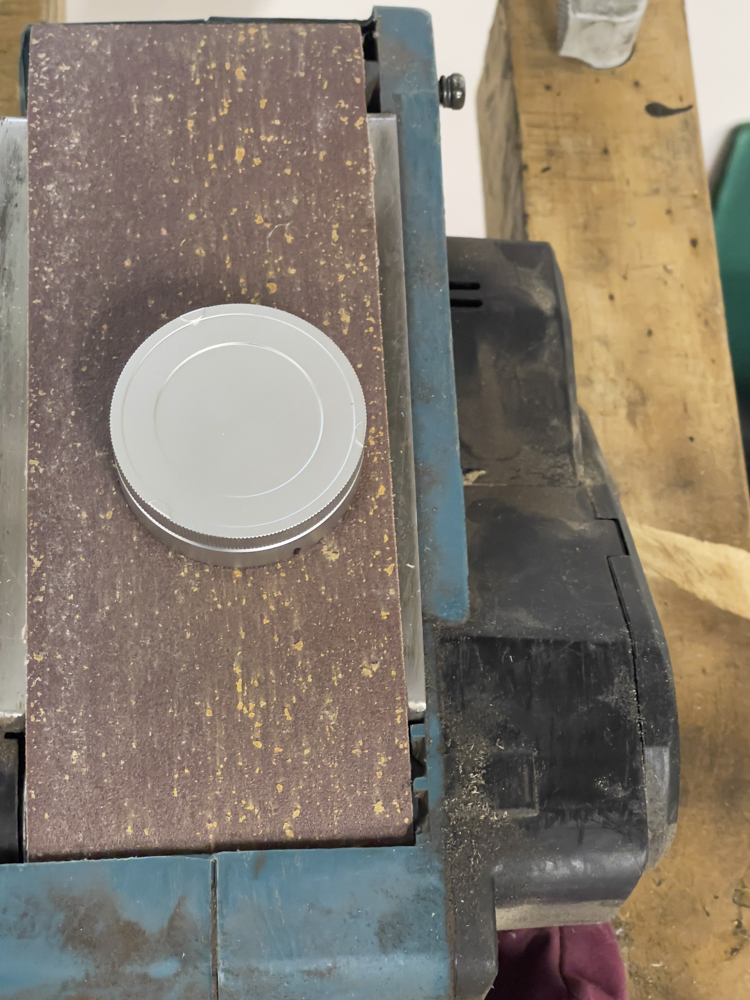
Grinding down the adapter using a 120 grit sanding belt.
To protect my fingers I inserted the adapter in an aftermarket all metal Leica M rear lens cap, way superior to the chintzy plastic Leica version, and took it down a bit at a time. The final ‘cut’ saw the flange reduced in thickness from 0.92mm to 0.87mm, not much, but the result is a significant reduction in lens-to-camera-flange positioning – see the double-arrowed image above. A final finish pass is made using wetted 600 grit sandpaper, thus:
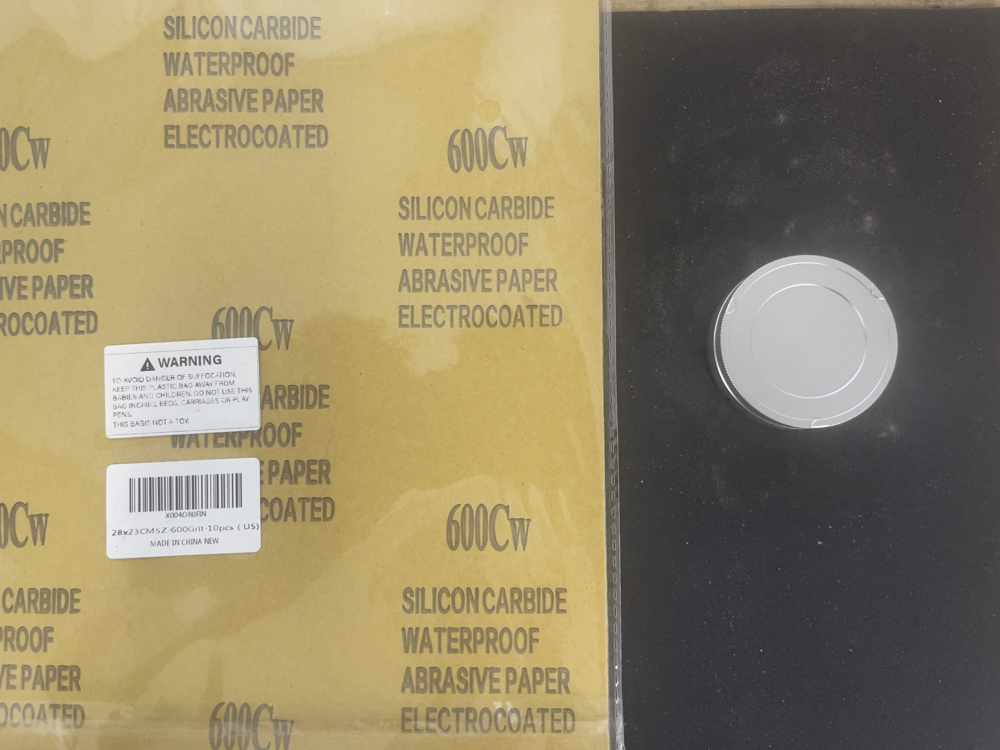
Final wet sanding.
This is how the lens looks mounted on my M10 now:
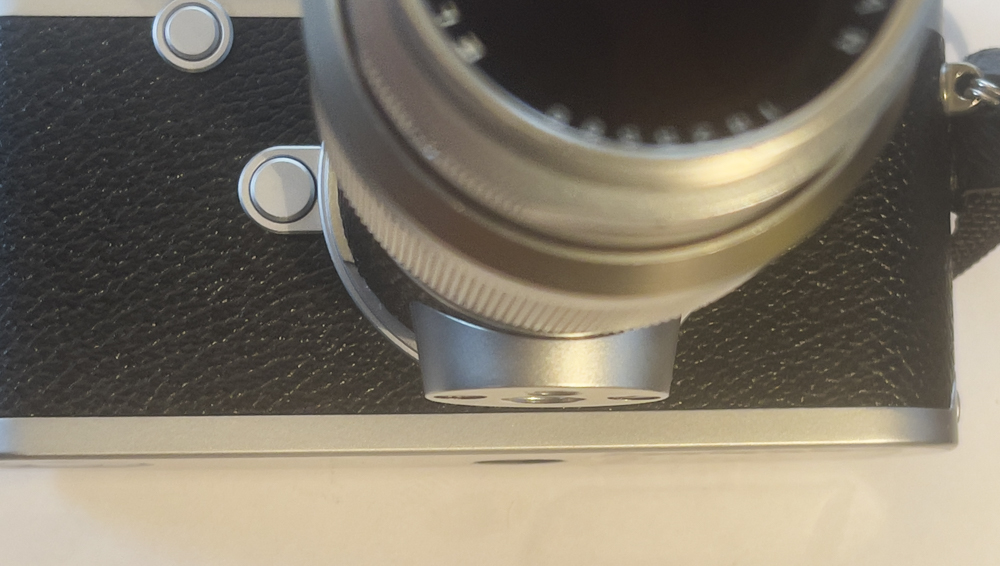
The 135mm Elmar LTM with the modified adapter fitted to the M10.
Focus at both infinity and the closest focus distance of under 5 feet is perfect at full aperture, using a 1.4x eyepiece magnifier.
Proper alignment of the lens’s tripod bush with the baseplate is a very simple and extremely accurate method of ensuring proper rangefinder function and, believe it or not, even my original Leitz adapter gets this wrong by a few degrees. Focusing a 135mm optic on the rangefinder Leica is an exercise in precision and unless both your rangefinder and adapter are correctly adjusted the result is frustration and unsharp images. You read all too often that Leica users say the 135mm is unusable with the rangefinder and that’s likely attributable to poor technique along with poorly adjusted hardware. Even Leica cautions that 135mm lenses be stopped down a couple of stops on the rangefinder body when the rangefinder is used to focus, which rather makes a nonsense of the whole thing. Further, Leica rangefinders are notorious for going out of spec and adjustment using a 2mm Allen wrench is detailed here. It takes very little time to get this dead right, anyone can do it and the resulting payback in terms of image quality is very significant. And if you cannot use a lens at full aperture, what use is it?
My M-mount 135mm Elmar is going on Bay, replaced by the enhanced LTM version.
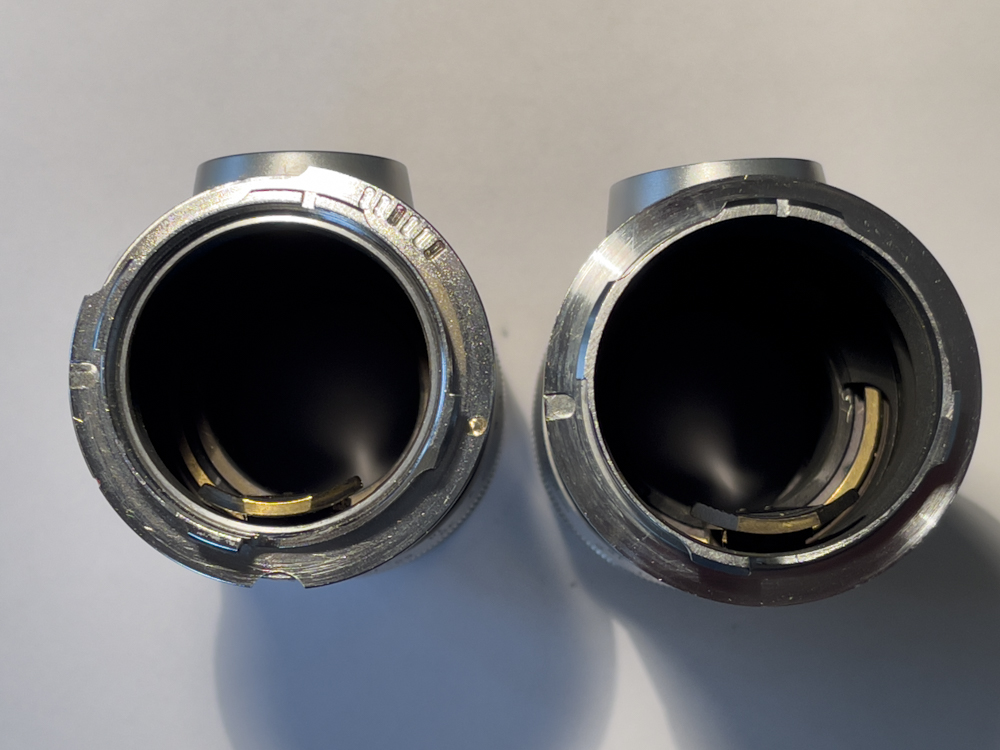
6-bit coded LTM and plain M-mount 135mm Elmars. The code is ‘001001’.
Is my LTM version of the 135mm Elmar sharp? Here’s an image taken at the full aperture of f/4, 20 images focus stacked in Helicon Focus, Leica SL2-S, lens head on the Leitz Focusing Bellows II:
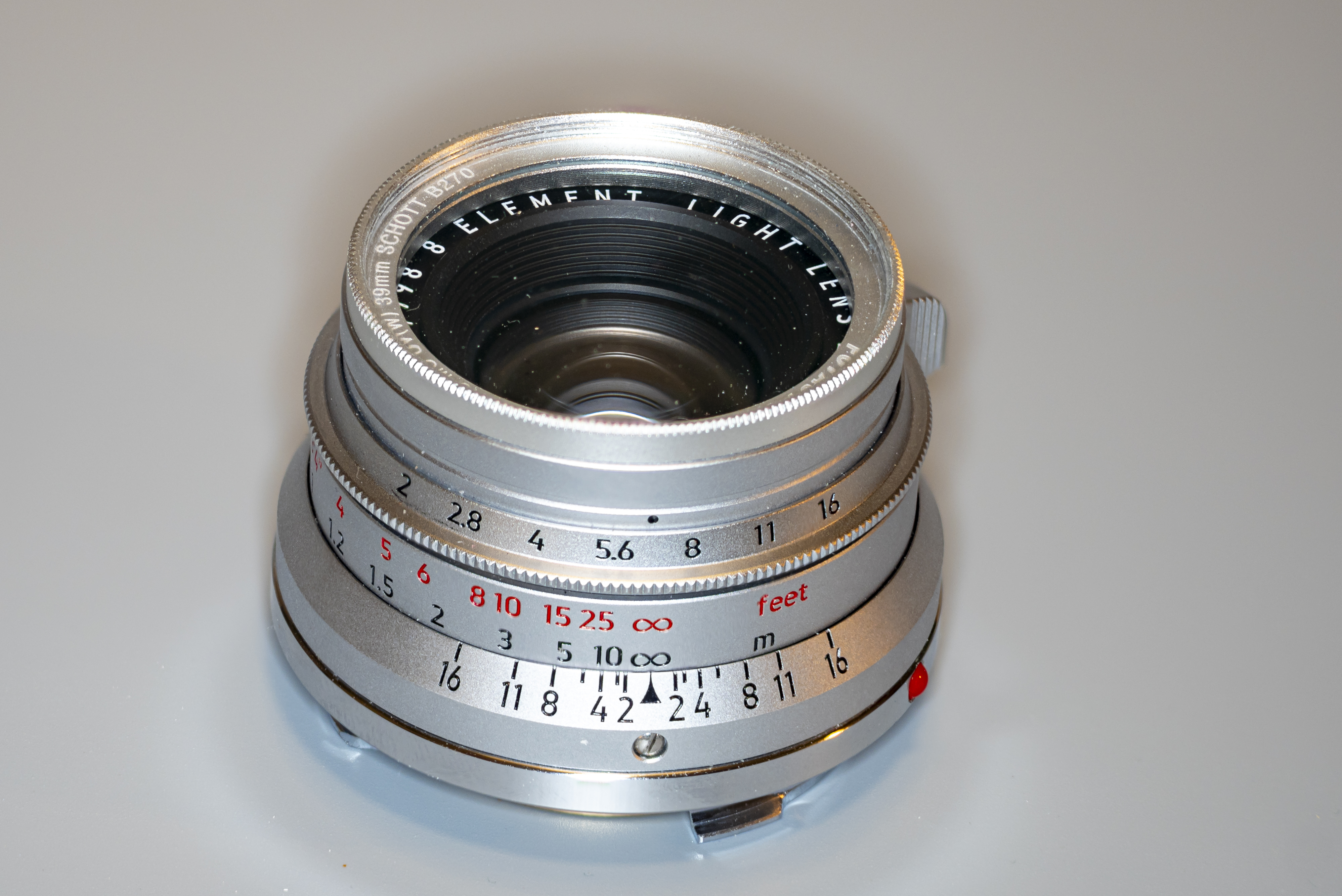
The Light Lens Lab 8-element 35mm Summicron clone.
Click the image for a larger version.