Book review.
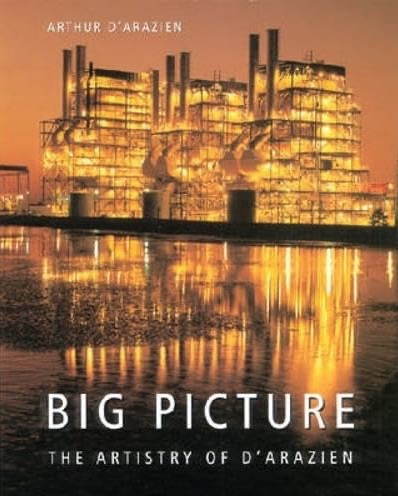
Arthur D’Arazien (1914-2002) was a premier industrial photographer, practicing during the period 1940 through 1999. His family, Armenian Turks, moved to America in 1922 when D’Araziien was 8 years old, to escape persecution.
D’Arazien’s specialty was industrial photography, his first major assignment being for AT&T in 1940. Not long after he was drafted into the Army, serving in the Air Corps as an aerial photographer. His first love, equipment wise, was the huge 8″ x 10″ Deardorff, of which he owned no fewer than three. These were manufactured from 1923 to 1988 in Rochester, NY, the Kodak town. While he also used Hasselblads and, later, Nikon F2s an F3s, he candidly admits that no equipment equalled the output quality of those old wooden monsters. He frequently used arrays of flashbulbs for lighting his industrial scenes and even, on some occasions, flash powder! Flashbulbs at the time were cheaper and lighter than costly electronic strobe flash, and far less fragile to transport to the photo site. What is clear from his detailed notes accompanying each of the many images in the book ‘Big Picture: The Artistry of D’Arazien‘ is the amount of care that went into planning each image.
Now steel mills and chemical plants may not be pulse raisers but if you are the CEO of a steel pant that mill is your baby and you are mighty proud of it. It’s something you want gracing the cover of your annual report sent to your (then) grateful shareholders. That’s before all the mills shut down and moved to China.
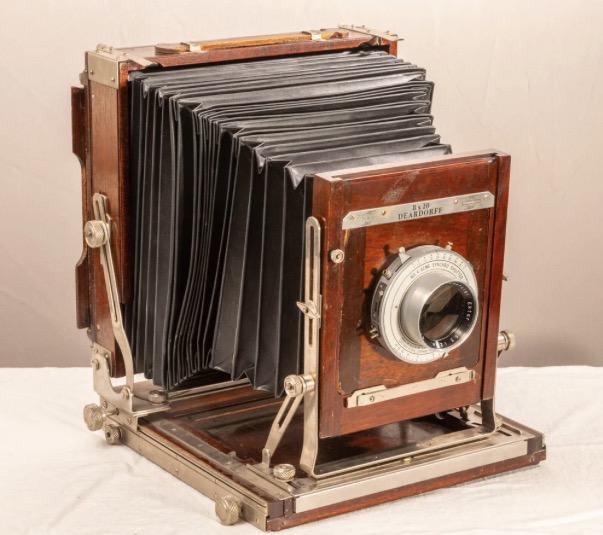
The 8″ x 10″ Deardorff camera.
Many of the Fortune 500 companies were his clients with some of the relationships lasting for decades. As he says in the foreword to the book “I am a good example of the American Dream come true”.
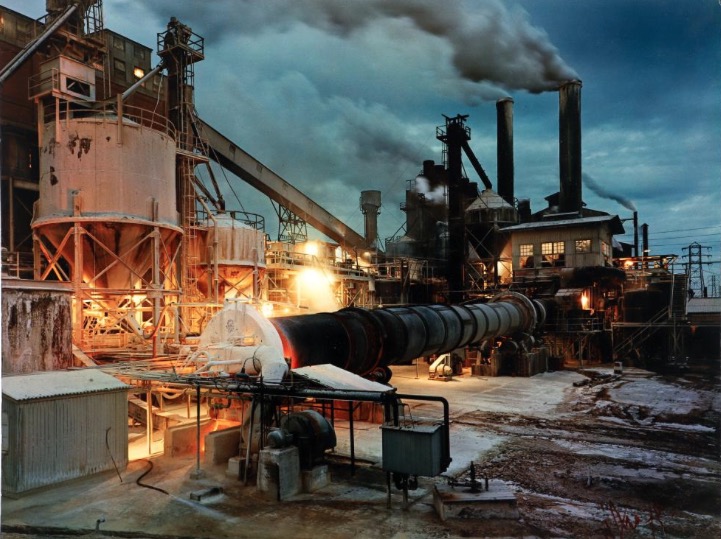
A typical D’Arazien steel mill image.
D’Arazien would often take multiple images on one sheet of film, with the first underexposed shot taken before sunset to capture the sky’s colors with the second overlaid image taken at night with lighting from the flowing steel and his many carefully placed flashbulbs, two to a reflector. Some images would take days to set up for the precious second or two of actual exposure.
If high end industrial photography, immaculately planned and executed, is of interest the book is a worthwhile library addition.