A fine medium telephoto lens.
For an index of all Leica-related articles click here.
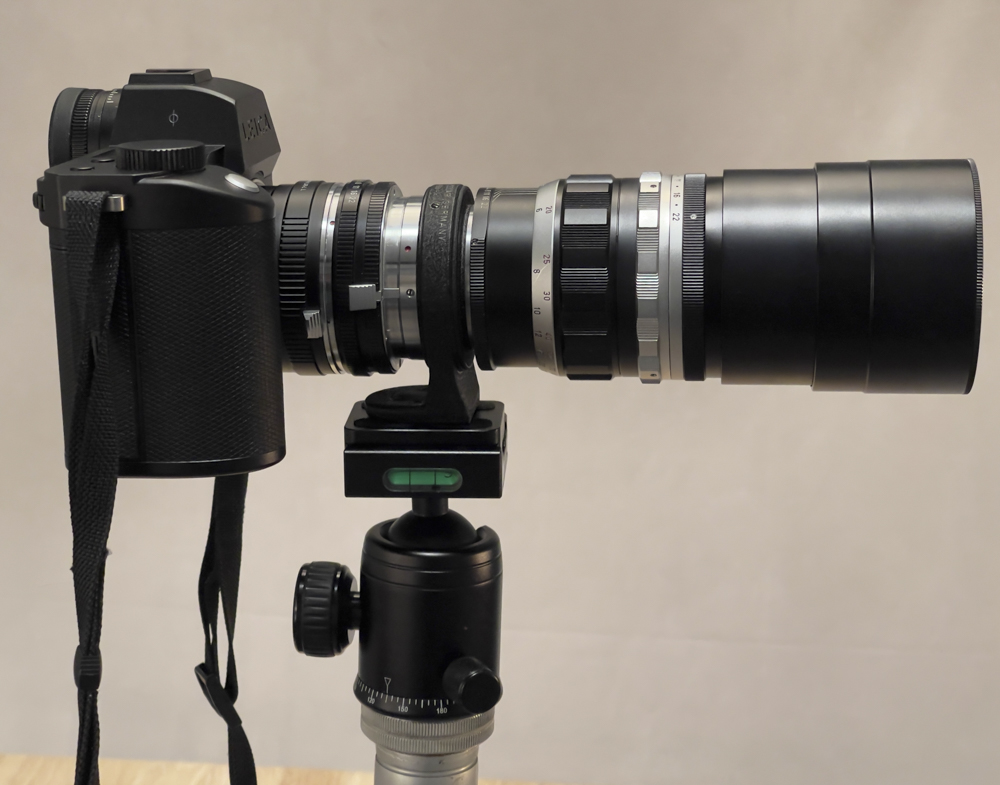
On the Leica SL2-S. From the left the adapters are Leica R-to-L,
Leitz 14127 Visoflex M-to-R and 16466/OUBIO Telyt-to-M.
History:
The 200mm Telyt, originally intended for use on the Visoflex reflex housings for the Leica LTM (Viso I and II) or M (Viso I, II or III) bodies, had a long life, being manufactured from 1959 through 1978, during which time 6,900 were made. The 4-element f/4 lens is a true telephoto, being physically shorter than its focal length, and replaced the earlier long focus (non-telephoto) 5-element f/4.5 version. Serial numbers ran from 1851001 through 2881700 with the chrome bands giving way to an all black finish with serial number 2371801 in 1969. The optics remained unchanged. Production was in Wetzlar, Germany and Midland, Ontario, Canada. The designer was the great Walter Mandler.
The lens was mounted on the adapter #16466 (code name OUBIO) which has a handy 90 degree locking rotation catch for the tripod plate. The rear of the OUBIO is a bayonet M mount for attachment to the Visoflex.
Adapting the lens to the L mount:
Replace the Visoflex with Leitz M-to-R adapter #14127 and fit a Leica R-to-L aftermarket adapter to the 14127 and the lens fits the SL2-S body perfectly and focuses to infinity. The closest focus is just under 10 feet. The machining and finish of that aftermarket adapter are well up to Leica quality.
Focusing and performance:
The 200mm Telyt is manual with a pre-set diaphragm. Use it in Aperture Priority auto exposure mode on the SL2-S with finder magnification for critical focus and it’s easy to nail focus even stopped down to f/8, which is arguably this optic’s sweet spot. I write ‘arguably’ because, as the test results below disclose, the lens is sharp at all apertures. It’s much easier to focus using the SL2-S’s EVF than using it on a clunky and bulky Visoflex – ask me how I know!
Cost:
Mine is serial number 1753656 which dates it to 1961, came in mint condition with the OUBIO adapter, included front and rear OEM lens caps and ran me all of $150. The 14127 adapter added $60, the aftermarket R-to-L adapter cost $15, a 58mm UV filter was $12, making the all in cost $237.
The 14127 Visoflex to R adapter:
The 14127 Visoflex-to-R adapter includes a rotatable diaphragm adjusting ring. This was intended for the first version of the Leicaflex with its external CdS prism mounted light meter and single cam lenses. You would center the meter’s needle in the viewfinder using either this ring or the camera’s shutter speed dial, then transfer the aperture indicated on the ring to the aperture setting on the lens itself. It’s redundant for later Leicaflex and Leica R bodies and has no function on those bodies or on L mount cameras.
Use on the Focusing Bellows II:
The lens head unscrews for direct mounting on the Focusing Bellows II for close-up work. That makes for a rather unwieldy setup and I would recommend using the 135mm Elmar or Tele-Elmar optical unit instead for less weight and greater flexibility.
Dimensions and weight:
I owned this lens two decades ago when I had it adapted to my Canon EOS 5D where it served me well on that splendid DSLR body. Now that I’m seriously into older manual focus optics and given the ease of adaptation to the mirrorless Leica SL2-S it was time to snap up another copy. The construction is all metal and glass, with no plastic or resin in sight. The Leica SL2-S body, lens, with 16466 (lens-to-M mount), 14127 M-to-R and R-to-L adapters, a 58mm UV filter, an Arca-Swiss tripod plate and the Upstrap weighs 69ozs/1950grams. The lens alone weights 34ozs/948grams. The length of the lens from the mounting flange to the front is 6.7″/170mm, with the lens hood adding 1.8″/45mm when extended. Balance with the SL2-S body is at the foot of the OUBIO adapter – just perfect – and there is no play or wobble anywhere.
The mirrorless advantage and IBIS:
What does use on the SL2-S mirrorless body offer with this long manual lens that is not available on a DSLR film or digital body? In Body Image Stabilization (IBIS) is the most important feature. You get up to 5 stops of stabilization on a long lens which is prone to camera shake. Further, owing to the EVF, when using aperture priority auto exposure mode the image brightness is constant at all apertures, making for much easier use. Finally, the image magnification option in the SL2-S makes correct focus a breeze.
Two settings are required for IBIS to work:
- Menu->Page 5->Image Stabilization->On
- Menu->Page 6->Camera Settings->Lens Profiles->R lens->Choose any 200mm lens
It’s essential to dial in the correct focal length of the lens (the lens’s name is not important) so that IBIS can properly compensate for camera shake. So if your lens’s name does not appear on any of the many choices, choose a lens of identical focal length and all will be well. The EXIF data can be changed using an LRc plugin such as CaptureTime to EXIF.
Test results:
These are all handheld with IBIS engaged and the lens’s focal length dialed in as 200mm. Click on the image for a download of large files. The focus was on the registration plate:
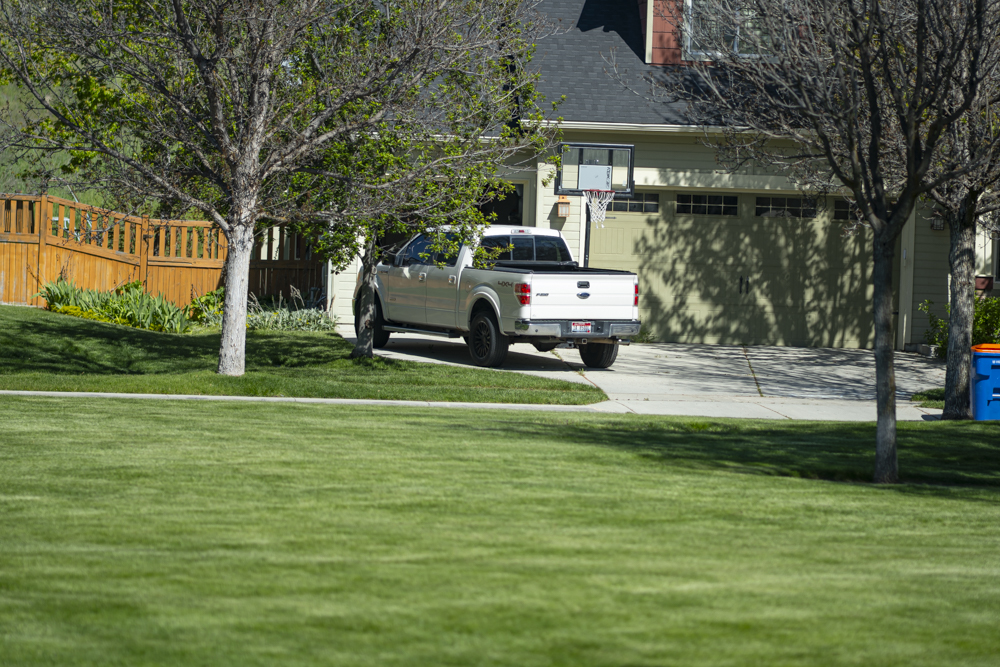
Click the image to download the 112mb zip file. It takes a while.
Apertures used are in the file name, so ‘f40’ means f/4, etc.
IBIS does a fine job here. At ISO100 and f/22 the shutter speed was 1/25 second, yet the image is crystal clear, and I’m far from the steadiest person on earth.
As these large files show – feel free to magnify them after downloading – definition at f/4, already excellent, improves only slightly as the lens is stopped down, and there appears to be no diffraction loss at the smallest apertures. All told, not bad for a 57 year old design, acquired at a bargain price. IBIS and modern digital sensors have given this fine optic a new lease on life.
Some early results appear here.
Comparison with the 200mm Micro-Nikkor at normal distances:
Careful tripod base images taken with the Micro-Nikkor and Telyt show the two to be uncannily similar in performance at all apertures through f/16. At f/22 diffraction starts to take the edge off definition with both and the Micro-Nikkor adds f/32 at which aperture it is slightly worse than it is at f/22. The lens weights with adaptors and tripod mounts/Arca Swiss plates are also uncannily similar – 33.9ox for the Micro-Nikkor compared with 33.2oz for the Telyt. However, as you gain the macro focusing range with the Micro-Nikkor, and given that used prices are also extremely similar, the Micro-Nikkor would be the better choice. Both optics are made to the very highest mechanical standards and the Micro-Nikkor permits removal of the tripod mount for handheld use, saving a few ounces. The Micro-Nikkor also adds Internal Focusing which I find superior to the traditional helicoid design of the Telyt.