Family album snaps.
These biographical columns run annually and you can see the lot by clicking here.
The Polish word for the verb ‘had’ is mial, pronounced like a cat’s meow, and gives rise to that old joke that every Pole is like a cat. He ‘had’ but no longer ‘has’. It’s one familiar to my generation whose parents saw WWII take the lives of loved ones and material possessions, never to be recovered. The lucky ones amongst us had Christians for forbears, which improved the odds of birth, our parents enjoying a better chance of being saved from the German killing machine. At the same time, Polish Catholics need to be deeply ashamed of our forbears whose country was by a considerable margin the most anti-Semitic on earth. Why do you think most of the gas ovens were in Poland?
A while back I had taken the precaution of scanning all those fading photo albums – the subject of the very first column here in 2005 – to preserve them for the future, and came across a couple of interesting snaps of my Old Man and I. Now he would shudder at the appellation ‘Old Man’ but it has just the right tinge of disrespect from one who rues his parents’ abject stupidity. Here’s the Old Man, married to my mum the Countess (every Pole has royalty for parents, and you can call me Count), knee-deep in horses, acreage, homes and servants – that was the order of importance then – with an aggressive foe on his border. Not only does that putative enemy announce his intent to rape, pillage, steal and destroy, he writes it all down, broadcasts it loudly and continues to do so for six years before finally invading on September 1, 1939. And my parents do what exactly? Why, they keep all their coin and securities in a couple of banks in Warsaw and Krakow and all their capital assets – the acreage, the homes, the coal mines – in Poland. Not exactly the cutting edge in risk diversification.
Now when the snaps below were taken I was 3 and 9, respectively, so it’s not like my image of my parents was exactly fully formed and well thought out. Heck, I just wanted to read a book and, later, take pictures. But they are interesting.
The first, and I have no idea who took it, is at Lyons’ Corner House in Marble Arch, London, where the OM would take me for a treat now and then. London? Because in a rare burst of intelligence, even my folks had twigged that living under Russian occupation in Poland might not be a good thing, and five years of speaking German had not exactly been fun, so they had high tailed it in 1947, with the proverbial clothes on their backs. Fast forward to 1955 and the chocolate cake which I seem to be anticipating in the snap. It’s such a Proustian moment of remembrance that it gives me the intensest pleasure today to do a like favor for Winston, my son, though our choice of restaurant has a few more stars. Winston looks forward to the treat and I enjoy his emotions as much as the Old Man likely enjoyed mine. Mercifully, Winnie’s dad had the foresight his parents lacked in their choice of destination, exiting stage right from losing Britain to a vibrant United States 35 years ago. Maybe one of the waitresses snapped the picture? Her timing is impeccable because it says so much about childhood and the sense of wonder and amazement which pervades it.

The second is no less extraordinary for its juxtaposition of emotions. This was done in one of those photo booths, invariably placed in railway stations, where you inserted your half-crown (about $1 then), rushed in, were blinded four times by the flash after drawing the little privacy curtain, then waited for ages outside for your black and white passport sized pictures to emerge, damp. The Old Man was generally on a bit of an authority trip – too bad he hadn’t taken like authority over the family’s capital in the spring of 1939 – so I rather fancy he told me to smile and I, ever a dork, did my best. As you can see, the pictures are all about him, and I am appropriately out of focus. Still, he was clearly not a man to be messed with.
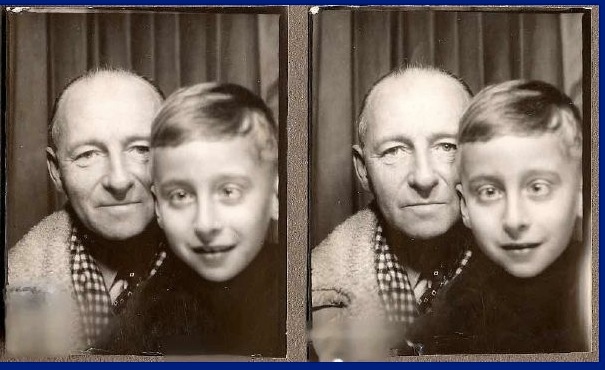
Anyway, he died in 1966 when I was 15, so I barely really knew him. Destroyed by the stress of fighting in the Resistance and greasy Polish cooking he succumbed at 60 to coronary thrombosis before Christian Barnard and his successors invented transplants and the coronary bypass.
Given that I was never allowed to think of him as my ‘dad’, but was always reminded that he was ‘Father’, I can’t say I miss him. What a way to bring up a child. Authoritarian, cold, distant, domineering, severe, strict. Where I was interested in art, architecture and science, his talk was solely of chivalry and war. How he expected this to make an impression on a kid with a severe squint, flat feet and scoliosis, beats me. I was closer physically to a young Richard III than to Richard the Lionheart, and that vicious squint from youth leaves me without three dimensional vision to this day, meaning you really do not want me pouring the red wine at dinner where a white tablecloth is involved. I have missed more times than I care to relate. So if I tell you that when my son Winston calls me ‘dad’ it evokes the biggest possible frisson of pleasure, you will understand. Heavens forbid that I would have addressed the OM in that casual manner, and as a result the last thing on this earth I expect from my son is any of that hierarchical respect.
But the Old Man did leave a couple of fine mementos in the guise of these snaps. As for the lost fortune, I got over it and made my way, though I still rue the idle life of a dissolute, spendthrift wastrel that was rightfully mine. And, unlike for the Old Man and his wife the Countess, I made my own bed to lie in, rather than through the more traditional route of choosing my parents well.

The Old Man, left, 1932, with his manservant, preparing for a spot of hunting.
Nothing like a bit of slaughter to regale the lads over a few pops in the evening.
These pictures provoke so many mixed emotions, but parental love is most certainly not one of them.
* * * * *
Click here for an index of all the Biographical pieces.