Category Archives: Photographers

Vince Laforet again

Some very original new work.

I first wrote of Vince Laforet when complimenting his superb photograph of the welder atop one of the Chrysler Building’s gargoyles.


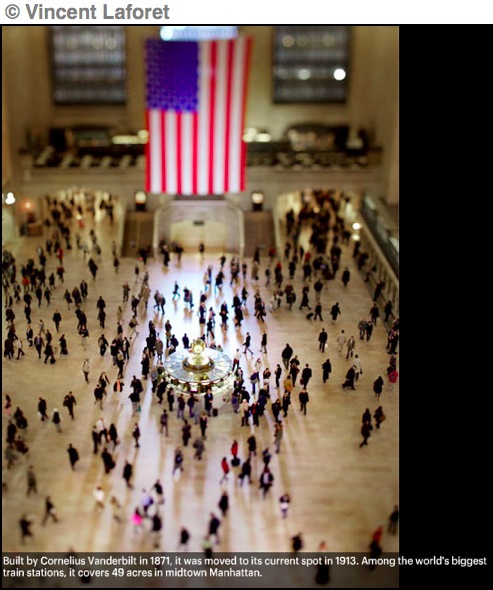
From the April 2008 issue of Condé Nast’s Portfolio. Picture by Vince Laforet.

Click on this link to be directed to his photographs for a piece in Condé Nast Portfolio addressing changes in commuting. A tedious sounding topic made gripping by Laforet’s photography.

He’s using some sort of smart selective focus technique which appears to render only a narrow band of a picture sharp. A strange side effect is that his subjects end up looking like toys and you wonder whether this is not work by William Eggleston.

Worth the visit to enjoy once more the work of one of the most original photographers working today.

René Maltète

A fine French photographer.

A reader writes:

Thomas,

You often make reference to great or at least famous photographers. I am French and when I was a child (I am 56 now) I used to flip over my uncle’s photography books. There was one French photographer I loved and I would like to share it with you, here is the link.

You may have to brush up a bit your French to understand certains images, they were taken some 40 to 50 years ago.

Cheers,

Michel

Thanks, Michel. I was not familiar with René Maltète’s work and I’m grateful for the reference.

Most enjoyable!

Arnold Newman: Evil

Arnold Newman got it right.

Some three years ago I wrote about Karsh’s wonderful portrait of Churchill, a portrait which is very much a confirmation of the man’s qualities. The unyielding, courageous bulldog. To say that it had an impact on me is an understatement. Our son is named Winston.

But there’s another portrait of a powerful man which needs to be mentioned, though the subject in this case is at the opposite end of the moral scale. It’s by Arnold Newman.

While Newman excelled at powerful pictures of powerful men, never did he surpass the portrayal of evil than when he took the picture of the exemplar of that trait, Alfried Krupp.

Now quite what the Krupp Steel PR machine was thinking of when they had a famous Jew photograph a famous Nazi is hard to understand, but Newman did not let them down. Krupp, for those not up on him, used slave labor to produce the Nazi machines of war in his steel works and, worse, got away with it.


The personification of evil

A magnificent picture which need no words from me.

Ludwig Schricker

A forgotten name

From its post-war inception in the late 1940s, the German Leica Fotografie magazine, under its founding editor Heinrich Stöckler, profiled much that was best and most banal in European photography.

I subscribed in the 1970s (mostly because I wanted to get published there!) and managed to find most of the back issues to those from 1952, the first to come with an English translation. Stöckler was strictly a pictorialist, meaning he loved the worst kind of schmaltz which typifies the German love of all that is bourgeois, but even he saw the writing on the wall as expressionism raised its (to him) ugly head.

This pretty much came to a turning point with the 5/1958 issue – the magazine was published bi-monthly. Stöckler had the courage to publish a selection of photographs by Ludwig Schricker, publishing also their exchange of letters where Stöckler made it clear that he had no love for the young Schricker’s work. Where was the fabled German countryside and its buxom blonde lasses? Nowhere to be seen in Schricker’s dark work.

I have been thinking of publishing this piece for a couple of years but could not find any of Schricker’s work on the web to illustrate my writing. He is non-existent on the web. So I finally dug out that old issue and scanned four pictures for reproduction here.

Schricker’s is a dark vision of a nasty, cruel world. I hope you find his pictures as memorable as I do. They are scanned unretouched here and, as the magazine is now 50 years old, some yellowing and fading has occurred.

Stöckler finally retired in 1973 at which point the magazine was far more skewed to expressionism than pictorialism. Therafter it went off the rails and now seems to be published once or twice a year as little more than an advertisement for the latest overpriced and already obsolete Leica toys. But I did learn mightily from its pages in the 1970s.

Update February, 2026: For more of Schricker’s fine work click here.

Early Penn

A special technique makes for special pictures

I may have grumbled about Irving Penn’s love of darkroom technique before, but there’s no denying the originality of the results. So it’s no surprise that some early pictures of his, taken with a Leica, and published in Leica Fotografie 2/1955, have stuck in my mind. Penn was mostly using large format and 6×6 film in those days, but he was not past messing about with 35mm film on his vacation.

But he did not stop at just taking snaps. These were made on color film with the originals cropped and rephotographed in monochrome and printed with a point light source condenser enlarger. It’s worth adding that most 35mm and 6×6 film users enlarged their negatives using diffuser enlargers, meaning that the light source was a coated neon bulb which naturally softened the image, obviating the worst of the grain. They were also inexpensive, thanks to the simple optical design. By contrast, the high intensity, uncoated, focused, point light source Penn used in his costly professional enlarger (complete with an exhaust fan to stop things melting) magnified every detail and line in the print, an effect Penn used to startlingly good effect in these pictures from the Arabian desert.

Note the etched appearance and the startling effect of the stripes on the running boys’ clothing. No less striking is the composition here, with everything but the main subject sharp – shades of Parkinson’s red hat picture. Or was it the other way around? Yes, I rather think Penn got there first.

I have never seen these reproduced elsewhere and hope you share my excitement on seeing these images. The original magazine is now over fifty years old, so please pardon the yellowing and fading.