And others.
Before looking at these fantastic pictures, remember one thing. Men start wars, women win them.
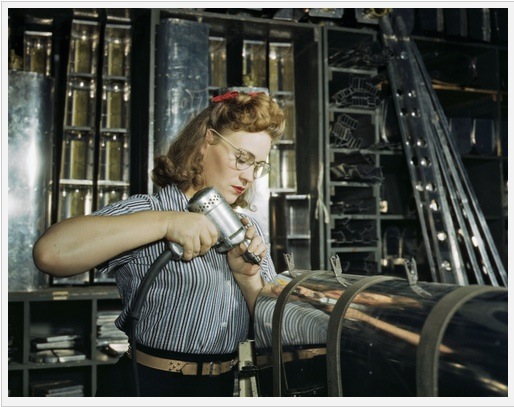
These are snaps of WWII (the last one we won) in glorious color for the most part.
And others.
Before looking at these fantastic pictures, remember one thing. Men start wars, women win them.
These are snaps of WWII (the last one we won) in glorious color for the most part.
A stunning image
Something special comes along now and then and this is an example:
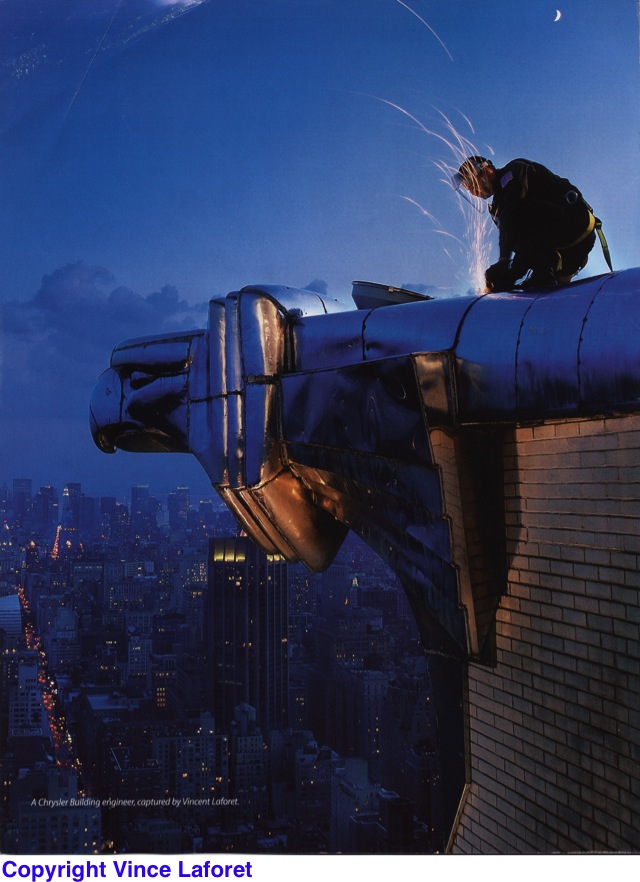
Not only does this make you gasp for breath, it’s in the very finest tradition of Margaret Bourke-White, who just happened to have an office in the Chrysler Building.
Laforet does it in color. It’s better than hers. Hands down better.
More of Laforet’s stunning work can be found here.
The story of the above picture is here.
And a lovely, clean web site
A recent exchange of correspondence with Rod Edwards, a British photographer, prompted me to check his web site.
Rod does this for a living and his site shows lots of things done right – simple, clean and with a great sound track to match.
Check his work out.
Book review
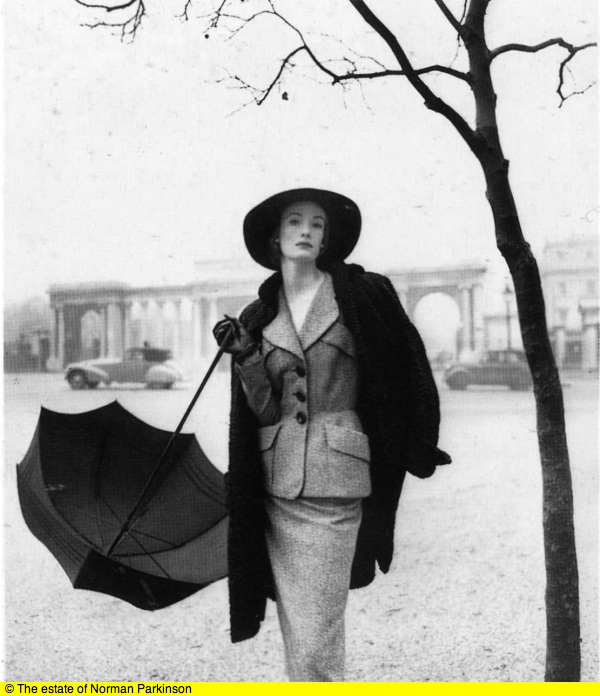
Touring the ancestral manse the other day, it occurred to me to see which photographers’ work graced its many walls. Well, I found only three. Dozens of my own pictures (I like my work, so there), one signed by Lucien Clergue and two others. And those two are by the great photographer Norman Parkinson. My mum chose one, I the other. The one above has found its home on one wall or another for some thirty years now and with good cause. My mum’s choice happens to feature the same model.
The year is 1951. England has won the war and lost the peace. In his infinite wisdom, Ike had determined that America had better recapitalize Germany first for, given half a chance, the bastards would try again. Poor old England would have to wait another thirty years before getting a leader who would fix things. But by then I had left her for the new world for there seemed to be nothing but despair to look forward to. (Note to voters: Elect more women).
This picture speaks to my youth and to England’s end of empire. The sophisticated woman holding the umbrella in that offhand manner is Wenda Rogerson. The wool suit is by the fabulous Hardy Amies – the last couturier to dress the Queen properly. And the location is a tired Hyde Park Corner, one know well to me. There is no traffic. The sky is grey. The blasted, leafless tree speaks of darker times. Yet Rogerson’s demeanor shows that resolute will and quiet determination which speaks so highly of the British back then.
Years later (I was born in the year Parkinson took the picture) I would come to know the spot well as my nanny frequently wheeled me through Hyde Park and Kensington Gardens, two locations that would feature heavily in my first book of pictures. These are magical places.
In the late ’40s and early fifties, when women were ladies and hands wore gloves, there were but two supermodels as the modern vernacular would have it. One was Wenda Rogerson, the other Lisa Fonssagrives. Now while your chances of being recognized as a great fashion photographer are undoubtedly better if you are homosexual, these two magnificent women showed it need not be so. Rogerson became Mrs. Norman Parkinson and Lisa Fonssagrives married Irving Penn. Both marriages lasted. And Penn often photographed Rogerson, with Parkinson returning the favor with Fonssagrives.
It’s an interesting comparison. At one end of the spectrum the severe, carefully controlled, studio lit and never less than original Penn, who continues to this day, aged 90. At the other, the electric Parkinson, his snaps seemingly unposed, the model invariably outdoors, an impressionistic vision. And never less than original. The classical and the romantic. In earlier times the comparison was between Ingres and Delacroix. Later Degas and Monet. And in the fifties it was between Penn and Parkinson.
It is unfair to refer to Parkinson’s work as fashion photography. Certainly, beautful women, clearly much loved by the photographer, are in all his pictures. And yes, the fashions are there to be seen. But what is also there is a perfect sense of timing and composition, rivalling Cartier-Bresson at his best but a whole lot more fun to look at. I don’t know about you but I would far rather spend my time gazing at pictures of the world’s great beauties than looking at snaps of fat guys jumping puddles.
One of the best ways to explore Parkinson’s work is in the book Norman Parkinson – Portraits in Fashion where his work is set out in decades. Sadly, the faded color originals have not been corrected (a poor editorial decision) but the sense of the work remains undiluted. And you wonder why I like his work? Well, just look at that outrageous cover.
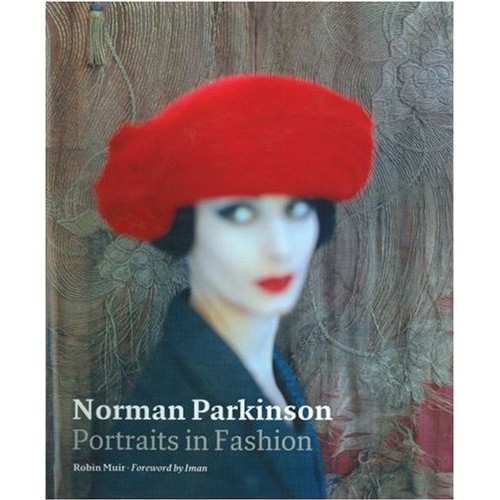
If this book is not in your library I have but two words for you: “Why not?”
Book review
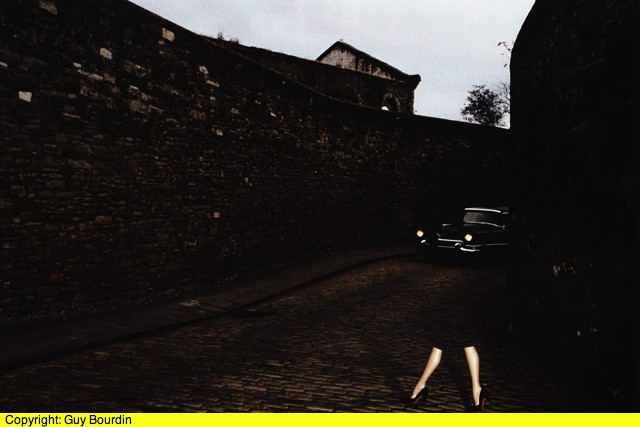
You know how you remember the first of anything? The first book you read, the first music you heard, the first glass of wine, and so on? Yes, that too.
Well, the first fashion photography I remember was by the French master Guy Bourdin. Sometime in the early 1970s when I had a subscription to British Vogue.
He is not a mainstream name in fashion the way that Beaton, or Hoyningen-Huene or Horst or Bailey or Klein or Testino are. (Click here to see all my Book Reviews). Yet his imagery is so startling, the compositions so perfect, the point of view so different, that he can probably lay claim to having influenced more photographers clandestinely than anyone. His images simply change the way you see and think. Everywhere the influence of Man Ray, with whom he apprenticed, is to be felt.
The picture I have scanned from the book, above, is just one example. I had never seen it before and found myself spontaneously expostulating “Goodness gracious!” when I first saw it.
For fifteen years Bourdin had the most extraordinary relationship with the haute couture fashion house of Charles Jourdan. He took the snaps. They published them without question. No crops. No rejects. What they got they ran. They made shoes. Bourdin, you might argue, is a photographer of shoes. And the Ferrari is just a car. And Sophia Loren is just a woman. And the Leica is just a camera.
Do yourself a huge favor. Buy this book.