Category Archives: Photographers

Frans Lanting – Good Advice

From the July 21 issue of the Wall Street Journal.

These extracts from the article in the July 21 issue of the Wall Street Journal include some excellent advice from the greatest living nature photographer:

“Slow down.”

“Don’t try to photograph everything in a scene.”

“Don’t get held back by technology.” Details like digital resolution and shutter speeds, as well as the plethora of different cameras and lenses available, can be daunting to the amateur photographer. To start, apply yourself to one main camera, and learn it and its accessories inside and out, Mr. Lanting says.

“Think of the story you want to convey.” Think of the three or four main photographs that would illustrate this story. Always have these four images in mind before you set out on the photography expedition. Take hundreds of shots, but always be looking for those four images, he says.

“Watch for light.” This is one part of the photographic process you can manage minutely, he says. Wait for the right light, add a flash or learn to say no to a shot if the light isn’t optimal. Mr. Lanting travels with a large selection of flash equipment, and uses a flash to light details like a tiny horseshoe crab on a beach at sunset, or even a high-powered strobe light to illuminate a flying puffin.

“Think first, shoot later. Photography is methodical.” Think first of the image you want to capture, then go about getting it. If you shoot first, then think later, that is a snapshot, not a photo, says Mr. Lanting.

“Go digital.” Mr. Lanting resisted switching to digital photography for years — he gave up film for good just one year ago. Finally, he says, digital technology can deliver the same quality images as film. He travels with several external hard drives and a Macbook Pro laptop, so he can shoot hundreds or even thousands of photos on each shoot, and upload them directly to his computer.

“Get up early. The best light is often at dawn, and animals and people are often at their best early in the morning.” Mr. Lanting often rises at daybreak to wander around his own backyard, snapping photos of birds and hoping to spot a bobcat or two.

You can read the whole thing by subscribing on line to WSJ.com.
Diane Arbus – fake.

A cruel, exploitative photographer without a shred of decency.

Diane Arbus, of course, is famous for having killed herself at the age of 48 in 1971. Since then, this unknown photographer’s work has sky rocketed in fame and value. Proving that nothing so much enhances the value of your work as suicide.

Which is not the same as saying that her photography is either good – it is not – or genuine. Indeed, few photographers have produced more shamefully contrived work than Arbus, which qualifies her instantly for the Hall of Fakes.

Arbus was smart. She cottoned on to the fact that the photographic intelligentsia was buying It, It being her cruel, exploitative view of a world seemingly filled with monsters, freaks and the deformed. There’s not another photographer who so cruelly mocks his subjects, distorting them this way and that, ridiculing them at every turn, without the least indication that she had either a heart or a conscience. It’s as if one of those poor fools who photographs beggars on the street suddenly acquired a taste for the bedside manner of the IRS and proceeded to put it to work in the local mental institution with a camera as a weapon.

Her work, then, is the antithesis of class, of decorum, of decency.

But face it. The intelligentsia, the taste makers, goodness help us, believed the exact opposite of what her pictures represented. Where there was poor taste, they saw insight. Where there was cruelty, they saw sympathy. Where there was depravity, they saw honor. Or said they did. She got away with it, until her lack of conscience eventually caught up with her, culminating in a miserable ending of slashed wrists and a drug overdose.

The best example of her fakery is perhaps seen in the contact sheet of the seemingly crazy child holding the hand grenade. Robert Frank, you cannot help thinking, would have pounced on this subject as an example of American depravity. Anything to knock the country that is his adopted home. At least his picture would have had some class. But taking a look at Arbus’s contact sheets you see, to your amazement, that this is in fact a very ordinary little boy playing with a toy. It’s just that in this one accidental shot he is grimacing just so and the whole thing takes on a look of insanity. A sweet, ordinary child, rendered crazy for the ages by the lying, dishonest vision of a supreme fake.

Don’t believe me? Then let me quote her for you and you be the judge:

“Freaks was (sic) a thing I photographed a lot. It was one of the first things I photographed and it had a terrific kind of excitement for me. I just used to adore them. I still do adore some of them. I don’t quite mean they’re my best friends but they made me feel a mixture of shame and awe. There’s a quality of legend about freaks. Like a person in a fairy tale who stops you and demands that you answer a riddle. Most people go through life dreading they’ll have a traumatic experience. Freaks were born with their trauma. They’ve already passed their test in life. They’re aristocrats.”

You can find her garbage on the web as I’m damned if I’m reproducing it here.

May we not see her like again.

Slim Aarons and rich people

Rich beats the alternatives any day

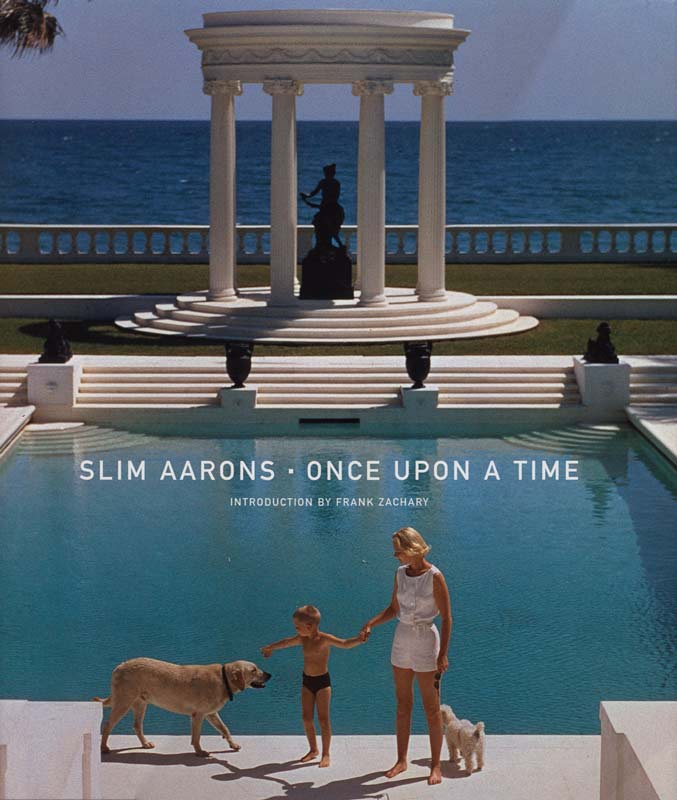
One of the best things to be said about Slim Aarons’s book Once Upon a Time is that there is not a cat in sight. Lots of dogs and a few horses, but no felines. For that hooray! The rich like their pets obsequious and subservient. Plus they like loyalty. That must explain it.

And it’s the rich this book is about. Having got tired of being shot at in WWII, Aarons rightly decided to enjoy the rest of his life and ended up taking pictures of rich people. Not first generation Gates-rich, you understand. We are talking old money here. The kind your forbears made and you got to enjoy, if you had chosen your parents well. Cabots, Phippses, Agnellis, Fords, Marlboroughs (no dear, not the cigarettes), Windsors and so on.

Frankly, what makes the pictures in this book interesting is the voyeuristic frisson they generate, for the photography is, for the most part, unexceptional to downright mediocre. Aarons’s subjects save the day as often as not. A blurred picture of Prince Charles will always be more interesting than your blurred picture of your sister. Unless, that is, she just happens to be Paris Hilton in the buff.

And while it may take ten generations in Italy to make your money Old Money, five in Britain and one in America, what is very much on display here is Old Money. Lots of Old Money.

The most appealing picture in the book? Page 23 where Mrs. Henry B. Cabot, Jr. (probably named Muriel Finkelstein in real life, for all I know, she cottoned on to the Cabot thing fast), her pert little jeans-clad tushie resting on the fender of the Alfa runabout, the obligatory poodle in the car, proudly displays her magnificent estate home, not so accidentally in the background. You see, being rich means showing that you have money. Don’t bore me with tales of quiet wealth. No such thing. No, what makes this picture special is the Cabot arriviste’s three gorgeous kids variously disposed all over the car. The picture is dated 1960 and the eldest child is probably seven. You see, these kids have yet to learn they are rich. One little boy grins stupidly while holding a football, while the other makes a silly face at his sister, because little boys are like that. A charming and very special photograph.

And while you or I could have done much better with most of the content given the chance – even the cover picture is poorly timed – let’s face it. It’s a lot more fun to look at these than yet another book of war photographs. Aarons got that right.

Jack Dykinga – nature photographer

A master of the modern Western US landscape photograph.

If Eliot Porter’s nature photography appeals to the romantic side of one’s personality, Jack Dykinga’s appeals to the other extreme. A more formal, studied approach. Classical, if you like. That sounds boring on paper but the reality is that his work is astonishing. Whereas with Porter’s work the reaction tends to be “Hmmm, I need to think about that” with Dykinga it’s a more simple “Wow!”.

As is often the case in aesthetic matters, I chanced on his work by accident. It was 1983 and I was half way though my six year stint in New York City. The excitement I had first felt for the city was increasingly turning to dismay. Corruption, dirt and congestion. I reckoned I could get the same in Los Angeles and at least have good weather thrown in at no additional cost. So somewhere about that time I began thinking of going west.

Now there’s a lot that is good about Manhattan. Museums and art galleries everywhere. Restaurants of all ethnicities easily found. Central Park. Carnegie Hall. The Met. Broadway. Wall Street. Street photography opportunities to die for (sadly, literally true in the early 1980s, far better now) and those mom and pop grocery stores (mom and pop being Vietnamese or Korean) open 24/365, seemingly on every street corner.

But one of the best things about the City is the large selection of book stores, both traditional brick and mortar establishments, and the street vendors, just like in Paris. So it was some time around 1983 that I came across a magazine named Arizona Highways at just one of those places. Large format, slim and with no advertising, the photography, limited to Arizona, was stunning. There are no advertisements as the magazine is bankrolled by none other than the State of Arizona, or at least its taxpayers. To cut a long story short, it was there I first encountered the work of Jack Dykinga.

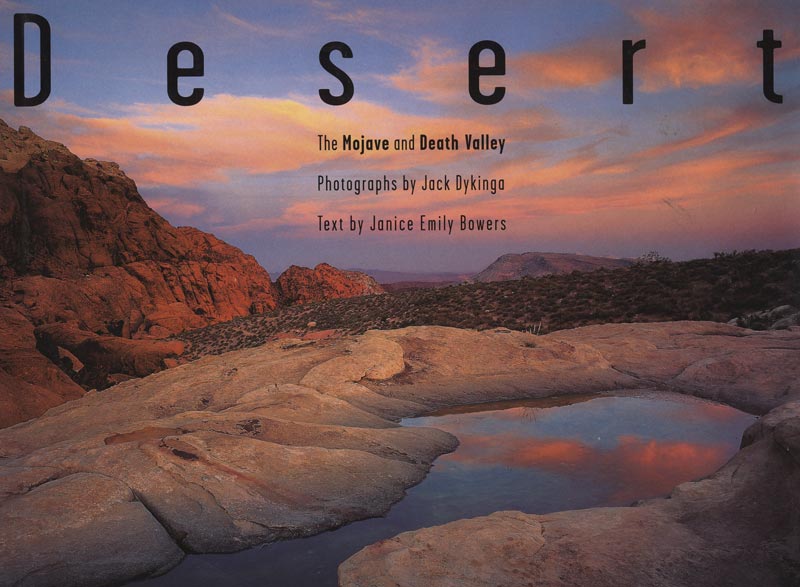
Best as I can tell, Dykinga still works with large format film and I was prompted to write this entry after pulling his book ‘Desert: The Mojave and Death Valley’ from the bookshelf the other day. If Arizona Highways was one reason I moved to the great landscape of the American West in 1987, then Dykinga’s photography was the catalyst.

In the winter of 1997-98 the heavy rains brought by the El Nino weather system produced a tremendous flowering of desert plants in the Mojave, and Dykinga was there to capture it. While large format is not necessary for the modest size of the book – some 10″ x 11″ in size – the photographs are simply magic. Far more than record pictures, Dykinga takes extraordinary pains over composition, thinking nothing of being up with the birds or going to sleep when the owls are coming to.

Thanks to the phenomenon that affects all photography books, you do not have to pay the $49.50 I did back in March, 2003 when this was published, as Amazon will sell you a new hardcover copy for the grand sum of $19.98. Add a fine and relevant text (rare attributes those, in photography books) by Janice Emily Bowers, and you have a treasure. I would spill the beans and tell you all about ‘The Racetrack’ but that section of the book is so extraordinary, so simply unbelievable, that I am going to keep mum and suggest you send some money to Amazon and find out for yourself. You will not believe your eyes.

And supporting a hard working photographer makes far more sense than throwing more money into the corporate coffers of Nicansonypan for the latest gadget. You can see Dykinga’s work on his web site. It does not do his work justice. Buy the book.

Robert Gambee – Downtown Manhattan

A standout from the crowd of Manhattan picture books.

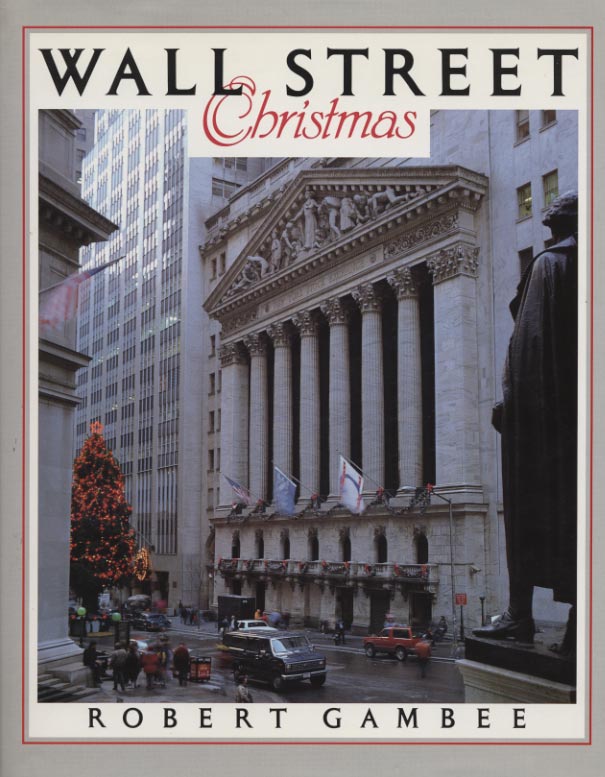
Wall Street Christmas by Robert Gambee was published in 1990, some three years after I had taken Horace Greeley’s advice and moved west to Los Angeles. It is a wonderful piece with superb photography and text by Gambee – a monumental task. The book has over 270 pages and probably as many pictures.

While no longer in print you can pick up a good used copy for a few dollars from Amazon or other booksellers, and I recommend it unreservedly is you like superb architecture and photography.

I was reminded of the book when cataloging some pictures the other day and coming across a batch from my Wall Street days. Gambee records not only the exteriors but also the plush executive suites where the rich were made to feel better about parting with their money, for they could see so much of it hanging on the walls. My favorite recollection of the time is attending meetings in the board room of J. P. Morgan at 23 Wall Street where, for some inexplicable reason, I was always seated directly opposite the huge oil of J. Pierpont Morgan himself, dark glowering gaze and all. I have absolutely no recollection of the content of the meetings but the portrait will go with me to my grave! I recall traipsing down the corridor of this fine space – the building deliberately built to just a handful of stories to emphasize the wealth of the institution – and suddenly the industrial carpet changed to plush pile as you approached the hallowed ‘executive’ area.

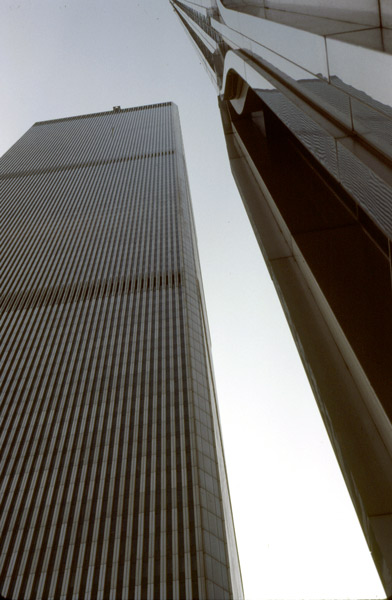
There are the obligatory pictures of the World Trade Centers, of course, as it was impossible not to notice them. They only looked good at night when all those office lights made the facades look like some digital modern art piece. I had a client in one on the 95th floor and you had to take two elevators to get there. Each building was so large it had its own zip code for mail. Having dined a few times in the surprisingly good Windows on the World restaurant at the very top on the 110th floor, I recall on one windy winter’s day when the short elevator trip to the top was interrupted by the failsafes which would refuse to allow the elevator to move if the building and its shaft were twisting too much …. these buildings were tall!

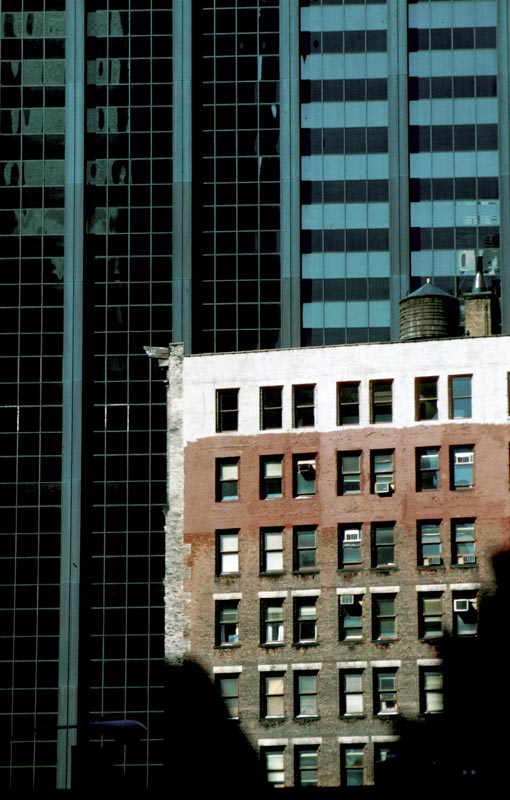
Gambee’s pictures are far superior to anything I ever did in New York, but just for fun, here are a couple of my images.

Old and new, downtown Manhattan. Pentax ME Super, 200mm Takumar. Kodachrome 64

World Trade Centers. Pentax ME Super, 40mm ‘pancake’ Takumar. Kodachrome 64

A fine book, whether your interest is in architecture or just a vouyeuristic one wishing to glimpse the corridors of American financial power.