Category Archives: Photographers

Political photography

Anti-American photojournalist’s writings exposed.

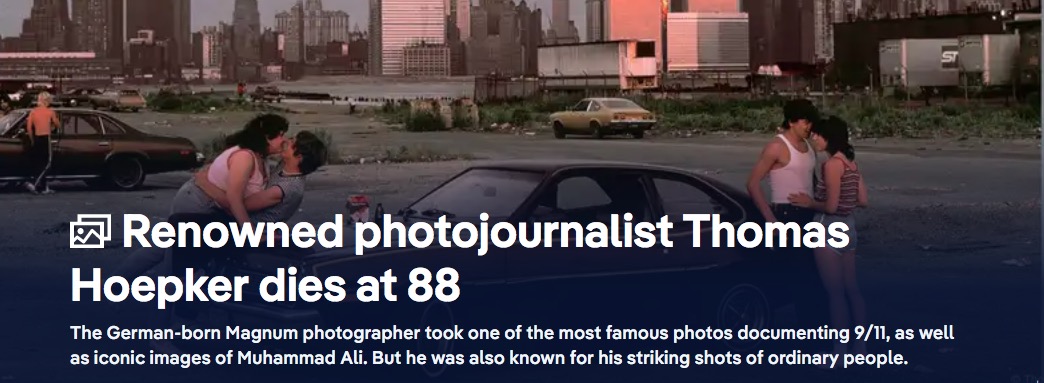
In yesterday’s Wall Street Journal, art critic Richard B. Woodward writes about how famous Magnum photographer Thomas Hoepker fabricated a story to suit his anti-American mind set. No surprise that German Hoepker proudly boasts of making his home on Manhattan’s upper east side.

The picture in question shows five people in Brooklyn chatting on the waterfront on September 11, 2001, while smoke billows from the World Trade Centers behind them.

Specifically, and scandalously, Hoepker wrote:

“It’s possible they lost people and cared, but they were not stirred by it.”

And here’s more of his tripe:

“Four and a half years later, when I was going through my archive to assemble a retrospective exhibition of my work from more than 50 years, the color slide from Brooklyn suddenly seemed to jump at me. Now, distanced from the actual event, the picture seemed strange and surreal. It asked questions but provided no answers. How could disaster descend on such a beautiful day? How could this group of cool-looking young people sit there so relaxed and seemingly untouched by the mother of all catastrophes which unfolded in the background? Was this the callousness of a generation, which had seen too much CNN and too many horror movies?”

Needless to add, Hoepker’s fraud was aided, abetted and amplifed by none other than, yes, you guessed it, The New York Times, whose Frank Rich called the image “shocking”. You can imagine how much research went into that opinion. Any publication with ethics policies would fire Rich for his drivel; I imagine a promotion is probably in store for him for getting circulation and anti-American feelings up.

Hoepker’s fraud was exposed when none other than one of the people portrayed in the picture wrote to Slate magazine stating:

“Had Hoepker walked fifty feet over to introduce himself he would have discovered a bunch of New Yorkers in the middle of an animated discussion about what had just happened.”

Subsequently, the woman in the picture – a professional photographer, no less – also contacted Slate with a poignant and moving rebuttal.

The Wall Street Journal writes succinctly that “In effect, (Hoepker) has Photoshopped (the image) in his mind so that it now belongs neatly in a more contemporary storyline of this nation’s culpability for world unease”.

Well written.

While I disagree with Woodward’s earlier statement that digital trickery has “…not eroded the truth value of photographs…” – I have shown many examples of Photoshop fraud in this journal which should make everyone sceptical – it is heartening to see people taking a stand against America’s detractors, not least against those who would, in the same breath, proffer inane apologia for all that was good and great about all those moral German industrialists during WWII. You can substitute ‘German industrialists’ with ‘terrorists’ and ‘mass murderers’, and it works just as well.

Update 9/102014: Hoepker’s cynical exploitation of tragedy for personal gain, his self-serving response notwithstanding, is further addressed here.

Update July 12, 2024:

Mercifully Hoepker has finally done the decent thing and passed on to his German heaven. A first for him, doubtless.


A bad man passes.

His crass profit making from one of America’s greatest tragedies confirms that no German should ever lecture Americans on what doing the right thing means. Good riddance.

Keld rediscovered

The Great Dane is back.

I first learned of the sparse, severe work of Danish photographer Keld Helmer-Petersen from early issues of Leica Fotografie magazine from the 1950s. His focus on carefully composed details of ships, ropes, man made items for the most part, was appealing for its clarity of vision and very sparing use of color. It has aged a lot better than Danish furniture.

While ‘lifestyle’ magazines leave me cold for the most part – why would you pay for marketing after all? – there’s one that is head and shoulders above the others. Indeed, as the only way to get it is to be the registered owner of one of their products, its hardly marketing at all. After all, you have already paid up. And the best thing about their products is that no one will know what you have. If you like gauche Rolexes, look elsewhere. That magazine is put out by the makers of one of the very few mechanical items more lovely to behold than an early M Leica. It is called Patek Philippe and I urge you to get a Patek if for no other reason than to enjoy the publication:

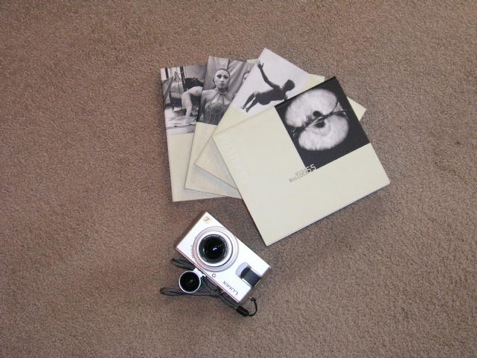
Most noteworthy in its editorial policy is the frequent focus on art and photography. The currrent issue (Volume 11, Number 7) has, in its large pages, superb portolios of the work of Don McCullin (of Viet Nam war photography fame) and Keld Helmer-Petersen. An equally fascinating article looks at modern makers of sundials. Add substantive pieces on French sculptor Camille Claudel and Francois Junot, a Swiss maker of mechanical objects (see the cover, above), and you have content not likely to be found in the pages of some nouveau riche-targeted hack job put out by ‘luxury’ car makers extolling the virtues of their plastic upholstery and the latest in internal decorating.

While Keld-Helmer Petersen made his living as a commercial photographer, it’s his 1948 book ‘122 Colour Photographs’, which I am lucky to have in the library at home, that made him famous. When everyone was working in monochrome, he turned to color because, in his words “You have to think of colour as form….”. It helps that the interview is conducted by a famous photographer, the Englishman Martin Parr, so it is neither banal nor trite.

It looks as if his ‘rediscovery’ may encourage Petersen to publish again and I urge you to place the book on your short list.

And just in case you fall for Patek’s tag line “You never actually own a Patek Philippe. You merely look after if for the next generation”, let me disabuse you of that belief. The reality is that it’s like owning a rangefinder Leica, meaning a cleaning and overhaul every five years at horrendous cost. These are intensely mechanical devices, after all. The next generation had better hope I don’t go belly up if it wants mine (the Patek, not the Leicas; I’m selling the latter). Leicas get obsoleted. Pateks do not.

Joseph Sudek

A master of lyrical monochrome.

There is so much to like in the Aperture book ‘Josef Sudek – Poet of Prague’ that it’s hard to know where to begin. Sudek (1896-1976) spent nearly his whole life in Czechoslovakia. From 1940, inspired by contact prints from large negatives he devoted himself to this way of working, using a cumbersome large format camera and tripod.

None of this was made easier by the fact that he had lost his right arm as an army soldier in WWI, yet no allowances need be made in looking at his wonderful pictures. What a life. Surviving the first war only to see his country dismembered by the greedy Germans, Poles and Hungarians while cowardly French and English politicians stood by and watched. Surviving twice more, this time WWII and the Cold War, and finally enjoying the fame that was deservedly his late in life.

The reproductions are superb, none finer than those of his series of St. Vitus Cathedral taken in the late 1920s. The narrative is outstanding, written by people who both knew and worked with him.

My favorite quote of his, on page 44, goes as follows:

“It would have bored me extremely to have restricted myself to one specific direction for my whole life, for example, landscape photography. A photographer should never impose such restrictions upon himself.”

The book can be bought for 50% of its original hardcover price, which was $40, from Powell’s Books and should be in every photographer’s library.

A Blast from the Past

Extraordinary recreations by a Russian photographer.

Run, don’t walk, to see the work of Dmitry Popov, a Russian photographer who has meticulously recreated scenes from the first 60 years of the American Century for a car magazine. Each features period automobiles together with actors in period clothing recreating the time and feel of a place (mostly) in America, none better than this one at the Golden Gate in San Francisco. The man reading the San Francsco Examiner, leaning on his magnificent Buick, is doing so on September 3, 1939 – the war that America won for an ungrateful Europe would not start here until some 27 month later, when Japanese tourists visited Hawaii.

Popov writes:

“Every photo shoot is preceded by thorough research of the era. When and under what conditions a particular vehicle model was produced sets the theme. The majority of my photographs are the result of a classically arranged photo shoot. The actors, costumes, hair, makeup, setting, and props are all fashioned to the standards of the era. Although each of the photographic series on each site is presented only partially, the collection taken in its entirety tells a story. The term “Photo-Clipping” would best describe my collection. The series of pictures tells a “moving” story using still images. Most of photographs on this site were taken between 2002 and 2004 for a Russian automotive magazine Autopilot produced by the Kommersant Publishing and Golf Style Next magazine, Moscow, Russia.”

This is story telling in the classsic mould of Life or Picture Post magazines of the era, when photojournalism was king and television in every home was still a distant idea in RCA’s corporate brain.

You don’t have to like cars to enjoy Popov’s fabulous work, though it doesn’t hurt if you do.

Highly recommended.

Adding sound to QTVR panoramas – Part I

The penultimate enhancement.

Well, over the past few days my feet and the tripod’s have been buried in sand and in running water. Five wet feet….

The QTVR + HDR accompanying this column, from Limekiln State Park in central California, despite using three pictures for each of the eight components of the panorama, renders the running water quite nicely. Note also the great shadow detail in the trunks of the massive redwoods thanks to the HDR process – no way that I can see conventional single shot exposures capable of this.

But the picture alone is not enough.

After asking around a bit and being met with stone cold silence, I spent the morning searching the web for some way of adding sound to my QTVR panoramas. QuickTime, even in its upgraded ‘Pro’ version, does not let you do this with VR movies, only with regular movies. Shame.

Well, after much searching the answer lay no further than the boys at ClickHere Design, the good folks in Australia who make CubicConverter to allow adjustment of default settings on QTVR movies. In addition to being great cricketers, the Aussies make great software and Foster’s beer – a fine race. The application is named Cubic Connector.

CubicConnector does far more than add sound. It permits creation of an interactive web design with clickable hot spots. When clicked, these hot spots, which can be superimposed on a map, take the user to a VR movie of the location selected. That’s the ultimate and it will take a few more trips to Limekiln for me to complete a comprehensive, QTVR, map and panorama web page which will give the viewer an experience close to being there. Sorry, no way I know of adding the fabulous aroma of a redwood forest. Maybe Apple will do that in the next version of QuickTime?!

CubicConnector also allows presetting of panning actions and speeds, which I have used here; you can override it and pan in any direction, including up and down, by using the mouse. The file is 7mB so it will take a few moments to load – 25 secconds on my broadband connection. Enjoy!

Limekiln State Park, CA in sight and sound – click here

If you want to add sound to your QTVRs, buy Cubic Converter and CubicConnector together at $99, not like I did at $79 each.

I will look at recording your own sound track in Part II.