Category Archives: Photographs

Walter Mandler

The designer’s designer.

For an index of all Leica-related articles click here.

The names of great engineers are known to few. And that is sad. Who knows who designed the Golden Gate? Who cares? What do you mean who cares? What does that say about our educational system? Everyone should know and care.

And it’s the same with photographers. Ask the average fellow with $10k of the best in gear around his neck who Gauss, Bertele or Mandler (1922-2005) was and you will be met with a blank stare. And that saddens me. Because those are three of the lens designers without whose work the 12-400mm f/2.8 autofocus retractable zoom on that magical digital in your vest pocket would not exist.

Mandler’s primary design tool.

Back in 1973, I concluded my undergraduate dissertation, which happened to deal with the thrilling subject of the erosion of polymers. Until then, research had lacked understanding of a crucial variable. That was accurate determination of the speed of impact of abrasive particles (sand, grit) on the polymer (plastic) linings used to reduce wear in intake ducts for helicopter jet engines, essential for killing the innocents in Asia. Because the subject fascinated me no end (the erosion, not the killing part), I determined to solve for this missing variable and rooting around in the back of the lab at University College School of Engineering, UC London, I came across two tools of priceless value. A Perkin-Elmer stroboscope whose light duration was specified to great accuracy, and a Minolta SRT101 SLR with a 50mm f/2 Rokkor lens. Yes, you guessed it. Another rip off of Walter Mandler’s timeless Leica Summicron design. (By the way, this was my first serious inkling of America’s genius. Perkin-Elmer made the mirror which NASA placed on the moon, allowing us to determine its distance to, oh, a foot or two, when they bounced a timed light beam off it).

Now my first thought of the Minolta was that I could get to rack it out, no charge, given UC’s famously liberal culture, taking pictures of the many street protests of the time. “Honest, Dr. Jones, they grabbed me and smashed the camera. It wasn’t my fault!” But then I thought about it and the light went off, so to speak. I have a light of known duration, I have a camera which can photograph the intervening flying abrasive particles using Schlieren lighting with the strobe pointed directly into the lens and the rest is just exposure and some simple measurement of blur lengths and schoolboy mathematics. Heck, I even processed the film myself! (PlusX in Microphen if you must know – I was a loyal Kodak man even back then).

The dropped jaws occasioned by my insouciant presentation to the assembled dons, with the requisite anti-American incantations about ‘Nam and the efficiency of killing, said a First, and a First it was. “No, Doctor Jones, I want to go into the real world. Thanks for the offer of post-graduate study, anyway. I want to compete, not teach. And escaping poverty would be nice, too.”

What a First looks like. I had to type this on my mum’s old Remington ….

My tool of choice. RMP? Renata Maria Pindelski.

And thank you, Dr. Mandler.

Surprise fact, something other than Labatt’s and professional complainants was produced in the frozen North that passes for Canada, a nation with the longest contiguous border with the most powerful country on earth and little to show for it. A German company in Midland, Ontario, Canada, a subsidiary of Ernst Leitz, Wetzlar, West Germany, saw to it that Canada’s reputation in the optical pantheon would be secure, even if it was secured by a German mathematician and designer. Walter Mandler was that designer and few would dispute that he is one of the premier optical designers in history.

I am pleased to relate that I owned and used all of the following Walter Mandler designed lenses and not for one moment were they anything but the best. And every time I pressed the button I knew Mandler’s genius was on my side; all I had to do was to try to live up to his standards:

  • 35mm Summicron f/2
  • 50mm Summicron f/2
  • 90mm Elmar f/4
  • 90mm Summicron-R f/2
  • 90mm Elmarit f/2.8
  • 90mm Tele-Elmarit f/2.8
  • 135mm Elmar f/4
  • 135mm Tele Elmar f/4
  • 200mm Telyt f/4
  • 280mm Telyt f/4.8

…. and last, and by no means least, his masterpiece for NASA (and for you and me), the ….

  • 180mm f/3.4 Apo-Telyt-R f/3.4

Mandler’s 200mm f/4 Telyt for the Visoflex.

I owned maybe a half dozen other Leitz optics, non-Mandlers I admit, but clearly he dominated the output of the marque. And if you tell me that my 21mm Apo-Elmarit-M f/2.8, the 35mm Apo-Summicron-M f/2, the 90mm Apo-Summicron-M f/2 or the 400mm Telyt f/6.8 didn’t have Mandler’s genes all over them, well, you have no idea.

And each was special in its own way. Anything with that magic sobriquet ‘Summicron’ needs no explanation. It means ‘f/2 and beyond compare’. Maybe bad pictures can be taken with a Summicron, but I never went there. And while I could never afford a Mandler Summilux (f/1.4 and every bit as good, while twice as fast) I now revel in a 1969 Nikkor-S 50mm f/1.4 which was ‘borrowed’ from Mandler’s workbench. That and Nikon’s 50mm Nikkor-H f/2 of that era, a Summicron clone, are every bit as good as Mandler’s Summiluxes and Summicrons, respectively. Though I hate waste, I have no qualms about owning both. And the Nikon optics make no quality concessions. Today those facts would attract some serious patent litigation, but back then the king deigned not to sue his loyal supplicants.

So, unsung master that he may be, next time you snap a picture give a thought to the master lens designer of the past century.

Words are cheap. Here are some Mandlers:

Pelican, Morro Bay. Leica M2, 90mm Elmar, Kodak Gold 100.

Morning paper, Greenwich Village. Leica M3, 135mm Elmar. Kodachrome 64.

American whales. NY Museum of Natural History. Leica M3, 35mm Summicron, Kodachrome 64.

Amsterdam café. Leica M3, 50mm Summicron.

Lake Elizabeth. Leicaflex SL, 180mm Apo-Telyt-R, Kodachrome 64.

SoHo, NYC. Leicaflex SL, 50mm Summicron-R, Kodachrome 64.

San Diego downtown. Leica M2, 90mm Elmarit, Kodak Gold 100.

San Luis Obispo hard hat. Leicaflex SL, 90mm Summicron-R, Kodak Gold 100.

See what I mean?

San Francisco from up high

What a city!

Taking dramatic aerial pictures of San Francisco requires no skill. Choose a clear day with light clouds, make your way to the top of Bernal Hill Park and bang away.

That’s all it took to make these.

Downtown and the Bay Bridge. 135mm.

The Golden Gate from Bernal Hill Park. 135mm.

All on the Nikon D700 using ‘all metal era’ 135mm Nikkor MF lens, made exactly 40 years ago. Experts assure me that the lens is garbage compared to the latest and greatest, which just goes to show that most ‘photographers’ should stick to test charts and brick walls.

Bernal Heights

What a neighborhood should be.

Bernal Heights.

Wander down to Cortland Street, the main drag in the city of Bernal Heights, and you will be transported back to 1950s America. No WalMarts, no McDonalds, no ghastly chain stores of any sort. Just local groceries, cafes and restaurants, and utterly charming. And no Starbucks with its condescending help and burned coffee beans. None of the mass marketing, in other words, that has made every city in the civilized world look pretty much like every other.

Bernal Heights is that rarest of things, a true neighborhood with regular people. No aggressive displays of errant ‘lifestyle choices’, no tattoo-defaced bodies, no foolish body piercings, no Harley Davidson poseurs. Just regular people going about their lives without show or artifice. People being comfortable being what they are.

Red Hill Books. 24mm.

Corner coffee shop. 24mm.

Residents take their dogs’ fitness seriously here. 50mm.

Tended with love. 50mm.

Bernal school. 24mm.

“Why do you live in the city?” 24mm.

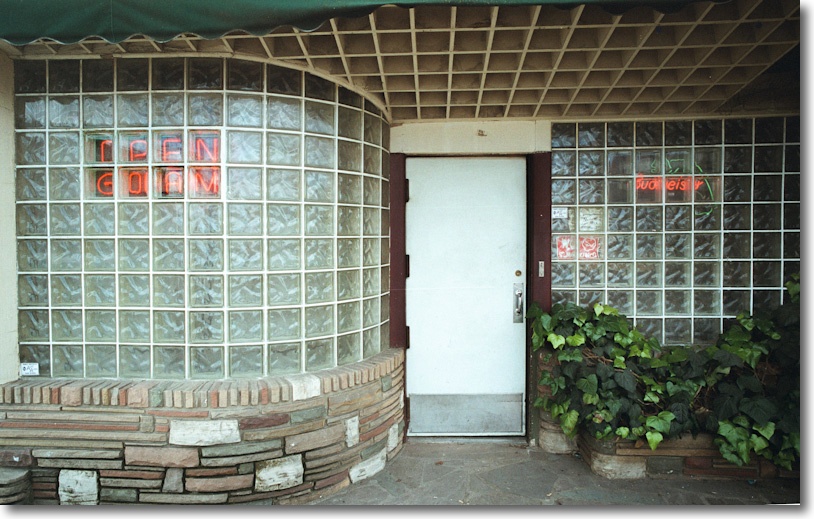
Local boozer. 24mm.

Polling Day. 24mm.

Hanging out. Click the picture for the map. 24mm.

Aged awning gears. 24mm.

Front door. 24mm.

And the very best thing about Bernal Heights? There are dogs everywhere!

On Cortland Street, Bernal Heights. Happy to proffer a paw and a cold nose.
About as good an egg as I have met this year, and with massive dignity. 24mm.

All on the Nikon D700 using ‘all metal era’ Nikkor 24, 50 and 135mm MF lenses, aged 35 years or more.