Category Archives: Photographs

Edward Hopper and photography

Even if you don’t care for painting, check him out.

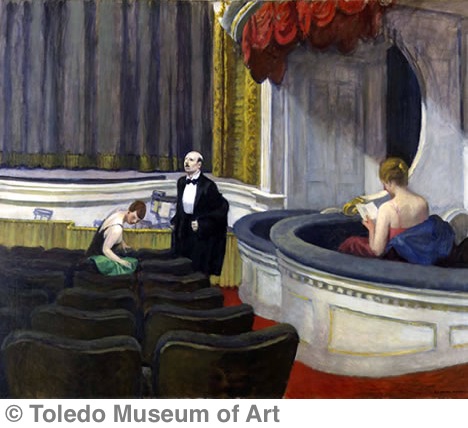
I have written before about the American painter Edward Hopper (1882-1967) and of both the love I have for his work and the strong influence he has exerted over my way of seeing as a photographer. For Hopper is that most photographic of painters. And I don’t mean photographic in the dry, sterile, rather sick sense of the photorealists (gee, if you are going to kill yourself making a painting look like a photograph, why not just photograph the bloody thing and save some time?). No, I mean it in the sense that with his people-in-the-city paintings there are all the elements of photographic composition with the painter’s singular advantage that distracting clutter can simply be blended out with some brushwork.

Case in point:

Edward Hopper, Two on the aisle, 1927

You get a touch of realism in the ‘decisive moment’ timing of the picture, a touch of surrealism in the detailing of the woman’s face and a touch of Degas (also a fine photographer) in the back of the woman in the box on the right. The perspective is gently skewed in the best Bonnard tradition.

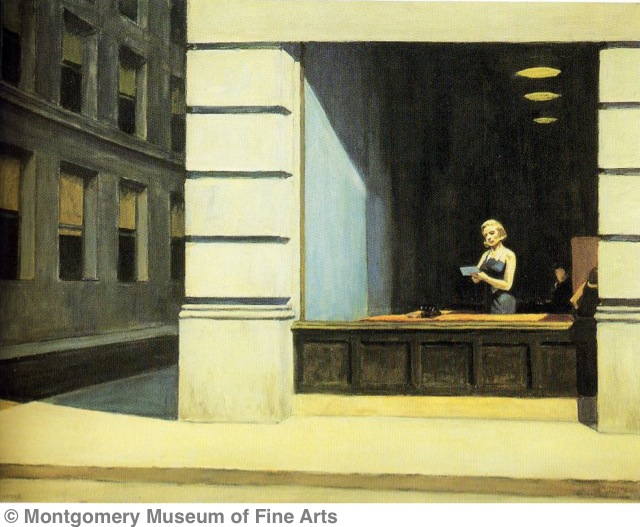
Invariably, when it comes to people, Hopper trends to the lonely vision of the American Experience, as here:

Edward Hopper, New York Ofice, 1962

I know exactly how he felt.

Leica M3, 50mm Summicron, Kodachrome 64, Anchorage, 1978

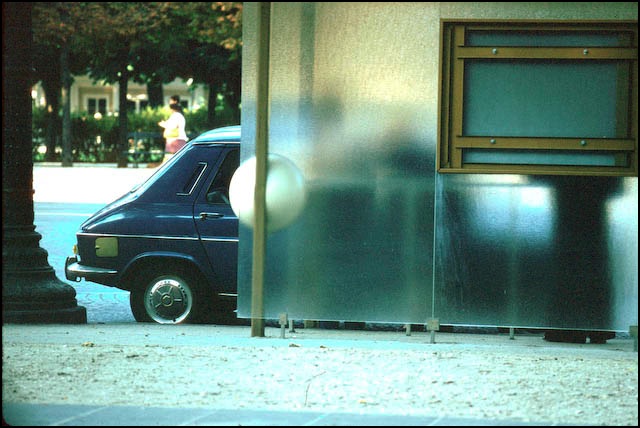
Nor is that vision unique to American cities:

Leica M3, 35mm Summaron, Kodachrome 64, Paris, 1974

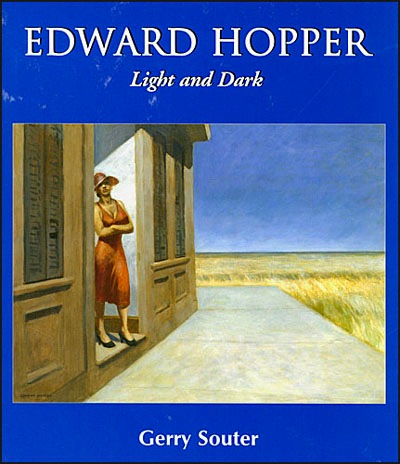
There are many fine books on Hopper. One I recommend is “Edward Hopper: Light and Dark” by Gerry Souter, Parkstone, 2007. Barely published and already remaindered, it’s replete with many illustrations (over 140) and Souter’s text makes for interesting reading, devoid of pomposity. Any photographer looking to sharpen and refine his vision could do worse than plonking down $25 for a remaindered copy.

Click the picture for Amazon.

The King

No, not Elvis.


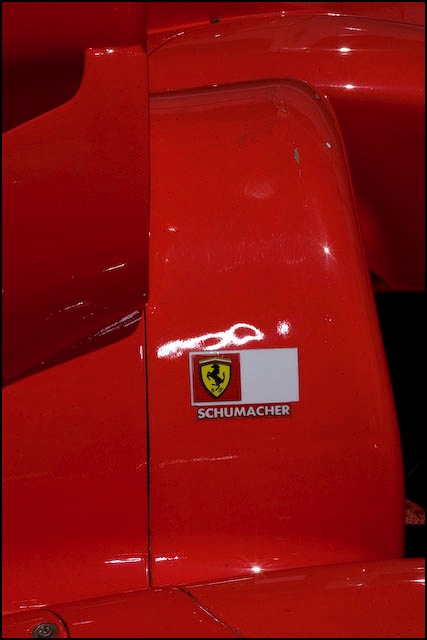
Sensuous curves on the car driven by the greatest ever.
2002 F1 Ferrari. 5D, 100mm Macro, Ring Flash.

No sport enjoys such a rapid pace of technological change as motor racing so comparisons of drivers between generations is a pleasant diversion if not one based in objective measurements.

But few, I think, would disagree that Michael Schumacher was the greatest ever – sportsman, gamesman, competitor, professional.

One color works here – what else for a Ferrari?

Machismo

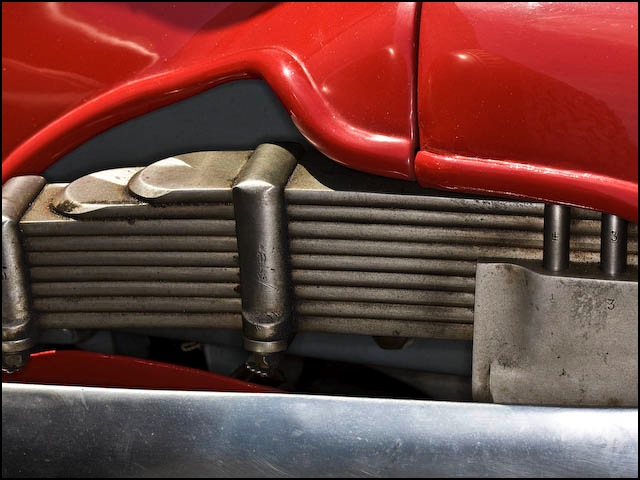
It doesn’t get more macho than this.


Suspension detail on a pre-war Alfa Romeo racer. 5D, 100mm macro, ring flash, 1/200, f/11, ISO250.

My normal habit of underexposing by half a stop does wonders in preserving the dynamic range in the printed version. This has an almost Fritz Lang-like mechanistic intensity which greatly appeals to some part of my nature. The curves of the bodywork are easy on the eyes, too.

I find that f/11 gives you workable depth of field and the best definition. Smaller apertures do not show the Canon 100mm macro at its best. I simply change the ISO until f/11 is indicated.

Monocolor

The thinking man’s Monochrome.


1920s Bugatti racer, with safety wire. 5D, 100mm Macro, Ring Flash.

No need to hide behind the forced abstractions of monochrome when color does it better. Just imagine how unspeakably dull this would be in black and white.

This small version cannot begin to do justice to the large print hanging on my garage wall. Only minimal processing (regular sharpening to offset the effect of the 5D’s anti-aliasing filter) was required, using Lightroom.

Bring your own …. drop cloth!

Cleaning up the clutter.

After my first serious venture into the world of macro pictures of vintage car details one persistent irritant was the clutter many snaps exhibited in the background.

So before venturing forth a second time, the occasion being the Monterey Historic Races, I dropped by that acme of capitalism and low prices, WalMart, and asked the nice lady in the haberdashery department for a couple of pieces of non-reflective cloth in black and red. These would serve as backdrops to clean up the clutter. I thought about getting some green for British cars but concluded that my love was closer to the Mediterranean than the English Channel, so plain black and Ferrari red seemed more in order.

Now a back drop is useless without a drop cloth manager, so I prevailed on friend and vintage racer Franklin Rudolph to accompany me on the two hour drive to Laguna Seca. This had several advantages. First, as I find driving the ultimate time sink and Franklin likes little else, he got to drive the car and I read the Wall Street Journal. Second, few know more of vintage racers than my colleague, so I had the best possible tour guide to the paddock area, replete with dozens of $5mm toys. If the arcana of 1954 Maseratis are your thing, Franklin is the man. Finally, Franklin not only helped with spotting interesting shapes and forms, he volunteered to be the back drop man, holding up the cloth or placing it under the cars as we saw best.

A win-win. He gets two 18″ x 24″ prints of his choice for his superb workshop and I get the best possible professional help on the planet.


Leaf springs on a vintage racer, red back drop in place

On the way home, going south on the 101 Freeway, we cut a two hour trip to what was seemingly a few minutes as we gazed with appreciation on the dozens of exotics making their way north from Los Angeles for the Historics while simultaneously keeping a careful eye out for cops writing speeding tickets, to finance their early retirement at the local doughnut store. Franklin’s choice was a gorgeous Dino with a V6, mine a late 50s tourer with a real Ferrari V12 in the front, where they belong.

Thank you, Franklin, for your friendship and easy expertise. Not to mention your back drop skills!