Category Archives: Photographs

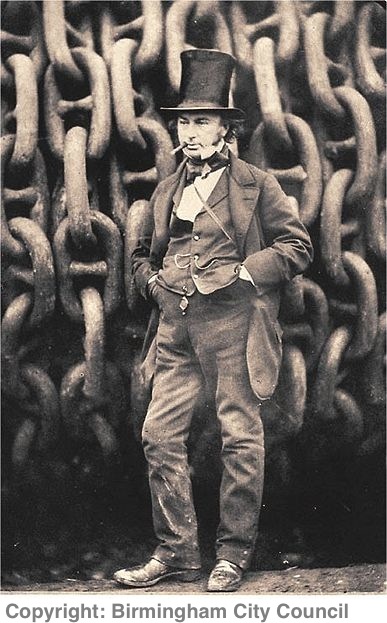
A great picture of a great man

The greatest engineer of the Victorian age.

Because so much of it is so very special, I have been reading up on railways and railway architecture.

Huh? Railway architecture?

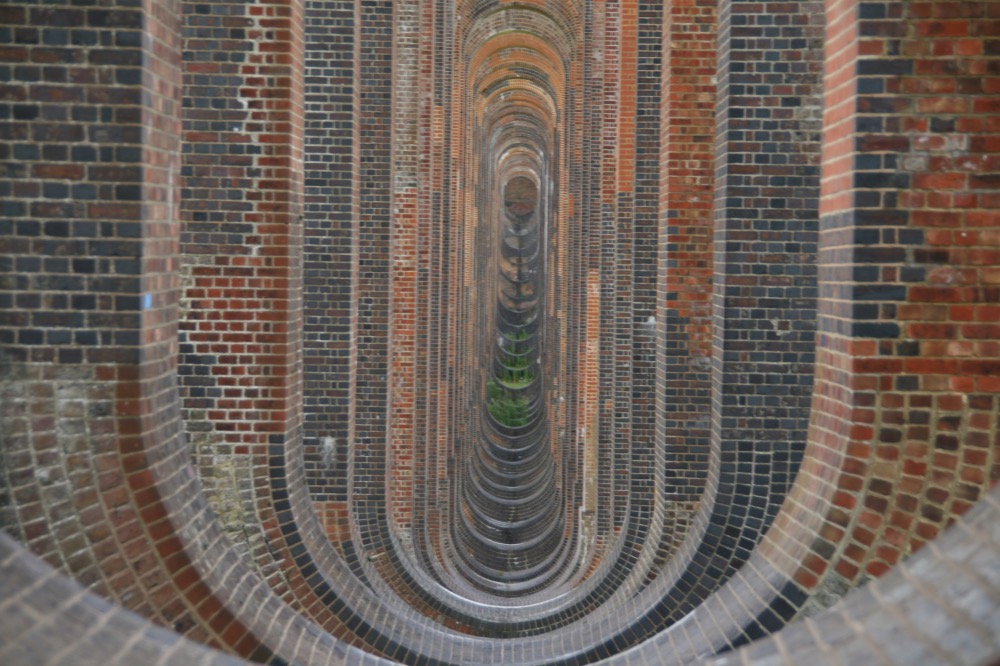
Can you say Grand Central station in Manhattan – maybe the greatest interior in America? St. Pancras or King’s Cross in London? The gorgeous Ouse Valley viaduct in Sussex?

The supports for the Ouse Valley viaduct, 1841. Can you say ‘Perfection’?

One of the facts disclosed in my reading is that most of the world’s railways run on 4′ 8.5″ spaced rails. Known, to this day, as the Stephenson Standard, after the great Victorian railway engineer. How did he come up with that? His wife’s height? Some personal recollection? A dictate of mine engineering where he got his start? It seems to bear no resemblance to known measures, Imperial or Metric. (Please refer to Comment #2 for the solution – thank you, Alex!) I learned also that the giant amongst Victorian engineers, Isambard Kingdom Brunel (what a name!) refused to compromise with the limp-wristed Stepehnson Standard. Compromise was not a word in Brunel’s vocabulary. When he designed the Great Western Railway its was no less than a seven foot gauge. His tracks would run the largest locomotives and would be the most stable.

This refusal to compromise, his drive, determination, individuality and commitment, is what distinguished him in an already distinguished group of great engineers. Today you see that rarely – Steve Jobs is an obvious example.

Here’s the picture – you doubtless know it – maybe the greatest industrial portrait of a powerful man ever made. A man with no fear of getting his hands dirty. An engineer’s engineer.

The backdrop comprises the chains used to launch the Great Eastern iron ship
down the slipway. (Photographer by Robert Howlett, 1857.)

Today, everyone is a ‘team member’. The order taker at MacDonald’s. The Target sales clerk. The smug coffee maker behind the Starbucks counter. The workers at Nikon and Canon and Dell and Microsoft. All seeking to avoid accountability by hiding within the ‘team’.

Not so with I. K. Brunel. He took huge risks, had huge failures. And greater successes. What a man. What a photograph.

The ultimate book of railway photography while we are on the topic? None other than O. Winston Link’s.

A bank has an original idea

A first in business.

When I was a lad learning about business, one of the oft quoted saws of the day was “If all else fails, run a bank”.

That comment on bank management remains true today, though in America one would have to make it “…. run a big bank.” The simple reason being that if all goes well you get paid a lot and if you mess up really badly you still get paid a lot and the taxpayer bails you out. Economists call it moral hazard. I call it a broken system

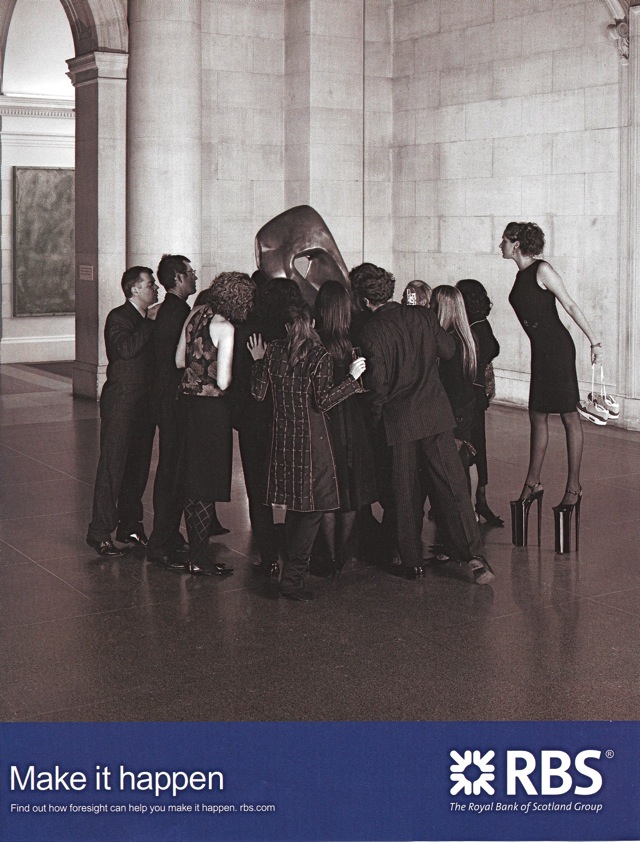
So when I was flipping through Fortune magazine at breakfast, I nearly choked on my muffin when coming across a really neat ad for, of all things, a bank. Can you remember ever having used the word ‘neat’ and ‘bank’ in the same breath? No, neither can I. Fortune magazine, by the way, has long had a focus on using good photography – one of its early contributors being the estimable Margaret Bourke-White.

I would have preferred it in color with the shoes in red – this bank’s favorite color recently – but no matter. Any bank with a sense of humor is a good thing.

Raphael and advertising

The Renaissance lives!

The Great American Corporation has many herd instincts, including mind-numbing group get-togethers and a love of flying that probably accounts for $100 per barrel of oil. Two of the many things I am delighted not to have to do, having left this kind of organization years ago.

However, I got a haunting reminder of those horrid days a couple of months ago when Delta Airlines’s computer mailed me a reminder that my remaining 12,000 miles of frequent flier time- and oil-wasting miles were about to expire. Well, 12k gets you nothing other than magazine subscriptions, so I signed up for a bunch. Who knows, the advertisements may provide fodder for photographic ideas.

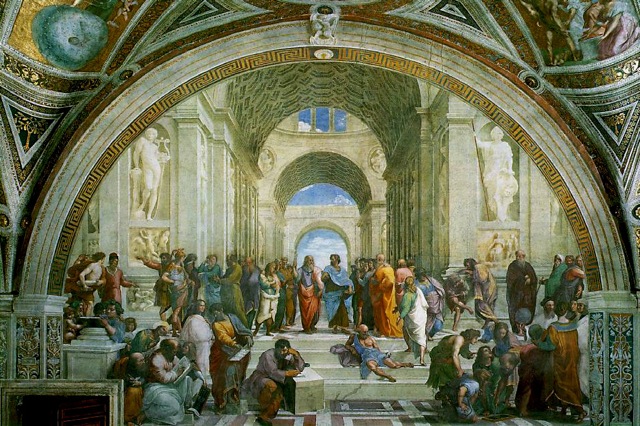
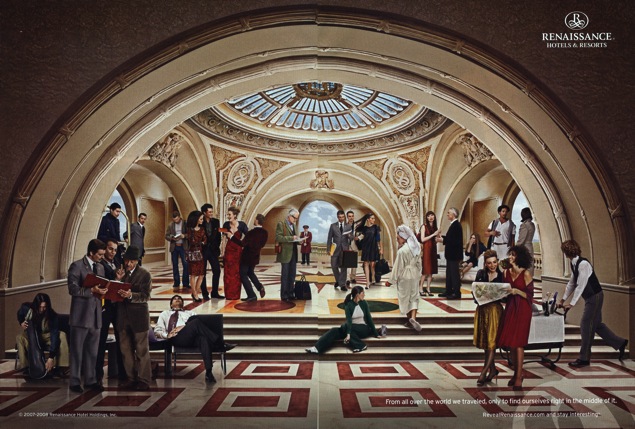
As I was shaving this morning, and idly flicking through the pages of one of these (my mailman probably hates me as I got a dozen subscriptions, all told!), I came across a real corker. A double-page ad In ‘Men’s Vogue’ for the aptly named Renaissance Hotels (Marriott) which is nothing more or less than a very amusing recreation of Raphael’s ‘School of Athens’.

Here’s the original:


Raphael. School of Athens. 1511. Papal Rooms, Vatican

And here’s the advertisement which I stitched together as best as I could in PS CS2:


Advertisement for Renaissance Hotels, 2008. Artist unknown.

The brooding figure slumped at the desk (Heraclitus acted by Michelangelo) has been replaced with the slumped businessman (another victim of frequent flying), Diogenes (to the right on the steps) has become a young woman clutching a cellphone. Plato (Leonardo) and Aristotle, entering through the portal, have morphed into pair of amoral (is there any other kind?) lawyers. The floor inlays in the foreground are identical. The boy on the far right is delivering tax deductible booze at the taxpayers’ expense.

And so on.

Great fun and thanks Renaissance Hotels. Maybe next time you would like to actually credit the team which made this fabulous recreation?

More information about who-is-who in the Raphael can be found here.

Paint Job

Always carry a camera….

I remember hearing that advice when I was still wearing short trousers.

“Always Carry a Camera”.

Often I have thought that it’s like the English invocation to always carry an umbrella. Whenever you do, nothing happens.

Then again, sometimes you come across a little bit of magic and it all seems worthwhile. Sometimes it actually rains.


Paint Job. Lumix LX1, 1/200, f/4, ISO 100. Processed in Lightroom in Widescreen format

Always carrying a camera became a lot easier with today’s pocketable digital marvels. No one could accuse my street shooter of days past, the Leica M, of being pocketable. And you certainly do not want to try this with a DSLR. As Mae West might have said: “Is that a Leica in your pocket or are you just happy to see me?”

The Leica lens (so some continuity there, I suppose) in the Lumix LX1 suffers from red chromatic aberration (visible in large prints), easily removed with Lightroom’s built-in controls. That and a tad of noise reduction to counter the small sensor’s interference, does the trick in seconds. Another three seconds and the picture is in JPG on the desktop, ready for uploading.

Winston and Vermeer

Our boy is six

For the annual portrait of our son Winston, I decided to try Vermeer lighting this year. There is little new under the sun when it comes to portraiture. Winston is six years old.

Vermeer used window light often in his portraits, with the darker side of the face rotated towards the viewer. As I prefer the control that comes with studio lighting, I used umbrella flash to emulate the effect. Here’s the result:


5D, 85mm, 1/180, f/5.6, ISO 50, two Novatron flash heads with silver and gold umbrella reflectors


Vermeer. The girl with the Pearl earring, 1665.

The black background Vermeer used would be too harsh for our young subject, but for contrast I opted for Winston’s karate outfit. The gold-coated umbrella was used on the shadow side, the silver, one stop brighter, on the bright side. I moved the dark side light far enough to Winston’s right side that only one flash reflects in his eyes – the main light on the left. It seems Vermeer was a Novatron fan too! Aperture 2 (Trial version) was used to process the RAW original.

Read more about my highly portable studio flash outfit here.

Obviously you know which subject I find to be the most beautiful.