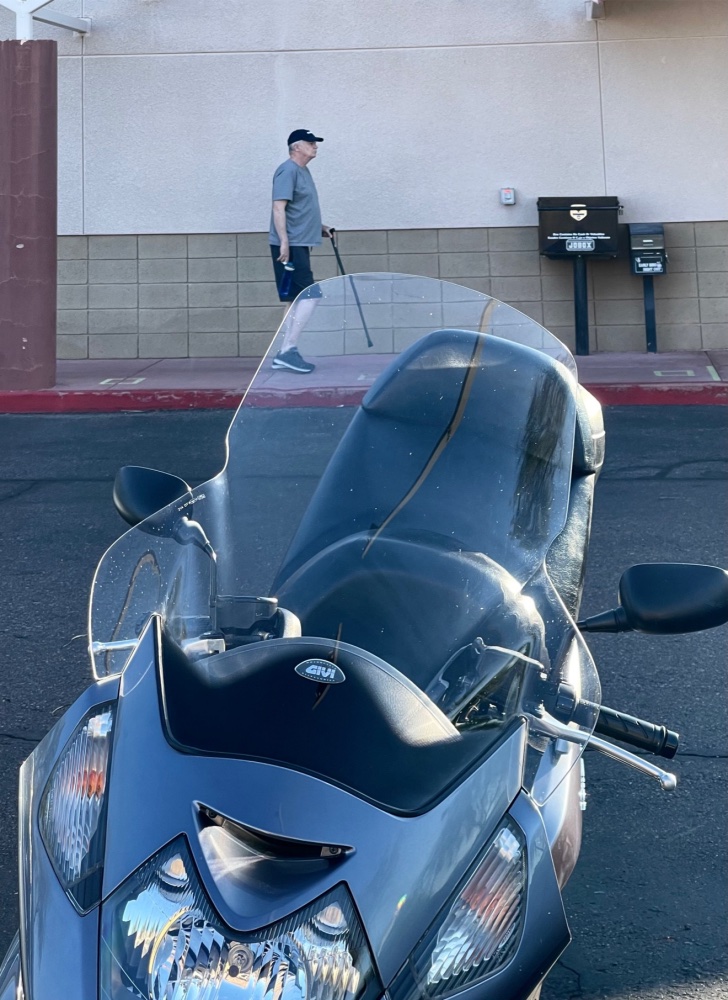
Maxi-scooter.
Americans do not ‘get’ scooters. Neither do Canadians, but that lot pretty much ‘gets’ nothing in any case. Still, we can excuse our northerly friends on grounds of climate, as theirs is awful.
After decades of motorcycling I bought my first scooter, a Honda PCX150, four years ago. It has proved to be the perfect urban errand machine, faster to 45mph than anything absent a Porsche Turbo or a Tesla and, with an added top box, it came with abundant storage for groceries and what have you. Averaging 95mpg on regular gas, and taking no space to park, what’s not to like?
Indeed, think about this. Were the 40% of the United Sates, bathed perpetually in sunshine, to adopt scooters as its primary transportation, rather than opting for the single driver in an eight seat SUV behemoth, Middle East and Russkie hegemony over global energy supplies would disappear immediately, and both evil empire petrostates would collapse overnight, Novochok or no. Putie, the world’s wealthiest person, would have to buy Switzerland and hide out there with his stolen billions. Simultaneously, America’s wasteful military spending would halve and we might even erase poverty in our homeland. Ah! well, one can but dream.
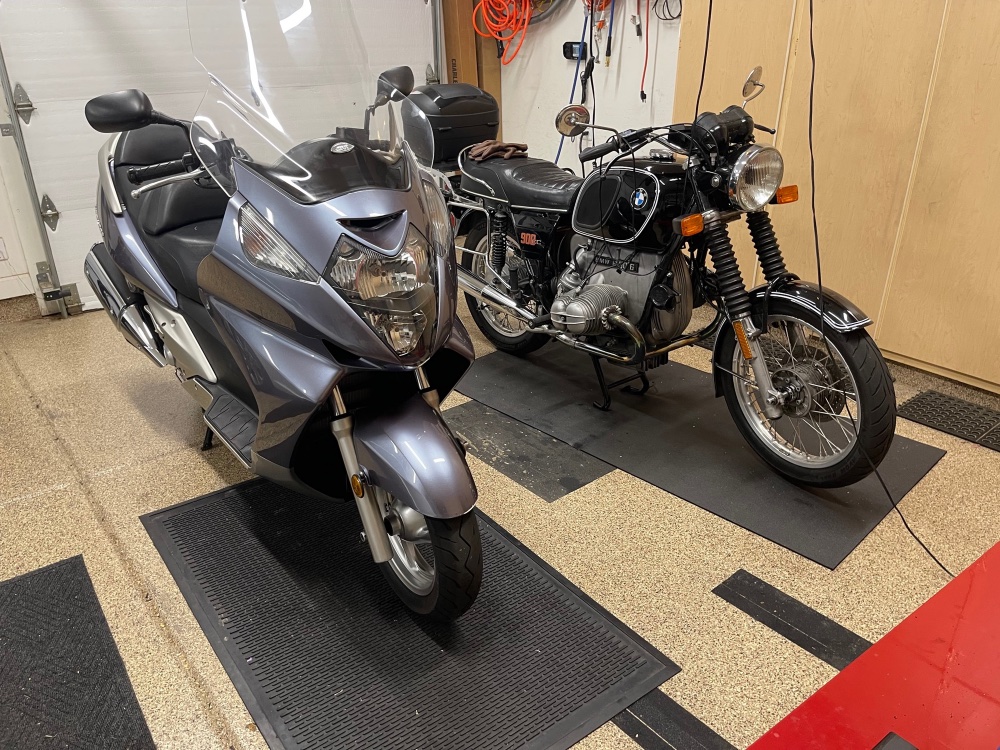
The Honda Silverwing, alongside an old friend, my 1975 BMW R90/6.
But Honda, maker of the world’s finest powered two wheel vehicles, is not a quitter. Back in the 1980s they tried to make motorcycling a more automotive experience, with the machine’s works shrouded in plastic to hide the nasty bits. They called it the Pacific Coast. It came with an excellent 800cc V twin with hydraulic valves (no adjustments needed!) and abundant power, great under seat storage and it was …. a complete flop. Honda imported it during 1989-98 until they finally gave up. Great machine, but spares are increasingly hard to get so not a viable modern ‘super scooter’.
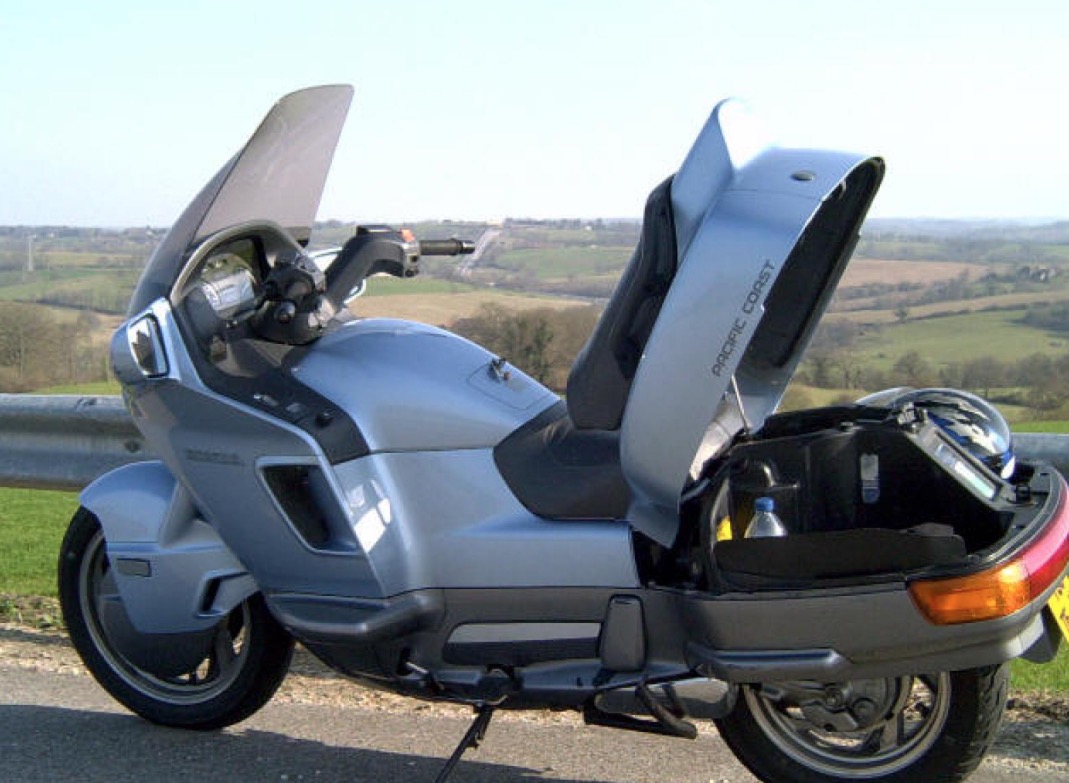
Honda’s magnificent Pacific Coast. Vast underseat storage.
But not being quitters, Honda had another go in 2002. For years the big touring motorcycle of choice has been the Honda Gold Wing, now morphed into a six cylinder 840 lb. behemoth with a reverse gear to convey Americans’ waistlines out of tricky parking spots and, for all I know, a refrigerator and four channel sound. All for the price of a nice new car. An obscenity among motorcycles, it continues to sell well for chunky riders giving up their 3 tons SUV for a spot of light weight, relatively speaking. Ah!, the open road. So, deciding on a sane alternative, Honda decided to make a lightweight Gold Wing and came up with the idea of the maxi-scooter. A traditional scooter but with a fuel injected 600cc twin for power and genuine 100mph capability. They imported the resulting Silverwing to the States from 2002 through 2013 and it was …. a complete flop. Americans not ‘getting’ small 150cc runabouts, which is what scooters were traditionally, what hope was there for a midweight genuine tourer with all the scooter’s cargo carrying verve and true motorcycle performance to boot?
Yet that is exactly what the Silverwing is, with high global sales (Asians and Europeans truly ‘get’ scoots, foul weather notwithstanding) so parts availability is not an issue. The US import’s design changed very little with optional ABS becoming standard in 2007, along with a 10% increase in fuel economy, meaning an average of some 55mpg on, you got it, regular unleaded. Mine, acquired after a long search, is a 2007 with ABS and came to me for pennies on the dollar with just 13,800 miles on the odometer. A couple of small boo-boos in the paintwork from a parking lot tipover by the seller are easily touched up and while new tires and a transmission drive belt are dictated largely owing to aged rubber, the machine is ready to ride as purchased. And that drive belt, which takes all of 30 minutes to change, is part of a Continually Variable Transmission whose provenance dates to Holland and DAF’s Variomatic of the 1950s, plonked into their Daffodil sedan. Yes, you guessed it. With a name like’Daffodil’ the DAF’s chances of success in a market dominated by Rams, Chargers and Mustangs were zero, so the DAF disappeared from these shores but left behind an innovative dual pulley transmission design. And Honda was paying attention. Honda perfected it, so much so that their CVT is to be found in a high proportion of the world’s scooters, none of which has so much as a clutch or gearshift lever in sight. The Silverwing’s CVT belt has a 16,000 mile service life and even your better half could change it with a minimum of tools. Thirty minutes for me using one of these, two hours and a bad back for those without.
After the usual check of vital signs – tires, oil, coolant (the engine is liquid cooled), indicators, brakes, etc. – I removed the ‘duck tail’, drilled it in the spots indicated by the factory, and fitted my small Givi top box.
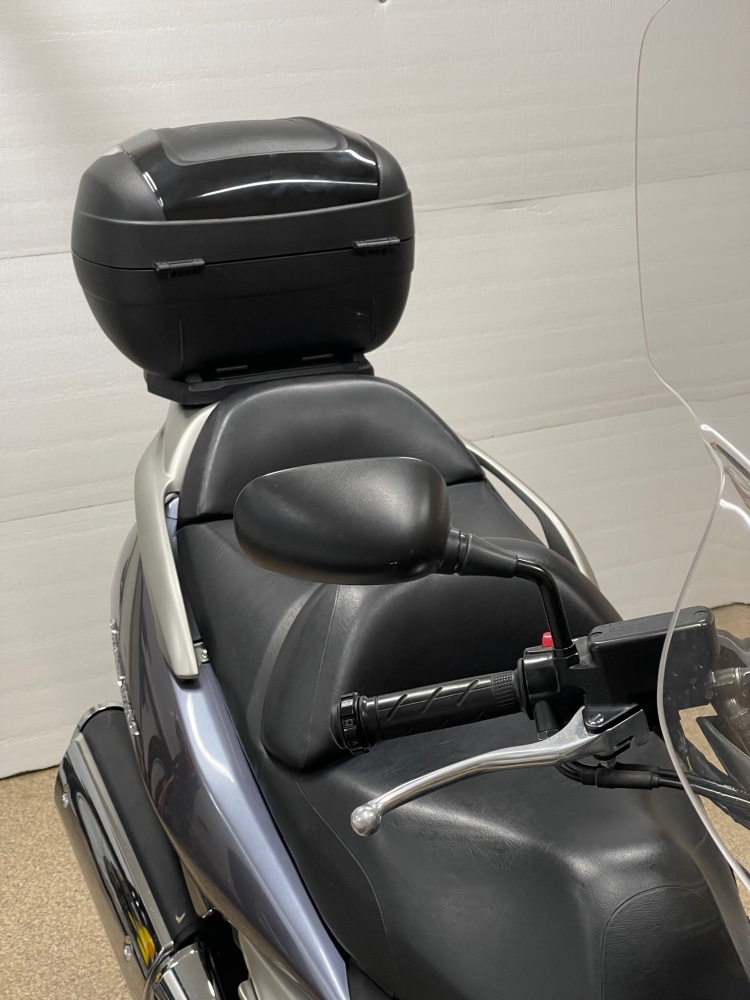
With the QD top box in place, you have all the storage needed.
A quick 50 mile shakedown run disclosed an engine which is most refined, along with disc brakes at both ends which stop the powerful machine fast. At 541 lbs fuelled, the Silverwing is some 50 lbs heavier than my old BMW airhead, but that weight penalty brings with it fuel injection (no choke needed), ABS, a powerful parallel DOHC twin and abundant protection from the elements. The ride is the quietest I have experienced on two wheels and Honda has paid careful attention to eliminating the irritating vibration which bedevils parallel twins. Have you ridden a British bike recently? They have added vibration counterbalancers to the motor and the absence of handlebar buzz is similar to that in my 1975 BMW boxer twin. Ah!, progress.
What’s left to do before some serious long distance touring? Well, the aforementioned new rubber – tires and transmission belt – but, most importantly, I have ordered a headlight modulator, as used for decades on my BMW, to grab the attention of soccer mommies rushing junior to his fifth sports activity of the day in their behemoth SUVs, the while drifting into the opposite traffic lane while texting on their cell. Once fitted, I will feel much safer. There is no better attention grabber for a two wheeled vehicle.
The maxi-scooter is recommended to anyone who ‘gets’ it. Just be sure to practice on something less powerful first, if you are new to motorcycling. So is the old airhead for sale? Heck, no. I need something to work on during the summer months in the furnace that is Scottsdale.