Scottsdale, Arizona.

One of many at this time of the year.
iPhone 12 Pro Max, long lens.
Scottsdale, Arizona.
iPhone 12 Pro Max, long lens.
Japan rules.
BMW airheads first saw the addition of electric starters in 1970, and still came fitted with kick starters as a back-up. These were deleted for the 1975 year but the original owner of my 1975 BMW R90/6 had one fitted at the factory before importing the machine. It’s pretty useless on a cold motor, but works OK with a warm one if the whole macho scene is your thing.
To say that the massive Bosch starter in my bike is an enthusiastic participant when it comes to getting sparks and explosions going would be an overstatement. It always struggled a bit getting over the compression hump with a cold engine and things deteriorated further in recent months, so much so that I would use the kicker to position the motor just past compression to give the ailing German starter a running start at things, so to speak. But clearly, a rebuild was indicated, reverting to a properly tuned but still weak willed Bosch original, for some $250.
Now engineers are always looking for something better though I do rather struggle with the idea of installing non-OEM parts in my classic machine. I corresponded with a riding friend explaining that there is a Japanese alternative but I felt rather uncomfortable mixing races, if you know what I mean. No problem with Japanese bikes; in fact they are the most reliable and well made machines out there. “Well”, he replied somewhat caustically, “they seem to have got on just fine in the last World War, so I wouldn’t worry about it”. OK!
Why Japanese? Well the Bosch starter in my bike is 1970’s technology – probably more like 1950’s, truth be told. And aftermarket places have been modifying a Nippondenso/Toyota starter with the right Bendix (the geared teeth which the solenoid advances into the flywheel when the starter button is depressed) along with the correct nose cone for aforesaid Bendix, which allow the whole thing to fit just so in the innards of the bike.
The Bosch unit was discontinued many years ago, replaced with a French Valeo which used to shed its magnets destroying the starter. That problem was fixed and manufacture moved to Poland, a nation not renowned for its engineering prowess, and a new one can be had for $300 with the correct 8-tooth Bendix. BMW later reduced gearing – acknowledgment of the marginal power of the Bosch – to 9 teeth but that would also dictate changing the flywheel, which is overkill for a little more turning force.
Over the years the Nippondenso variously used a Toyota truck starter, a forklift starter and a small car starter, and it’s the latter I decided to pony up $350 for after reading of some 20 years’ good experience with the Japanese part from any number of Airhead riders. Toyota trucks and cars routinely run the distance to the moon and back several times, so there’s reason to be confident here. I estimate that the Bosch starter had some 2,500 starts under its belt.
The Nippondenso is 1995 technology, this model being from a 1995-97 Toyota Corolla 1.6 liter four banger. If it can spin a four cylinder engine, I reckoned it should make mincemeat of the twin in my bike. Weight dropped significantly:
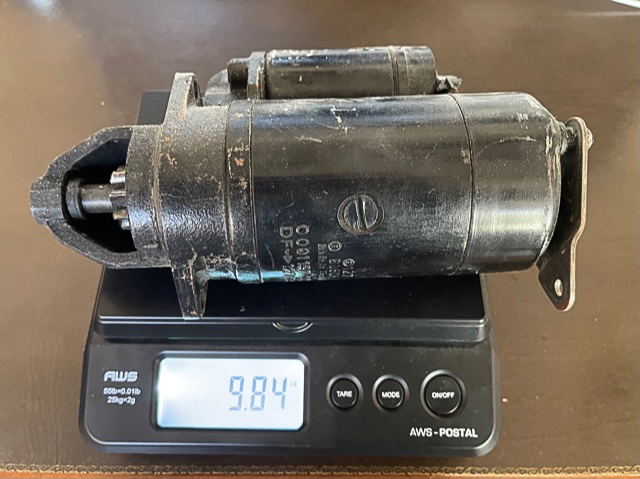
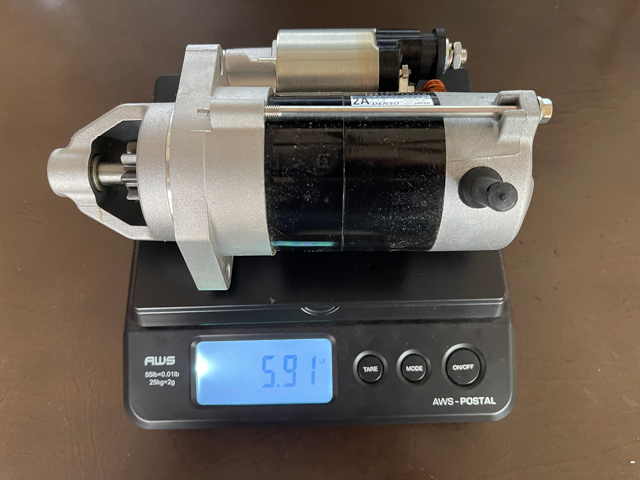
The lighter weight means that the alignment bracket on the Bosch starter can be dispensed with.

Installation is a breeze. After disconnecting both battery terminals the starter cover comes off in two minutes – two Allen bolts – the two starter retaining bolts are removed (wobbly extensions come in useful in the tight confines here), three electrical connections are disconnected and the new starter is installed. The Nippondenso used threaded eyelets and uses the stock 13mm metric bolts to hold it in place. Being a belt and suspenders type I also installed the washers and nuts which are used with the original.
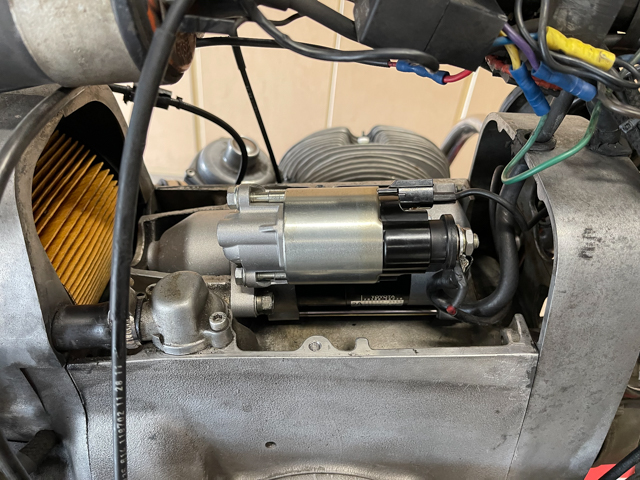
All sorts of claims are made for the lower power draw and the superior cranking power of the Nippondenso. The only data I can find suggest that the 120 amp draw of the Bosch falls to 80 amps with the Nippondenso. In the absence of further data I can only report empirical findings. Simply stated, the compression hump hesitation is notable for its absence, and the new starter spins a cold motor faster than the former Third Lady can say “Leave the Money on the Dresser”.
Recommended.
The greatest sport.
If no motors are allowed there is no question that test (international) cricket is the only game. The game requires physical skills of a high order, immense courage, guile, strategy, tactics …. and on occasion political malpractice. And the last intruded in the 1932-33 England tour of Australia which saw five test matches played by the two nations and was, with the possible exception of the 1936 Berlin summer Olympics, the most controversial encounter in modern sports memory. These were ‘timeless’ tests, meaning you played until there was a result or a draw. Typically that meant 5 days for each test, which is what current rules mandate. Modern rushed lives preclude the timeless test variant.
Jesse Owens, with his four Olympic golds in 1936, saw to it that Hitler’s white supremacy was dealt a body blow, even if the fight continues to the present day. But Test cricket between the two leading exponents of the game, England and Australia, was exclusively a white man’s sport, and it would be many years before the magnificent teams from the West Indies showed the white man who is who and what is what. In 1933 English teams were captained by prep school aristocrats with the occasional coal miner thrown in for luck. And it was one of each genre – the aristocratic Douglas Jardine, England’s captain, and a former Lancashire coal miner, Harold Larwood – who were the core of the drama. Jardine was the devil to Larwood’s hero.
Jardine brought to the game an intense dislike of Australians – likely driven by England’s many recent losses to the colonials – and an all out determination to do anything it took to win the series. And his secret weapon was the world’s most feared fast bowler, Harold Larwood. As a child Larwood had worked in the Nottinghamshire coal mines where he was a ‘pit pony’. Pit ponies were young children assigned the task of pushing coal laden railcars out of the mine and whatever you think of the related child labor laws of the time this hard graft gave Larwood one outstanding attribute. Massive upper body strength. Not tall for a fast bowler at 5′ 8″, Larwood perfected his skills playing for the county side and was chosen as one of the fast bowlers for the 1932-33 test series. His musculature saw to it that he was very fast indeed. And this is where the plot thickens.
There have been any number of statistical analyses which attempt to use mathematics to compare performances of the best players from disparate sports. No matter how it’s done the winner is always the same and he is Don Bradman, Australia’s ace batsman, who was pretty much guaranteed a score of 100 or more in any innings, regardless of the opposition. And while the equipment has not changed since then, cricket pitches have changed greatly, the modern glass smooth and level version putting the lumpy, uneven surface of the 1930s to shame. This made batting much harder back then yet, despite these challenges, Bradman’s star shone brightly. Jardine was only too aware that a winning strategy required something different or Bradman would simply dominate the game and Australia would win the series handily. So he came up with Bodyline, which required his fast bowlers to bowl fast and short aiming for the batsman’s head as often as not. The short deliveries – in cricket the ball almost always bounces before reaching the batsman – would rise fiercely off the sun baked surface of Australian pitches and, well, injuries resulted. Jardine had concocted this idea when Bradman had last played in England, astutely noticing that if the great man had a weakness then it was to short pitched deliveries aimed at his left (leg) side. So he conscripted Larwood in his plot and told him to bowl at the man. Larwood touched his cap in the approved manner, obeyed his captain’s orders and went at it. He was, after all, a team player, and it was simply not done to question the captain’s orders.
And Jardine’s strategy worked in spades. Of the five encounters, England won all but the second test by mostly huge margins. Australia’s sole win came in that test and it was the only one in which Bradman scored his usually expected century, scoring 103. And that was in his second innings, having been dismissed with the first ball he received in his first innings. Bradman was beaten and England came home victorious, but not before leaving carnage on the pitch and a major diplomatic incident between the two nations. By virtue of Larwood’s hostile deliveries, Australia’s captain Bill Woodfull, was felled by a blow to the heart. A man of great moral character, he refused to object, with the crowd in Adelaide on the verge of rioting. Woodfull was dismissed shortly after recovering from his injury. Most famously, when the England manager went to see him in the dressing room to offer his condolences, Woofdull replied “I do not want to see you, Mr. Warner. There are two teams out there. Only one is playing cricket and the other is not”. But Larwood was far from done, fracturing Bert Oldfield’s skull with a fast delivery putting him out of the game. Ironically, this was a regular delivery, not a Bodyline special. The crowd was now at fever pitch, not helped by repeated blows to the body of Australian batsman Bill Ponsford who had wisely been kitted out with (somewhat) protective layers of rubber and foam. The crowd was now screaming obscenities at the English team and the Australian authorities filed a formal protest on Sunday, the rest day in the middle of the test. This most certainly was not cricket. A 5.5 ounce leather covered cork and hard rubber projectile shot at the batsman with lethal intent would have required full body armor to withstand injury.
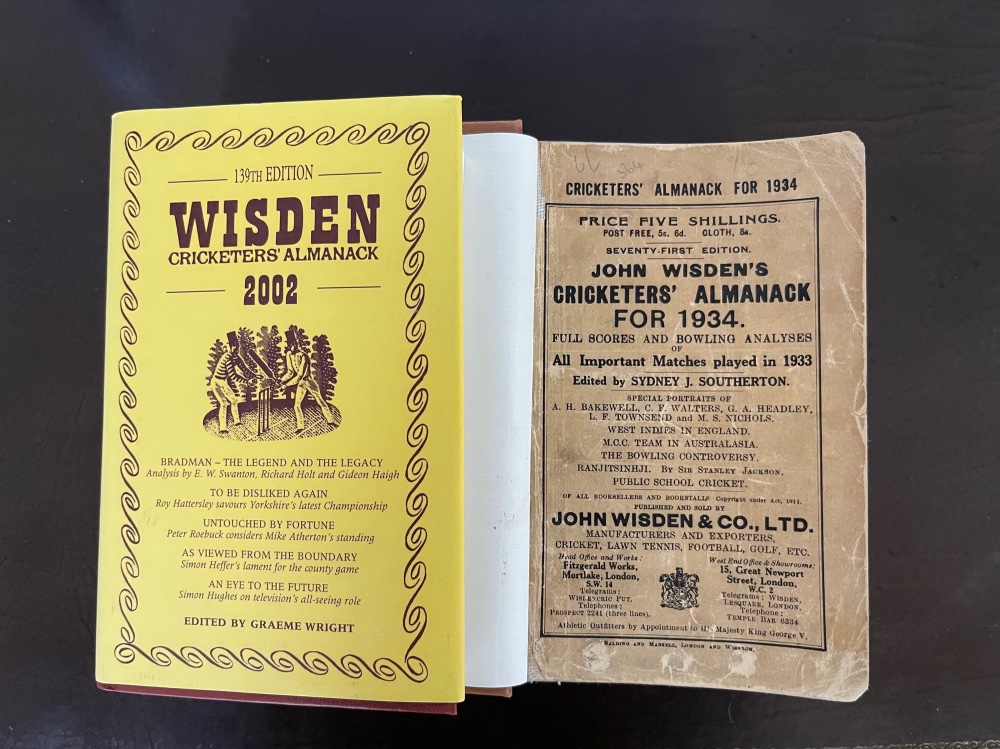
This is all documented in the 1934 Wisden, the annual almanac published since 1864. I have long owned the 2002 edition for it includes a moving set of obituaries for Donald Bradman. Now I own the 1934, a Christmas gift from my sister in West Sussex. The full text of the diplomatic cables is reprinted and it makes for fascinating reading.
I wrote that Larwood was a hero. He was. He obeyed his captain’s orders and was then forced to apologize by Jardine in a thoroughgoing act of treachery and cowardice by his captain. He never played for England again and after many more successful years in county cricket retired to Australia at the invitation of Jack Fingleton, one of the Australian batsmen in the 1932-33 side. The Australian people knew what had transpired between Larwood and Jardine and Larwood was met with a hero’s welcome on disembarking in the land which would become his home.
I shall be poring over the contents of the 1934 Wisden this Christmas Day. If there is a finer way to pass time I do not know of it. And it bears adding that to this day Australians style unsportsmanlike behavior as ‘Bodyline’.
Joy of the season.
All told there are some 134 homes in my Scottsdale community, and while the Stepford aspects sometimes irritate (limited color palette permitted, lots of rules, all the wives with perfect teeth and plastic chests, driving BMWs) there’s no denying the pride of place exhibited by homeowners.
Last night, with my son driving, we toured the community at night and counted no fewer than 30 homes decorated with Christmas lights, and very professionally at that. Here are seven of the best:
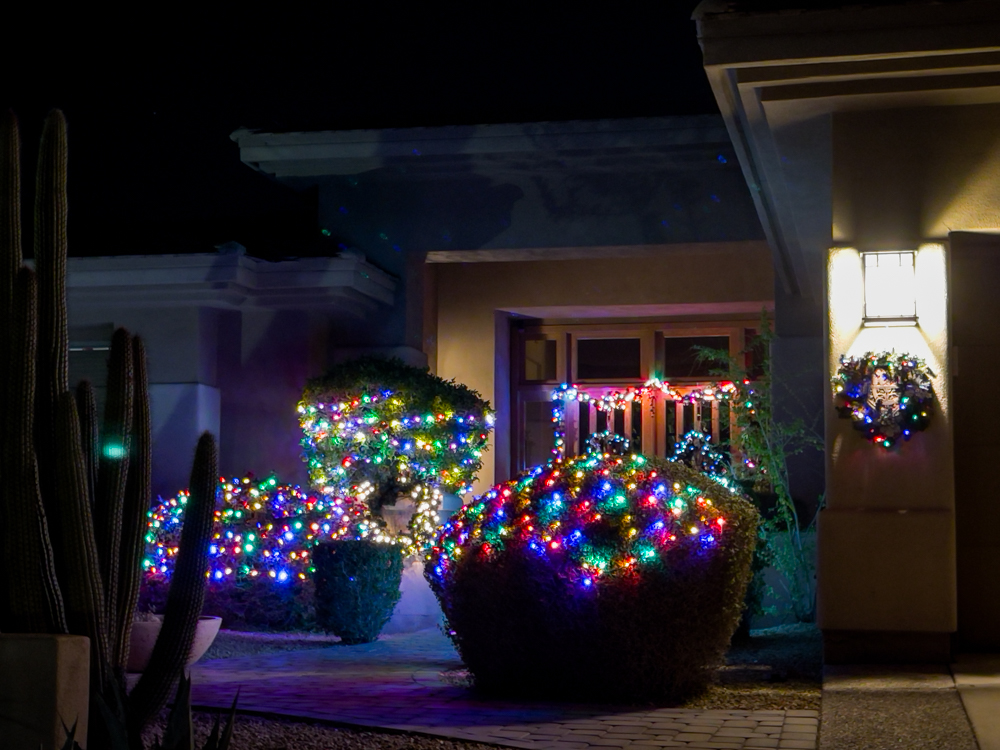
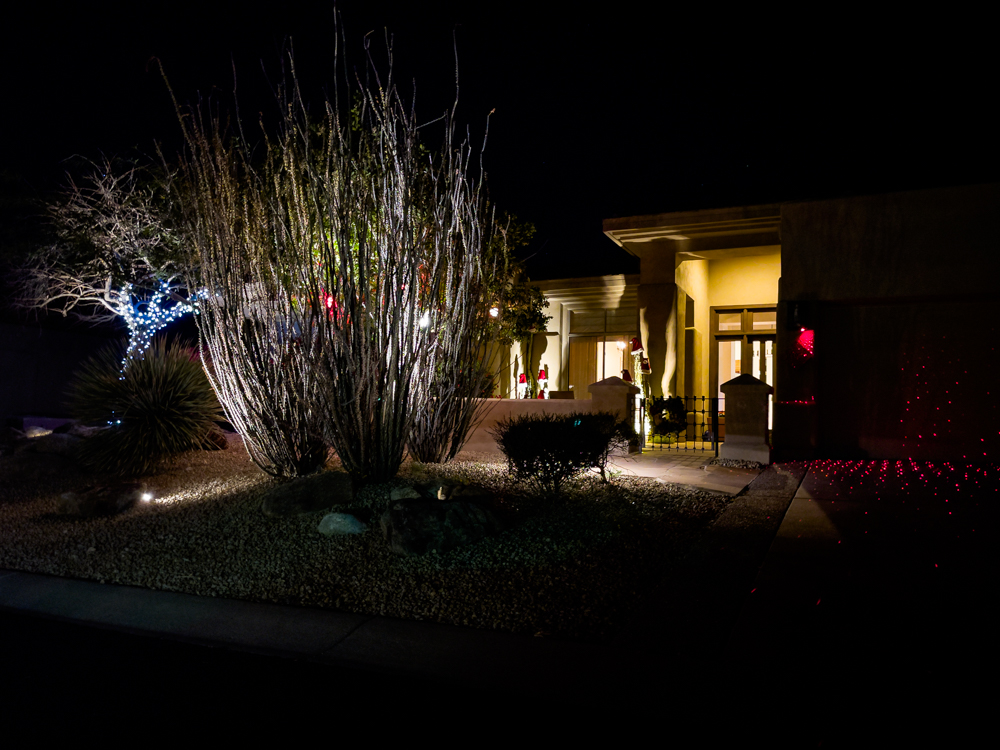
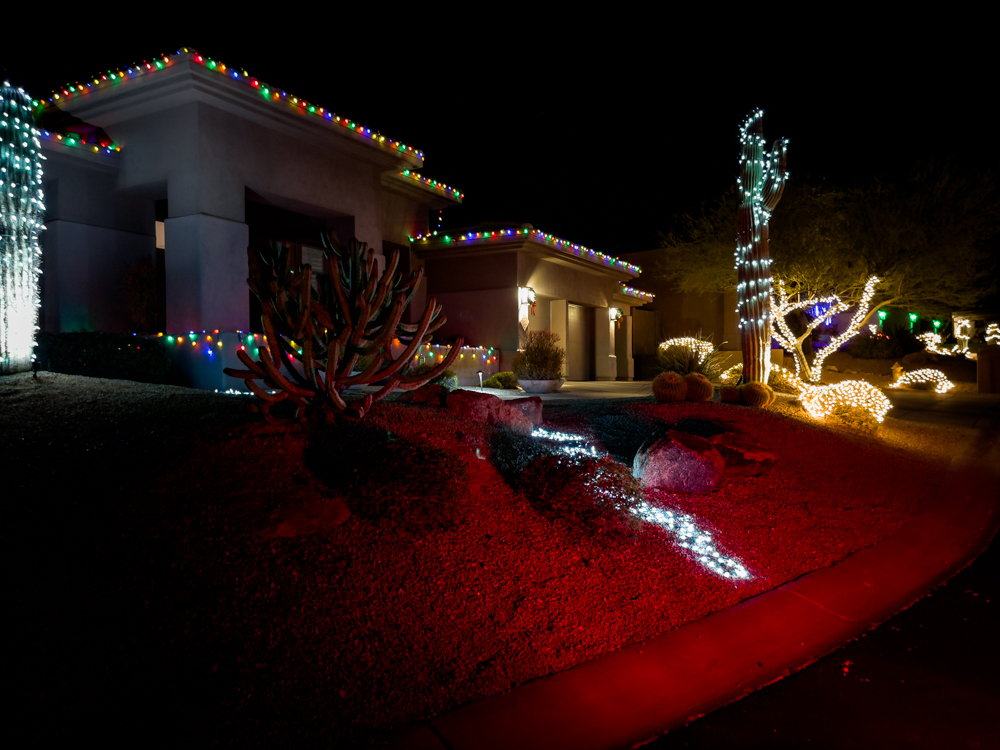
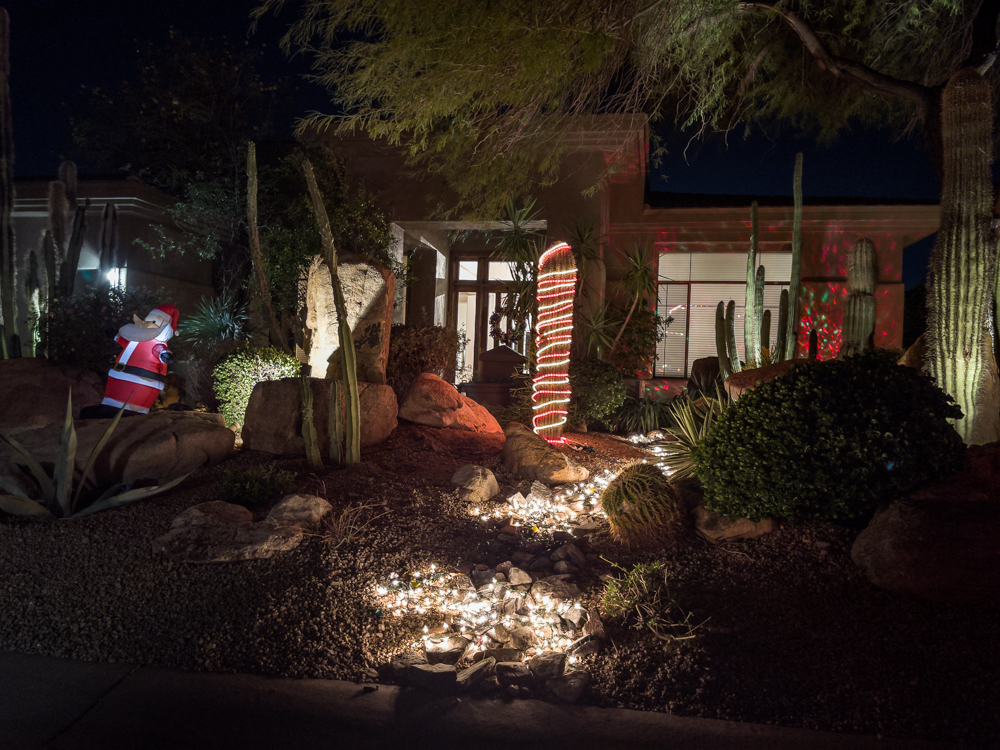
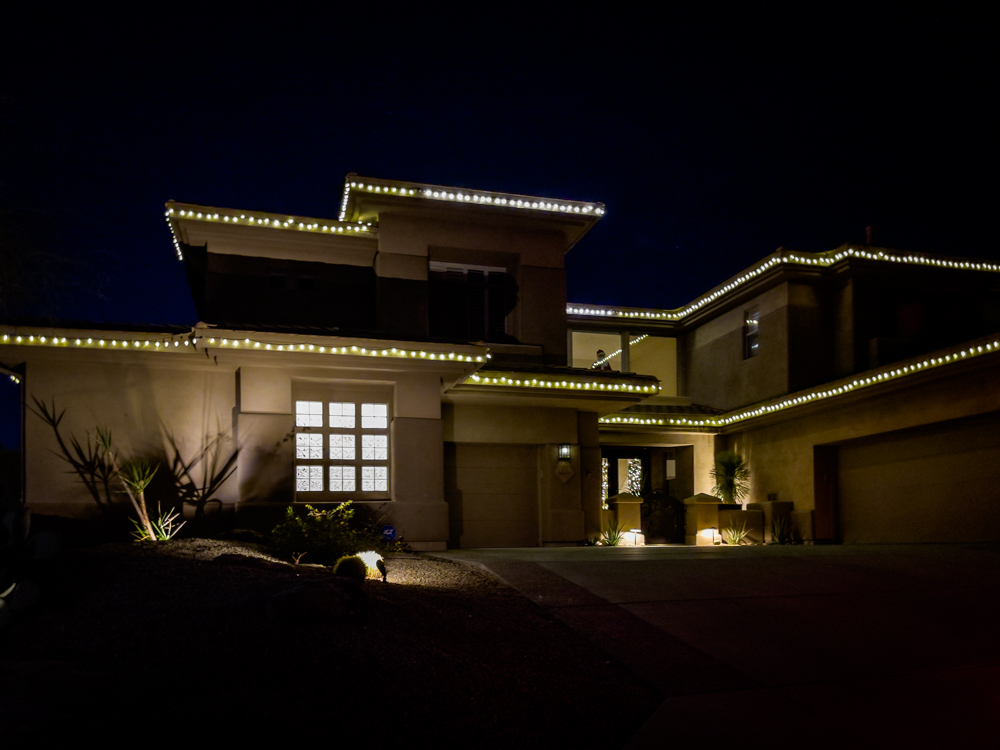
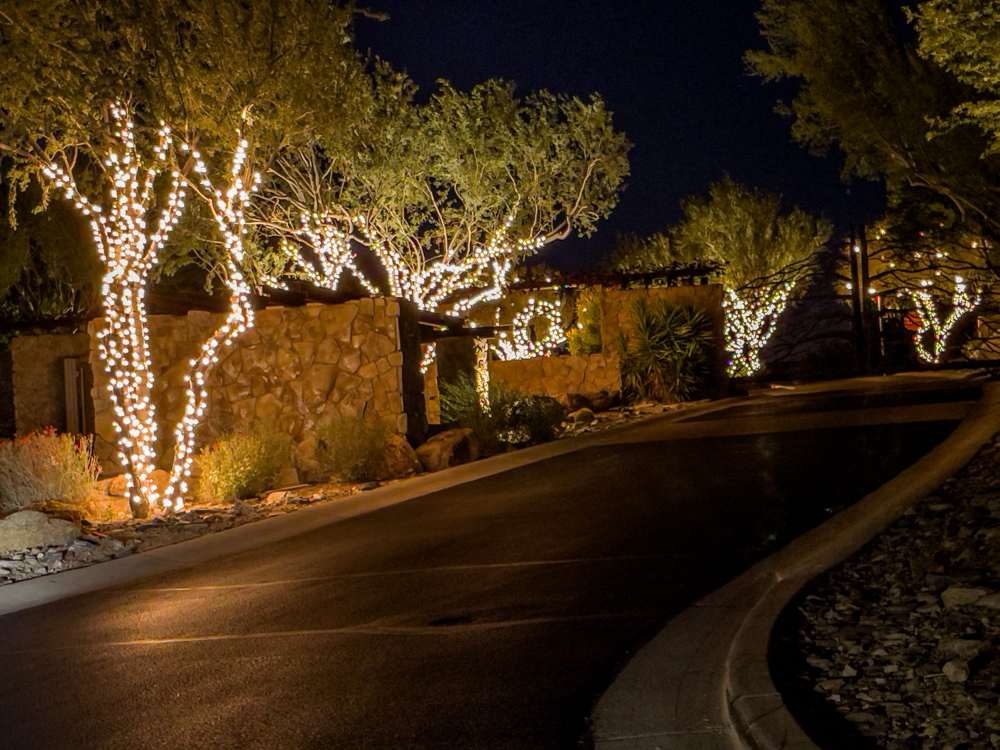
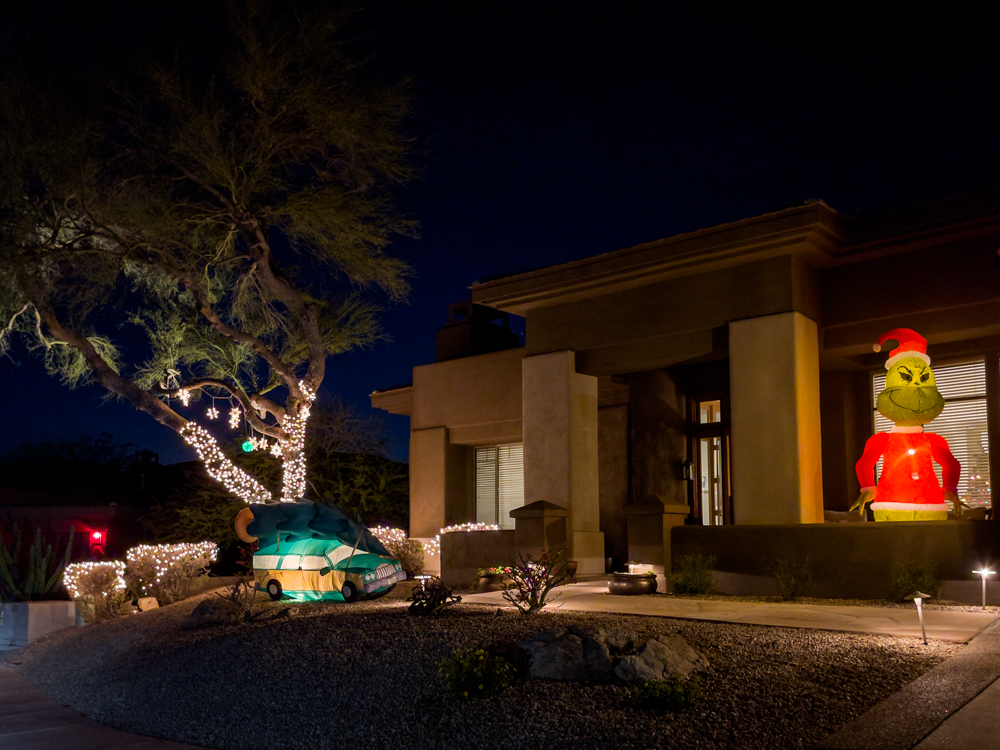
iPhone 12 Pro Max, handheld, Apple ProRAW, processed in LR.
Another nail in the DSLR’s coffin.

Your intrepid writer was to be seen at 2AM of a beautiful Scottsdale night (Jammies? Scotch tartan, green. Slippers from LL Bean) banging away in both JPG and ProRAW on the iPhone 12 Pro Max after installing iOS 14.3, the operating system which added ProRAW support.
Great news? My ancient Lightoom 6.4 imports the files faster than a Wall Street shyster can take your money, no questions asked. Apple uses the universal DNG file format, saving us yet another upgrade from the nasty people at Adobe and allowing what is now ‘legacy’ software to continue working fine. No monthly shakedown payment required.
Here’s the import dialog in LR for both the JPG and ProRAW files:
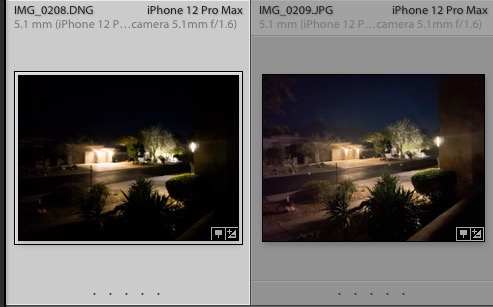
The files after import:
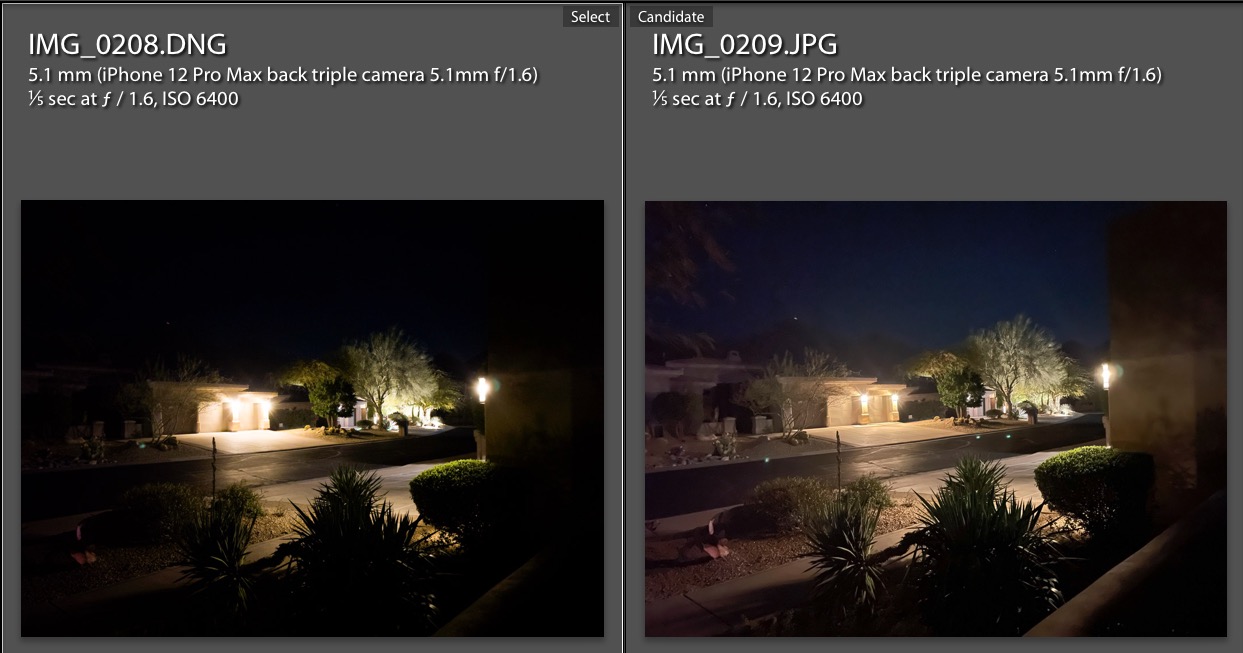
As Apple advises, file sizes for the RAW images are much larger, suggesting you want to selectively use the technology to conserve storage space – there’s a toggle in the photo taking screen:
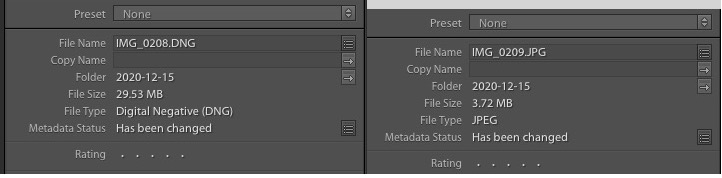
The ProRAW highlights in this extreme dynamic range image seem beyond redemption:
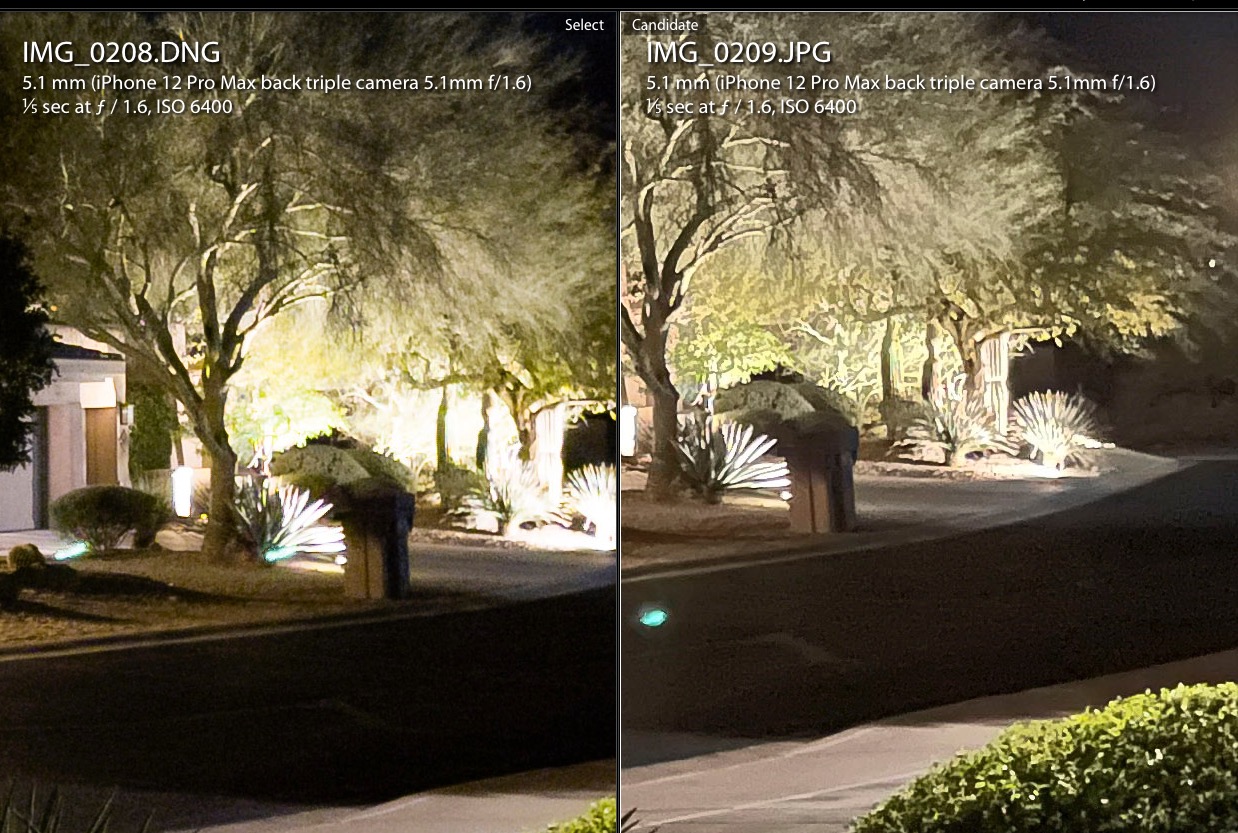
But after working the sliders vigorously ….
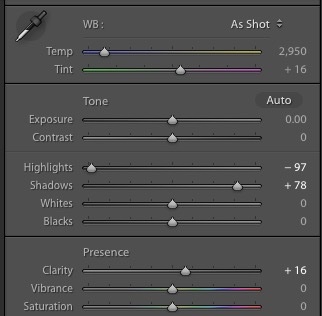
….a crackerjack image emerges:
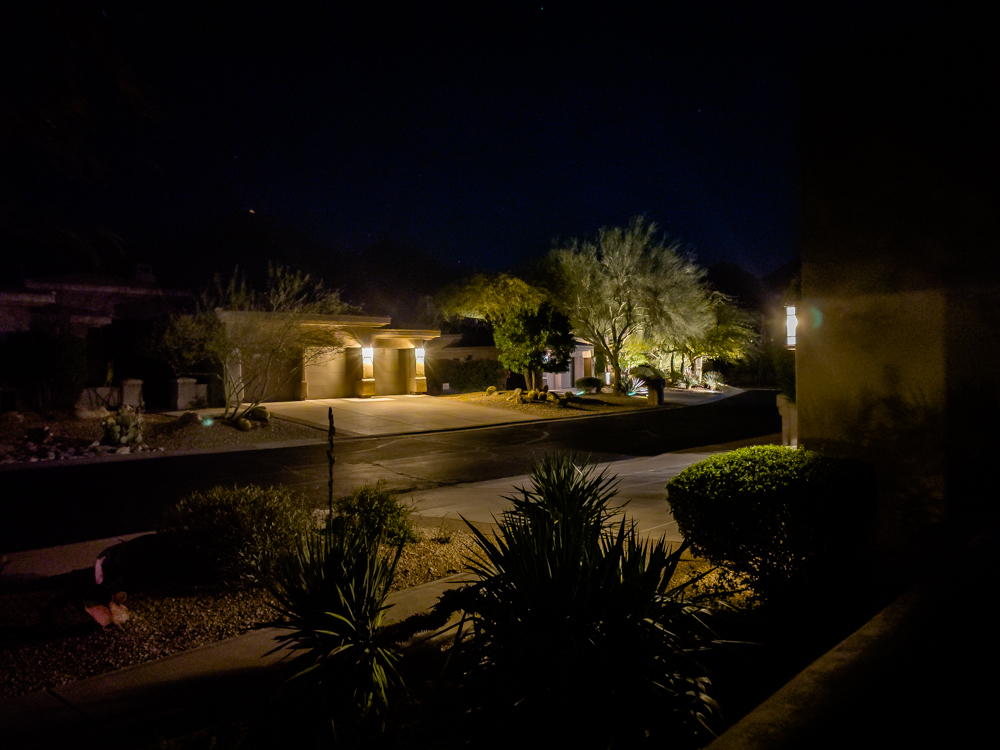
ProRAW is not true RAW, in the sense that Apple (wisely) retains its image manipulation to provide the sharpest images by melding the best, and adding Deep Fusion where appropriate. But the results meaningfully improve on SOOC JPGs, just be prepared to work the post-processing software quite a bit. Nothing a Preset or two in LR couldn’t largely automate.