Category Archives: Photographs

First film results

A mixed bag.

For an index of all my Film related articles, click here.

I sold my first – and last – Leica 35mm film camera 12 years ago after 35 years of use, and that tragic tale is related here. Maybe the lesson from that experience is that no modern camera is going to last 35 years as technology marches on, for in all key regards film camera technology did not improve after the first Leica M3 was introduced in 1954. Heck, you might argue that the outstanding Zeiss Contax II really defined the genre, and that was in 1936! The only material improvement added in the M3 was the suspended, illuminated frame lines, admittedly a stroke of design genius.

When my first serious digital camera came along, the magnificent full frame Canon 5D it was clear that film was toast. The flexibility and resolution of that 12mp Canon sensor was an order of magnitude above anything film could do, even if it was Kodachrome in a Leica with a Summicron lens fitted. And the sensor in that 5D delivered excellent colors, to boot. And booting was never necessary as this complex machine was as reliable as a hammer.

So it was with some apprehension that I awaited the processing of my first two rolls of Kodak Gold 24 by TheDarkroom.com, exposed primarily to check for any malfunctions in my newly acquired $100 Nikon FE body. I say that but a related goal was to take good photographs and hope that nothing went wrong.

I opted for the highest resolution 6774 x 4492 byte scans, which figures to a 30.4mb file though Lightroom reports less, likely due to compression of continuous tone areas:


Theoretical and actual scan sizes.

Exposures seem to be bang on using the camera’s Auto function, and no light leaks were noted. Maybe 1/4-1/2 stop over-exposed, but nothing to worry about. The scans are clean, scratches notable for their absence.

Anomalies? One frustrating finding is that the perspective correction controls in LR (Lens Correction->Basic->Level/Vertical/etc. are useless. They simply do not work with the film scans making a hash of things, so you have to round trip the image to Photoshop which works fine. Mystifying. These LR controls work perfectly with original digital images from any number of cameras and I use them often in architectural images. Frustrating and mystifying.

How is the resolution? Meh. It compares to a decades old 5mp Olympus C5050 point-and-shoot digital with a stated stated 1920 x 2560 byte sized image coming out at just 2.3mb in the file below. In the images below I have selected enlarged sections which would, as a whole deliver prints sized 60″ x 40″. In other words, very large. There is more detail in the film image but also a lot more grain.


Olympus C5050 at 40x.


Kodak Gold 200 at 40x.

The digital image shows pixelation, the film one coarse grain.

The film image was from the Nikon FE using a superb 135mm f/3.5 Nikkor stopped down to f/8 and correctly exposed.

Practically speaking the film image would deliver a decent 16″ x 20″ print, but forget selective enlargement or pixel peeping.

Here are some images from that first outing, all snapped in downtown Phoenix:


Sheraton downtown. 135mm f/3.5 Nikkor Q.


Crooks’ HQ. Grain in the sky is visible
even at modest enlargement. 135mm Nikkor Q.


Hyatt with trumpeter. 135mm Nikkor Q.


ASU. 135mm Nikkor.


Ambulance chaser. 35-70mm f/2.8D Nikkor.


Vet. 35-70mm Nikkor.


Basketball. 20mm UD Nikkor.


Art Deco. 35-70mm Nikkor.


Red. 20mm UD Nikkor.


Central Avenue. 20mm UD Nikkor.


Signature cocktails. 135mm Nikkor Q.


Downtown Deli. 35-70mm Nikkor.


Adding EXIF data:

I like to have camera and lens data in the EXIF data for each image as that’s how I tend to remember images, rather than through clunky keywords.

As scanned the EXIF data shows the name and model of the Noritsu film scanner used by the lab.

To confer proper camera and lens data I purchased an app named ‘EXIF Editor’ from the OS X App Store. It’s a tad clunky but can be integrated into LR for the roundtrip in Lightroom->Preferences->External Editing:


EXIF Editor set as an external editing option.

Then, after restarting Lightroom, choose the photo or photos (this functionality permits batch processing in EXIF Editor) to be round tripped thus:


Here is an example of ‘before’ and ‘after’ EXIF data:

I generally find that you have to restart LR with each batch of images to be round tripped; while EXIF Editor is clunky, you can set up presets with favorite camera/lens combinations, electing the preset once the image batch is in EXIF Editor. Hit ‘Process’ and the images will be saved as additional photos in a stack for each image in LR. The originals in LR can then be deleted as they add no value.

Here is the LR metadata display after adding correct camera/lens data for the folder:

Once you establish a workflow it’s less effort than it seems and, after all, there are one 36 images on a roll!

TheDarkroom.com:

This film processing and scanning service is in Los Angeles and came recommended. Their 6774×4492 scans are the largest HQ ones I could find and unlike other services I looked at, TheDarkroom.com offers online image download from their servers which store your images for 60 days, unless you want to pay for extended storage. This is what you see once your scans are on their server:


Scanned images ready for download.

There were two snags. First this, which is simply inexcusable:

I selected just two images and got this idiotic message:

That means you have to download one image at a time.

Second, the selection box for checking images to download returns a green check mark when clicked but then clicking ‘Download’ does nothing. I managed to beat direct download links out of them – after two tries for they sent me the wrong ones. Next time I’ll take my business elsewhere. Meanwhile, they got what they deserved in my Yelp review:

Memorial Day 2018

In the high desert.

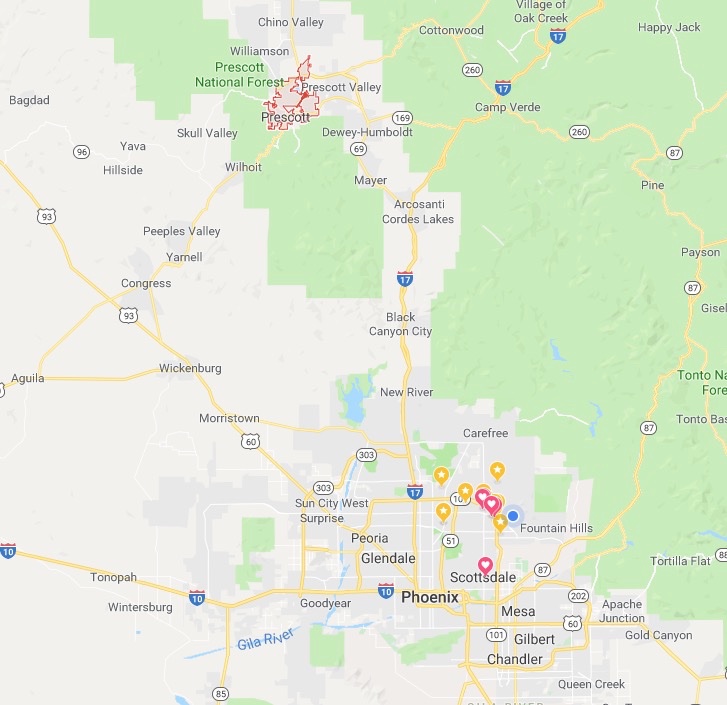
The National Memorial Cemetery of Arizona is located on a vast piece of desert land in Cave Creek, northeast of Scottsdale where I live. The fallow space leaves lots of room for future generations of murderous politicians to send innocent men and women to an early grave. As usual, I try to visit a National Cemetery on Memorial Day and as this one is near my home, convenience was an added plus.


Click the image for the map.


Dedication.


Austere memorial.


Grave Locator.


True colors.


In the Columbarium – where ashes are stored.


The Columbarium.


Saguaro cemetery.


Lone flag.


Moving display.


Ocotillo.


Memorial Day.


Mourning.


Never forget.


USAF.


Under the hot Arizona sun.


On this occasion the hardware consisted of the Nikon D3x along with the ancient but superb 20mm UD Nikkor, the 35-70mm AFD Nikkor and the 200mm Nikkor-Q which, I swear, will not allow you to make a bad picture. The 20mm and 200mm were AI’d and chipped by me to allow recording of EXIF data, which I find key for image search and retrieval. The AFD is factory Ai’d and chipped. All pretty much straight out of camera with the exception of #10 (warmth added, cropped), #13 (monochrome conversion), #15 and #16 (LR cold tone preset plus highlight reduction). ISO200 throughout with #10 being the best of ten at 1/60th and f/32 for maximum DOF. I’m getting less steady with age!

Paris 1976

With the grain master.

This journal seems to have hit a bit of a film streak recently, so here’s more of the same.

In the 1970s, the height of the 35mm film era, Ansco made a film named GAF500 which was a color slide film rated at a nominal 500 ASA. Given that most slide snappers were using Kodachrome II (25 ASA) or Kodachrome X (64 ASA) at the time, this was quite a statement.

The film’s fame owes much to the work of French photographer Sarah Moon who jumped on its creative possibilities which perfectly matched her impressionist – nay, pointillist – photography style. Pointillisme was originated by that most special of French painters George Seurat in the 1880s. Dots of color replaced continuous tones and the results were electric. Maybe his finest work is ‘A Sunday Afternoon on the Island of La Grande Jatte’ from 1884 and you have zero excuses for not seeing it for it resides in all its magnificence in The Art Institute of Chicago.


La Grande Jatte in Chicago. The canvas is huge at 7′ x 10′.

At this time in my life I had already long decided to abandon dreary, failed England, where I had grown up and graduated in 1973 from University College, London, and had my eyes firmly set on the New World and America, a reality that came to closure in late 1977. But having been an ardent Francophile for the past 15 of my 26 years on earth, a visit to Paris was first called for. I had already devoured Proust’s magnum opus ‘Remembrance of Things Past’ not once but twice, had enjoyed a passionate affair with Impressionist painting, based on my readings of John Rewald’s magnificent books, and had maybe two hundred of Henri Cartier-Bresson’s images committed to memory.

What causes this flashback is not any great love of tea or madeleines (I dislike the first and rarely eat the second) but rather my son’s trip tomorrow to Paris with his school as part of his French studies. He will stay ’embedded’ with a French family – no English allowed! – for two weeks, half in Strasbourg, Alsace on the German border, the other half in Paris. Strasbourg with its overweening Germanic culture leaves me cold, but Paris ….

Returning to the Divine Sarah, I packed one roll of GAF500 on my trip in 1976, much inspired by her work. The rest was all TriX which is about all I used back then. Why mess with perfection? The greatest monochrome emulsion ever made. I doubt I had taken more than a handful of color snaps in my life a that point, but I did find GAF500 in my Leica on the obligatory trip up the Eiffel Tower and one of the snaps made there came out rather nicely, the essence of all that is French, looking into the fine restaurant atop the Tower.


Atop the Eiffel Tower. Leica M3, 35mm Summaron, GAF500.

So the next three weeks I will be living vicariously through my boy, Winston, whose namesake WSC was once asked how he managed to tolerate DeGaulle’s endless grandstanding in London during WW2. “He is my cross of Lorraine to bear”, WSC replied. Expounding on his theme, he added that a world without French culture, cuisine, couture and women would be a far worse place. Churchill wisely chose the south of France for his retirement, abandoning drafty, cold, rainy Chartwell to the tourist hordes. Here’s more of the same:

That week I spent in Paris was magical and I do not recall taking one bad image. This trio from the Tuileries Gardens about sums it up:


Tuileries Triptych. Leica M3, 35mm Summaron, TriX.

May Winston have as good a time.

Vive La France!