Category Archives: Paintings

Without paintings we are nothing

Raphael and advertising

The Renaissance lives!

The Great American Corporation has many herd instincts, including mind-numbing group get-togethers and a love of flying that probably accounts for $100 per barrel of oil. Two of the many things I am delighted not to have to do, having left this kind of organization years ago.

However, I got a haunting reminder of those horrid days a couple of months ago when Delta Airlines’s computer mailed me a reminder that my remaining 12,000 miles of frequent flier time- and oil-wasting miles were about to expire. Well, 12k gets you nothing other than magazine subscriptions, so I signed up for a bunch. Who knows, the advertisements may provide fodder for photographic ideas.

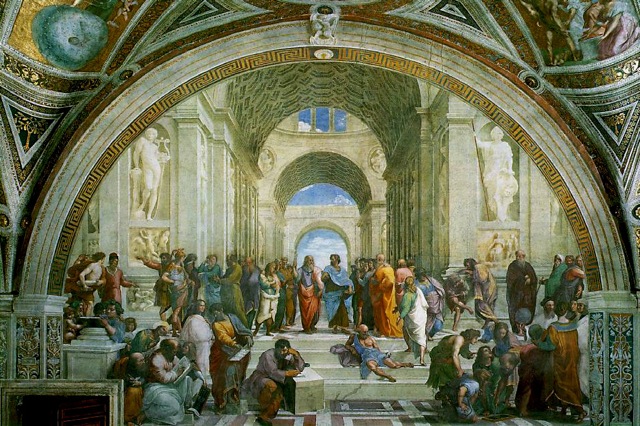
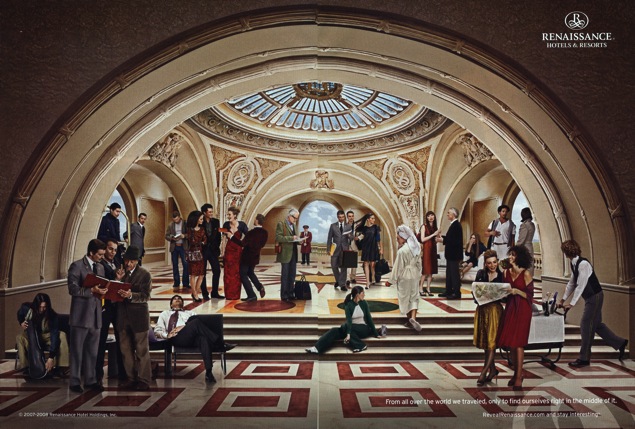
As I was shaving this morning, and idly flicking through the pages of one of these (my mailman probably hates me as I got a dozen subscriptions, all told!), I came across a real corker. A double-page ad In ‘Men’s Vogue’ for the aptly named Renaissance Hotels (Marriott) which is nothing more or less than a very amusing recreation of Raphael’s ‘School of Athens’.

Here’s the original:


Raphael. School of Athens. 1511. Papal Rooms, Vatican

And here’s the advertisement which I stitched together as best as I could in PS CS2:


Advertisement for Renaissance Hotels, 2008. Artist unknown.

The brooding figure slumped at the desk (Heraclitus acted by Michelangelo) has been replaced with the slumped businessman (another victim of frequent flying), Diogenes (to the right on the steps) has become a young woman clutching a cellphone. Plato (Leonardo) and Aristotle, entering through the portal, have morphed into pair of amoral (is there any other kind?) lawyers. The floor inlays in the foreground are identical. The boy on the far right is delivering tax deductible booze at the taxpayers’ expense.

And so on.

Great fun and thanks Renaissance Hotels. Maybe next time you would like to actually credit the team which made this fabulous recreation?

More information about who-is-who in the Raphael can be found here.

Winston and Vermeer

Our boy is six

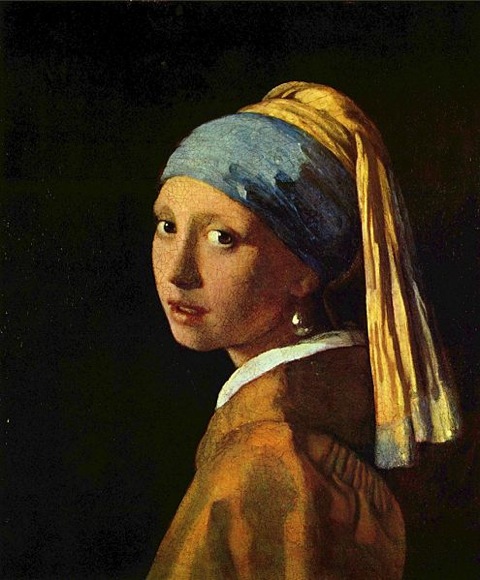
For the annual portrait of our son Winston, I decided to try Vermeer lighting this year. There is little new under the sun when it comes to portraiture. Winston is six years old.

Vermeer used window light often in his portraits, with the darker side of the face rotated towards the viewer. As I prefer the control that comes with studio lighting, I used umbrella flash to emulate the effect. Here’s the result:


5D, 85mm, 1/180, f/5.6, ISO 50, two Novatron flash heads with silver and gold umbrella reflectors


Vermeer. The girl with the Pearl earring, 1665.

The black background Vermeer used would be too harsh for our young subject, but for contrast I opted for Winston’s karate outfit. The gold-coated umbrella was used on the shadow side, the silver, one stop brighter, on the bright side. I moved the dark side light far enough to Winston’s right side that only one flash reflects in his eyes – the main light on the left. It seems Vermeer was a Novatron fan too! Aperture 2 (Trial version) was used to process the RAW original.

Read more about my highly portable studio flash outfit here.

Obviously you know which subject I find to be the most beautiful.

Frescos and photography

The modern professional photographer is at a huge disdvantage

A recent email from a reader, a professional photographer, bemoaned the growing difficulty of making money in the profession.

Now while the Renaisasance is a period of great interest to me and I have oft exhorted photographers to study the great works of that greatest period of western art, it doesn’t merit extensive mention here simply because the subject is too far removed from the world of photography.

But the book I am reading, Michelangelo and the Pope’s Ceiling, is not just compelling reading, maybe the finest art book I have yet read, but it also goes to the heart of the pro’s complaint.

Look at the skill set Michelangelo had to bring to the equation. When Pope Julius II retained him to paint the vault of the Sistine Chapel (Julius was busy tearing down old St. Peter’s at the time – we are talking c.1508 here) Michelangelo had several problems.

First was the small matter of several tons of Carrara marble he had procured to sculpt the Pope’s tomb. They were sitting in a square around the corner from St. Peter’s when Julius decided to pour capital into the new cathedral, and hang the tomb. And hang paying Michelangelo for the useless marble. So Michelangelo was broke.

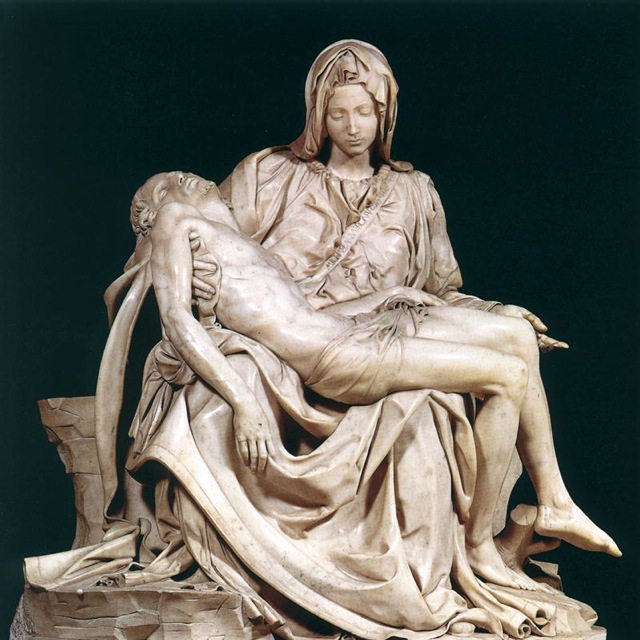
Second was the problem that Michelangelo was a sculptor, not a painter. He had created the two greatest sculptures ever, the Pietà, (though adherents of Donatello’s Mercury might differ) and followed up with the David, also not too shabby.


Michelangelo’s Pietà, St. Peter’s Basilica, Rome. 1499

Third, the Pope was a true believer in having only the best – Bramante was retained to design the cathedral, Raphael to do the walls in the papal apartments and when it came to the ceiling, it had to be on fresco, meaning a layer of wet cement that had to be painted within 12 hours if the pigments were to be absorbed by the cement. Michelangelo had never painted on fresco.

Now the painters and sculptors of the day, the same we now adulate, were regarded as little more than tradesmen at that time. Sure, highly paid tradesmen (just like the public school educated plumber today who, when he deigns to show up, does so in a brand new SUV), but they took their orders from their employers. If the Pope said I want the Virgin Mary right here, that’s what you did.

Unlike the more politically astute Raphael – I consider him the greatest painter of his age – Michelangelo cared not one whit for his employer’s preferences and proceeded to craft a large canvas sheet (the invoice still exists!) to screen his work from visitors to the chapel. My way or no way. Indeed, so confident was he of his skill that the book relates how he got in a physical fight with his patron who had tried to sneak in to look at the work. Luckily for posterity, Julius repented and the threatened death sentence for his painter was soon forgotten.

Michelangelo’s contract provided for a payment up front, one half way through, then a final payment on completion. ‘Half way through’ meant two years, after many false starts as the sculptor learned just how hard fresco painting was. In other words, he had serious technical problems with the composition of the concrete, its absorption rate, etc., etc. Like photo processing in the dark ages of the darkroom. But the artisan in him triumphed and two years later he and his team unveiled the first half of the ceiling, to universal approval. God alone knows what Julius would have done had it gone down poorly. Mercifully his syphilis was not playing up at the time.

So look at the skills Michelangelo had to bring to the equation. Negotiation, procurement, relearning how to paint, mastering a new medium, man management (it takes lots of people to build scaffolds and make concrete), a psychotic, driven employer, mastery of the latest in pigments and colors, composition, cartooning, transfer of the cartoons to the wet fresco. The list is endless. And the one essential skill, which cannot be learned, was the fact that he was a great artist.

Now think of the modern photographer. Let’s assume he knows how to take good pictures. Unlike Michelangelo and Rapahel and Bramante, he has enormous competition. After all, is it not true that anyone can take a photograph? The barriers to entry are non-existent. There is no trade school or years of apprenticeship to foster development of technical skills. Why bother when it’s largely done for you by the people at Nikon or Epson or whatever? Sure he has to have marketing skill to find a client but unfortunately for him his client can get most of what he wants at very low cost on the web. His art, in other words, has been commoditized. The premium for skill has been drastically discounted.

Step back and look what has happened to western hemisphere people. Maybe it’s best illustrated in the story of the two American tourists (one imagines they must have been Texans) who, presented with yet another priceless Renaissance church on their trip to Italy, yet keenly aware that their flight back home is but two hours away, are posed with a quandary. How to take it all in during the time available? “Simple”, says the hubby. “You take the outside honey, and I’ll do the inside”. Cameras clicking, videos whirring.

So in a world increasingly suffering from short attention spans who has the time, let alone the interest, to absorb a beautifully composed, perfectly lit, artistically printed photograph? Who cares when you can see something even better in video on the truly ghastly YouTube?

So the professional photographer’s lament of how it’s getting harder to make a living at his art is not hard to understand. Anyone can push a button. Few can paint a fresco ceiling.

Civilisation

A great and erudite teacher.

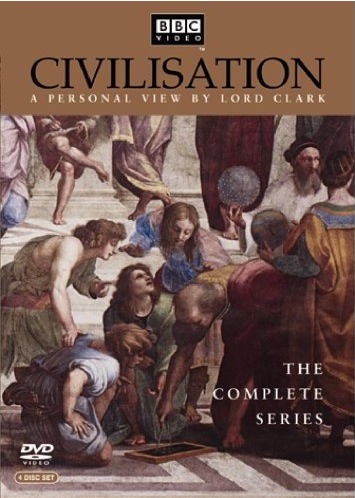
I had the most extraordinary case of deja vu the other day, having indulged in the DVD set of Kenneth Clark’s Civilisation. I mention this as I have frequently maintained that there is more for photographers to learn from the art of the Renaissance than in any other field of visual rendering. Click on Paintings for more.

The nature of this strange flashback was that, as Lord Clark was extolling the insane abstraction to be found in Giotto’s faces (Giotto died in 1337, so hardly a Johhny-come-lately) I found myself rooting for something on Giorgione and, suddenly, Clark is talking about him. Now I want some Caravaggio and sure enough, up it comes. Then Donatello, Veronese and Michelangelo. What was going on here? My every wish was Clark’s command!

Then it struck me. Civilisation was released by the BBC in 1969, when I was 18 and just getting serious about the Renaissance. Until then I had been fixated for years on the Impressionists, later Cezanne for his nascent cubism and Degas for his perfect sense of line (until Seurat chanced on the scene, that is). The Old was not for me. All those stuffy oils, over framed, in big galleries. Well, the reality is that, unknown to me these 40 years, Lord Clark had been my teacher. So perfect was Clark’s taste, so beautiful his mellifluous use of that most gorgeous of languages, English (it has fallen out of use since) that I sat entranced and overjoyed at this journey of artistic and spiritual discovery.

As a photographer you are interested in images. As a photographer, your education remains incomplete without an appreciation of the Renaissance and there is no better way to gain that than with this series. Sure, Clark doesn’t affect polyester clothing or make any effort to conceal his patrician leanings. On the other hand, he has no cynicism or snobbery in his make up and the whole is simply a delight. I guiltily admit to having put in the first DVD last night and found that I had sat through four episodes before it was time for bed.

I think you may have the same reaction.

Ways of Seeing

No, not the one by John Berger.

One of the books on art I enjoyed most was John Berger’s About Looking which went on to become ‘Ways of Seeing’ when the BBC filmed it. What was especially interesting about the piece is that it is cast in the author’s Marxist viewpoint of the world, where every object or possession is examined through the eyes of society rather than seen as the thing itself. That is no bad thing. After all, are we not told that small minds speak about people, middling minds talk about issues and great minds cast about for concepts? Berger is all about concepts.

The only snag with this thinking is that just because the author addresses concepts does not mean that his frame of reference is sane.

But, for much the same reason that I sometimes read the New York Times or watch Fox News – a recheck of reference points on the loonie left and the psychotic right – it is always an education to read the works of a Marxist as it serves to freshen one’s ideas about freedom, personal responsibility and the sanctity of the individual. So far, my belief in these attributes has only been strengthened by digesting the claptrap put out by these media.

Just think. In a perfect Marxist paradise there would be no music – you might, after all, enjoy it more than I, and we can’t have that. There would be no art – we all look alike and dress alike and live alike, do we not, comrade? And, worst of all, there would be no photography. That is the purest form of subversion. You want my likeness? The Ministry of Truth will not like this, you know.

Crazy? Ever seen any good snaps of Mao’s totalitarian China?

No. I didn’t think so.

No photography. Just think.

Horst and Hoyningen-Huene would never have made their homo erotic-tinged masterpieces. Mapplethorpe’s illustrated history of perversion would never have been seen. Newton’s jejeune dirty pictures would not have been published.

Hang on. Maybe Marxism would not be so bad for photography.

Just a minute, though.

That means we would have never been afforded the chance of seeing the guilty confections of Beaton. The just-so elegance of Cartier-Bresson. The soaring aristocracy of Blumenfeld. The gay abandon of Doisneau. The passion and sophistication of Parkinson. The guts of Bourke-White. The vision of Evans and Weston. The courage of Adams and McCullin and countless others. And, yes, even the second rate candy box tripe of Ansel Adams.

So maybe Marxism is not such a good thing.

I was reminded of all of this on reading in the Wall Street Journal (centrist mostly, loopy right on the OpEd pages) of the Met’s exhibition of no fewer than 228 pictures from its Dutch collection. Thank heavens for the robber barons. They provided labor for all and bequeathed great art collections to the Met. Works for me. And that got me thinking about the differences between religious art (meaning ‘Vatican-religious’) and secular art (being the Dutch and Belgian schools of the 17th century and their British and German forbears).

While painters of both schools were working on commission, the Vatican types enshrined their subjects, whether biblical or Papal, in halos and angels, the better to hide the foul stench underlying their accession to power. The Dutch chaps surrounded their clients with the attributes of wealth, perhaps never shown better than in Holbein’s ‘The Ambassadors’ (OK, so he was a German painting in England. The point is he adopted a secular rather than religious tone). And the stench? There is none. As my grandfather used to remind me, pecunia non olet. Money does not smell.
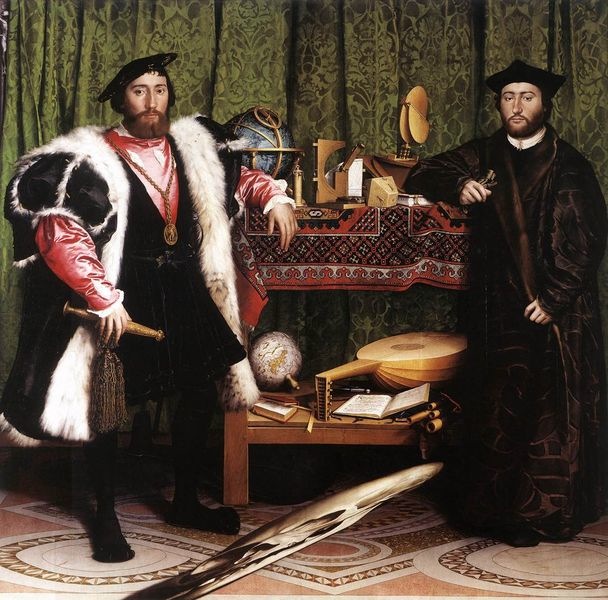

Holbein. The Ambassadors. 1533. The National Gallery.

The fine cloaks, the tools of navigation, attributes of wealth like the lute, are all seen large. These people are rich and successful. Of course, most photographers care not a whit for that. All they can fixate upon is the elongated skull in the foreground which, viewed obliquely from the lower left, shows itself in full splendor. You can interpret it as you like but I have long preferred to think of it as the ultimate statement in secular art. It is there because the clients wanted it there. It’s as spontaneous as, say, a White House speech or a politician at the site of an airplane disaster.

That’s not to say that the Vatican types didn’t try to subtly subvert the system. Take a look at Caravaggio’s ‘Supper at Emmaus’ – the one in the National Gallery is the corker, not the one in Milan.
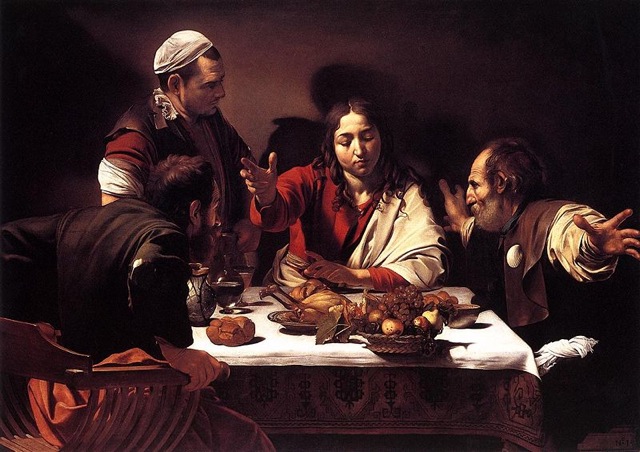

Caravaggio. The Supper at Emmaus. 1601. The National Gallery.

At first it is what you want to see. Christ surrounded by fawning apostles on his resurrection. I first saw it on the obligatory school outing, short trousers and all, when I was maybe 10 years old. And, like every misbehaving schoolboy, I stuck my nose in the canvas and all I could see was the imperfections. (OK, so my mother was Germanic and demanding. Leave it.) The tear in the sleeve. The worms in the fruit. The ravaged and bloated faces. Years later, the secularist in me acknowleges how smartly Caravagggio has hidden the stigmata, despite their being the object of focus for the two at the table. He isn’t buying it! In every possible way the painter is saying “Screw you and your religion” and I fell in love with him there and then. Even if my original admiration was for the worms. And even if I was having to go to mass three times a week.

Another guy who got it really right, meaning he got paid though his clients didn’t notice his work was no less subversive, was Mantegna. In his Death of St. Sebastian (I am reproducing it in a large size here as the detail in the painting merits it) you must agree at first glance that, surely, this is the proto-religious picture. The martyr is well and truly martyred, and true to form, is saving his dying gasp for the one true God, with that damnably condescending look of forgiveness for his killers. The only snag is that Mantegna, like some latter day cartoonist, has neatly insinuated two of the shooters at the lower right. And what do you think the one is saying to the other? “Nice shot, Ernie?” “Fancy a couple of quick ones at the pub?” “Did you catch the thing at the Coliseum last night?” It is a superbly crafted piece of subversive, secular propaganda.
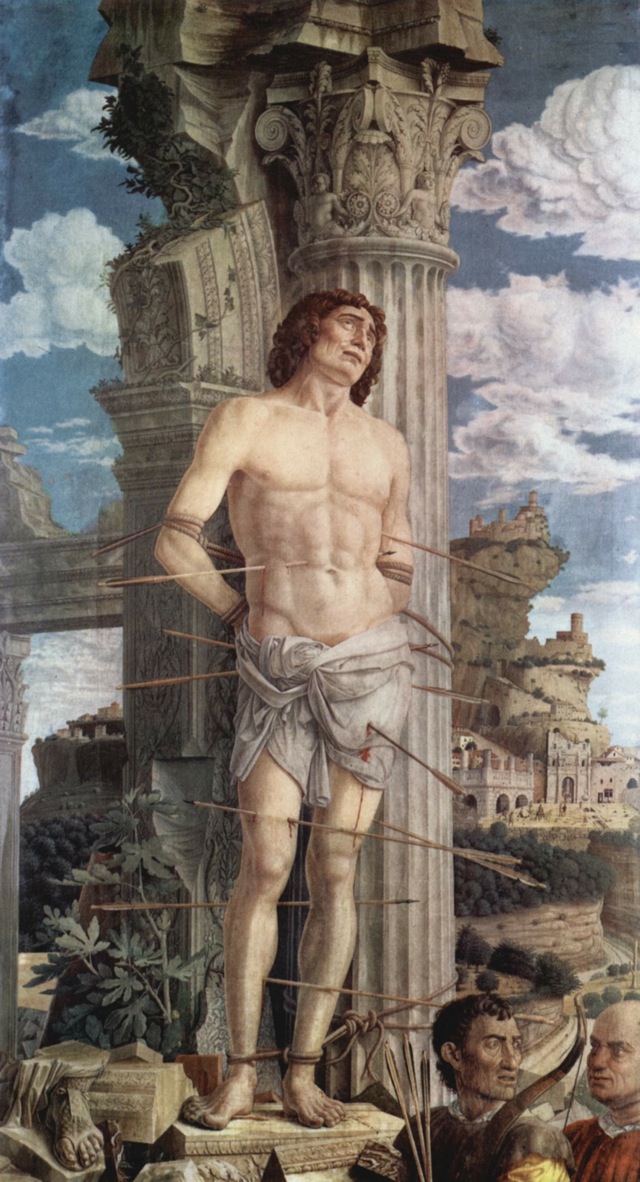

Andrea Mantegna. The Death of St. Sebastian, 1480. The Louvre.

Now do you see why Sebastian’s expression gets my goat? Don’t you think a guy who just got one through the privates would at least admit to some pain? And the painter was Spanish. Can you say Spanish Inquisition? Catholicism’s version of modern Islam. Whoever painted this had real courage. Viva Mantegna!

So great painters were making ‘photographs’ 500 years ago. The Decisive Moment was there – it just took a while to place it on canvas. No 1/60th @ f/8. Their genius in reducing imagination to canvas gave us works like those above. Not being as good, we needed Kodak and a button to press. And by the time real photography came along the religious had disappeared. The world, as western hemisphere photographers know it, was secular. And hooray for that. May all our photographs be as subversive as those of Holbein, Caravaggio and Mantegna.