Category Archives: Nikon bodies

About Nikon DSLRs

AF and AFD Nikkors

A curious bunch.

Before Nikon migrated to AF lenses with built in linear focus motors – the AFS series – they marketed the AF and AFD ranges which used a screwdriver linkage in the lens for focusing, the actual focus motor being in the body of better film and digital Nikon SLRs.


The Nikon screw drive motor coupling on the body and in the lens mount.
The film era F100 works well with these and just as well with the latest AFS optics.

While a seemingly Rube Goldberg solution it has proved to be solid and reliable with millions of lenses made. The line started around 1986 and one or two are made to this day.

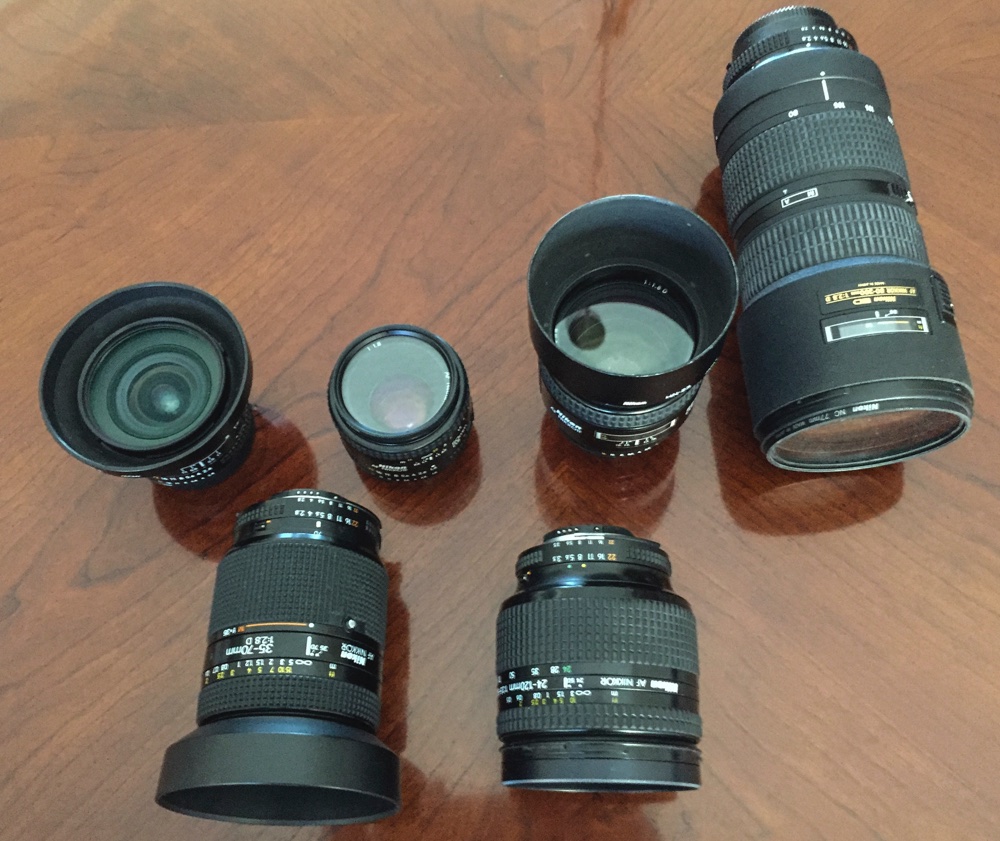
What is odd about the AF and AFD lenses (the later AFD versions added an enhanced metering chip for better results with flash; otherwise all else was identical) is just how much construction quality varied across the line. I have a half-dozen:


My small AF/AFD collection – 20/2.8, 50/1.8, 85/1.8 and 80-200/2.8 ED IF rear row;
35-70/2.8 and 24-120 f/3.5-5.6 front row.

The mechanical stand-outs here are the 80-200 and 35-70. The former is a two ring zoom, the latter a push-pull design which wears less well, the action becoming sloppy with age. Both are fabulously made and optically as good as it gets. The 80-200 is still sold new at over $1,000, my mint sample running me just $476. The limited range 35-70 is long discontinued (1987-2005) and is often found for under $200. Both are wonderful bargains.

The mechanical quality story with the others is quite a bit different. All these optics have proper aperture rings, a feature sadly deleted from the latest AFS line where apertures are set using one of the command dials on the body of the camera. The 50/1.8 is a piece of garbage. Cheap materials, rattling internals, awful controls. And dirt cheap at $70 used, mint. The 20mm ($230) and 85mm ($270) are mechanically so-so, but focus fast with the 85mm especially pleasant to use in the portrait studio where acquiring focus on the subject’s eyes is a piece of cake with AF especially fast.

And the 24-120mm is a jack-of-all-trades and master of none. It comes with fairly pronounced barrel distortion, rather wobbly construction, an unspectacular f/5.6 at the long end yet it’s invariably found on my D700 or F100 when I want to lug only one optic along. The 24mm comes in especially handy for architectural images and the barrel distortion is easily removed in LR. At well under $100 for a mint one, it’s hard to pass by.

Where Nikon did not compromise is in the optical quality of these lenses. All are at least as good as their MF predecessors with the 80-200 considerably better (and bulkier) than what came before. It’s a weapon, not a lens. The 85mm, with its chintzy external plastic, can almost match the classic 85/1.8 MF at full aperture, equalling it at f/4 and below. And even that piece of garbage, the 50/1.8 is almost as good as the classic 50/2 MF – it’s 1.5 stops less sharp at f/2 compared to the old MF optic, but usable wide open even in the extreme corners. Finally the 20/2.8, which scarcely needs AF owing to large depth of field, is almost as good as the classic 20/3.5 UD MF …. made 21 years earlier.

If MF is not for you, or you are just feeling lazy, none of these economically priced AF/AFD Nikkors will let you down. Just make sure your body comes with the screwdriver coupling or AF will be lost. Sadly, none of these will AF on the new FF Z6/Z7 mirrorless bodies, which lack the screwdrive motor in either the body or the related adapter.

For an index of my Nikkor pieces click here.

The new Noct

Exciting.

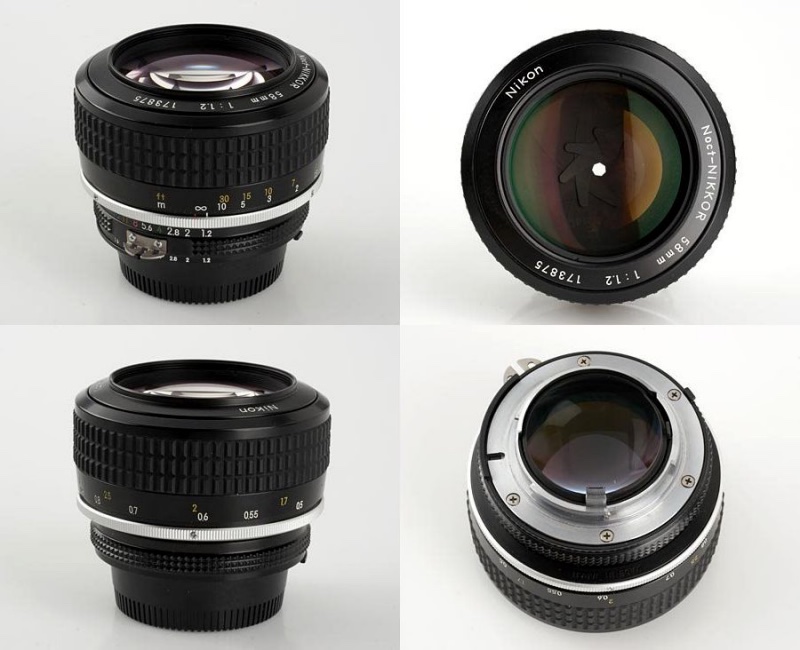
The original Noct Nikkor, a 58mm f/1.2, was first sold in February, 1977.


The original Noct Nikkor.

The original design has Ai aperture coupling which was revised to Ai-S in November 1981. The ‘S’ designation designates a linear aperture coupling cam compared with the non-linear original but optically and operationally there was no difference. If you could fit a CPU to the Noct then the Ai-S design would allow control of the aperture with either the aperture ring on the lens or the command dial on the body while still maintaining proper exposure metering. The snag, as the above images disclose, is that there is absolutely no room to install a CPU. Some brave/foolish souls have machined a recess in an arc of the rear element to permit CPU installation but that seems like a drastic solution to a not so real problem, as this is the only Nikkor in F mount to which a CPU cannot be fitted.

The Noct was reckoned by all and sundry – not just Nikon – to be the best standard f/1.2 lens around, and Nikon proudly profiled it in a factory piece which you can read here. The optic’s distinguishing characteristic was low coma at full aperture, as the illustrations in that linked article confirm. A mere 2,461 Ai versions and a further 8,950 Ai-S versions were sold, making the lens an instant choice of the pond scum known as ‘collectors’, which means that used examples sell for $3-7,000. The lens was discontinued in November 1998.

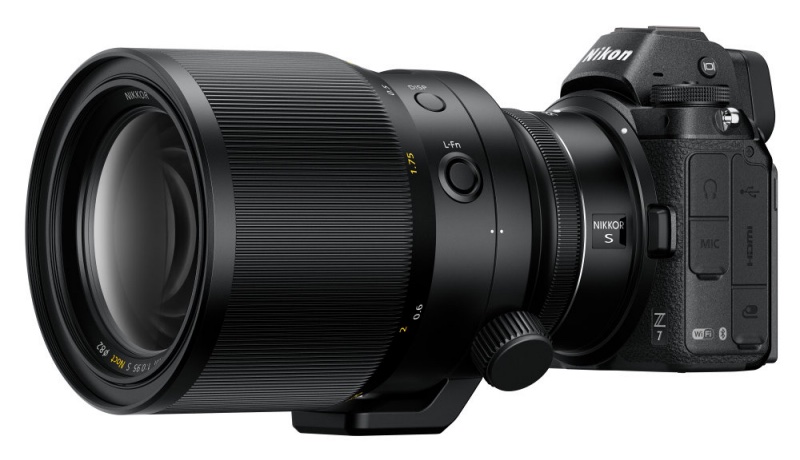
With the introduction of the new Z series mirrorless bodies yesterday Nikon also announced that a new Noct would be marketed in 2019, but this time it would come with a maximum aperture of f/0.95, while retaining the 58mm focal length. Price is unknown but reckon on $5-6,000. Interestingly Nikon will not include AF in the new optic, but the ability in the Z6 and Z7 mirrorless bodies to magnify the focus area in the finder/on the LCD screen means that critical focus wide open should be simple to determine. The lens is a whopper, its bulk dictating the inclusion of a tripod socket:


The new Noct.

The wider diameter of the bayonet mount’s throat on the Z6/7 makes the faster aperture possible.

I can think of a couple of similarly fast lenses in the past – the f/0.95 Canon for their rangefinder cameras (good luck focusing that), reputed to be poor, the f/1.1 Zunow in a Nikon mount, reputed to be awful, the original 50mm f/1.2 Leitz Noctilux with hand ground aspherical elements, suitably priced and excellent optically and the current 50mm f/1.0 Noctilux, like its predecessor available in M rangefinder mount also and superb, as it should be at the asking price of $11,000. The original f/1.0 design of the Noctilux is now F/0.95. How on earth you are meant to focus this optic given the limitations of the Leica M’s optical rangefinder beats me, but $11k gets you bragging rights.

The new Noct promises to be cheaper and better than all comparable predecessors. Exciting times at Nikon. This may be a ‘glamor’ optic with little practical use, but it’s good to see Nikon allowing its designers to stretch for the ultimate.

Nikon FF mirrorless bodies

Promising.


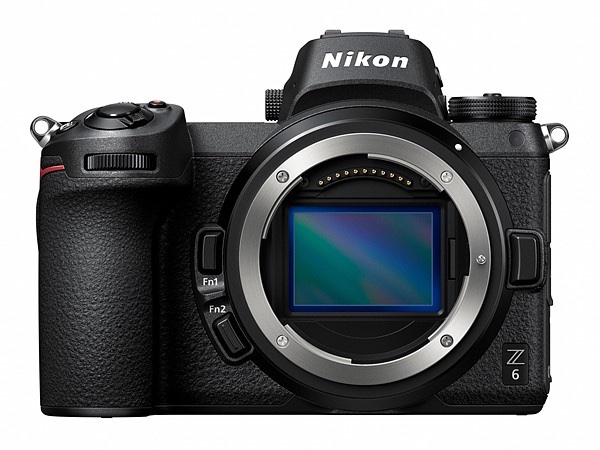
The 24mp Nikon Z6 FF mirrorless body.

After much teasing and speculation, Nikon today announced two new FF mirrorless bodies, the 45mp Z7 and the 24mp Z6.

The motivation for these releases is likely the increasing popularity of the Sony FF mirrorless bodies but let’s get one big misconception out of the way first. There is no reason to buy an FF mirrorless body if you want to materially reduce the bulk and weight of your gear. While a mirrorless body should be an ounce or two lighter than its mirrored counterpart, for the mirror and associated mechanism are deleted, the size of the lenses will be unchanged. That means when compared to MFT lenses, FF lenses are positively gigantic. On a related note this is why mirrorless APS-C bodies make so little sense if bulk and weight reduction are motives. The lenses are still very large.

No, the primary reason to buy a mirrorless body is silent operation as they generally come with an electronic shutter option, as well as potentially very high framing rates using that shutter, for no high inertia flapping mirror has to be raised and lowered multiple times a second.

Nikon has one other legacy advantage which Canon does not offer and is irrelevant with Sony bodies. Canon made multiple changes to its lens mount over the past three decades, from RM to FL to FD to the current EF version, each largely incompatible with its successor. Legacy Canon lenses are stuck with legacy Canon bodies, fine as both may be. As for Sony, there’s no population of legacy lenses with this more recent entrant to FF.

Thus, with tens of millions of legacy Nikon F lenses out there a significant issue with the new Z6 and Z7 bodies is backwards compatibility. Will my legacy Nikkor work?

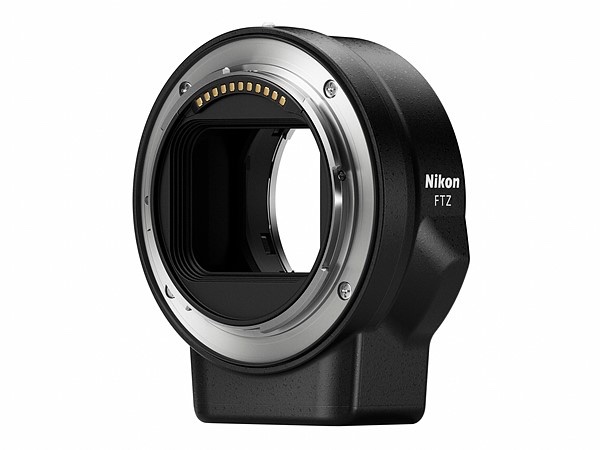
This issue is not lost on Nikon which has announced the FTZ adapter for legacy lenses at a reasonable $250, or $150 if bought with one of the new bodies.


The Nikon FTZ adapter for legacy lenses. No AF with AF/AF-D Nikkors.

Many readers of this journal have converted their ancient non-Ai Nikkors to Ai as I indicate here. Then, to add icing to the cake they have added a CPU, finishing the whole thing off with one of my many custom lens profiles. Now that pre-Ai Nikkor offers aperture priority auto exposure with full recording of EXIF data. Make that Nikkor a late MF Ai-S model and you get linear aperture ring response meaning that you can pass aperture control back to one of the command dials on the Nikon body and still retain linear exposure automation. Will the new Nikon FTZ adapter maintain this level of data flow and automation? Looking at the specs the answer is a resounding ‘Yes’. The adapter includes pass through electrical contacts for recording of the maximum aperture of the lens and of EXIF data, and appears to retain lens aperture stop down on exposure. And the new mirrorless bodies add focus peaking as a manual focus aid.

With the first generation of AF Nikkors, the AF/AF-D optics, the situation is not as happy, for the autofocus feature is lost. Thus AF/AF-D optics appear to revert to the same operational specifications as their pre-AI, Ai and Ai-S predecessors. Sad, but for Nikon to have retained AF with the AF/AF-D optics would have meant retaining the manual ‘screwdriver’ focus motor in the body, adding bulk and weight. Maybe one day the screwdriver motor will be added to the adapter? Certainly this would make all AF/AF-D Nikkor owners very happy and would help retain the smaller body dimensions of the new mirrorless bodies.

AF Nikkors which have the focus motor inside the lens, like the AF S optics, appear to retain autofocus with the adapter.

More as we learn about theses exciting developments from Japan’s premier camera and lens maker. As a minimum the prospect of enjoying IBIS with legacy MF lenses has one salivating.

Nikkor 24-120mm f/3.5-5.6D IF AF lens

OK, with some reservations.

The 24-120mm Zoom Nikkor was made from 1996 through 2002. Many regard it as the worst AFD zoom, in much the way the 43-86mm Nikkor is similarly damned in the MF era.

My copy of the 43-86mm zoom shows that, in its Mark II version, the lens is a capable performer, and a lovely compact package on a smaller film camera body.

By contrast, the 24-120mm, with its high 5:1 zoom range, comes with more design compromises. For one, the lens is not constant aperture, the speed falling to f/5.6 at the long end. Second, there is considerable weakness in the edges at 24mm with poor definition and chromatic aberration aplenty. The optic also comes with a reputation for sample variation and the plastic content means there’s a bit of wobble in the extended part of the lens at longer focal lengths.


Shown here at 120mm, fully extended. The lens hood is as useless as these things get.

Then again, mine came mint, boxed, with caps, hood and no fewer than three 72mm filters – UV, IR (!) and ND. Quite why you would want an ND filter with a lens that is already natively slow beats me, but whatever. And the price of entry – and proceeds of exit if it’s not for you – was a very modest $83 shipped. After selling the useless IR and ND filters, my cost was $17!

At 24mm the lens is compact and the zoom action is by a rotating collar rather than trombone action, meaning the lens ages well with none of the slop common in well used push-pull zooms. You can compare sizes with the 85mm f/1.8 AFD, a decidedly superior optic, in this image:


The zoom is at 24mm. Note the dual aperture indexes – blue at 24mm, yellow at 120mm.

The good news here is that the lens is very sharp in the center at all apertures, with negligible chromatic aberration. AF is satisfyingly fast and very welcome given the lens’s small maximum apertures. There is fairly pronounced vignetting in the corners at anything below 50mm but that is easily corrected using Adobe’s lens correction profile in LR. At the edges the story is different. I’m reproducing extreme corner test images here as the center ones are so good. In all cases the lens correction profile was applied. These are 40x enlargements:


At 24mm, f/3.5 and f/8.


At 70mm, f/5 (fully open) and f/11.


At 120mm, f/5.6 (fully open) and f/11.


As Adobe does not include a profile for this optic with LR, I used that for the later VR version and it works well:


Lens correction profile applied in Lightroom.

At 24mm the extreme corners really suffer at full aperture, only coming into their own at f/11. At medium and long settings things are much better, as disclosed above.

Handling of out of focus areas is rather so-so, if not awful, at the long end using wider apertures. (At the short end it’s tough to get anything out of focus). See above.

So your under $100 investment gets you a lens with a wide zoom range, decent performance at most settings except at full aperture at the wide and, and so-so out of focus handling. But if you want to carry just one wide-range zoom for outdoor snaps, the 24-120mm AFD Nikkor checks many boxes. Use with a polarizing filter is tricky as the front element rotates some 30 degrees through the zoom range. Adjust the filter once the focal length is set.

Comparing the results with images from the Canon 5D using the 24-105mm L auto kit kens, the Canon shows even greater barrel distortion at 24mm and poor corner definition and chromatic aberration in the corners fully open. The Canon is larger and heavier, owing to its constant aperture design and is generally a stop or two sharper than the Nikon. It also costs a lot more.

For a comparison with the Nikkor 28-105mm f/3.5-4.5 AF D lens, click here.

Two fine 85s

As good as it gets.

Recent articles here comparing the AF/AFD era autofocus Nikons, like the 20mm and the 50mm/1.8, confirm that the AF/AFD ‘plastic fantastic’ lenses certainly use a lot of plastic, but fantastic they are not. The old ‘metal era’ lenses outperform the AF ones easily, and are far better constructed in addition.

With the 85mm f/1.8 Nikons, the story is a little different.


85mm f/1.8 MF, 1969 vintage and the AFD version made in 1997. The AF takes a 62mm filter and hood,
not the usual 52mm HN-7 for the MF.

Previous experience with the AFD optic showed it to be quite special from f/2 down, but I was surprised to see how much better it was compared with the older MF lens, in which I had installed a CPU. Something was wrong. I was using the focus confirmation light in the Nikon D700 to determine focus, and it was clear that the MF lens was not at best focus with the viewfinder LED lit. So off to the bookshelf, which disclosed that the MF was focusing slightly in front of the target. An angled shot confirmed my suspicion:


Green line is where I focused. Red line is sharpest point.

The MF was not properly collimated. Refer back to a piece I wrote six years ago on how to collimate MF Nikons fitted with an aftermarket CPU. One of the functions of the CPU is that the point at which the body’s focus confirmation light illuminates can be shifted back or forward, eight small steps in each direction. One shift using the ’20’ function and this is what I got:


Green line (LED illuminated) and red line (sharpest point) now coincide.

This quick tweak now permitted proper comparison of the performance of the MF and AF lenses.

In the image pairs below the image from the MF lens is at the left:


At f/1.8.


At f/2.8.


At f/4


At f/5.6


Rendering of out-of-focus areas is similar, with that of the MF optic marginally preferable to my eyes. Both lenses are fully usable at f/1.8, a tribute to Nikon’s designers.

It’s clear that the MF lens is superior through f/2.8 after which differences are slight. The traditional warmer tones of the MF lenses are again notable here.

So the AFD lens is really good, and my studio image of my son Winston taken in 2012 testifies loudly to that fact:


Winston in his karate outfit. D700, 85/1.8 AFD Nikkor, two Novatron heads.

Either optic is a wonderful addition to any snapper’s arsenal. The MF lens is slower in use but outstanding in every way, while the AF version excels in the studio where critical focus on the eyes is made easy by the autofocus function.