Category Archives: Photographs

Just walking the pup

Sometimes you get lucky.

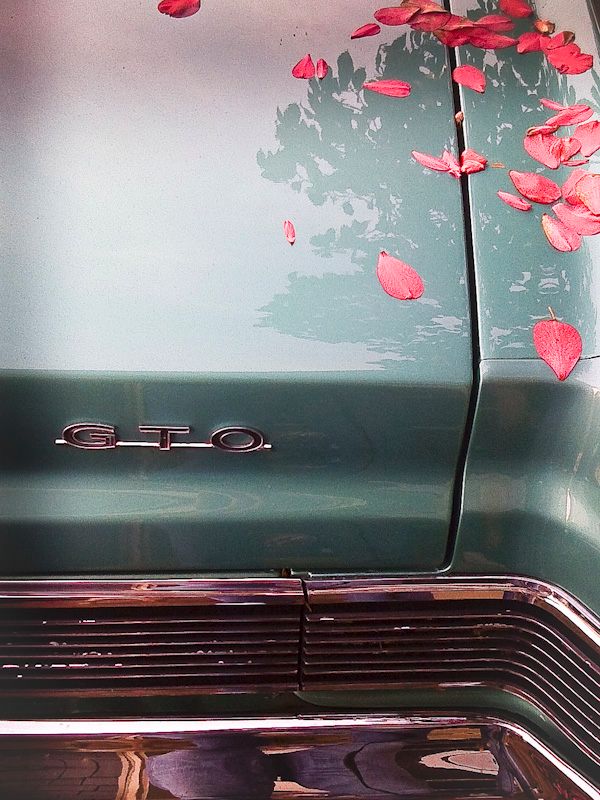
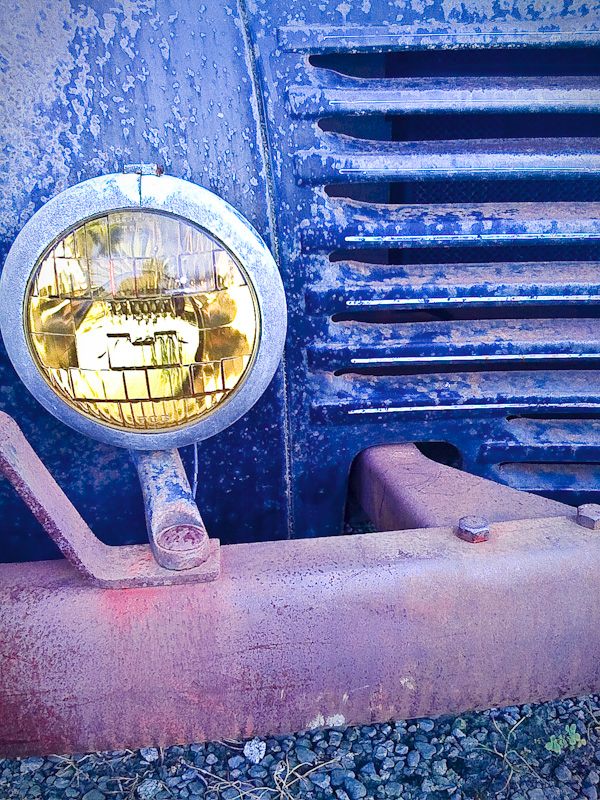
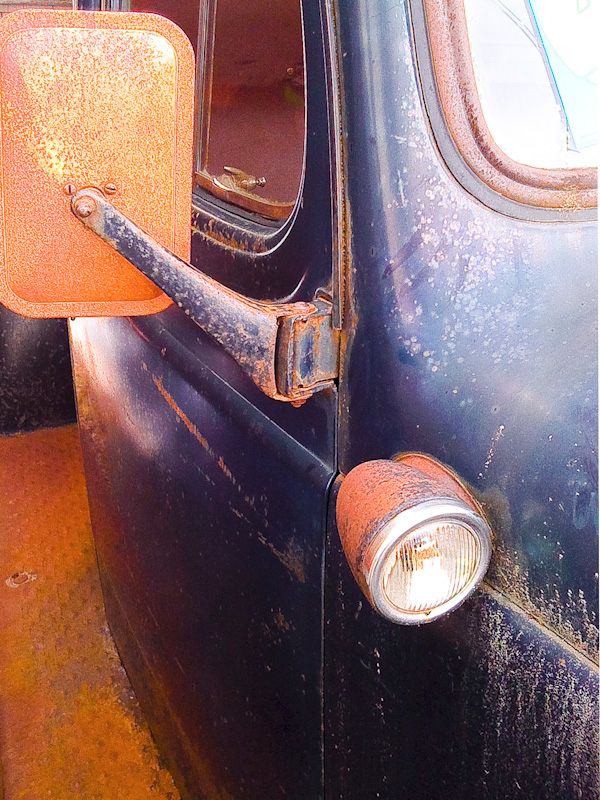
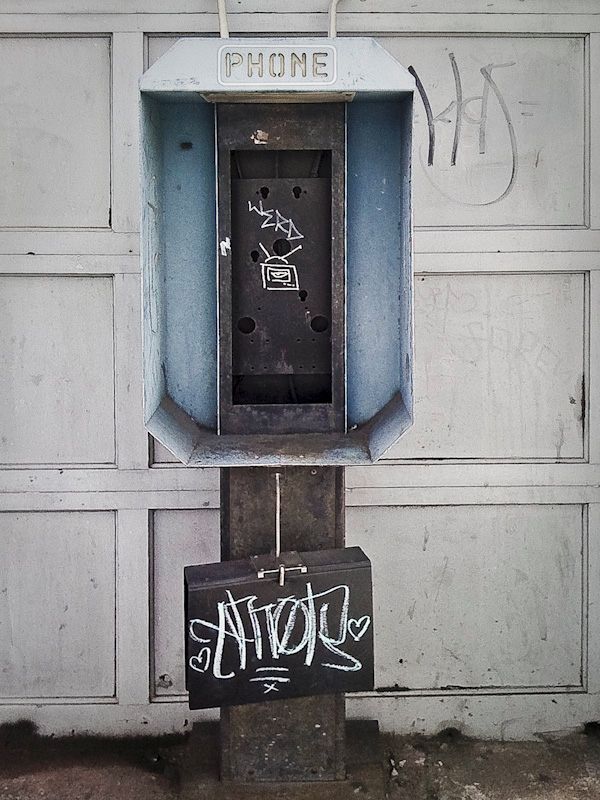
Though I’m no great fan of the “always carry a camera” exhortation, preferring to argue that you seek out good pictures and they rarely just happen, I was walking the dog yesterday and spotted these five in the space of 2 minutes and twenty yards. All I had was the iPhone 3G but it seems to have done OK in the circumstances.

Awning.

AT&T

GTO

Dodge

Corrosion

Always carry …. an iPhone!

A note on iPhone photo files sizes: If you email a photo taken on the iPhone the size is 640 x 480, or 0.3 mp. By contrast, if you download it to Lightroom or iPhoto by connecting the iPhone to your desktop or laptop, the full size of 1600 x 1200, or 1.9 mp is downloaded, which is still not great but offers far better definition.

Life with Mahler

Life without him is not living.

How can anyone live without Mahler? Standing at the cusp between the classical romanticism of Tchaikovsky and Schubert and the atonality of Stravinsky and Berg, he changed music as we know it. Whether through his beautiful songs or his massive symphonies, one’s understanding and appreciation of nature is raised an order of magnitude through listening to his works.

Absent a few documentaries, the only dramatic movie of Mahler’s life is the one made in 1974 by Ken Russell, much of it filmed in the Lake District of England, as the production budget was tiny and the crew could scare afford to decamp to the Tyrol for the right scenery. Proving again that money and results are frequently poorly correlated in movie making, Russell does a masterful job, with his usual obsessions and eccentricities thrown in.

In addition to dramatic intensity, the movie has some exceptional photography, a few frames of which I excerpt below. My original was a VHS copy which was pretty bad, though it was in widescreen. Now I have tracked down an ex-rental DVD which is a little better, though unfortunately in 4:3 format. One day someone will remaster this long forgotten out-of-print work and put it on BluRay with proper formatting. Meanwhile, the second rate DVD is all I have, so excuse the poor quality of what follows.

Mahler is acted by Robert Powell, every bit as special here as in Zefirelli’s Jesus of Nazareth. He gives it his all, never overacting.

The movie opens with some extraordinary imagery. After we see his lakeside hut explode in flames the director cuts to Mahler’s wife, Alma, trying to escape from a cocoon – the allegory being how his genius stifled her far from trivial musical talents.

Alma Mahler tries to escape from the cocoon.

The narrative takes place on a train where Alma tries to decide, over the course of the journey, whether to leave Mahler for a dashing soldier. Needless to add, Russell cannot resist a funny dig at Visconti’s Death in Venice, with this scene glimpsed on the train platform:
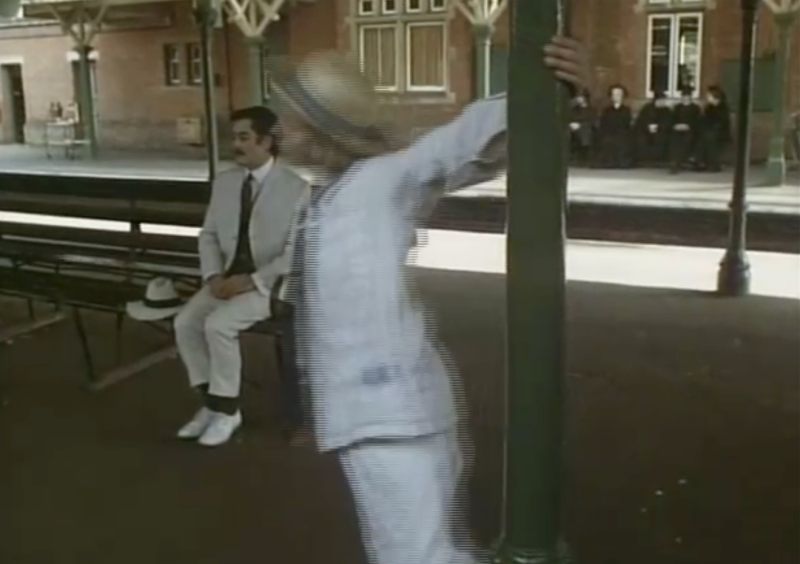
Mahler as von Aschenbach.

Another cut to a lakeside scene recalls nothing so much as Thomas Eakins’s famous picture:
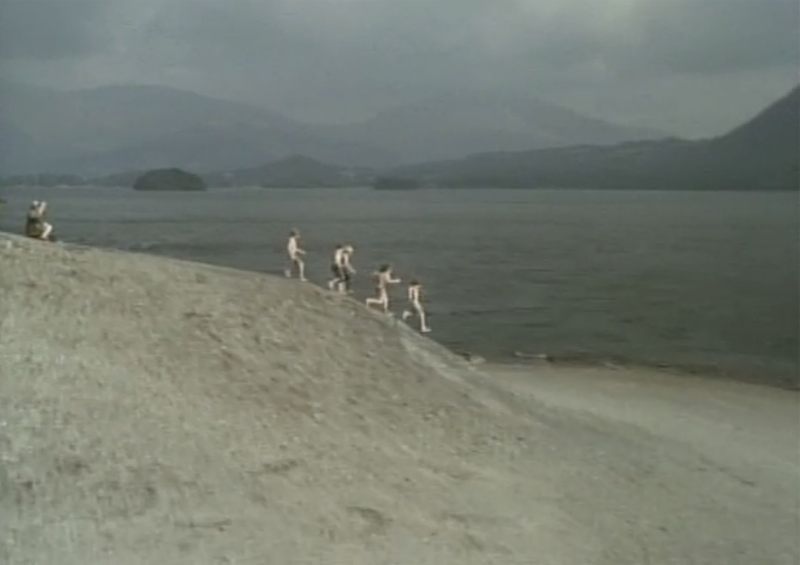
A recreation of Eakins’s The Swimming Hole
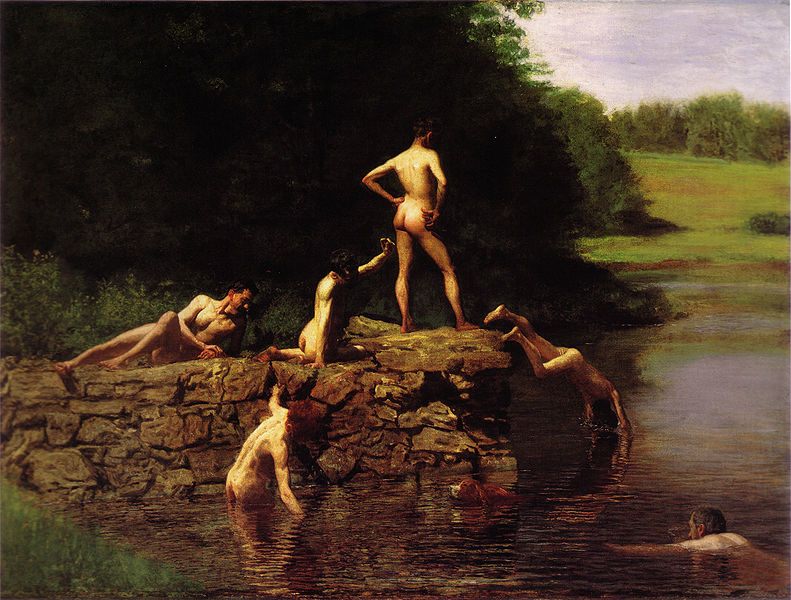
The Swimming Hole by Thomas Eakins.

As the train wends its way through the Austrian countryside there is an unforgettable image of Mahler as music plays in his head.
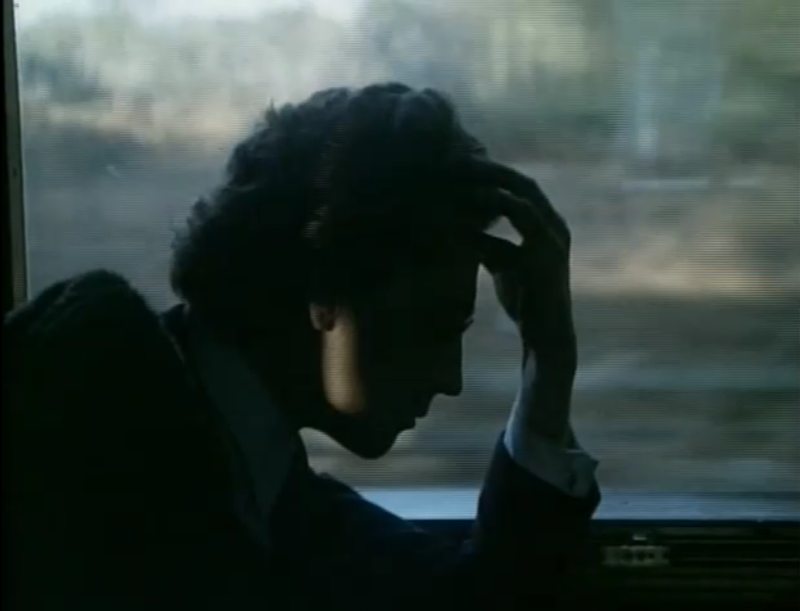
Robert Powell IS Mahler.

But if I have one favorite moment from this orgy of imagery served up by Russell, it is the scene where Mahler threatens to dunk Alma in the lake from the same little hut which explodes in flames at the start of the movie. Set to the concluding bars of the first movement of the Sixth Symphony, you have to be clinically dead if the hairs on your back do not rise at this lush combination of sound and picture:
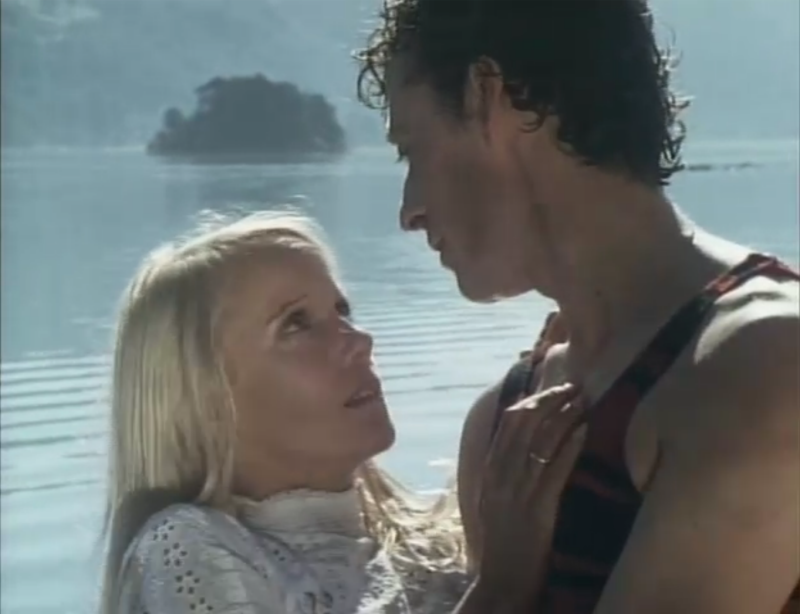
The lovely Georgina Hale is Alma Mahler.

A few years back I loaded up the CD player in my car with all of Mahler’s symphonies and drove up the coast highway of California from San Diego to the Oregon border, then inland across Death Valley listening to nothing else. If you want to appreciate what music tells you about nature, I recommend a like course of action.

It’s been said that the Austrians’ greatest genius was to convince the world that Hitler was a German and Beethoven an Austrian. There is no need for such posturing here, for Mahler was quite simply the greatest musical creation of a nation which gave us anti-semitism, an anti-semitism which he took on and conquered in his all too brief life. The movie is highly recommended. I confess that parts of the Second Symphony are dancing in my brain as I type ….

Update may 24, 2023:

Well, it’s finally here. I just watched a Japanese remastering of Mahler on the big screen. No more scratchy VHS definition. No more castrated 4:3 format. In glorious 16:9 widescreen BluRay quality. Thank you, Japan, and I’m still wiping the tears from my face. A glorious piece of movie making.

Paris – 26 gigapixels

Just fabulous!

With two Canon 5D Mark II cameras fitted with 300mm lenses and 2x teleconverters, Arnaud Frich took no fewer than 2,346 pictures of Paris from one location and stitched the result into a 26 gigapixel (that’s 26,000 megapixels) photograph.

While his subject is stunning and while it’s likely impossible to take a bad picture of this fabulous city, the work is extraordinary and you can see the result by clicking the picture below.

The center of Western civilization from the base of the tower of Saint Sulpice

The original bad boy

aka Michelangelo Merisi.

No painter has so influenced photography and photographers as has Caravaggio, whom NPR amusingly and accurately refers to as the first of the “Bad Boy artists”. An exhibition in Rome is celebrating the 400th anniversary of his death and you can read more of this master by clicking the picture below.

I prefer the version that has him dying in a sword fight as it seems so in character with the man. Brawler, debauched party goer and totally original genius. His use of light and shade is as fresh today as it was four centuries ago.

On of the best episodes of Simonn Schama’s ‘The Power of Art’ illustrates Caravaggio’s life with some stunning recreations of his signature pieces, not least ‘The Calling of St. Matthew’. You can rent it from Netflix. It’s clear that while his commissions came largely from the Catholic Church (who else had money back then?) his art is about as secular as it gets. Another reason to adore his work.

Blurring the lines

Where does graphic arts start?

The hardliner in me loves Alcatraz. It’s what a prison should be, compounding a remote location which dares the prisoner to escape on pain of death by hypothermia, with the ultimate cruelty – a view of one of the world’s great cities whose sounds you can hear when the wind blows right. Thus heightening the meaning of incarceration, freedom just out of reach, is true punishment.

But the liberal in me sees those same factors as nothing more or less than cruel and unusual punishment, for no matter how heinous the crime, civilization can do better than that. Visit Alcatraz, look around you and listen to the excellent tour tape and you will know what I mean.

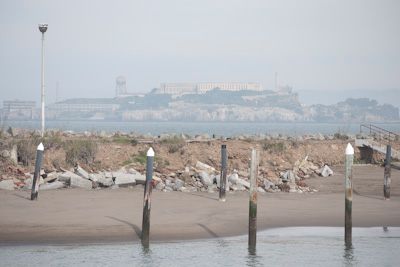
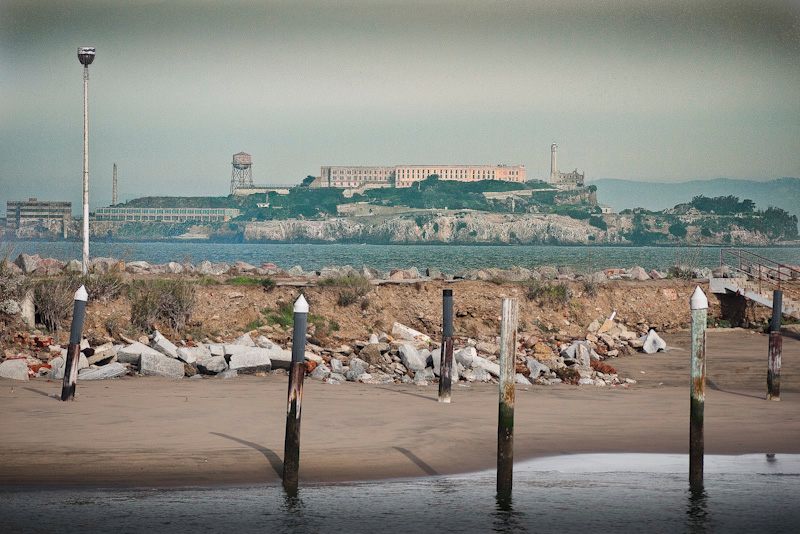
So the other day finding myself on the Marina at the north western end of San Francisco, I naturally couldn’t resist a snap of this forbidding, long unused, fortress by the bay. The icy, biting wind may make northerners laugh with scorn but it reminded me why you wouldn’t want to try to swim from the island to the shore.

As it was a blustery day and the haze and water mist were conspiring against visibility, I didn’t expect much and not much was what I got.

Alcatraz lost in the mist. G1, 45-200 @ 91mm, ISO 320.

But later, sitting at the monitor and thawing out, I thought I would try to make something of it. It took a while, masking this and enhancing that, but the whole process reminded me that nothing is real any more. And, candidly, I have no qualms making something half decent out of an image that would ordinarily head straight for the trash. The final version, antique coloring and all, works for me. The lines between photograph and illustration are now so blurred that nothing is real any longer.

Alcatraz prison in all its threatening splendor.