Neat idea.
Here’s an ad in the current Harper’s Bazaar that caught my eye:

The imitation.
And here’s the real thing:
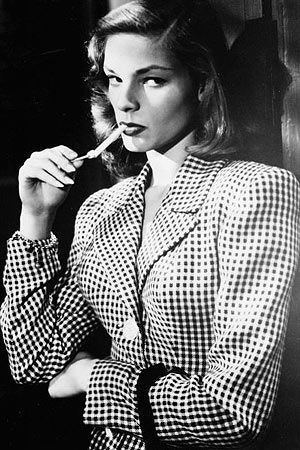
The real Bacall.
Neither photographer, sadly, is known.
Neat idea.
Here’s an ad in the current Harper’s Bazaar that caught my eye:
The imitation.
And here’s the real thing:
The real Bacall.
Neither photographer, sadly, is known.
The first snapshot artist.
While Spaniards may have hated Napoleon for the invasion of their nation and the destruction of the ruling Bourbon dynasty they should, in fact, have been grateful to the French dictator. By hastening the end of monarchical rule, Napoleon effectively put a simultaneous end to the power of the Catholic church in Spain and ushered in a secular constitution with representatives elected by the people, not by Rome. Poor Spain. We think nothing of damning modern religious dictatorships while conveniently forgetting the cruelest of systems which denied citizens even the basest rights. That system, of course, was the Spanish Inquisition.
Nations of all stripes continue to use similar tactics today to deny people their rights – torture and execution in the name of the state – though the excuse is now national security rather than exorcism of witches. And the actions of our rulers are no more representative of the will of the people than were those of the Bourbon kings of old.
In the thick of all of this back in the days of the Inquisition was the Spaniard Francisco Goya (1746-1828). He was lucky to have died in his bed. While he took on a number of church projects – who wouldn’t when trying to put bread on the table – he was the most secular of painters. In his powerful etchings and sketches of the horrors of war and the Inquisition he documented, as never before, the evils committed in the name of a ruling power. His anti-war work reached a peak never before scaled by Western art in his painting of French soldiers executing loyalists on May 3, 1814. This snapshot-like vision was conjured up from his imagination, as he was too old and too deaf to be traipsing about the streets of Madrid while its citizens were waging guerilla war against the French enemy,
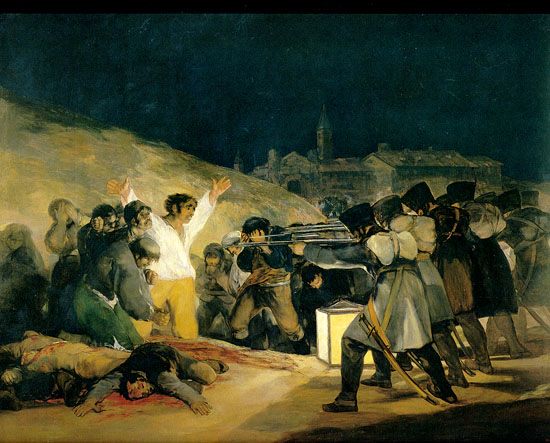
Goya – May 3, 1814, Madrid
Modern times make it far simpler to record the horrors of armed conflict and that fact takes away much of the power of the message. We are numbed by so much of this that it no longer gets through. While the most famous picture of the Vietnam war undoubtedly speeded America’s defeat and exit, few remember it now. It is Eddie Adams’s picture of a Viet Cong having his head blown off.
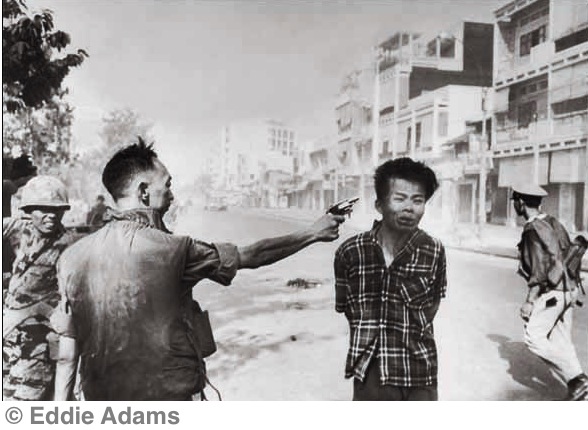
Unlike Goya’s snapshot, Adams had no need of imagination. He just had to be there. There’s a newsreel of the same event so it’s not like he was the only photographer there or the only one to see this ‘photo op’ coming. And, to his lasting surprise, he helped end a war in much the same way that Goya’s snapshot put paid to the Spanish peoples’ prosecution by church, state and invader. The difference is that Goya was recording with intent whereas Adams was just another guy with a camera.
And while Adams’s picture, in its own way, is no less powerful than Goya’s, I need not ask which you would rather have hanging on your wall.
This has been a productive year for writing about Photographs, Photographers and Photography and I had a blast doing it. I hope you have been stimulated, inspired and, yes, angered from time to time. Without emotion there is no progress.
So, without further ado, here are my favorite posts of the year, in no particular order:
I am delighted to report that the revenue I have derived from this journal in 2009 was identical to that for 2008 and prior, meaning zero. I can assure you that will continue in 2010.
Happy New Year and thanks for dropping by.
Onward and upward:

A neat G1 shutter experience
I confess that when I first saw this image, taken just before Christmas, I almost erased it. It’s another focusing on the theme of lone individuals in the big city – what I call my ‘Edward Hopper series’ after the great American painter.
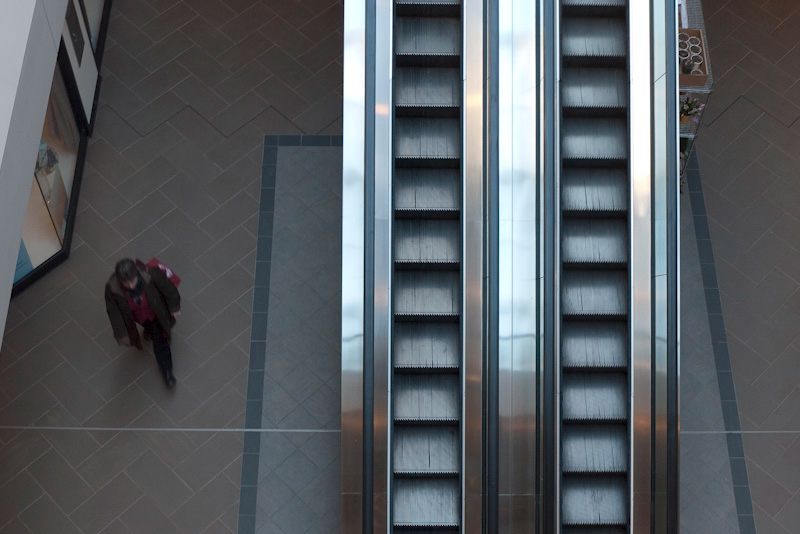
The key element is the figure and is lost in gloom. But right before I hit the ‘Delete’ key I noticed something strange. The ‘up’ escalator is blurred whereas the ‘down’ one is sharp as can be. That’s an interesting little mystery, and it suddenly struck me that despite all it’s electronic magic, the Panasonic G1 which I used to snap this still uses a conventional focal plane shutter, with vertically traveling blinds. While it happens to default to an open state, thus permitting the sensor to receive and transmit the image to the electronic viewfinder (the camera has no prism or mirror) it’s conceptually identical to those used in some cameras a hundred years ago.
So I decided to manipulate the image and started messing with selective-this and slider-that in Lightroom, ending up with this:
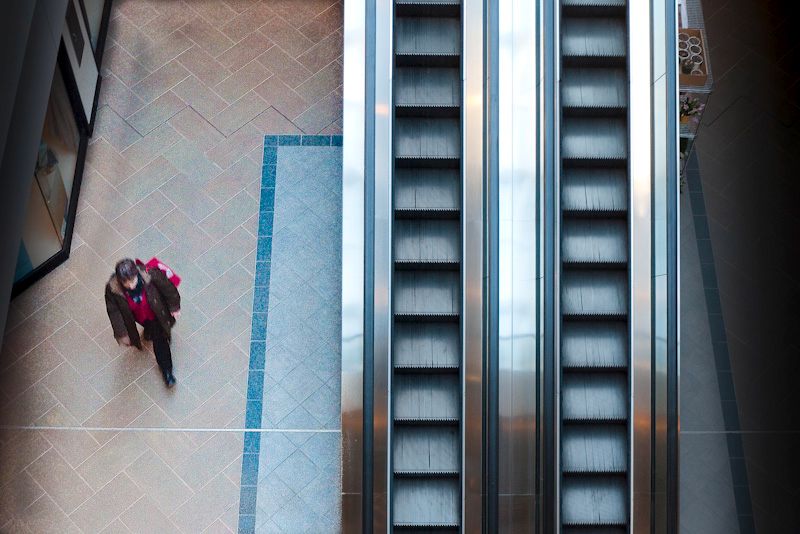
Escalators and lone figure. G1, kit lens at 28mm, f/5.6, 1/30, ISO 320.
The camera’s shutter was moving with the down escalator and in the opposite direction to the up escalator, which accounts for the differential sharpness of the two.
Here’s a detail screenshot:

Perhaps the most famous example of funkiness from focal plane shutters is this picture by Jacques Henri Lartigue, where the wheel’s seeming elongation is the result of …. you guessed it, a vertically traveling focal plane shutter, the effect further magnified by the photographer’s panning with the motion:
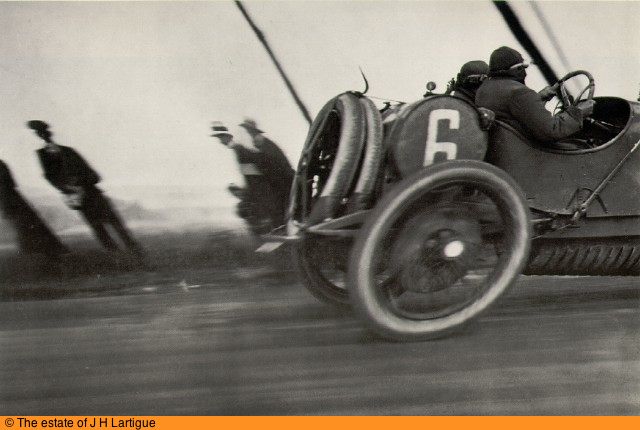
Early focal plane shutter distortion. Taken in 1913.
Modern focal plane shutters travel too fast for this sort of extreme distortion which is a shame!
There really is little new under the sun, but the strange effect in my picture and a bit of manipulation make for an interesting snap. It seems that the 1/30th second used (excuse me, the 1/30th second the camera’s electronics chose, as I invariably use aperture priority exposure automation) was perfectly in sync with the speed of the down escalator.
It comes with the territory.
Churchill called it his Black Dog – the days where it seemed that all the effort and striving were for naught. No matter how you looked at things, all was lost.
Well, it comes naturally with Slavic blood. Like mine. Where else could Dostoyevsky be a best selling author other than in Eastern Europe? And his readers, like Winston, drink to excess, compounding their depression rather than helping it.
I have these Black Dog days frequently when looking at my pictures. The depression part, not the drinking, that is. While I now do my ‘snap a day’ thing on my photoblog that’s not where I expect to find many of my best pictures. It’s a place to think aloud, experiment and cull for later publication. Those that make the cut I place on my more static web site and it’s that which causes the depression.
I mean, after all these years, I sometimes think there is absolutely nothing to show for the effort.
For example, I have always loved this picture, which says a lot about the England I adore – some people enjoying the park on a rare, sunny day with the lady standing in the way only an eccentric nation could understand, to get a better view of a passing parade. I remember taking that as if it was today and I knew it was fabulous. Or is it?
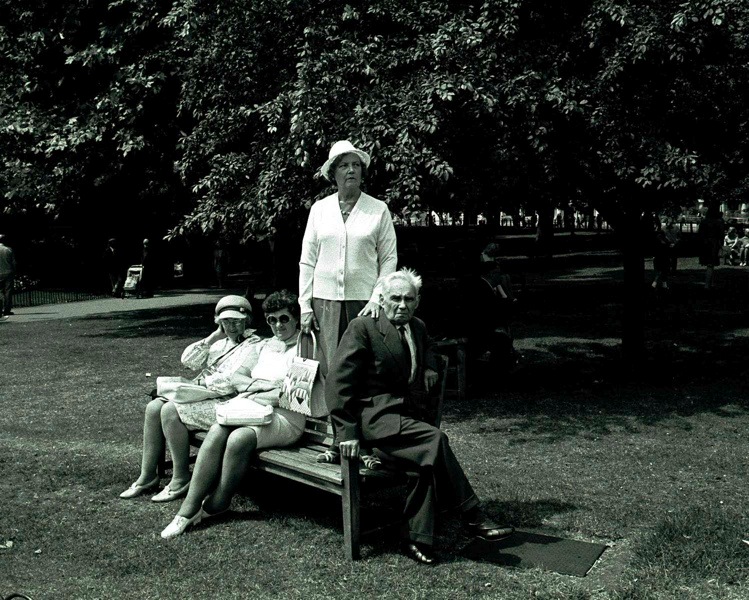
Green Park. London, 1973
Then this one has only improved with age, now that we live in a time where you cannot get within hundreds of yards of Britain’s center of power without all sorts of clearances. I loved it when I snapped it and I like it even more now. Or do I?
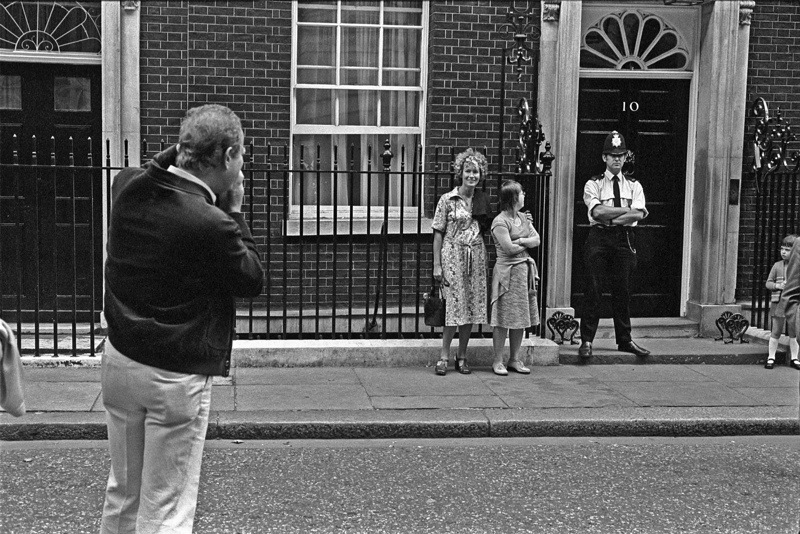
Outside Number Ten. London, 1974
I was especially happy with the next image – the light just so, the colors simple. Or am I mistaken?
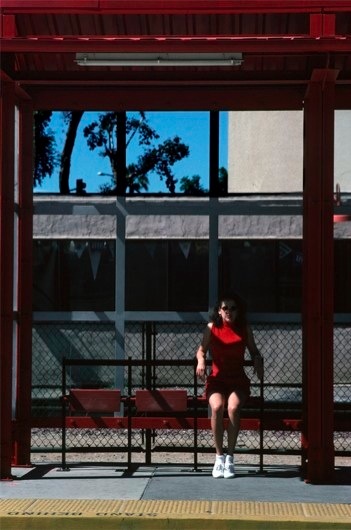
Thinking of Hopper. San Diego, 1997
The next snap has everything I could think would make a perfect color picture – a sense of abstraction, a monochromatic palette and I love the composition. Or do I?
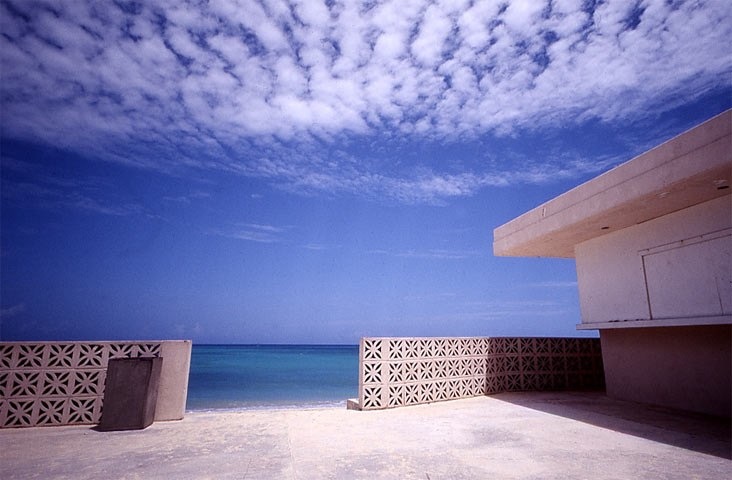
Sky. Bermuda, 1999
For an abundant sense of mystery, I adore this. Or do I despise it for its sheer ordinariness?
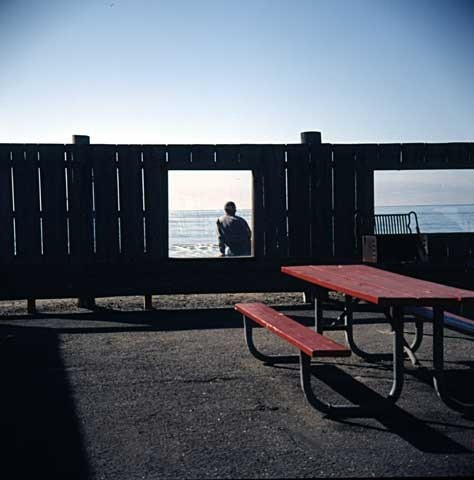
Penseur. Cayucos, 2005
Finally, I keep telling myself that my best is yet to come. That I still have ‘it’. That my sense of color and composition gets stronger with the passing years. Or is this simply self delusion passing for a defence mechanism?
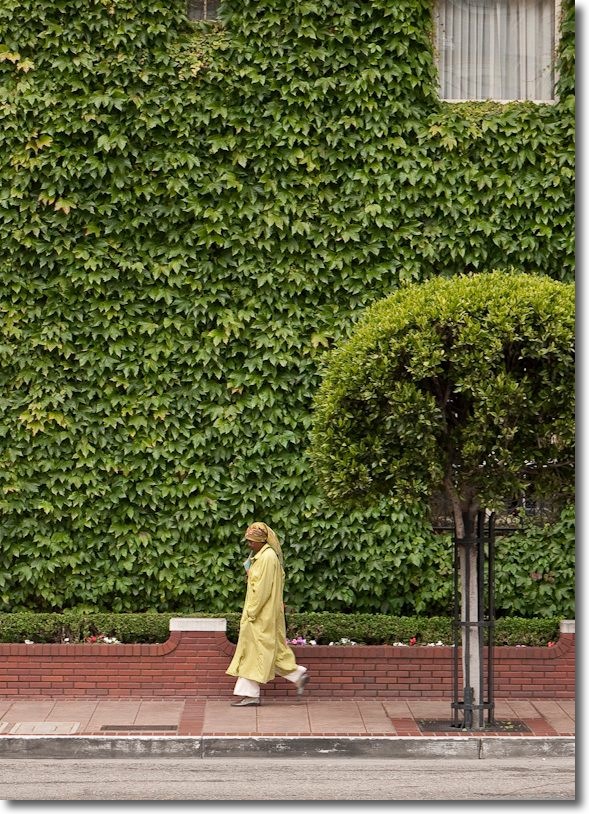
Minuet in Green. San Francisco, 2009
Do you see where I’m coming from? Sometimes it just all seems hopeless. Maybe this whole photography thing is just a mindless time sink?
Well, I’m 58 today and that alone is sufficient cause for Depression.