Category Archives: Ramblings

Miscellaneous thoughts.

Garage kaizen

The second most important space in the home.

For a closer look at the many art works on display click here.

I wrote about kaizen in the context of the most important room in the home – the home theater – a while back.

It’s common for members of the Toyota C-suite to spend formative years in the kaizen function where failed parts are analyzed and improvements conjured up. This inculcates the belief that nothing surpasses reliability in importance when it comes to daily conveyances and explains why Toyota makes the best cars in the world. Contrast this with GM. One example of many is their Northstar V8 engine. It took Detroit 6 years to determine the cause of the serial head gasket failures and leaks before they realized that the studs were pulling out of the block. A mere few millimeters of additional thread did the trick by which time the motor’s reputation was irreversibly damaged. Considering American occupational psycholigist W. Edwards Deming had taught the Japanese how to make reliable cars you would think GM would know better. But no. Hang reputation, aim for short run profits, the American Way.

And talk of cars brings us to the second most important space in the home, the garage. My goal is to make this a warm and welcoming place, with shadowless task lighting the first consideration. Art works on the walls enhance the sense of occasion when entering this working space, but it’s the placement and display of tools and parts which is the key to making this a proactive and efficient workplace. And there are rules guiding this goal.

First a tool hidden in the drawer of one of those awful rolling carts is a lost tool. The cart will sooner or later crash into one of your machines and you will spend endless hours searching for that one special tool buried in its innards. No, tools must be displayed in logical groupings which means pegboards on the wall. And not those awful, depressing brown ones. Yecch! They must be white to contrast the tool with its background and to reflect ambient light into the workspace. For safety – the weight of tools adds up quickly – wooden battens are fastened to the studs behind the drywall and the pegboards are fastened to these battens, using drywall screws with finishing washers to spread the load. This makes for both a robust attachment method while providing clearance for the pegboard hooks as they poke through to the rear.

Further, tools must not be stacked for the same reason that they must not be hidden in drawers. Anything below the top of the stack will be lost or forgotten, sooner or later. Here’s my tool wall and yes, kaizen is easily eroded as the images show, for I have started stacking tools over the years, denying my own rules. In addition to the growing stacking issue with the pegboards, the area with fasteners is an absolute disaster, and the shelving needs work too.
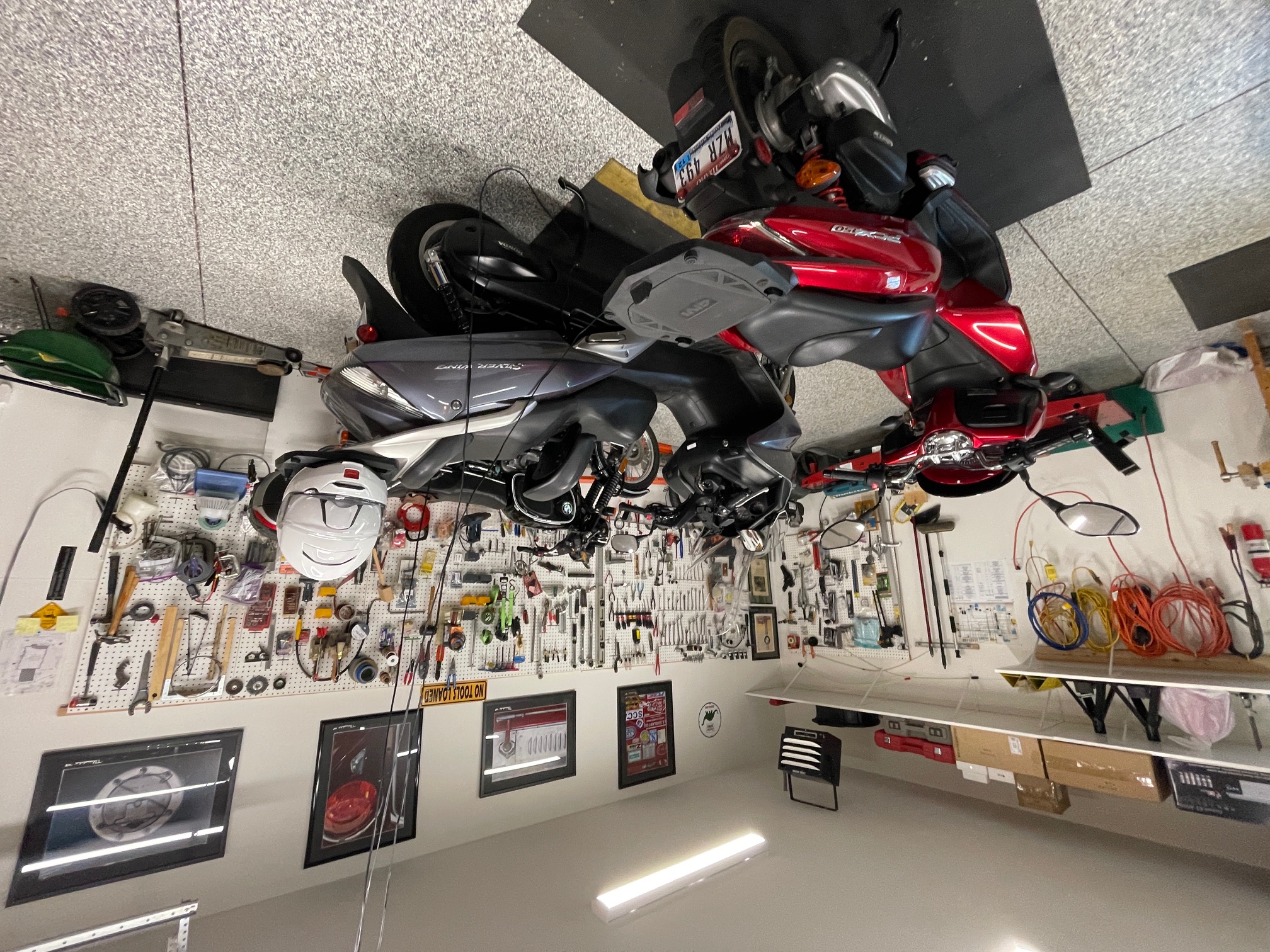


The tool wall
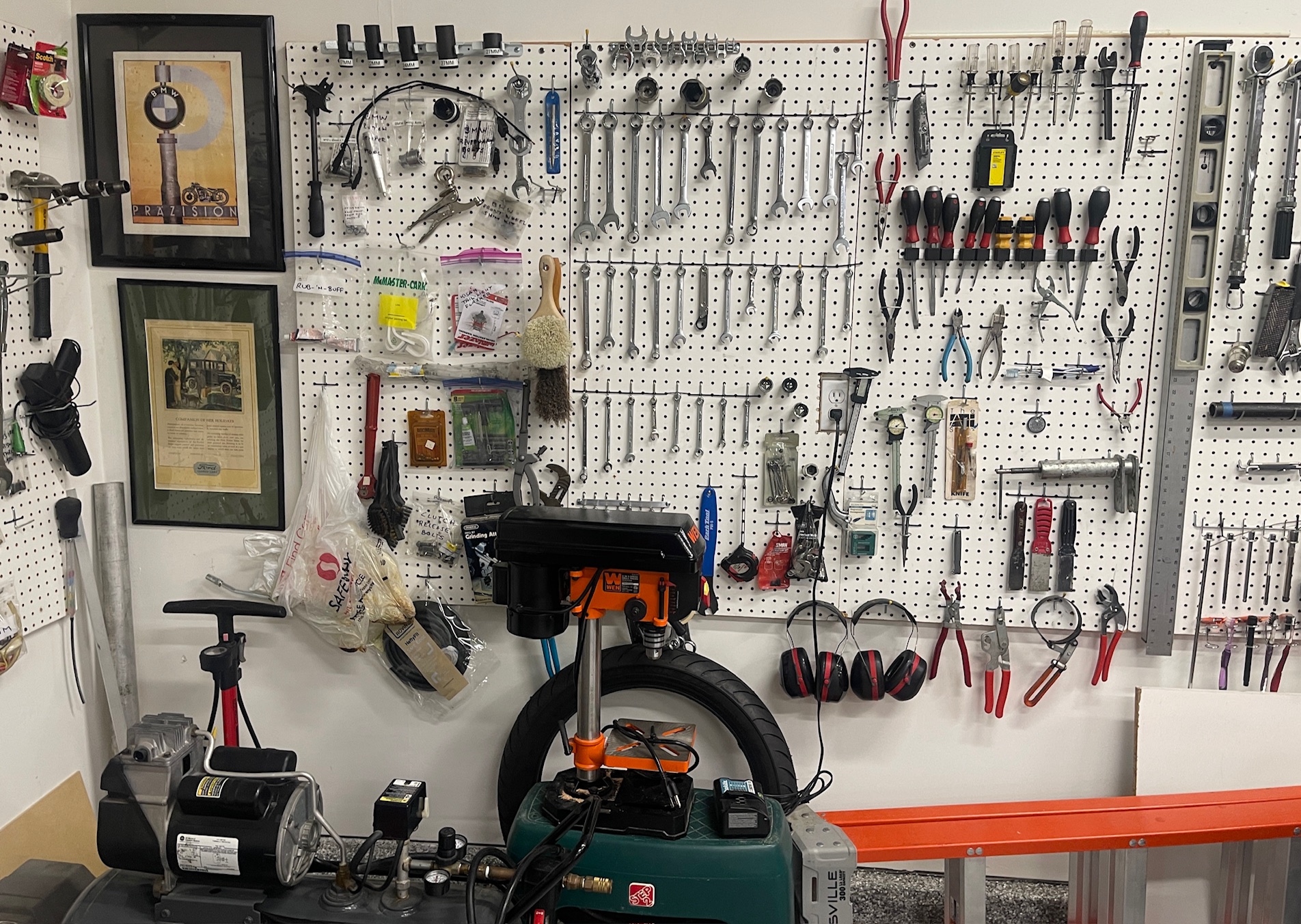


The tool wall – a closer view.
Classic BMW and Ford posters at left.

Note the magnificent red Handy motorcycle air lift, the finest tool in the garage, at lower left. It’s one of the few things, along with the attendant compressor, I will allow to take up floor space. As a general rule the fewer things on the floor the better:
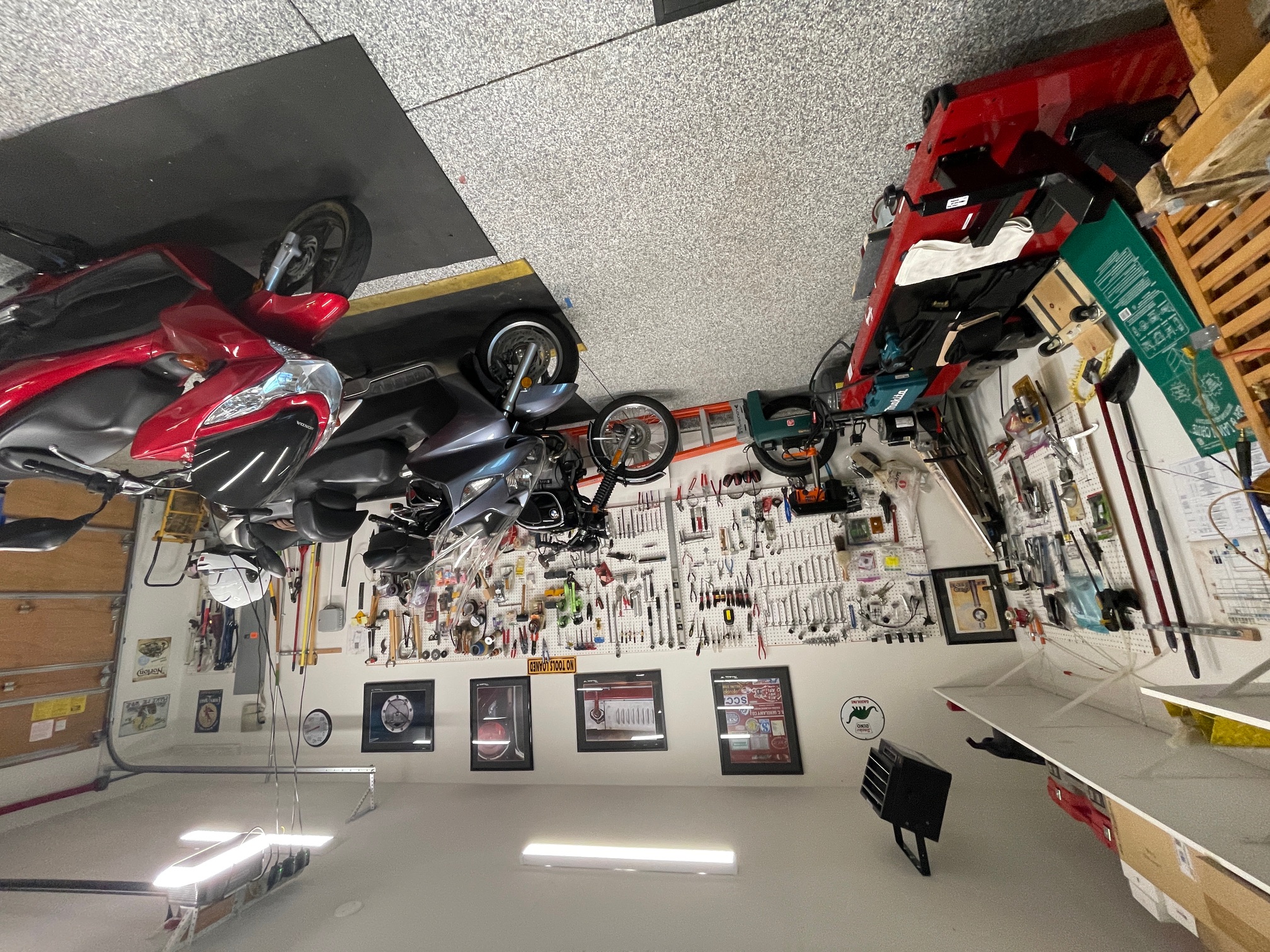


1975 BMW R90/6, 2007 Honda Silverwing and 2013 Honda PCX 150.
The artwork is from the Laguna Seca Historics

This fastener assembly is a disaster. To remove any one bin all above must be removed, the bins spill fasteners faster than a politician accepts a bribe and those lost nails on the floor lead to flat tires. Hard to imagine anything worse. Well, there’s always the Titanic:
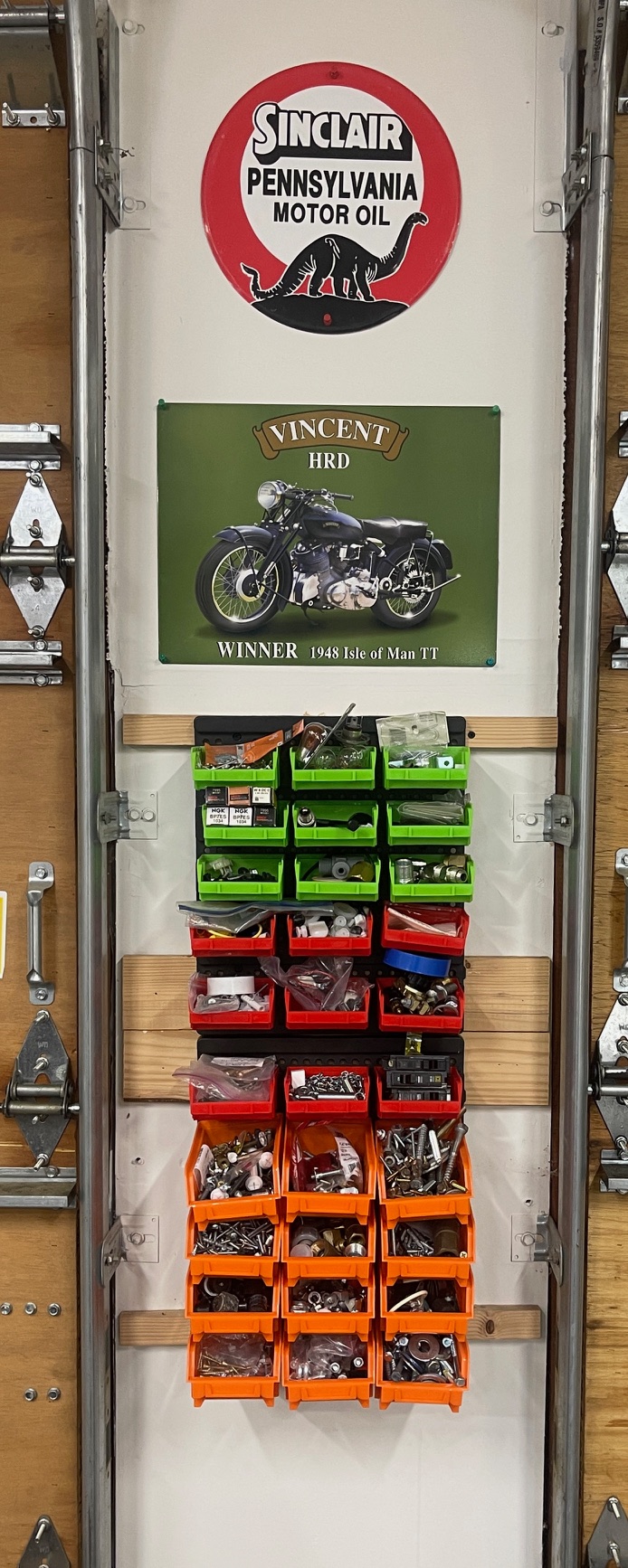


Disaster area – fasteners. Inaccessible and
waiting to fall out.

Mercifully Amazon lists an alternative for very little money with several configurations.

This took a bit of time with the need to properly sort mis-filed pieces, but boy is it worth it:
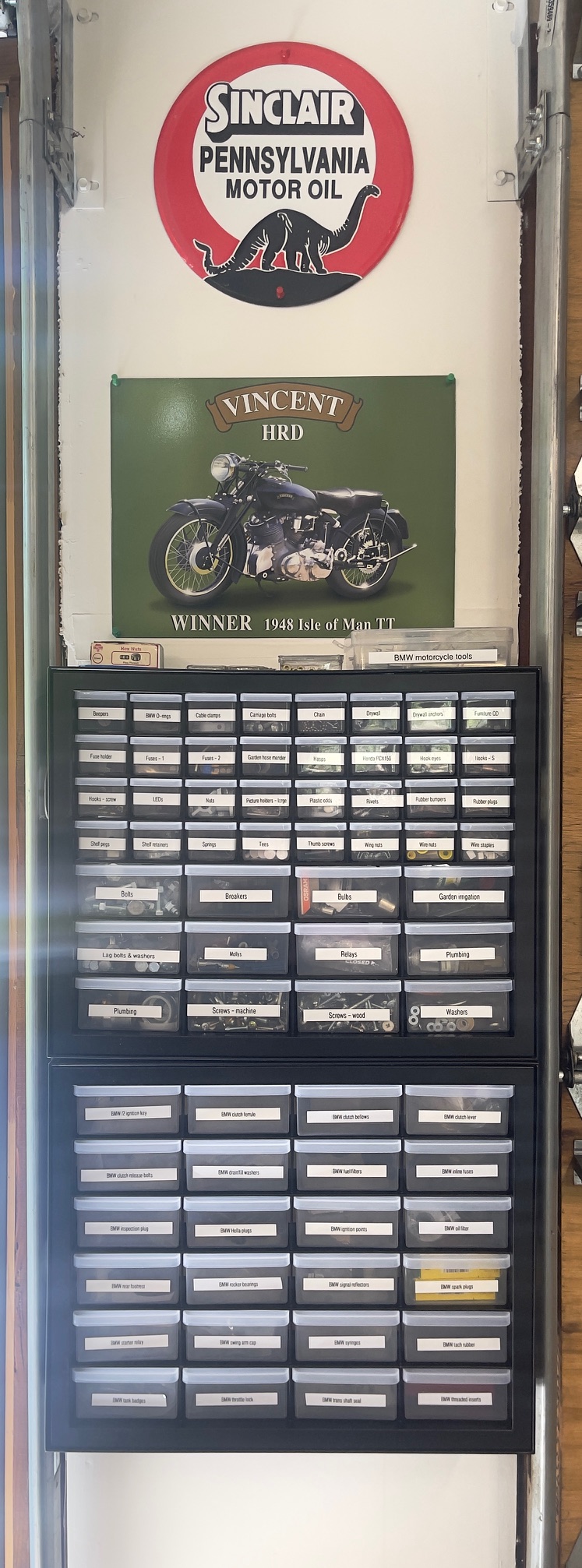


Neatly labeled in alphabetical order

Amazon lists very robust 5 shelf units and I had installed four of these a few years ago when they cost $100. The price has now dropped to $55 and they are recommended. Easy to assemble, robust with a 350 pound capacity per shelf, I fastened them with metal straps to the batten you can see in the image, the latter attached to the studs behind the drywall. This both protects against earthquakes and takes out the tippiness of the heavy structure waiting to fall on a car or motorcycle:



Shelving from Amazon – lots of wasted space, too much stacking

Like the stacking which bedeviled the pegboards the shelves have suffered similar migration over the years and there is much wasted space. More shelves are called for:



Four shelving bays, 5 shelves apiece

So I procured an additional five shelf unit, discarded the uprights and installed the five additional shelves where the gaping spaces were. The metal semicircular straps securing the uprights to the batten have been removed in this illustration:
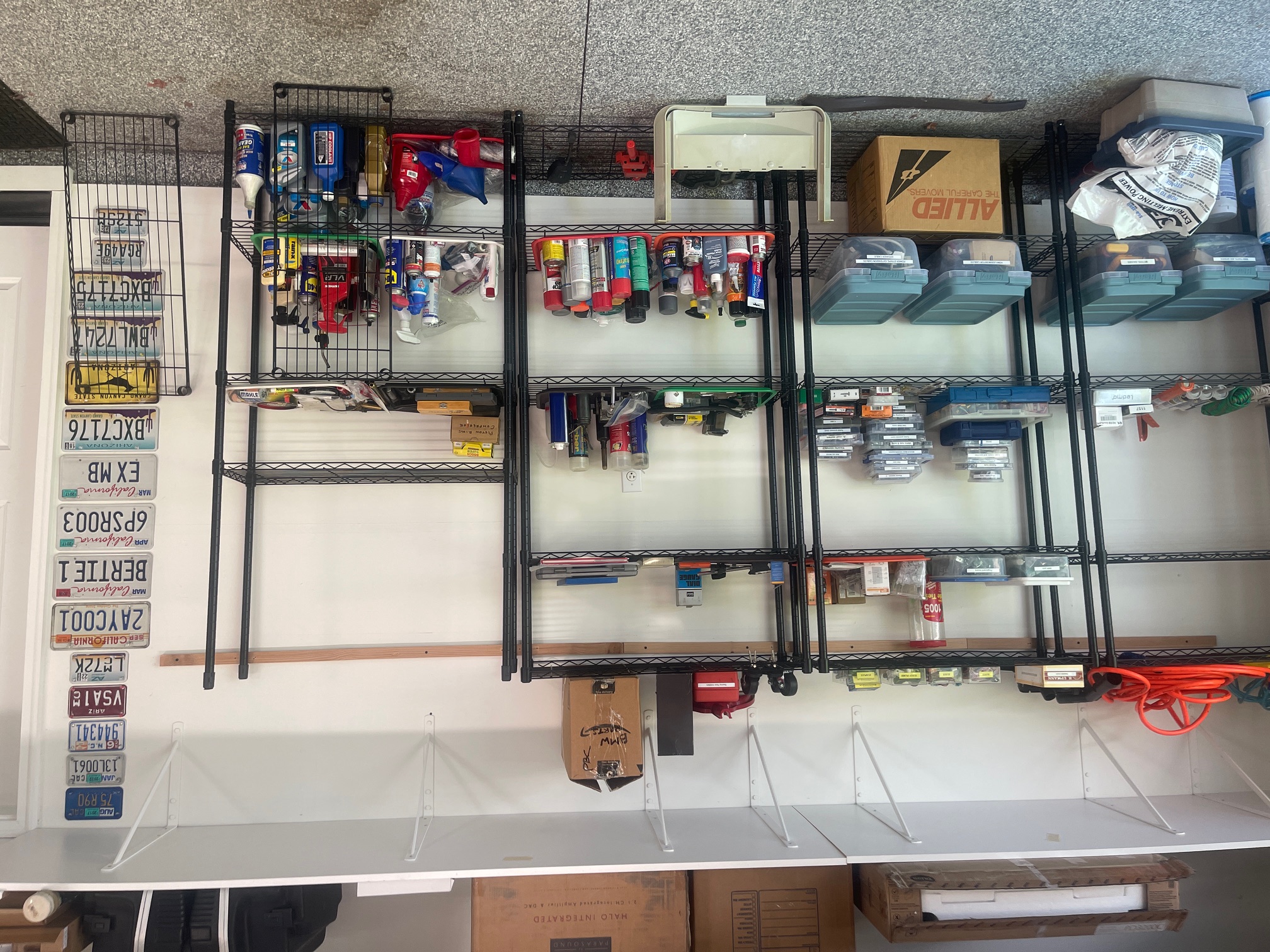


Adding shelves.

While that’s just a 25% increase in shelf area the difference is night and day. A related rule in any garage is to have as few items on the floor as possible and these added shelves really help:
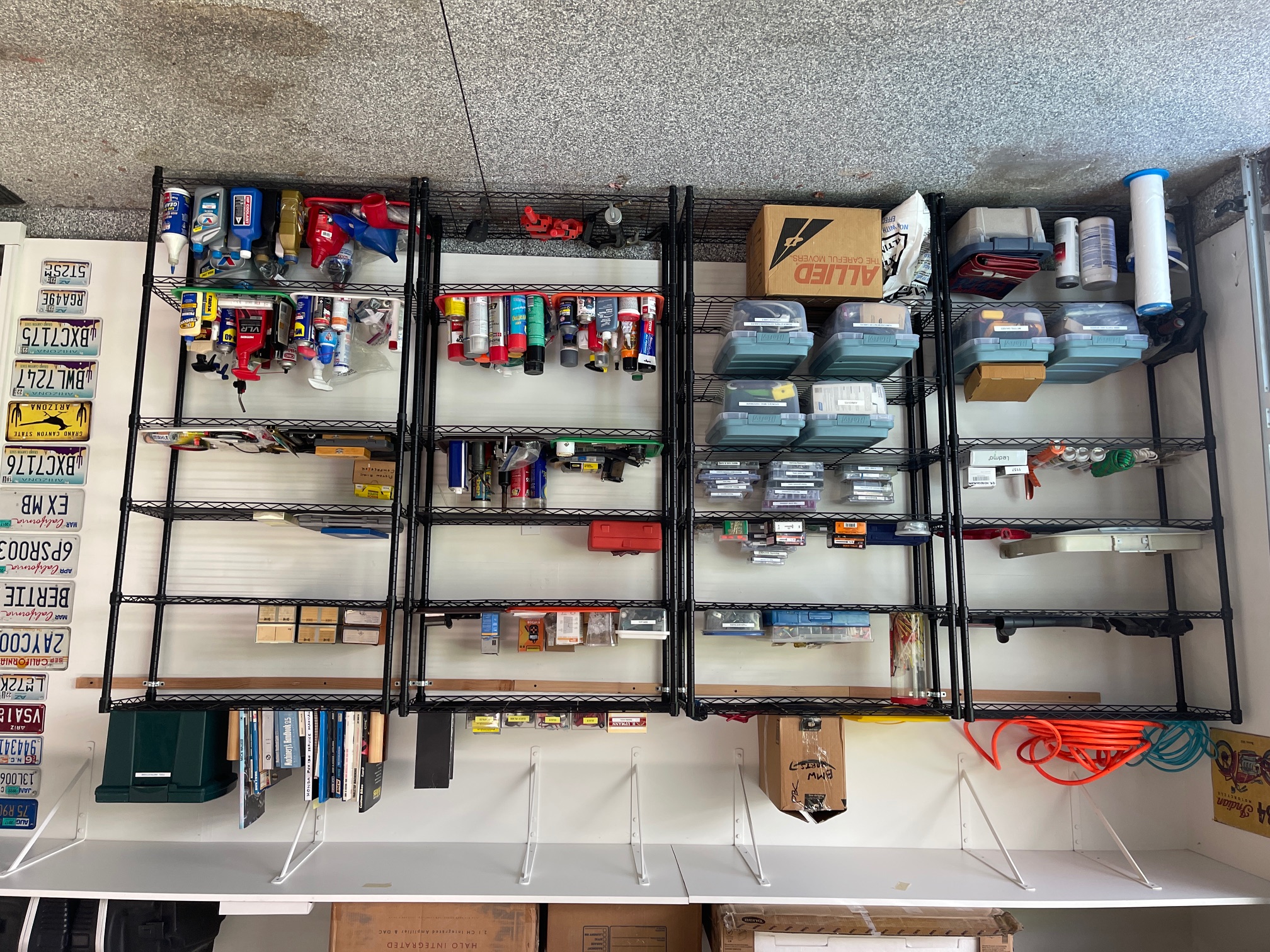


Five added shelves in place

So after a few days of banging away at this kaizen project the garage is once more that special place which invites quality wrenching …. until the next time things need remediation. Constant improvement is the ticket.


Old Glory

Flying proudly.

My previous Stars & Stripes flag was a tad worse for wear and I never cared for the cheap printed design, meaning I splashed out for a higher quality stitched one with woven stars. Made in America, of course.

But this new one suffered from the same issue common to seemingly all flags mounted on an angled flagpole, namely that they get twisted around the pole in windy conditions, making for an unsightly presentation. So I determined to do something about it.

First I added two pairs of insanely powerful neodymium magnets towards the base to add heft. These certainly stopped the twirling around the pole but in high winds the magnets would adhere to the mild steel pole! And that looked even worse. Further, in a high wind the added weight generated additional force on the thin walled mild steel pole and …. the pole bent at a right angle, landing OG in the dirt.

So I added a hardwood dowel to add robustness to the pole, after some straightening and garage language, and …. a new gust of wind bent the pole and snapped the dowel like a matchstick. Clearly I was dealing with forces whose severity I did not appreciate. So off to the hardware store for two additional purchases. A length of steel rod for the inside of the pole and a three foot length of mild steel bar stock to place across the space between the magnet pairs to add stiffness to the flag and prevent the magnets from attaching themselves to the flagpole.

I first tried this arrangement transversely, the bar at right angles to the stripes and while it did the job the flag looked pretty unnatural, never coming to rest in wind free conditions. So then I tried it with the magnets on the bottom stripe and the bar stock parallel to that stripe and, bingo!, it worked perfectly and the flag looked gorgeous at rest.

But the devil was not done. Now in windy conditions the base holder, secured with three screws to a wooden upright, started to pull the screws out of the wood. So those three were replaced with longer and beefier alternatives and so far, so good. I now have a new appreciation for the term ‘wind power’. And, just for grins, I riveted the two section flagpole together as it had a tendency to separate, yet again landing OG in the bushes. So there!

One final step was called for and that was to spray paint the bar stock red. That would make it virtually disappear against the background of the red stripe and also protect against rust. And here is the happy result:


Old Glory at rest.
Triple cable ties for safety.

A tribute, enjoyed daily, to the once and future greatest nation there has ever been. Meanwhile, we have a convicted felon destroying the economy and kowtowing to our foes, an ex (?) heroin junkie masquerading as Health Secretary, and a billionaire zonker and manic humper destroying the tendrils of our government. What could possibly go wrong?

Thanksgiving?

Questionable, but reversible.


Macy’s Parade, November, 1981.
Pentax ME Super, 28mm Takumar, Kodachrome 64.

Oscar Wilde once opined that foxunters were the unspeakable in pursuit of the uneatable. Adapting his saying to modern times one can only conclude that American voters are the deplorable in support of the unconscionable. Were I to tell the proverbial visitor from Mars that a majority of the voters of this nation just again elected a traitor/felon/rapist/grifter/multiple bankrupt/moral and ethical degenerate then that little green man would vamoose back to Mars real pronto. Well, looking on the bright side, I suppose that makes us immune to a Martian invasion.

Yet this, my 48th Thanksgiving in The United States, finds me as optimistic as ever, largely based in the belief that this too shall pass.

Yes, there are many things to dislike in addition to the recent election results.

There’s the one trillion dollars we spend annually on a military which has drawn or lost every conflict it has foolishly entered in the past 79 years. There’s increasing moral degeneracy where gender at birth is denied so that a handful of perverts can use the little girls’ restroom. There’s an electorate most of whom define “low information”. Our public schools are a disaster. There is a fading work ethic. Americans are becoming lazy, like Europeans. There is a level of inequality comparable to that found in the Gilded Age. And there is a massive obesity and health crisis caused by the addictive nature of ultra processed foods backed by the fast food industrial complex. And the cretinous – there is no other word for it if you passed Econ 101 – ideas of mass deportation and punitive tariffs will inflict great damage on the American economy, if they come to pass.

None of this is good.

Yet consider. America leads the world in every field of technology, has the best medical care on earth (if you can afford it), remains the most philanthropic nation on earth, is home to most of the greatest institutions of higher learning, has the best managed economy on the planet, in the jewel that is New York City lays claim to being the cultural center of the earth and the nation continues to offer the near certain chance of economic success to any one – native or immigrant – willing to work hard. No genius level brains required. I should know.

I continue to take inspiration from Milton Friedman whom I was privileged to meet on his 90th birthday in 2002, still as sharp as ever, who reminds us that “A society that puts equality before freedom will get neither. A society that puts freedom before equality will get a high degree of both.” I passionately believe that, once they come to their senses, Americans will live up to Friedman’s dictum. And as that great half-American reminds us: “Americans will always do the right thing, having first tried all the alternatives.” Winston Churchill.

Happy Thanksgiving.

Sofabaton U1 universal remote

A smart universal remote.

I explained how to add surround sound to a two channel sound system here. The only snag I have encountered is that the small Fosi two channel amplifier I procured to drive the rear surround sound speakers failed after a few months of service. The maker – Fosi Audio – proved to be a thief, refusing to honor the warranty. So be warned – do not buy the Fosi brand unless you want to be ripped off.

Anyway, there I was, feeling sorry for myself, when it struck me I had an old Sony two channel receiver hidden away in the garage in the corner that the black beetles call home. I whipped it out, plugged the rear speakers in and voila, rear channel sound was restored. After a bit of digging I determined that this old Sony could be used with an IR remote and it was the work of moments to find one on eBay. $12 later it was mine. And it’s nice having a remote for the rear speakers because you really want to set the volume on these from your usual listening position, as engineers are wildly inconsistent on the relative volume accorded the rear channel.

But the snag is that I was now in Remote Chaos.


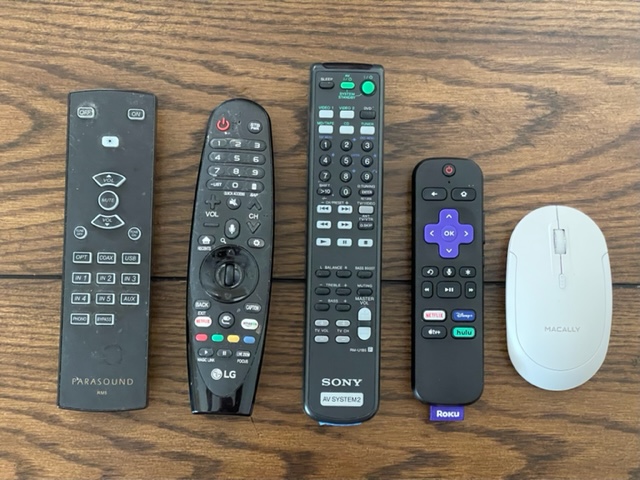
A gaggle of remotes.

Reading from left to right, these control the top notch Parasound two channel front amplifier, the LG 4K OLED TV, that old Sony receiver resurrected from the garage, the Roku Express 4K streaming puck and the Mac Pro mouse, where all our movies are stored. The ridiculous thing is that no one remote permits the functions of another to be added, and despite the plethora of buttons – I count 117 plus the mouse – only one or two buttons on any one remote are ever used.

So it was time to think about adding a universal remote, though memories of earlier efforts with past devices, ones from RCA and Logitech, recalled only bad experiences.

Enter the quirkily named Sofabaton U1 universal remote.


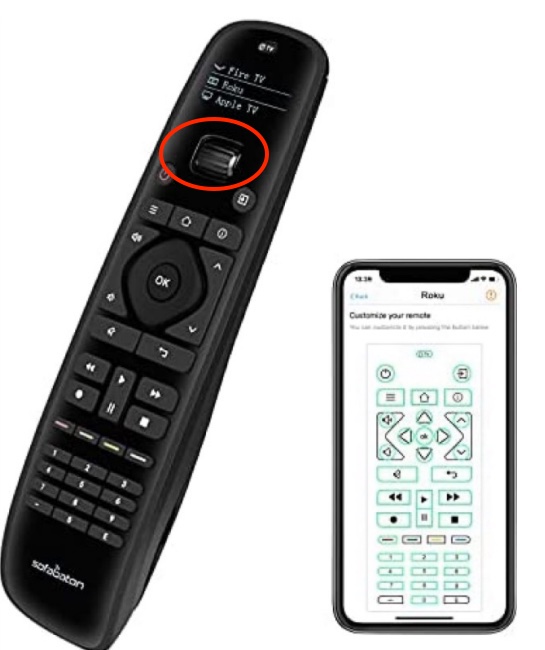
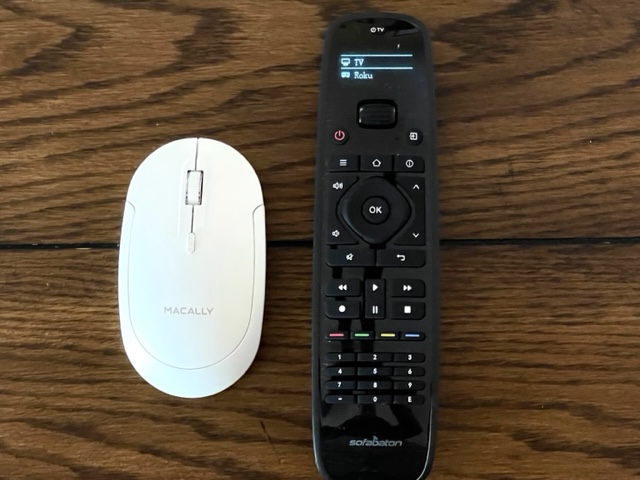
The Sofabaton U1 with a cell phone. The scroll wheel is circled.
Click the image to go to Amazon.

Priced at an attractive $50 the device uses two (included) AA batteries and any Android or iOS cellphone or tablet to program. First, you download the Sofabaton app from the AppStore. There’s a substantial database of saved devices, accessed when you enter the manufacturer and device names (sadly there’s no scrollable list) and, if your devices are there, adding them to the Sofabaton, which can accommodate up to 15, is simplicity itself.

If your device is not in the database, you can use an existing remote to program it, and such was the need for the relatively obscure Parasound amplifier remote where the only buttons I programmed were power, volume, mute and two input options. You place the Sofabaton opposite and 3″ from your existing remote, choose the button to program on your iOS or Android device, and hold the corresponding button on the remote until the app tells you the button is programmed. No problemo.

All the other remotes were in the Sofabaton database.

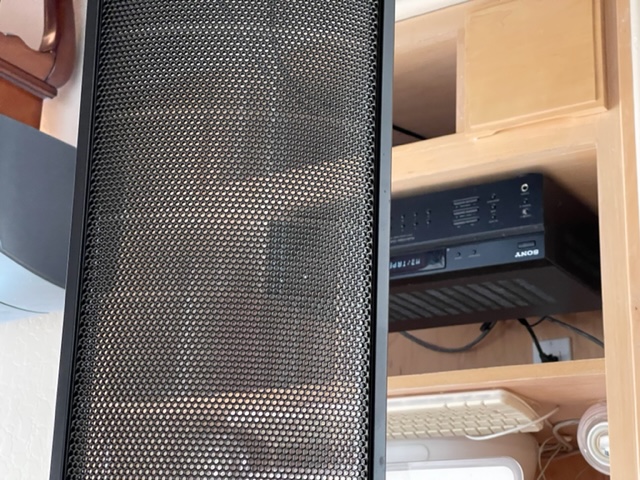
The Sofabaton is an IR/line of sight device, and mercifully that old Sony rear channel amp, nestled on a shelf behind one of the Martin Logan electrostatic speakers, can be seen through the transparent speaker!


Transparent speakers rule.

The universal remote can also control one Bluetooth device, not a requirement in my case. If your devices use RF then you need the Sofabaton X1 universal remote, costlier, but a handy solution.

Cross-assigning keys: This is not in the instructions. Say you have programmed the TV scroll wheel setting on the Sofabaton using the stock codes in the database. Your volume keys, as an example, will control the TV speakers’ volume. But that is not what is wanted as an external amplifier is used with external speakers. Sure, you can switch the scroll wheel to the Amplifier setting and change the volume there, but it would be far better to have the TV scroll wheel setting volume buttons operate the amplifier and not the internal TV volume adjuster. You can do this. Go to the TV setup on your cell phone and choose the Up Volume key on the display. Then touch ‘Learn from Original Remote’ but when it comes to pointing a remote at the Sofabaton use the remote for your amplifier, not the one for your TV. I have done this in the TV setting for Volume Up, Volume Down and Mute. Now, without changing devices with the scroll wheel, I can change the volume setting on the external amplifier while remaining in the TV scroll wheel setting.

Note that ‘learning mode’, where an original remote is used to ‘teach’ the SofaBaton IR codes, is not perfect. Sometimes you need two or three goes to get the code to take, something which is clearly indicated on the cell phone’s display. In some cases I had to vigorously pump the button on the original remote before the SofaBaton played ball. But with a little persistence all was well.

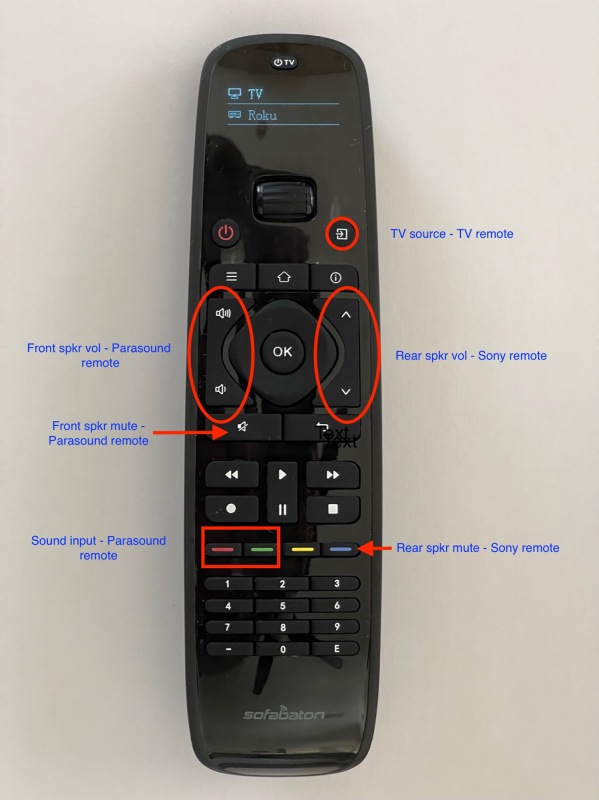
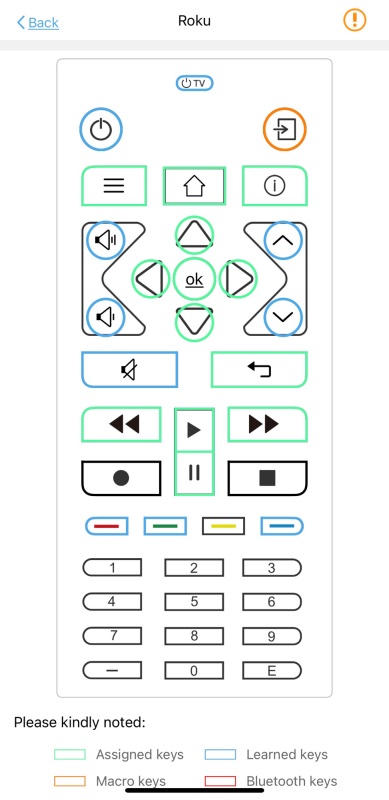
Here’s an illustration of how this is done. I first programmed the Roku Express 4K keys using the stock data in the Sofabaton database. I then used the indicated remotes to override programming of selected keys with the happy result that all functions for the Roku are accessible without any scroll wheel selection – front and rear speaker volumes and muting, TV sources and sound sources:


Cross-assigned remote buttons.
This takes far longer to illustrate than to do.

Here is the programming screen on an iPhone for the above settings:


Green designates the stock database download for the Roku Express 4K.
Blue shows keys overriden with separate device remotes.
Orange is a Macro key to invoke the TV source display.

Snags? The battery cover is hellish to remove – I used a nickel and still managed to marginally scar the two opening slots. And there’s no way to program the mouse, despite the Bluetooth functionality, as the Sofabaton has no ball wheel.

Macros? These are series of steps – like ‘turn on the TV/turn on the front amplifier/turn on the rear amplifier’ – and are easily programmed with the requisite 0.5 second delay between each so as to allow sluggish devices to keep up. As for IR beam angle, my devices subtend maybe 45 degrees of angle from my seated position and pointing the Sofabaton at the middle of that angle saw no issues with response. In other words, the broadcast IR beam is wide.

The scroll wheel at the top of the device (see the first image, above) display the device chosen on the small LCD screen whose activation is motion sensitive. Pick up the remote and it comes alive. Leave it alone and it turns off after some 20 seconds of inactivity.

Look and feel? Except for the issue with the overtight battery door, feel and finish are excellent. The audible feedback from the keys is welcome, and the matt keys are set off against a very attractive glossy black fascia. It remains to be seen whether this will disclose a lot of scratches, but it looks great. The overall feel is that of a quality tool and the fit in the hand is superior to that of any of the now obsoleted separate remote controls. The English in the minimalist instruction book is truly ghastly, but the programming process with a cell phone is so simple that it does not matter.

And the pleasant result of all this magic?


The remote population now.
The OLED display is illuminated.

Reliability? Unknown as the device is new to me. I fancy the battery door clips will need some work with a fine file to ease removal. The buttons are not backlit but give off a satisfying ‘click’ when used.

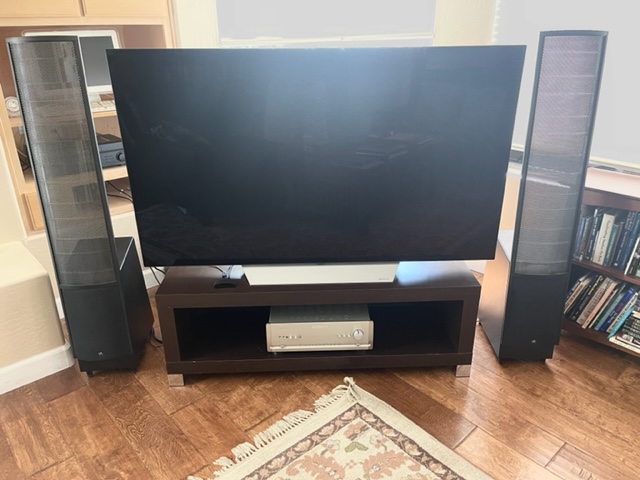
The home entertainment center – technology should be enjoyed …. and invisible:


No mess.

Rolex Datejust 41

A fine and expensive timepiece.


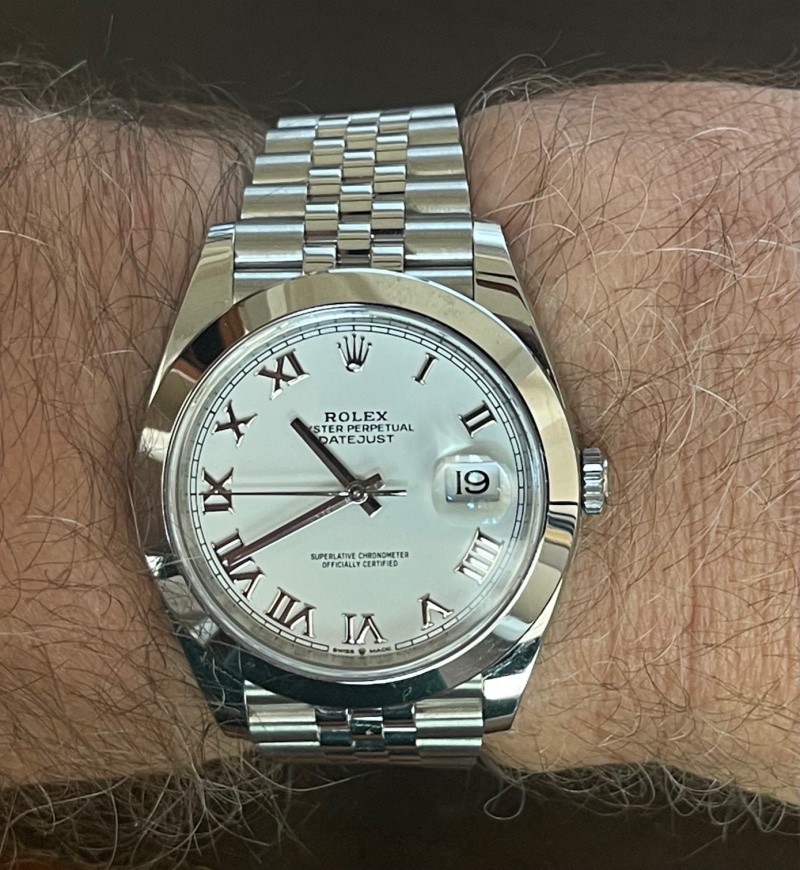
The Rolex 41 Datejust 16300

A year or so ago I wrote in disgust about my abandonment of Patek Philippe wristwatches and their replacement with a dirt cheap Seiko Solar. That Seiko is recommended every bit as much today as is my warning to steer away from Pateks. These may be the most elegant and desired of watches but they are like Jaguar cars of old. You need two. One on your wrist and the other in for service. In fact, it looks like you need two service men, in case one breaks down, and you can bet they are nowhere to be found in the US of A. It’s off to Geneva and many months of waiting, during which time your inquiries are disregarded.

So with the proceeds of the Nautilus and the Golden Ellipse burning a hole in my pocket, it was just a question of waiting for the wounds to heal after decades of association with the marque. The healing time was used for some serious research into alternatives.

And when the withdrawal symptoms faded with the coming of the new year I looked to a brand I though would never grace (darken?) my wrist, Rolex.

Frankly, all that bling and association with guys named Tony left me cold. Not my thing. While I do believe a good whacking beats our legal system as often as not, it’s not an activity with which I want to be associated.


…. guys named Tony….

But there are Rolexes and there are Rolexes as a glance at their extensive offerings confirms. As I wanted a classic, simple watch my attention fell on the Datejust, first offered in 1945 and the first watch with a date display. After a while Rolex added the ‘cyclops’ date magnifier, 2.5x unlike the 1.5x found elsewhere, and that was a must for these aging eyes. The look is simple, almost severe, ‘no gold’ options abound and you can even side step that awful machined bezel which screams ‘look at me’. So I went for a plain steel model with a smooth bezel and made sure it came with the gorgeous Jubilee bracelet – the one with the three rows of fine, polished links in the center in contrast to the single link of the clunkier Oyster alternative – and plunked down a (small) percentage of the proceeds from the Pateks. This is the Datejust 41 model, their latest, and obsoletes the thicker and clunkier Datejust II, which is more reminiscent of the fat onions of old. Roman numerals? You bet. An essential option on my timepieces. The trade-off is that the Roman numerals dial has no luminosity. If that is a desired feature, you have to go with the stick hour markers and stick luminous hands.

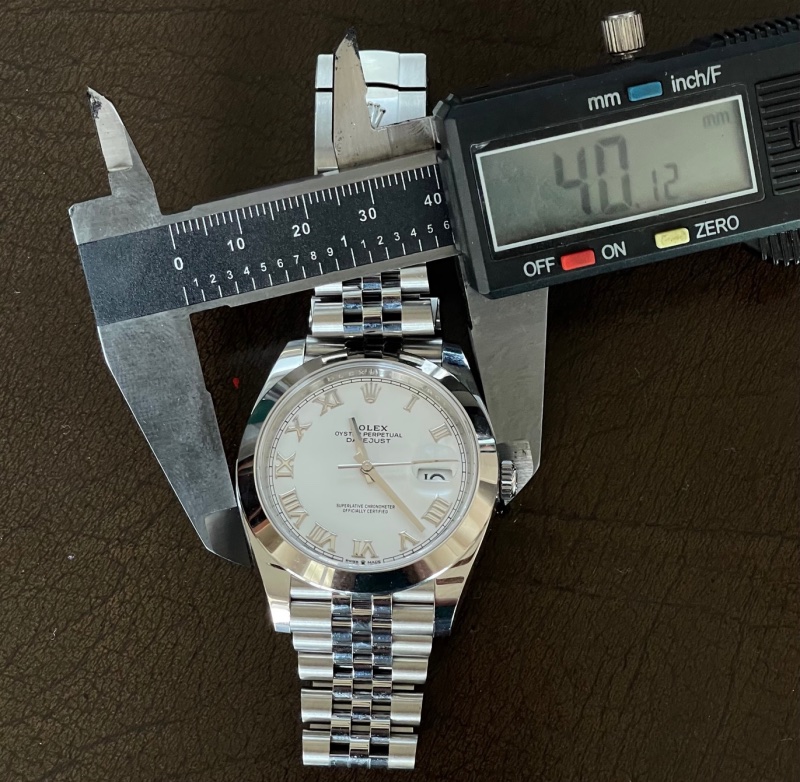
While Rolex claims a 41mm bezel diameter, that is a lie. It’s actually 40.1mm:


Little lies.

No matter. It looks just right on my 7 3/4″ circumference wrist and more discreet than some of the modern monsters from the competition.

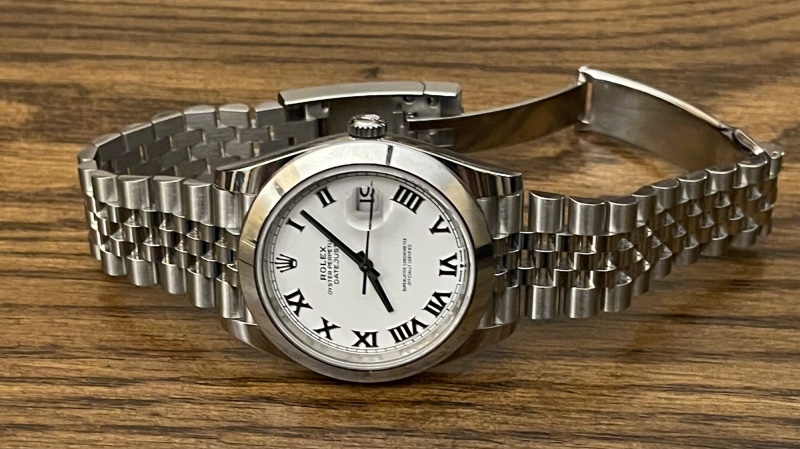
And while silver hands on a white background suggest poor readability, tilt the wrist a few degrees and the contrast is striking, courtesy of the facets on the hands:


No lack of contrast

The watch can be ‘hacked’, meaning the second hand can be stopped for precise alignment with Apple Time, and my early readings suggest it is losing 1.0 seconds a day. Compare that with the quartz magic of the Seiko which gains 2 seconds …. a month! The Rolex is automatic and the power reserve a generous 70 hours. The movement is made in house, unlike with most Swiss brands who buy in movements from mass market makers. Stated differently, your are buying a packaging and marketing exercise with those, not a statement of mechanical originality. You want your Porsche 911 with a Chevy motor?

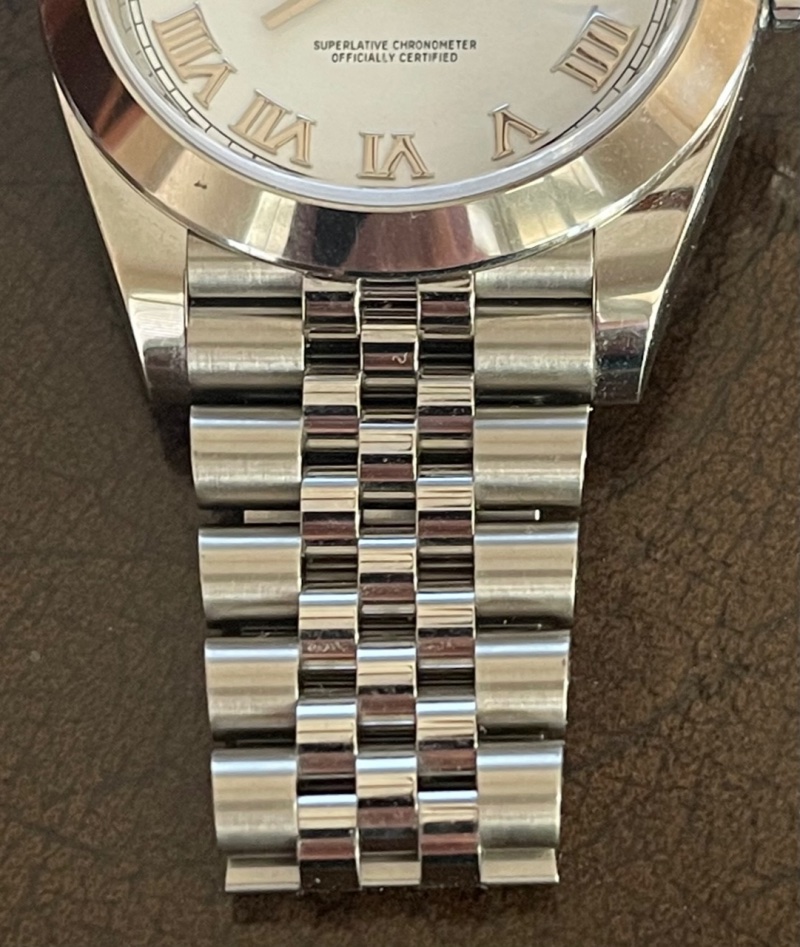
A great deal of thought has gone into the making of this timepiece. Look at the perfect integration of that gorgeous bracelet with the lugs and body:


Perfect integration of band and lugs

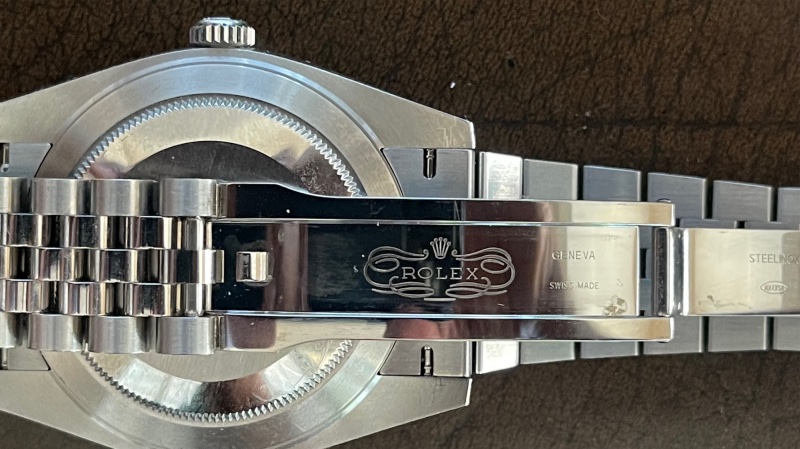
And the attention is not all on the surface, as this detail of the clasp’s design and finish discloses:


Clasp detail

So for those seeking a mechanical watch which will never really be an heirloom – in the sense of a Patek Philippe or Audemars Piguet – but which nevertheless boasts high standards of design and execution, and if a 2 seconds a day accuracy is acceptable, add the Rolex Datejust to your list. Waterproofing is good to 100 meters below the surface.

If you want a Rolex with a stopwatch function, you should look at the Daytona model. This will run you 2 to 3 times as much as the Datejust, above, and be prepared to add 50-70% to prices on the Rolex website for any model. No jeweler will offer you those prices. Excuses will include “supply chain”, “sunken delivery ship”, “the European war”, “the pandemic”, “inflation”, and so on.

Provenance? Churchill was gifted #100,000, though like a true Victorian he preferred his Breguet pocket watch. Ike got #150,000 and the watch even made an appearance on the cover of Life magazine along with its distinguished wearer, in 1952. Elvis got a free one, but the number is unknown and he probably bought a few dozen out of his own pocket to give his closest hangers on. The Datejust has a distinguished history and has been around almost 80 years, so the kinks will have been well and truly ironed out by now. Plus the extensive USA dealer and servicing network means it’s not off to the land of the Gnomes of Zurich (Nazi and Russkie bankers to you) every time something goes wrong. This is a Swiss product after all and its reliability is most likely like that of a Mercedes. Stated differently, it’s no Toyota/Seiko.

Purchase the watch new from an authorized US dealer and it comes with a five year factory warranty.

For an interesting review of the history of the magnificent Jubilee bracelet, click here.

Update May 18, 2022 – after one month of operation:

The Datejust has lost 23 seconds in 30 days at a constant rate. This is comfortably inside the stated +/- 2 seconds a day specification. When resetting the date every two months for short months I will set the watch 23 seconds fast for minimum mean error across a two month period.

The bracelet has a tool less length adjustment feature allowing a 5mm change in length by clipping or unclipping one link inside the clasp. I find this to be most useful. My wrist shrinks during the day so I shorten the bracelet around noon for a perfect fit at all times. Very handy.

Update June 30, 2022 – after 72 days of operation:

July 1st will be the first time I have had to reset the date at which point I will also “hack“ the second hand to get the lowest error rate through the next reset, which will be on October 1st. For those 72 days, the average daily error rate sees the Datejust running just 0.4 seconds slow per day. That is excellent for a purely mechanical device.