In Wilmington, VT.

Panny GX7, 12-35mm pro zoom.
In Wilmington, VT.
Panny GX7, 12-35mm pro zoom.
At Amherst College.
For an alphabetical index of the New England College series of pieces, click here.
Unlike its public school neighbor across the road – U Mass Amherst with some 30,000 students – Amherst College is small at 2,000 and private. It is rivaled only by Colgate for the beauty of its setting.
Like many of the great private colleges in New England, Amherst boasts a superb art collection, most pieces donated by successful alumni. The small display space in Amherst’s Mead Art Museum can house maybe 200 items, and does not do the collection of 8,000 pieces justice.
As Amherst College is but 30 minutes south of Northfield Mount Hermon, my son’s prep school, I always try to drop by when in Massachusetts to check out their latest exhibition.

The entrance to the Museum, with Stearns Steeple at left. The steeple is mercifully
the last remnant of the College’s religious origins. Religion should have no rôle in education.


The entrance piece for the ‘Time is Everything’ exhibition.

Harold Edgerton’s famous 1964 image from his MIT days shows a bullet passing through an apple.
When a student at University College, London in 1976 I used his exact technique to determine
the speed of high speed grit particles impacting and eroding polymers, the subject of my senior dissertation.
It’s quite likely I used a stroboscope from the same manufacturer, America’s Perkin-Elmer.

Time has many manifestations. This magnificent grandfather clock by Isaac Gere dates form the 1794/95.

The Mead’s meeting room is beyond spectacular.

Another view of the ‘Time’ exhibition.

“Fragmented Identities: The Gendered Roles of Women in Art Through the Ages” is a small side show.
The painting at left with the idealized image of the young woman is by William-Adolphe
Bouguereau (‘Boo-zhou-row’), a 19th century academic painter much beloved by the Victorians whose
awfulness is now enjoying a serious renaissance for reasons lost on me.
The Mead changes its exhibits about every semester and is always worth a visit. As for Amherst College, it ranks up there with Williams, also in MA, for academic excellence. Many aver it’s as good as or better than anything the eight Ivy League schools (Harvard, Princeton, Yale, Brown, Columbia, Cornell, Dartmouth and Penn) offer. The beauty of the setting alone is worth a few points on your ACT score.
Panny GX7, 12-35mm pro zoom.
Some day I will ask you for a favor.
The Chelsea Royal Diner in Brattleboro, VT is a fixture. Everyone knows everyone else and out of staters are generally frowned upon. But my son and I have served our time and are now welcomed here. The waitress knows us from my many trips back east to visit my son at his school in nearby Massachusetts. Only my ever present camera discloses me as a tourist. That and the English accent.
On this morning a tall and wide Italianate man joined us at the bar as we chowed down on pancakes served with real Vermont maple syrup. Straight out of central casting and a ringer for the late great James Gandolfini, right down to the diamond encrusted rings on the fourth and fifth fingers of his right hand, Tony (he could only be named Tony) knew everyone in the joint and was the life and soul of the party.
I asked my son why he did not respond to T’s efforts to engage him in conversation and he replied that he did not want to end up owing him a favor ….
As we left the diner, we chanced on Tony’s ride.

Panny GX7, 12-35mm pro zoom.
Rip-off merchant, Vermont style.
Milk special. Usual price: $1/gallon. Today’s special: $3.

Seen in Brattleboro, Vermont.
Panny GX7, 12-35mm pro Zoom.
Exciting.
The original Noct Nikkor, a 58mm f/1.2, was first sold in February, 1977.
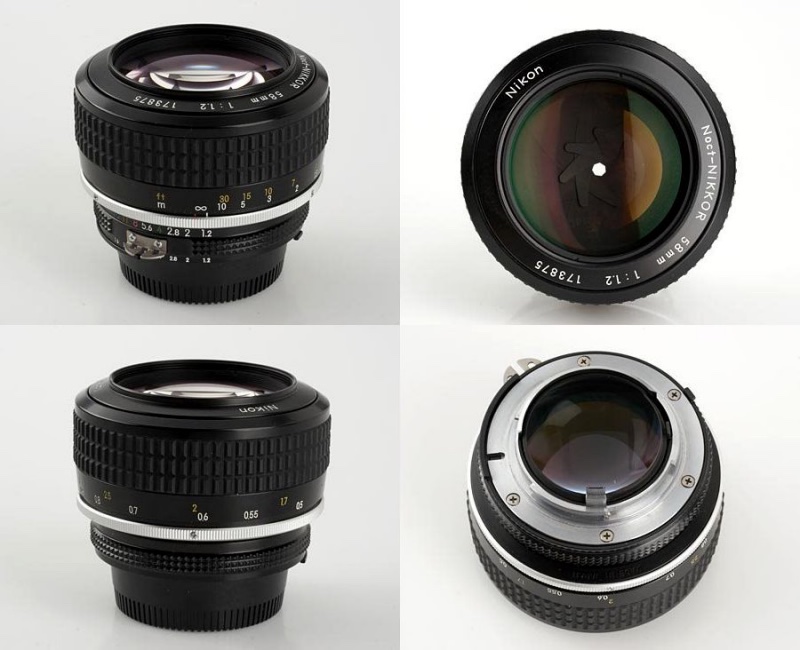
The original design has Ai aperture coupling which was revised to Ai-S in November 1981. The ‘S’ designation designates a linear aperture coupling cam compared with the non-linear original but optically and operationally there was no difference. If you could fit a CPU to the Noct then the Ai-S design would allow control of the aperture with either the aperture ring on the lens or the command dial on the body while still maintaining proper exposure metering. The snag, as the above images disclose, is that there is absolutely no room to install a CPU. Some brave/foolish souls have machined a recess in an arc of the rear element to permit CPU installation but that seems like a drastic solution to a not so real problem, as this is the only Nikkor in F mount to which a CPU cannot be fitted.
The Noct was reckoned by all and sundry – not just Nikon – to be the best standard f/1.2 lens around, and Nikon proudly profiled it in a factory piece which you can read here. The optic’s distinguishing characteristic was low coma at full aperture, as the illustrations in that linked article confirm. A mere 2,461 Ai versions and a further 8,950 Ai-S versions were sold, making the lens an instant choice of the pond scum known as ‘collectors’, which means that used examples sell for $3-7,000. The lens was discontinued in November 1998.
With the introduction of the new Z series mirrorless bodies yesterday Nikon also announced that a new Noct would be marketed in 2019, but this time it would come with a maximum aperture of f/0.95, while retaining the 58mm focal length. Price is unknown but reckon on $5-6,000. Interestingly Nikon will not include AF in the new optic, but the ability in the Z6 and Z7 mirrorless bodies to magnify the focus area in the finder/on the LCD screen means that critical focus wide open should be simple to determine. The lens is a whopper, its bulk dictating the inclusion of a tripod socket:
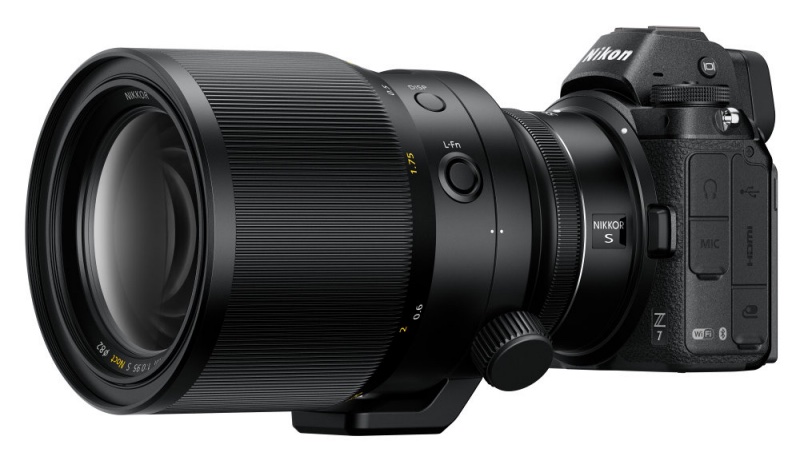
The wider diameter of the bayonet mount’s throat on the Z6/7 makes the faster aperture possible.
I can think of a couple of similarly fast lenses in the past – the f/0.95 Canon for their rangefinder cameras (good luck focusing that), reputed to be poor, the f/1.1 Zunow in a Nikon mount, reputed to be awful, the original 50mm f/1.2 Leitz Noctilux with hand ground aspherical elements, suitably priced and excellent optically and the current 50mm f/1.0 Noctilux, like its predecessor available in M rangefinder mount also and superb, as it should be at the asking price of $11,000. The original f/1.0 design of the Noctilux is now F/0.95. How on earth you are meant to focus this optic given the limitations of the Leica M’s optical rangefinder beats me, but $11k gets you bragging rights.
The new Noct promises to be cheaper and better than all comparable predecessors. Exciting times at Nikon. This may be a ‘glamor’ optic with little practical use, but it’s good to see Nikon allowing its designers to stretch for the ultimate.